|
Best Film Speeches and Monologues
|
|
Title Screen
|
Film Title/Year and Description of Film Speech/Monologue |
Screenshots
|
|
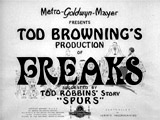
Freaks (1932)
Screenwriter(s): Willis Goldbeck, Leon Gordon
 Carnival
Barker's Introduction of a Real Freak - The Opening and Closing
Scenes Carnival
Barker's Introduction of a Real Freak - The Opening and Closing
Scenes
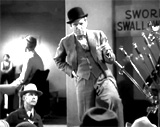
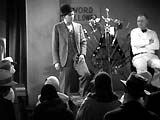
A carnival barker (Murray Kinnell) opened the
film with an enticement to customers, and his explanation of
the sideshow freaks' code of honor:
We didn't lie to ya, folks. We told you we
had living, breathing monstrosities. You laughed at them,
shuddered at them and yet, but for the accident of birth,
you might be even as they are. They did not ask to be brought
into the world, but into the world they came. Their code
is a law unto themselves. Offend one - and you offend them
all.
Then, he led the patrons to an enclosure and
introduced an off-screen creature, causing a woman to
scream at the sight of the hideous human monstrosity - but
the sight of the creature was postponed until the film's conclusion:
And now, folks, if you'll just step this
way. You are about to witness the most amazing, the most
astounding living monstrosity of all time. (woman's scream)
Friends - she was once a beautiful woman. A royal prince
shot himself for love of her. She was known as the Peacock
of the Air...
He concluded his speech at the end of the film
- when the "Peacock of the Air" was finally seen:
How she got that way will never be known.
Some say a jealous lover, others that it was the code of
the freaks, others the storm. Believe it or not, there
she is...!
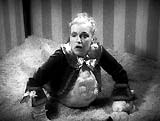
The tall and sexy Cleopatra had been transformed
into a legless, feathered chicken with a scarred
and bruised face, drooping mouth, and a squawking mouth. She
had been punished for her greed, cruelty and duplicity toward
the freaks. |
|
|
|
Freaks (1932)
Screenwriter(s): Willis Goldbeck, Leon Gordon
Cleopatra's
Memorable Short Speech to Reject the Freaks
In this horror film's story, beautiful but heartless
high-wire trapeze-artist Cleopatra (Olga Baclanova) had married
a gullible circus midget Hans (Harry Earles) who was due to
claim an inheritance, but her dastardly intention, plotted
with her strong-man lover Hercules (Henry Victor), was simply
to poison Hans to death for his money.
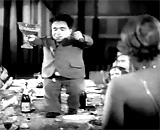
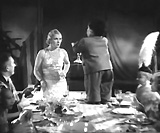
In the infamous and macabre "Wedding
Feast" banquet scene, after Hans had married Cleo, the
freaks began an unforgettable chant before passing around a loving
cup:
"We accept her, one of us. Gooba-gobble,
Gooba-gobble."
Cleopatra was seated
next to her real lover Hercules, who sarcastically mocked the
freaks for their friendly gesture:
"They're going to make you one of them,
my big duck!"
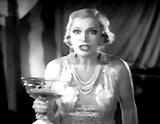
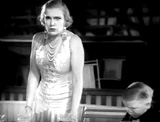
She incurred the wrath of
the tightly knit, loyal group of "nature's aberrations," when
she was offered the loving cup, rose stiffly from her chair, became
extremely revolted by them, and exclaimed: "You dirty slimy
freaks."
Cleopatra: You dirty, slimy freaks! Freaks,
freaks! Get out of here! (She threw the contents of her drinking
cup at them) You! Out!
Hercules: Get out! You heard her! Get out! Ha, ha, ha, ha.
Cleopatra: You filth! Make me one of you, will you?
Then, Hans' new bride challenged her ashamed
husband, and insulted him as a juvenile: Well, what are you
going to do? What are you - a man or a baby? -
and then she suggested giving him a childish horsey-back ride:
What must I do? Must I play games with you? Must Mamma take
you horsey-back ride?"
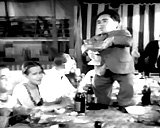
She carried him on her shoulders for a "horsey-back
ride", with Hercules assisting in the humiliation:
Ha, ha, that's it! Horsey-back ride! Ha, ha,
ha. Come, come, my little fly speck. Mamma is going to take
you horsey- back ride. Giddy-up! Giddy-up, horsey!
|
|
|
42nd Street
(1933)
Screenwriter(s): Rian James, James Seymour
"It's
My Last Show and It's Got To Be My Best" - Words of
Assurance from a Broadway Director
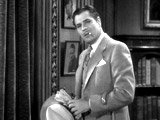
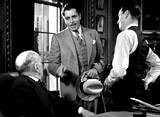
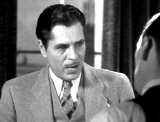
Producers Jones (Robert McWade) and Barry (Ned
Sparks) planned to stage Pretty Lady - a Broadway musical,
despite the Depression, and they had hired the well-known "musical
comedy director" Julian Marsh (Warner Baxter). In close-up,
the unseen director signed the Jones/Barry contract. Bankrupt
and broke from the Stock Market Crash in 1929, a wild-eyed
Marsh was only interested in recouping his economic
fortunes ("Money!"). The haggard and ill Marsh assured
his producers of his strength:
You'll get your Pretty Lady. You haven't
got anything to worry about. I'm not gonna let you down
because I can't afford to. I've given everything I've had
to that gulch down there and it's taken all I had to offer.
Oh, it paid me, sure, in money I couldn't hang on to -
fair-weather friends, women, headlines! Hah! Why even the
cops and the newsboys recognize me on sight. 'Marsh, the
Magnificent.' 'Marsh the Slave-Driver!' Actors tell ya
how Marsh drove 'em and bullied 'em and even tore it out
of 'em! And maybe there's a few that'll tell ya how Marsh
really made 'em. And they've all got somethin' to show
for it - except Marsh.
Well, this is my last shot! I'll make a few
more actors. But this time, I'm gonna sock my money away
so hard that they'll have to blast to find enough to buy
a newspaper. That's why I'm goin' ahead with Pretty Lady.
And Pretty Lady's got to be a hit. It's my last show
and it's got to be my best. You're counting on me. Well,
I'm counting on Pretty Lady, because it's got to support
me for a long time to come.
|
|
|
|
42nd Street
(1933)
Screenwriter(s): Rian James, James Seymour
"You're
Gonna Work and Sweat and Work Some More"
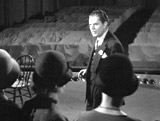
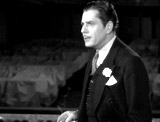
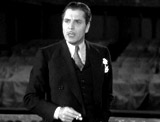
Describing the harsh routine of preparing for
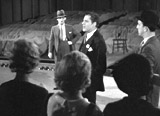
a show's production, a glaring, growling, harsh and demanding
Marsh (Warner Baxter) paced back and forth in front of the
lucky chorines and smoked nervously. In his vicious, bellowing
voice, he ferociously delivered a dyspeptic pep talk and verbal
lashing to his cast:
All right, now, everybody. Quiet, and listen
to me. Tomorrow morning, we're gonna start a show. We're
gonna rehearse for five weeks and we're gonna open on scheduled
time. (He brandished his cigarette) - And I mean scheduled
time. You're gonna work and sweat and work some more. You're
gonna work days and you're gonna work nights. And you're
gonna work between time when I think you need it. You're
gonna dance until your feet fall off and you're not able
to stand up any longer. BUT five weeks from now, we're
going to have a show! Now, some of you people have been
with me before. You know it's gonna be a tough grind. (He
warned some more with waves of his cigarette) It's
gonna be the toughest five weeks that you ever lived through.
Do you all get that? Now anybody who doesn't think he's
gonna like it had better quit right now. What do I hear?
Nobody? Good. Then that's settled. We start tomorrow morning.
|
|
|
|
42nd Street
(1933)
Screenwriter(s): Rian James, James Seymour
"You've
Got To Come Back a Star"

Play clip (excerpt): 
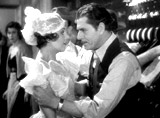
Producer Julian Marsh (Warner Baxter) gave motivational
instructions to young understudy Peggy Sawyer (Ruby Keeler),
culminating with one of the most famous exhortations in film
history, just before the opening night's show:
Now, Sawyer, you listen to me and you listen
hard. 200 people, 200 jobs, $200,000 dollars, five weeks
of grind and blood and sweat depend upon you. It's the
lives of all these people who've worked with you. You've
got to go on, and you have to give and give and give. They've
got to like you, they've got to. Do you understand? You
can't fall down, you can't, because your future's in it,
my future and everything all of us have is staked on you.
All right now, I'm through. But you keep your feet on the
ground, and your head on those shoulders of yours and go
out. And Sawyer, you're going out a youngster, but you've got to
come back a star.
|
|
|
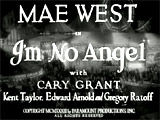
I'm
No Angel (1933)
Screenwriter(s): Mae West
A
Carnival Barker's Introduction of Vamp Performer
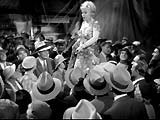
One-ring circus and sideshow carnival barker
(Russell Hopton) tempted a crowded audience with his introduction
of carnival queen and dazzling international small-time, vamp
circus star performer Tira (Mae West):
Over there, Tira, the beautiful Tira, dancing,
singing, marvel of the age, supreme flower of feminine
pulchritude, the girl who discovered you don't have to
have feet to be a dancer.
Tira made a sauntering entrance on the catwalk
and purred to spectators:
A penny for your thoughts. Got the idea,
boys. You follow me?
|
|
|
Queen Christina (1933)
Screenwriter(s): H.M. Harwood, Salka Viertel
An
Argument For Peace
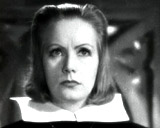
The reigning, peace-loving,
lovely yet willful 17th century Swedish Queen (Greta Garbo),
now an adult, was ruling on the throne when she was summoned
from hunting and told: "Sweden now has the commanding
place in Europe" after
thirty years of war; she was dismayed by the high casualty
reports of 10,000 men lost in the victorious war, and the
expensive drain on Swedish resources: ("A few more victories
like this and we will have to hire foreigners to fight our
battles").
The Queen's heroic, victorious, older Swedish-born
cousin from the warring Swedish army, Prince Palatine Charles
X. Gustavus (Reginald Owen) was about to arrive home from
the battlefield, and she was expected to become betrothed
to the national military hero; the controversial queen of
Sweden realized that she was being forced into the possibility
of a politically-correct marriage to Prince Gustavus, to
give her country an heir to the throne; she rejected the
idea of marrying someone she didn't love, and instead flirted
with her handsome and ambitious treasury secretary Count
Magnus (Ian Keith).
In Parliament, she listened
as all of her constituents (the nobles, a gallant general,
the Archbishop (David Torrence), and the returning Prince)
clamored for more war against the
"barbarians" to avenge the glory of Sweden, but Queen
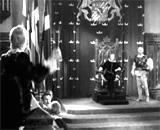
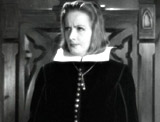
Christina disagreed with them; the Queen
requested another opinion from the down-trodden peasants who
were the ones sacrificed: "But what of the peasants? You
peasants have fought this war"; when a representative
from the peasants proclaimed that they would go when ordered,
she commanded: "You shall go no longer."
With a proclamation
of peace, she rejected calls for more violence and decreed that
the bloody war would end:
There are other things to live for than wars.
I have had enough of them. We have been fighting since I was
in the cradle and many years before. It is enough. I shall
ask the powers to meet for a speedy and honorable peace. There
must be an end!...Spoils! Glory! Flags and trumpets! What is
behind these high-sounding words? Death and destruction! Triumphals
of crippled men! Sweden victorious in a ravaged Europe. An
island in a dead sea. I tell you, I want no more of it. I want
for my people security and happiness. I want to cultivate the
arts of peace. The arts of life! I want peace and peace I will
have.
|

|
|
"I want peace and peace I will
have."
|
|
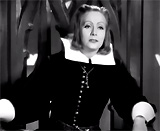
"But what of the peasants?"
|
|
It Happened One
Night (1934)
Screenwriter(s): Robert Riskin
"Wall
of Jericho" Scene and a Lesson on How a Man Undresses
When they shared a room and he strung up a blanket
on a clothesline to divide the room, reporter Peter Warne (Clark
Gable) gave a bare-chested demonstration of how a man undressed
in the infamous "Wall of Jericho" scene. He scared
young traveling companion-heiress Ellie Andrews (Claudette
Colbert) to flee to the other side of the "wall":
Well, I like privacy when I retire. Yes,
I'm very delicate in that respect. Prying eyes annoy me.
Behold the walls of Jericho! Uh, maybe not as thick as
the ones that Joshua blew down with his trumpet, but a
lot safer. You see, uh, I have no trumpet. And just to
show you that my heart's in the right place, I'll give
you my best pair of pajamas. (He pointed to the other
side of the blanket) Uh, would you mind joining the
Israelites? You don't want to join the Israelites?
All right. Perhaps you're interested in how
a man undresses. You know, it's a funny thing about that.
Quite a study in psychology. No two men do it alike. You
know, I once knew a man who kept his hat on until he was
completely undressed. Yeah, now he made a picture. Years
later, his secret came out. He wore a toupee. Yeah. Now I
have a method all my own. If you notice, the coat came first,
then the tie, then the shirt. Now, uh, according to Hoyle,
after that, the, uh, pants should be next. There's where
I'm different. I go for the shoes next. First the right.
Then the left. After that, it's, eh, every man for himself.
(She raced to the other side of the blanket) ...Aw,
don't be a sucker. A good night's rest'll do you a lot of
good. Besides, you got nothing to worry about: the walls
of Jericho will protect you from the big bad wolf.
|
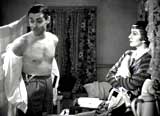
|
|
|
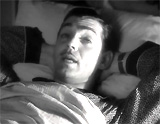
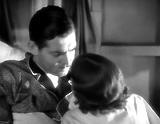
It Happened One
Night (1934)
Screenwriter(s): Robert Riskin
Bachelor's
Thoughts on Love and Marriage
Longtime bachelor Peter Warne (Clark Gable) also
gave his thoughts on love and marriage to traveling companion
Ellie Andrews (Claudette Colbert):
Sure, I've thought about it. Who hasn't?
If I could ever meet the right sort of girl. Ahh, where
you gonna find her? Somebody that's real, somebody that's
alive! They don't come like that way anymore. Have I ever
thought about it? Boy, I've even been sucker enough to
make plans. You know, I saw an island in the Pacific once,
never been able to forget it. That's where I'd like to
take her. She'd have to be the sort of a girl who'd jump
in the surf with me and love it as much as I did. Nights
when you and the moon and the water all become one. You
feel you're part of something big and marvelous. That's
the only place to live. The stars are so close over your
head you feel you could reach up and stir them around.
Certainly, I've been thinking about it. Boy, if I could
ever find a girl who was hungry for those things...
|
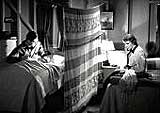
|
|
Mutiny on the
Bounty (1935)
Screenwriter(s): Talbot Jennings, Jules Furthman, Carey Wilson
Closing
Court Statement Before Death
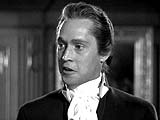
Midshipman/Ensign Roger Byam (Franchot Tone)
made a closing court statement to defend his men, after he
had been sentenced to hang:
My lord, much as I desire to live, I'm not
afraid to die. Since I first sailed on the Bounty over
four years ago, I've known how men can be made to suffer
worse things than death, cruelly, beyond duty, beyond necessity.
Captain Bligh, you've told your story of mutiny on the Bounty,
how men plotted against you, seized your ship, cast you
adrift in an open boat, a great venture in science brought
to nothing, two British ships lost. But there's another
story, Captain Bligh, of ten cocoanuts and two cheeses.
A story of a man who robbed his seamen, cursed them, flogged
them, not to punish but to break their spirit. A story
of greed and tyranny, and of anger against it, of what
it cost.
One man, my lord, would not endure such tyranny.
That's why you hounded him. That's why you hate him, hate
his friends. And that's why you're beaten. Fletcher Christian's
still free. Christian lost, too, my lord. God knows he's
judged himself more harshly than you could judge him. I say
to his father, 'He was my friend. No finer man ever lived.'
I don't try to justify his crime, his mutiny, but I condemn
the tyranny that drove him to it. I don't speak here for
myself alone or for these men you condemn. I speak in their
names, in Fletcher Christian's name, for all men at sea.
These men don't ask for comfort. They don't ask for safety.
If they could speak to you they'd say, 'Let us choose to
do our duty willingly, not the choice of a slave, but the
choice of free Englishmen.' They ask only (for) the freedom
that England expects for every man. If one man among you
believe that - one man - he could command the fleets
of England. He could sweep the seas for England. If he called
his men to their duty not by flaying their backs, but by
lifting their hearts, their... That's all.
|
|
|
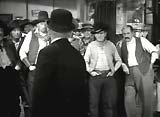
Ruggles of Red Gap (1935)
Screenwriter(s): Walter DeLeon, Harlan Thompson
Patriotic
Love of Adopted Country
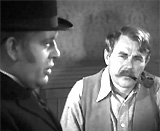
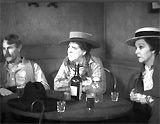
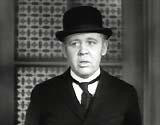
English butler-valet Marmaduke 'Bill' Ruggles
(Charles Laughton) expressed his love for America and the Old
West cow-town of Red Gap (in Washington), where he had moved
to work for
millionaire rancher Egbert Floud (Charles Ruggles). He showed
the cowhands at the Silver Dollar Saloon how he had become
inspired by "what
Lincoln said at Gettysburg" when no one else knew the words.
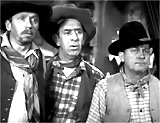
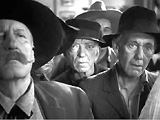
He recited Lincoln's Gettysburg Address
(he had been reading up on Presidential history), first softly
and then reaching a higher volume as more dumb-founded patrons,
cowhands, and bar-drinkers moved closer to listen (seen in
numerous cutaways).
"Four score and seven years ago, our fathers
brought forth on this continent, a new nation, conceived
in liberty and dedicated to the proposition that all men
are created equal.
Now we are engaged in a great civil war,
testing whether that nation, or any nation so conceived,
and so dedicated, can long endure. We are now on a great
battlefield of that war. We have come to dedicate a portion
of that field, as a final resting place for those who here
gave their lives, that that nation might live. It is altogether
fitting and proper that we should do this. But, in a larger
sense, we cannot dedicate, we cannot consecrate, we cannot
hallow this ground. The brave men, living and dead, who
struggled here, have consecrated it far beyond our poor power
to add or detract.
The world will little note, nor long remember
what we say here, but it can never forget what they did
here. It is for us the living, rather, to be dedicated
here to the unfinished work which they who fought here
have thus far so nobly advanced. It is rather for us
to be here dedicated to the great task remaining before us,
that from these honored dead we take increased devotion to
that cause for which they gave the last full measure
of devotion, that we here highly resolve that
- these
dead shall not have died in vain
-
that this nation,
under God, shall have a new birth of freedom, and
-
that
government of the people, by the people, and for the people,
shall not perish from the earth."
|
|

 Best
Film Speeches and Monologues
Best
Film Speeches and Monologues