|
Best Film Speeches and Monologues
|
|
Title Screen
|
Film Title/Year and Description of Film Speech/Monologue |
Screenshots
|

|
Funny Girl
(1968)
Screenwriter(s): Isobel Lennart
 "I'm
The Greatest Star" "I'm
The Greatest Star"
Aspiring, gifted rags-to-riches performer Fanny
Brice (Barbra Streisand) was seen in flashback, singing "I'm
the Greatest Star." She was trying to convince others,
through song, clever words and acting, that she was going to
be the next big star even though she wasn't one of the "beautiful
girls."
They showed her the door:
Suppose all ya ever had for breakfast was
onion rolls. Then one day, in walks a bagel! You'd say,
'Ugh, what's that?' Until you tried it! That's my problem.
I'm a bagel on a plate full of onion rolls. Nobody recognizes
me! Listen, I got 36 expressions. Sweet as pie and as tough
as leather. And that's six expressions more than all them
Barrymores put together. Instead of just kicking me, why
don't they give me a lift? Well, it must be a plot, 'cause
they're scared that I got such a gift!...
Well, I'm miffed. 'Cause I'm - the greatest
star. I am by far, but no one knows it. Wait - they're gonna
hear a voice, a silver flute. They'll cheer each toot, hey,
she's terrific!, when I expose it. Now can't you see to look
at me that I'm a natural Camille. And as Camille, I just
feel, I've so much to offer. Hey listen, kid, I know I'd
be divine because I'm a natural cougher. Some ain't got it,
not a lump. I'm a great big clump of talent! Laugh, they'll
bend in half. Did you ever hear the story about the travelling
salesman? A thousand jokes, stick around for the jokes. A
thousand faces. I reiterate. When you're gifted, then you're
gifted. These are facts, I've got no axe to grind! Ay! What
are ya, blind? In all of the world so far, I'm the greatest
star! No autographs, please. Huh? What? What did she say?
You think beautiful girls are gonna stay in style forever?
I should say not! Any minute now, they're gonna be out! Finished!
Then it'll be my turn!
|

|
|
If... (1968,
UK)
Screenwriter: David Sherwin
Not
a Punishment, But a Privilege and an Opportunity to Serve
Director Lindsay Anderson's British
coming-of-age social drama examined the rebellious nature
of three
anti-authoritarian students at a conformist British public school
(a symbolic microcosm of a repressive Establishment-oriented
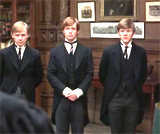
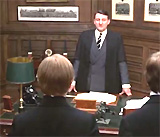
society). The three: Mick Travis
(Malcolm McDowell), Johnny Knightly (David Wood), and Wallace (Richard
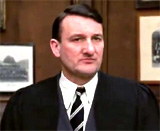
Warwick) were reprimanded by the Headmaster (Peter Jeffrey)
in his office for insubordination during cadet field corps paramilitary
training exercises in the woods.
The three recalcitrant boys were first told
to apologize to the chaplain for having attacked him. The chaplain's
body was withdrawn from a morgue-like
drawer behind him (a very surreal scene)! Then, they were forced
to listen to the Headmaster's speech that strained to be reasonable
- with a 'punishment' that was called a "privilege" and
an "opportunity"
- to clean up the church basement on the weekend:
I take this seriously. Very seriously indeed.
Now, Reverend Woods might have been quite badly hurt. Do you
realize that? Now I want you to apologize to him. Is that clear?
Now, you mustn't think that I don't understand. It's a natural
characteristic of adolescence to want to proclaim individuality.
There's nothing unhealthy about that. It's a quite blameless
form of existentialism.
This, for
instance, is what lies at the heart of the great hair problem.
I think you boys know that I keep an open mind on most things.
And of one thing I am certain: Short hair is no indication of
merit. So often I've noticed that it's the hair rebels who
step into the breach when there's a crisis - whether it be
a fire in the house, or to sacrifice a week's holiday in order
to give a party of slum children seven days in the
country. But, of course, there are limits. Scruffiness of any
kind is deplorable. I think you'd go that far with me.
Now,
the fees here are at present 643 pounds per annum, which works
out at about 15 guineas a week. This is no mean sum. It is
the salary, for instance, of the average trainee supermarket
manager. But on the other hand, it's no more than the cost
of keeping a juvenile delinquent in Borstal. However, this
is merely to look at the matter in terms of hard cash, which
is not the only consideration.
There is above all the question
of service. Those who are given most also have most to give.
Now you boys are intelligent. You're too intelligent to be
rebels. That's too easy. And it would be easy to punish you
in the normal way. But I'm going to give you a privilege. Work.
Real work. And I want you to think of this not as a punishment,
but as an opportunity to give, to serve.
|
|

|
The Lion
in Winter (1968, UK)
Screenwriter(s): James Goldman
Origins
of War - and Peace
Play clip (excerpt): 
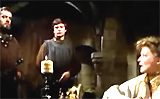
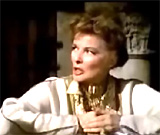
In the year 1183, Eleanor of Aquitaine's (Katharine
Hepburn) annoyed, despairing lecture to her sons about the
origins of war -- and peace, and how humans were barbarians:
Of course he has a knife, he always has
a knife, we all have knives! It's 1183 and we're barbarians!
How clear we make it. Oh, my piglets, we are the origins
of war, not history's forces, nor the times, nor justice,
nor the lack of it, nor causes, nor religions, nor ideas,
nor kinds of government, nor any other thing. We are the
killers. We breed wars. We carry it like syphilis inside.
Dead bodies rot in field and stream because the living
ones are rotten.
For the love of God, can't we love one
another just a little? That's how peace begins. We have
so much to love each other for. We have such possibilities,
my children. We could change the world.
|
|
|
The Producers
(1968)
Screenwriter(s): Mel Brooks
Agonizing
Remembrance of One's Former Greatness: "When You Got
It, Flaunt It!"
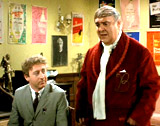
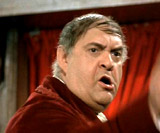
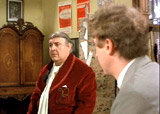
In the late 1960s, failed and aging Broadway
producer Max Bialystock (Zero Mostel) made a proud yet despairing
declaration of his former greatness and wealth to timid accountant
Leo Bloom (Gene Wilder):
How humiliating. Max Bialystock. Max Bialystock.
You know who I used to be? Max Bialystock! King of Broadway!
Six shows running at once! Lunch at Delmonico's. $200 suits.
You see this? This once held a pearl as big as your eye!
Look at me now. LOOK AT ME NOW! I'm wearing a cardboard
belt! I used to have thousands of investors begging, pleading
to put their money in a Max Bialystock production. Look
at my investors now. (He opened a cabinet with pictures
of wealthy, elderly women) Voila! Hundreds of little
old ladies stopping off at Max Bialystock's office to grab
a last thrill on the way to the cemetery! (To Leo)
You have exactly 10 seconds to change that look of disgusting
pity into one of enormous respect. One, two... Do the books.
Do the books...Window's so filthy, can't tell whether it's
day or night out there.
Then at the window after rubbing it clear with
his coffee drink, he spotted a chauffeured white Rolls Royce
parking outside Kippys restaurant across the street, and gleefully
yelled in admiration and jealousy:
That's it, baby! When you got it, flaunt
it. Flaunt It!
|
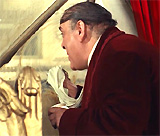
"That's it, baby, when you got it, flaunt
it"
|
|
|
The Producers
(1968)
Screenwriter(s): Mel Brooks
A
Deranged Ex-Nazi Comparing Hitler to Churchill
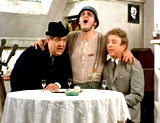
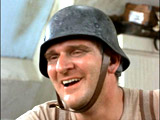
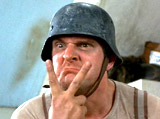
Over schnapps in his apartment, insane and deranged
ex-Nazi Franz Leibkind (Kenneth Mars), author of the play Springtime
For Hitler - that Max Bialystock (Zero Mostel) wanted to
produce on Broadway, had glowing, nostalgic memories of Adolf
Hitler and only scorn for British prime minister Winston Churchill:
You know, not many people knew it, but the
Fuhrer was a terrific dancer (Max: "Really, I never
dreamed that...") That is because that you were taken
in by that verdammte Allied propaganda! Such filthy
lies! They told lies! But nobody ever said a bad word about
Winston Churchill, did they? No! 'Win with Winnie!' Churchill!
With his cigars. With his brandy. And his rotten painting,
rotten!
Hitler - there was a painter! He count
paint an entire apartment in one afternoon! Two Coats!
Churchill. He couldn't even say 'Nazi'. He would say 'Noooo-zeeehz,
Nooooooooooooo-zeeehz!' It wasn't Noses! It was Nazis!
Churchill!...Let me tell you this! And you're hearing this
straight from the horse. Hitler was better looking than Churchill.
He was a better dresser than Churchill. He had more hair!
He told funnier jokes! And he could dance the pants off of
Churchill!...Churchill!
|
|
|
|
The Producers
(1968)
Screenwriter(s): Mel Brooks
"Whom
Has He Really Hurt?" Defense
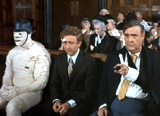
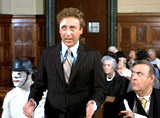
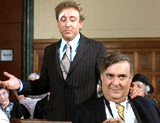
Co-producer/accountant Leo Bloom (Gene Wilder),
on-trial partner Max Bialystock (Zero Mostel), and crazed ex-Nazi
Franz Leibkind (Kenneth Mars) conspired to blow up the theatre
to end their production of Springtime For Hitler. After
the jury found all of them "incredibly guilty," Bloom
had the opportunity to give an impassioned "Whom has he
really hurt?" defense, before the judge pronounced their
sentence:
I would like to say something, your Honor.
Not on my behalf, but in reference to my partner, Mr. Bialystock...Your
Honor, Ladies and Gentlemen of the jury, Max Bialystock
is the most selfish man I ever met in my life. (Max: "Don't
help me") Not only is he a liar and a cheat and a
scoundrel and a crook, who has taken money from little
old ladies, but he's also talked people into doing things,
especially me, that they would never in a thousand years
have dreamed of doing. But, your Honor, as I understand
it, the law was created to protect people from being wronged.
Your Honor, whom has Max Bialystock wronged? I mean, whom has
he really hurt? Not me. Not me. I was... This man.
No one ever called me Leo before. I mean, I
know it's not a big legal point, but even in kindergarten,
they used to call me Bloom. I never sang a song before. I
mean with someone else. I never sang a song with someone
else before. This man, this man, this is a wonderful man.
He made me what I am today. He did. (He gestured to the
audience of old ladies) And what of the dear ladies?
What would their lives have been without Max Bialystock?
Max Bialystock who made them feel young and attractive and
wanted again? That's all that I have to say. (The ladies
stood and applauded)
Max stood and tacked on his own final words:
And may I humbly add, your Honor, that we've
learned our lesson and that we'll never do it again.
The trio were sent to the State Penitentiary,
where they hadn't learned their lesson. |
|
|
Targets
(1968)
Screenwriter(s): Peter Bogdanovich, Samuel Fuller
Appointment
with Death
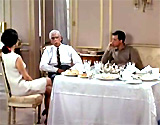
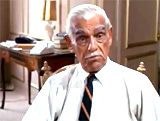
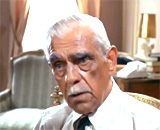
Elderly horror film star Byron Orlok's (Boris
Karloff in a semi-autobiographical role) beautiful narrated
recounting of the folk fable 'The Appointment in Samarra' to
his radio interviewers, as the camera slowly zoomed in. He
related the story of a man who had an appointment with mortality
and couldn't escape his fate:
Ladies and gentlemen, boys and girls, I'd
like to leave you with a little story to think about as
you drive home... through the darkness... Once upon a time,
many many years ago, a rich merchant in Baghdad sent his
servant to the marketplace to buy provisions. And after
a while the servant came back, white-faced and trembling,
and said, 'Master, when I was in the marketplace, I was
jostled by a woman in the crowd and I turned to look, and
I saw that it was Death that had jostled me. And she looked
at me and made a threatening gesture. Oh, Master, please
lend me your horse, that I may ride away from this city
and escape my fate. I will ride to Samarra and Death will
not find me there.'
So the merchant loaned him the horse
and the servant mounted it, dug his spurs into its flank,
and as fast as the horse could gallop he rode towards Samarra.
Then the merchant went to the market-place and he saw Death
standing in the crowd and he said to her: 'Why did you
make a threatening gesture to my servant when you saw him
this morning?' And Death said, 'I made no threatening gesture
- that was, that was only a start of surprise. I was astonished
to see him here in Baghdad, for I have an appointment with
him tonight... in Samarra.'
|
|
|
2001:
A Space Odyssey (1968, UK)
Screenwriter(s): Stanley Kubrick, Arthur C. Clarke
HAL's
Slow Death

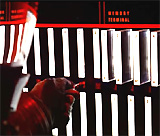
Malevolent super-computer
HAL's (voice of Douglas Rains) slow death, ending with the
singing of Daisy. The sequence began
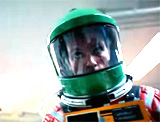
as angered astronaut Dave Bowman (Keir Dullea) - with the sounds
of his heavy breathing inside his helmet - strode towards the
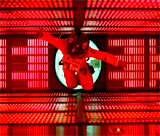
computer's reddish-toned "brain
room" to
remove parts of the computer's memory bank and shut the computer
down. HAL began to plead for him to reconsider, and asked him
to calm down and reassess the situation:
Just what do you think you're doing, Dave?
Dave, I really think I'm entitled to an answer to that
question. I know everything hasn't been quite right with
me...but I can assure you now...very confidently...that
it's going to be all right again. I feel much better now.
I really do.
Look, Dave, I can see you're really upset about this. I
honestly think you ought to sit down calmly, take a stress
pill, and think things over. I know I've made some very
poor decisions recently, but I can give you my complete
assurance that my work will be back to normal. I've still
got the greatest enthusiasm and confidence in the mission
and I want to help you.
As Dave started to de-brain, lobotomize,
dismantle and disconnect HAL's higher-logic functions, HAL
continued to plead and protest with Bowman - in a programmed
voice - as his 'mind' gradually decayed and he became imbecilic
and returned to infancy. HAL's poignant death was agonizingly
slow and piteous, and although the computer maintained a calm
tone - it still expressed a full range of genuine emotions
while dying. His voice eventually slowed and sounded drugged:
Dave...stop. Stop,
will you? Stop, Dave. Will you stop, Dave? Stop, Dave.
I'm afraid. I'm afraid, Dave.......Dave, my mind is going.
I can feel it. I can feel it. My mind is going. There is
no question about it. I can feel it. I can feel it. I can
feel it. I'm a...fraid......
When HAL's brain reached senility, and then a
second childhood, he called up his earliest encoded data-memories
as physical parts of his mind were pulled away:
Good afternoon, gentlemen.
I am a HAL 9000 computer. I became operational at the H.A.L.
plant in Urbana, Illinois on the 12th of January 1992.
My instructor was Mr. Langley, and he taught me to sing
a song. If you'd like to hear it I can sing it for you...It's
called Daisy.
HAL then sang his swan song, one of the first
songs he learned - Daisy, or A Bicycle Built For Two -
until the words entirely degenerated with his voice rumbling
lower and lower into distortion. He slid into his innate tabula
rasa state - and then there was utter silence:
Daisy,
Daisy, give me your answer do. I'm half crazy all for the
love of you. It won't be a stylish marriage, I can't afford
a carriage. But you'll look sweet upon the seat of a bicycle
built for two.
|





|



|
A Boy Named
Charlie Brown (1969)
Screenwriter(s): Charles M. Schulz
"World
Didn't Come to an End" Speech
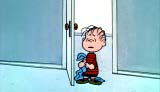
Linus van Pelt's (voice of Glenn Gilger) simple,
wise observation to a bedridden, shamed Charlie Brown (voice
of Peter Robbins), who had failed the National Spelling Bee:
Well, I can understand how you feel. You
worked hard, studying for the spelling bee, and I suppose
you feel you let everyone down, and you made a fool of
yourself and everything. But did you notice something,
Charlie Brown?... The world didn't come to an end.
|
|

 Best
Film Speeches and Monologues
Best
Film Speeches and Monologues