|
Best Film Speeches and Monologues
|
|
Title Screen
|
Film Title/Year and Description of Film Speech/Monologue |
Screenshots
|

|
Addams
Family Values (1993)
Screenwriter(s): Paul Rudnick
 The
Hypocrisy of Thanksgiving The
Hypocrisy of Thanksgiving
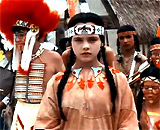
Steely-glaring, contemptuous Wednesday Addams
(Christina Ricci), participating in a summer camp play at Camp
Chippewa about the "First Thanksgiving"
feast as the lead Native American Pocahontas, lambasted the lead
white Pilgrim character with this ad-libbed monologue to the
stunned reactions of everyone:
Wait!.. We cannot break bread with you...You
have taken the land which is rightfully ours. Years from
now, my people will be forced to live in mobile homes on
reservations. Your people will wear cardigans, and drink
highballs. We will sell our bracelets by the roadsides.
You will play golf, and enjoy hot h'ors d'oeuvres. My people
will have pain and degradation. Your people will have stick
shifts. The gods of my tribe have spoken. They have said:
'Do not trust the pilgrims, especially Sarah Miller'...And
for all these reasons, I have decided to scalp you and
burn your village to the ground.
|

|
|
Falling
Down (1993)
Screenwriter(s): Ebbe Roe Smith
"I
Want Breakfast"
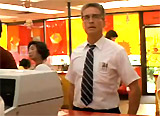
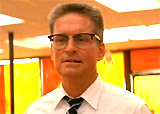
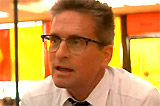
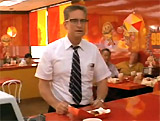
Frustrated, divorced, recently unemployed defense
agency worker William 'D-Fens' Foster (Michael Douglas) demanded
to have breakfast at 11:33 am in a Whammy-Burger fast-food
restaurant from a patronizing manager named Rick (Brent Hinkley)
and clerk Sheila (Dedee Pfeiffer), during his volatile trek
across Los Angeles on foot:
I'd like a ham and cheese Whamlette, an order
of Wham fries...
(Sheila: "I'm sorry, we stopped serving breakfast, but
we are on lunch menu now.")
I want breakfast.
(Sheila: "Well, you can't have it. We're not serving
it.")
So you said. Is that the manager?...Could I speak to him
please?...Hi, I'd like some breakfast.
(Rick: "We stopped serving breakfast.")
I know you stopped serving breakfast, Rick. Sheila told me
you stopped serving breakfast. Why am I calling you by your
first names? I don't even know who you are. I still call
my boss 'Mister,' and I worked for him for seven and a half
years. But I walk in here, all of a sudden, a total stranger,
I'm calling you Rick and Sheila like we're in some kind of
AA meeting. I don't want to be your buddy, Rick. I just want
a little breakfast.
(Sheila: "You can call me Miss Folsom if you want." Rick: "Sheila!
We stopped serving breakfast at 11:30.")
Rick, have you ever heard the expression, 'The customer is
always right'?...Yeah, well here I am. The customer.
(Rick: "That's not our policy. You have to order something
from the lunch menu.")
I don't want lunch. I want breakfast.
(Rick: "Yeah, well hey, I'm really sorry.")
Yeah, well hey, I'm really sorry too. (He pulled out a
semi-automatic weapon from his bag)
When he finally agreed to being served lunch
(a double Whammyburger with cheese and an order of Whammy fries
and a Choco-Wham shake) after accidentally shooting a hole
in the restaurant's ceiling, he further complained about the
size of the burger that he had been served, when compared to
the marketing poster behind the counter:
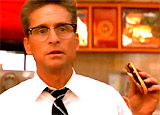
(He opened the burger container with
disgust) See, this is what I'm talkin' about. Turn
around. Look at that. Do you see what I mean. It's, it's
plump, it's juicy, it's three inches thick. Now, look
at this sorry, miserable, squashed thing. Can anybody
tell me what's wrong with this picture? Anybody? Anybody
at all.
|
|
|
The Fugitive
(1993)
Screenwriter(s): Jeb Stuart, David Twohy
"Your
Fugitive's Name is Dr. Richard Kimble"
Single-minded US Marshal Sam Gerard (Tommy
Lee Jones) instructed his men on how to look for escaped
fugitive Dr. Richard Kimble (Harrison Ford):
Listen up, ladies and gentlemen. Our fugitive
has been on the run for 90 minutes. Average foot speed
over uneven ground, barring injuries, is 4 miles-an-hour.
That gives us a radius of six miles. What I want out of
each and every one of you is a hard-target search of every
gas station, residence, warehouse, farmhouse, henhouse,
outhouse and doghouse in that area. Checkpoints go up at
fifteen miles. Your fugitive's name is Dr. Richard Kimble.
Go get him.
|
|
|
Gettysburg
(1993)
Screenwriter(s): Ronald F. Maxwell
"What
We're Fighting For!"
Play clip (excerpt): 
The address of Colonel Joshua Lawrence Chamberlain
(Jeff Daniels) to the 20th Maine Volunteer Infantry Regiment
about freedom, and his need for them to fight with him at the
Battle of Gettysburg:
...You know who we are and what we're doing
here, but if you want to fight along side us, there's some
things I want you to know. This regiment was formed last
summer in Maine. There were a thousand of us then. There
are less than three hundred of us now. All of us volunteered
to fight for the Union, just as you did. Some came mainly
because we were bored at home, thought this looked like
it might be fun. Some came because we were ashamed not
to. Many of us came because it was the right thing to do.
All of us have seen men die. This is a different kind of
army. If you look back through history, you will see men
fighting for pay, for women, for some other kind of loot.
They fight for land, power, because a king leads them or,
or just because they like killing. But we are here for
something new. This has not happened much in the history
of the world. We are an army out to set other men free.
America should be free ground - all of it.
Not divided by a line between slave state and free, all the
way from here to the Pacific Ocean. No man has to bow. No
man born to royalty. Here, we judge you by what you do, not
by who your father was. Here, you can be something. Here,
is the place to build a home. But it's not the land. There's
always more land. It's the idea that we all have value -
you and me. What we're fighting for, in the end, we're fighting
for each other. Sorry, I, uh, didn't mean to preach. You,
uh, you go ahead. You talk for awhile. Uh, if you, uh, if
you choose to join us, you want your muskets back, you can
have 'em. Nothing more will be said by anybody anywhere.
If you, uh, choose not to join us, well you can come along
under guard, and when this is all over I will do what I can
to see you get a fair treatment. But for now, we're moving
out. Gentlemen, I think if we lose this fight, we lose the
war. So if you choose to join us, I'll be personally very
grateful.
|
|
|
In the Line of Fire (1993)
Screenwriter(s): Jeff Maguire
"I
Shoulda Reacted"
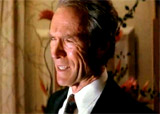
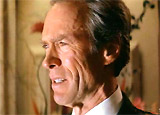
Guilt-ridden and haunted Secret Service agent
Frank Horrigan (Clint Eastwood) recalled to fellow agent Lilly
Raines (Rene Russo) how he couldn't save President Kennedy
on the fateful day of November 22, 1963, when he failed to
act quickly enough after the first shot:
For years, I've been listenin' to all these
idiots on barstools with all their pet theories on Dallas.
How it was the Cubans, or the CIA, or the white supremacists,
or the Mob. Whether there was one weapon, or whether there
was five. None of that's meant too much to me. But Leary,
he questioned whether I had the guts to take that fatal
bullet.
God, that was a beautiful day. The sun was
out, been raining all morning, the air was... First shot,
sounded like a firecracker. I looked over, I saw him, I could
tell he was hit. I don't know why I didn't react. I shoulda
reacted. I shoulda been running flat out. I just couldn't
believe it. If only I reacted, I coulda taken that shot.
That woulda been alright with me.
|
|
|
Indecent Proposal
(1993)
Screenwriter(s): Amy Holden Jones
The
Girl That Got Away
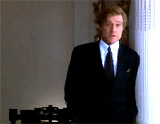
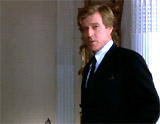
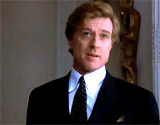
Businessman billionaire John Gage (Robert Redford),
when asking for "just one dance" from financially-strapped
married female Diana Murphy (Demi Moore), recalled a "beautiful" girl
he had fleetingly seen on the subway - borrowing a scene of
a recollection by Mr. Bernstein (Everett Sloane) from Citizen
Kane (1941):
I remember once when I was young, and I was
coming back from some place, a movie or something. I was
on the subway. And there was a girl sitting across from
me, and she was wearing this dress that was buttoned clear
up right to here. She was the most beautiful thing I'd
ever seen. And I was shy then, so when she would look at
me, I would look away. Then afterwards, when I would look
back, she would look away. Then I got to where I was gonna
get off, and got off. The doors closed. And as the train
was pulling away, she looked right at me and gave me the
most incredible smile.
It was awful. I wanted to tear the doors open.
I went back every night, same time, for two weeks, but she
never showed up. That was 30 years ago, and I don't think
that there's a day that goes by that I don't think about
her. I don't want that to happen again. Just one dance?
|
|

|
Malice
(1993)
Screenwriter(s): Aaron Sorkin, Scott Frank
"Do
I Have a God Complex?"
Play clip (excerpt):
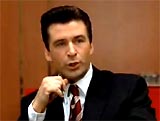
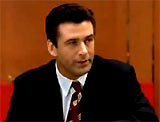
During a memorable deposition scene in front
of hospital administrators and lawyers in a massive Boston
conference room regarding a case of malpractice, the pompous
and narcissistic St. Agnes Hospital surgeon Dr. Hill responded
(off-the-record) to the question of whether he had a "God
Complex" or
not, in the presence of his Chief of Staff Dr. Kessler (George
C. Scott) at the Harvard Medical School - the issue was whether
Dr. Hill removed a healthy ovary without any scientific diagnosis
or listening to any other's advice:
The question is, 'Do I have a 'God Complex'?...which
makes me wonder if this lawyer has any idea as to the kind
of grades one has to receive in college to be accepted
at a top medical school. Or if you have the vaguest clue
as to how talented someone has to be to lead a surgical
team. I have an M.D. from Harvard. I am board certified
in cardio-thoracic medicine and trauma surgery. I have
been awarded citations from seven different medical boards
in New England. And I am never, ever sick at sea.
So I
ask you, when someone goes into that chapel and they fall
on their knees and they pray to God that their wife doesn't
miscarry, or that their daughter doesn't bleed to death,
or that their mother doesn't suffer acute neural trauma
from post-operative shock, who do you think they're praying
to?
Now, go ahead and read your Bible, Dennis,
and you go to your church - and with any luck you might
win the annual raffle. But if you're looking for God, he
was in operating room number two on November 17th, and
he doesn't like to be second-guessed. You ask me if I have
a 'God complex'? Let me tell you something: I Am God -
and this side show is over.
|
|
|
The Piano
(1993, NZ/Austr./Fr.)
Screenwriter(s): Jane Campion
"I
Don't Think Myself Silent"
Play clip (excerpt):
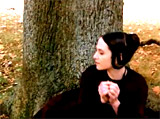
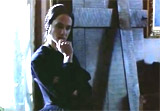
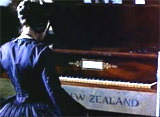
As she began her journey to New Zealand with
her daughter Flora (Anna Paquin) in the mid-19th century for
an arranged marriage as a mail-order bride, strong-willed mute
pianist Scotswoman Ada McGrath (Holly Hunter) thought to herself,
in voice-over in the film's first lines.
She explained how she had not spoken a word since
she was six years old. Instead, she expressed herself through
her piano - something she would miss during the long trip:
The voice you hear is not my speaking voice,
but my mind's voice. I have not spoken since I was six
years old. Lord knows why, not even me. My father says
it is a dark talent, and the day I take it into my head
to stop breathing will be my last.
Today, he married me to a man I have not yet
met. Soon my daughter and I shall join him in his own country.
My husband said my muteness does not bother him. He writes
- and hark this! 'God loves dumb creatures, so why not he?'
Were good he had God's patience, for silence affects everyone
in the end. The strange thing is, I don't think myself silent,
that is, because of my piano. I shall miss it on the journey.
|

|
|
|
The Piano
(1993, NZ/Austr./Fr.)
Screenwriter(s): Jane Campion
"My
Will Has Chosen Life!"
Play clip (excerpt):
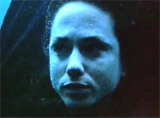
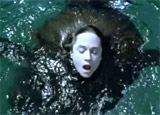
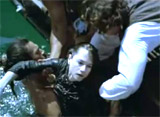
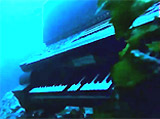
Mute pianist Ada McGrath (Holly Hunter) delivered
a haunting closing voice-over monologue about choosing life
over death (by drowning) in New Zealand, when she was ensnared
in her submerging "spoiled" piano and was plunged
underwater. She decided to kick off her boot and swim back
to the surface, and was hauled onto the boat by natives. In
voice-over, she mused:
What a death! What a chance! What a surprise!
My will has chosen life!? Still, it has had me spooked
and many others besides!
(Epilogue) I teach piano now in Nelson. George has fashioned
me a metal finger tip. I am quite the town freak which satisfies!
I am learning to speak. My sound is still so bad I feel ashamed.
I practice only when I'm alone and it is dark.
At night,
I think of my piano in its ocean grave, and sometimes of
myself floating above it. Down there, everything is so still
and silent that it lulls me to sleep. It is a weird lullaby
and so it is -- it is mine.
(As the camera continued to pull back, Ada was seen dead,
still tied to the piano.)
There is a silence where hath been no sound. There is a silence
where no sound may be. In the cold grave under the deep deep
sea. (Thomas Hood quote)
|
|

 Best
Film Speeches and Monologues
Best
Film Speeches and Monologues