|
Best Film Speeches and Monologues
|
|
Title Screen
|
Film Title/Year and Description of Film Speech/Monologue |
Screenshots
|

|
High Noon (1952)
Screenwriter(s): Carl Foreman
 All
For Nothing - A Tin Star All
For Nothing - A Tin Star
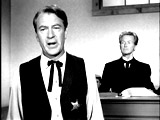
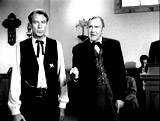
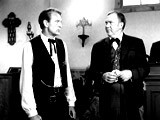
In the western town of Hadleyville, beleaguered
Marshal Will Kane (Gary Cooper) went to the townspeople at
the local church to gain support to help him defend the town
against vengeful gunslingers about to arrive: ("It looks
like Frank Miller's comin' back on the noon train. I need all
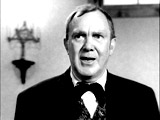
the special deputies I can get"). Mayor Jonas Henderson
(Thomas Mitchell) summed up the debate by first complimenting
Kane. He then stated that Frank Miller (Ian MacDonald) was the
town's concern and problem. A violent shoot-out would also
create a bad image for Hadleyville up North, especially for
financial growth and investment support from Northern business
interests. But then he concluded by advising Kane ("a
mighty brave man, a good man") to flee town for the good
of the local economy:
What this town owes Will Kane here it can
never repay with money - and don't ever forget it. He's
the best marshal we ever had. Maybe the best marshal we'll
ever have. So if Miller comes back here today, it's our problem,
not his. It's our problem because this is our town. We
made it with our own hands out of nothing. And if we want
to keep it decent, keep it growing, we've got to think
mighty clear here today. And we've gotta have the courage
to do what we think is right, no matter how hard it is.
All right. There's gonna be fighting when Kane
and Miller meet and somebody's gonna get hurt, that's for
sure. Now, people up North are thinking about this town -
thinking mighty hard. Thinking about sending money down here
to put up stores and to build factories. It'll mean a lot
to this town, an awful lot. But if they're gonna read about
shooting and killing in the streets, what are they gonna
think then? I'll tell ya. They're gonna think this is just
another wide-open town and everything we worked for will
be wiped out. In one day, this town will be set back five
years. And I don't think we can let that happen.
Mind you, you all know how I feel about this
man. He's a mighty brave man, a good man. He didn't have
to come back here today. And for his sake and the sake of
this town, I wish he hadn't. Because if he's not here when
Miller comes, my hunch is there won't be any trouble, not
one bit. Tomorrow, we'll have a new Marshal. And if we can
all agree here to offer him our services, I think we can
handle anything that comes along. And to me, that makes sense.
To me, that's the only way out of this. Will, I think you'd
better go while there's still time. It's better for you,
and it's better for us.
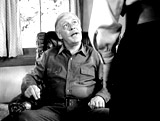
Shortly later, aging, discarded, arthritic, and
embittered ex-marshal Matt Howe (Lon Chaney, Jr.) gave his
cynical opinion to Kane about his past profession as a life-long
'tin-star' lawman:
It's a great life. You risk your skin catchin'
killers and the juries turn 'em loose so they can come
back and shoot at ya again. If you're honest, you're poor
your whole life, and in the end you wind up dyin' all alone
on some dirty street. For what? For nothin'. For a tin
star.
|
|
|
The Marrying Kind (1952)
Screenwriter(s): Ruth Gordon, Garson Kanin
The
Importance of Thinking
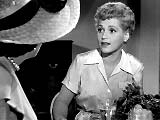
Newlywed Florence 'Florrie' Keefer (Judy Holliday)
delivered an epiphany, with flashback, about the beauty of
thinking while honeymooning in Atlantic City with her new postal-worker
husband 'Chet' (Aldo Ray). She was speaking to her mother Mrs.
Derringer (Phyllis Povah) and sister Joan Shipley (Sheila Bond):
Because everybody gets in a rut. Take me.
A rut! But down there in Atlantic City, I got into a lot
of thinking. You know what I mean? I don't mean just stewin'
around - I mean thinking. And to tell you the truth, I
was surprised by how enjoyable it was! Well, you take most
people, including me. They hardly ever get to do any thinking
- when do they get the time? Or if you do get the time,
there's the movies or the radio or you play a game of cards,
but no thinking. Down there it was my first chance in I
don't know how long, and I've made up a rule: I'm gonna
do at least a half hours of thinking every day, all by
myself. Just quietly. ("What are you going to think
about?") I don't know. Everything.
|
|

|
From Here to
Eternity (1953)
Screenwriter(s): Daniel Taradash
Decision
to Put Aside Boxing
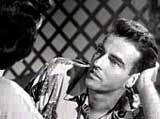
Private Robert "Prew" Prewitt (Montgomery
Clift) explained his decision to never box again:
Some of the guys are puttin' me over the
jumps 'cause I don't want to fight...yeah, on the boxing
team. I don't want to box. I don't even want to think about
it...see, I used to fight, middleweight. And I was pretty
good and they know it...I used to work out with this guy
Dixie Wells. He's a real good friend of mine. Loved to
box. People on the outside had their eye on him. He was
gonna come out of the Army and go right up to the top.
Well, one afternoon, he and I were sparrin' around in the
gym, you know, kind of friendly-like. And, he must have
been set pretty flat on his feet 'cause I caught him with
a, no more'n ordinary right cross, and uh, he didn't get
up. He didn't move. He was in a coma for a week, and uh,
finally, he did pull out of it. Only the thing was that
he was blind. Well, I went to see him at the hospital a
couple of times and finally I just couldn't go back. The
last time he and I started talking about fighting, and
uh, he started to cry. And seein' tears comin' out of those
eyes that couldn't see anything.
|
|
|
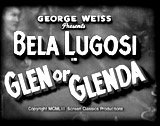
Glen or Glenda (1953)
Screenwriter(s): Edward D. Wood, Jr.
About
Transvestites and Men's/Women's Clothing
Play clip (excerpt): 
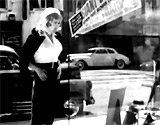
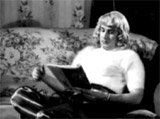
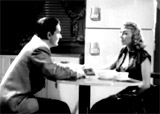
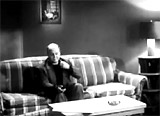
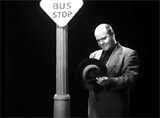
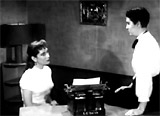
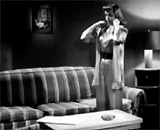
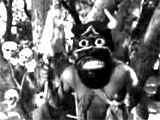
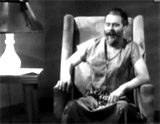
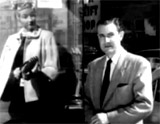
After a Young Man and a Young Woman made comments
about how the Creator gave us birth as either boys or girls,
The Narrator/Dr. Alton (Timothy Farrell) in voice-over responded
about how nature can make mistakes. An example of transvestitism
was illustrated with the story of conflicted cross-dressing
Glen/Glenda (Edward D. Wood, Jr.), shown in women's clothing
looking at items in a shop window, and lounging at home:
Are we sure? Nature makes mistakes, it's
proven everyday. This person is a transvestite. A man who
is more comfortable wearing girl's clothes. The term transvestite
is the name given by medical science to those persons who
wear the clothing of the opposite sex. Many a transvestite
actually wishes to be the opposite sex. The title
of this can only be labeled 'Behind Locked Doors'. Give
this man satin undies, a dress, a sweater and a skirt,
or even the lounging outfit he has on, and he's the happiest
individual in the world. He can work better, think better,
he can play better, and he can be more of a credit to his
community and his government because he is happy. These
things are his comfort.
But why the wig and makeup? He dares to enter
the street dressed in the clothes he so much desires to wear.
But only if he really appears female. The long hair, the
makeup, the clothing, the actual contours of a girl. Most
transvestites do not want to change their life, their bodies,
many of them simply want to change the clothing they wear
to that as worn by the opposite sex. Glen is engaged to be
married to Barbara, a lovely intelligent girl.
Shortly later, the Narrator continued, in voice-over,
to discuss how men's clothing was restrictive and uncomfortable
(and hats even caused baldness), while women's clothing was
attractive, comfortable, fluffy and fine. In the animal kingdom,
he noted that it's the male that is adorned to attract females'
attention:
Modern man is a hard-working human. Throughout
the day, his mind and his muscles are busy at building
the modern world and its business administration. His clothing
is rough, coarse, starched, according to the specifications
of his accepted job. At home, what does modern man have
to look forward to for his body comfort? The things provided
for his home, a wool or flannel robe, his feet encased
in the same thick, tight-fitting leather that his shoes
are made of. These are the things provided for his home
comfort. It doesn't look so comfortable, does it? And get
the hat - or better still, get the receding hairline. Men's
hats are so tight they cut off the blood flow to the head,
thus cutting off the growth of hair. Seven out of ten men
wear a hat, so the advertisements say. Seven out of ten
men are bald.
But what about the ladies? Yes, modern woman
is a hard-working individual also. But when modern woman's
day of work is done, that which is designed for her home
comfort is comfort. Hats that give no obstruction
to the bloodflow, hats that do not crush the hair. Interesting
thought, isn't it?
Just for comparison, let's go native, back
to the animal instinct. There in the lesser civilized part
of the world, it's the male who adorns himself with the fancy
objects, such as paints, frills, and masks. The true instinct.
The animal instinct. Bird and animal life. Is it not so that
it's the male who is the fancy one? Could it be that the
male was meant to attract the attention of the female? What's
so wrong about that?
Where is the animal instinct in modern civilization?
Female has the fluff and the finery, as specified by those
who design and sell. Little Miss Female, you should feel
quite proud of the situation. You, of course, realize that
it's predominantly men who design your clothes, your jewelry,
your makeup, your hair styling, your perfume. But life, even
though its changes are slow, moves on.
There's no law against wearing such apparel
on the street, as long as it can be distinguished that man
is man and woman is woman. But, what is it that would happen
were this individual to appear this way on the street? You're
doing it now - laughing. Yet, it's not a situation to be
laughed at.
Thus, the strange case of Glen, who was Glenda,
one and the same person. Not half-man, half-woman, but nevertheless,
man and woman in the same body, even though by all outward
appearances, Glen is fully and completely a man.
|

|
|
Julius Caesar (1953)
Screenwriter(s): Based upon William Shakespeare's play, Joseph L.
Mankiewicz (uncredited)
"Friends,
Romans, Countrymen, Lend Me Your Ears" - Mark Antony's
Thoughts on His Friend, the Assassinated Tyrant Caesar
Play clip (excerpt):
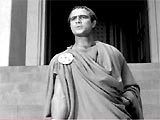
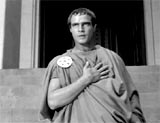
Mark Antony (Marlon Brando) gave an address to
the Roman citizenry following the death of tyrannical Julius
Caesar (Louis Calhern), who had been stabbed by Brutus (James
Mason) and other conspirators. He confronted an angry crowd
that at first sided with Brutus and the others:
Friends, Romans, countrymen, lend me your
ears. I come to bury Caesar, not to praise him. The evil
that men do lives after them. The good is oft interred
with their bones. So let it be with Caesar. The noble Brutus
hath told you Caesar was ambitious. If it were so, it was
a grievous fault, and grievously hath Caesar answered it.
Here, under leave of Brutus and the rest (For Brutus is
an honorable man. So are they all; all honorable men) Come
I to speak in Caesar's funeral. He was my friend, faithful
and just to me: but Brutus says he was ambitious, and Brutus
is an honorable man. He hath brought many captives home
to Rome whose ransoms did the general coffers fill: Did
this in Caesar seem ambitious? When that the poor have
cried, Caesar hath wept: Ambition should be made of sterner
stuff: Yet Brutus says he was ambitious; And Brutus is
an honorable man. You all did see that on the Lupercal,
I thrice presented him a kingly crown - which he did thrice
refuse: was this ambition!? Yet, Brutus says he was ambitious;
And, sure, he is an honorable man.
I speak not to disprove what Brutus spoke,
but here I am to speak what I do know. You all did love him
once, not without cause: what cause withholds you then to
mourn for him? Oh judgment! Thou art fled to brutish beasts.
And men have lost their reason. Bear with me. My heart is
in the coffin there with Caesar, and I must pause till it
come back to me....
|
|
|
Trouble Along the Way (1953)
Screenwriter(s): Melville Shavelson, Jack Rose
Troubles
with the Game of Football
Financially-distressed Saint Anthony's College
in NYC was floundering financially and was threatened to be
closed within six months. The Catholic school's
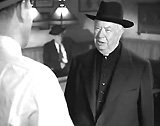
kind-hearted, elderly Rector, Father Burke (Charles Coburn),
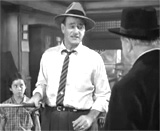
decided to recruit an experienced, yet
cynical and bitter ex-football coach named Steve
Aloysius Williams (John Wayne) to build
up a winning football program so that its ticket sales for
games would support the school. Williams had already experienced
disfavor among his sports colleagues and remained bitter about
the sport - and vowed to never repeat the experience.
[Note: This was the film in which it was stated:
"Winning isn't everything, it's the only thing."]
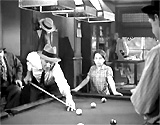
While Williams was playing pool (he was a bookie
in a billiard hall), Father Burke urged him to join the school
as the new coach. The
reluctant Williams explained how football had been developed
from very shaky roots, but ultimately had become America's
most enduring sport. At first, Williams was uninterested and
declined the offer after giving this explanation:
Oh, it's a fine game, football - noble game.
Originated in England in 1823. An enterprising young man
named William Webb Ellis - who studied for the ministry,
by the way - found his team behind in a soccer game. So he
picked up the ball, and ran through the amazed opponents
for a thoroughly illegal touchdown. And that's how football
was born - illegitimately.
So, it moved to America where someone took
advantage of a loophole in the rules and invented a little
formation called the Flying Wedge. So many young men were
maimed and killed by this clever maneuver that President
Roosevelt - Theodore Roosevelt - had to call the colleges
together and ask them to make the game less brutal. He was,
of course, defeated in the next election....
In spite of this
setback, football became an industry. The price of a good
running back often surpassed the salary of a professor. And
when some righteous committee unearthed this well-known fact,
there was always a coach that took it on the chin. I just
got tired of pickin' myself up.
By film's end, Williams was accused by Father
Burke of using dubious, underhanded, unscrupulous and dishonest
methods to build a winning team, including "buying players,
forging records, dividing profits, and laughing at us who were
naive enough to have had confidence in you." |
|
|
The Caine Mutiny
(1954)
Screenwriter(s): Stanley Roberts
"Ah,
but the Strawberries" Paranoid Testimony
Play clip (excerpt):
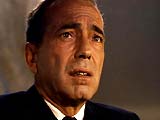
Captain Queeg (Humphrey Bogart) gave a paranoid,
unstable testimony during tough cross-examination from Lieutenant
Barney Greenwald (Jose Ferrer) in the court-martial trial of
two of his officers, Lieutenant Stephen Maryk (Van Johnson)
and Ensign "Willie" Keith (Robert Francis), as he
became increasingly unhinged, and rotated steel ball bearings
in his hand:
...He was no different from any other officer
in the ward room, they were all disloyal. I tried to run
the ship properly, by the book, but they fought me at every
turn. The crew wanted to walk around with their shirt tails
hanging out, that's all right, let them. Take the tow line,
defective equipment, no more, no less. But they encouraged
the crew to go around scoffing at me, and spreading wild
rumors about steaming in circles, and then old yellow-strain.
I was to blame for Lt. Maryk's incompetence and poor seamanship.
Lt. Maryk was the perfect officer, but not Captain Queeg.
Ah, but the strawberries, that's, that's where
I had them, they laughed at me and made jokes, but I proved
beyond the shadow of a doubt, with geometric logic, that
a duplicate key to the ward room icebox did exist, and I've
had produced that key if they hadn't pulled the Caine out
of action. I, I know now they were only trying to protect
some fellow officer. (He paused - looked at all the questioning
faces that stared back at him, and realized that he had been
ranting and raving.) Naturally, I can only cover these
things from memory. If I left anything out, why, just ask
me specific questions and I'll be glad to answer them.
|
|
|
On
the Waterfront (1954)
Screenwriter(s): Budd Schulberg
Sermon
on the Docks - Railing Against Corruption
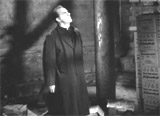
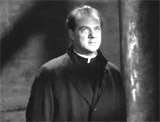
After the death of protesting longshoreman Kayo
Dugan (Pat Henning) who threatened to expose racketeering in
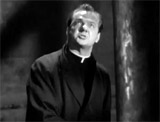
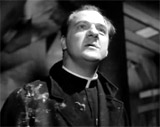
the waterfront Mob, crusading Father Barry (Karl Malden) preached
a "Sermon
on the Docks" in the hold of the ship at the scene of
the murder. He retaliated against apathy and keeping silent:
Some people think the Crucifixion only took
place on Calvary. They better wise up. Takin' Joey Doyle's
life to stop him from testifying is a crucifixion. And
droppin' a sling on Kayo Dugan because he was ready to
spill his guts tomorrow - that's a crucifixion! And every
time the mob puts the crusher on a good man, tries to stop
him from doing his duty as a citizen - it's a crucifixion.
And anybody who sits around and lets it happen, keeps silent
about something he knows has happened, shares the guilt
of it just as much as the Roman soldier who pierced the
flesh of Our Lord to see if He was dead.
Although some of the workers reacted with hostility
and yelled at him to go back to his church, Father Barry preached
that his church was anywhere that the longshoremen worked.
He also believed that the longshoremen were selling their souls
every day to the Mob. He tried to convince them to testify
against their corrupt employer, and he denounced the union
bosses who benefited off the labors and kickbacks of the workers:
Boys, this is my church! And if you don't
think Christ is down here on the waterfront, you've got
another guess coming!...Every morning when the hiring boss
blows his whistle, Jesus stands alongside you in the shape-up.
He sees why some of you get picked and some of you get
passed over. He sees the family men worrying about gettin'
the rent and gettin' food in the house for the wife and
the kids. He sees you sellin' your souls to the mob for
a day's pay....And what does Christ think of the easy-money
boys who do none of the work and take all of the gravy?
And how does he feel about the fellows who wear a hundred-and-fifty
dollar suits and diamond rings, on your union dues
and your kickback money? And how does He, who spoke
up without fear against every evil, feel about your silence?...
You want to know what's wrong with our waterfront?
It's the love of a lousy buck. It's makin' the love of the
lousy buck - the cushy job - more important than the love
of man! It's forgettin' that every fellow down here is your
brother in Christ! But remember, Christ is always with you
- Christ is in the shape up. He's in the hatch. He's in the
union hall. He's kneeling right here beside Dugan. And He's
sayin' with all of you, if you do it to the least of mine,
you do it to me! And what they did to Joey, and what they
did to Dugan, they're doin' to you. And you. You. ALL OF
YOU! And only you, only you with God's help, have the power
to knock 'em out for good.
|
|
|
|
On
the Waterfront (1954)
Screenwriter(s): Budd Schulberg
Taxi-Cab "I
Coulda Been a Contender"

Play clip (excerpt):
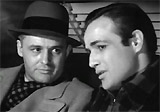
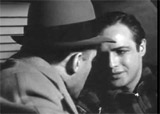
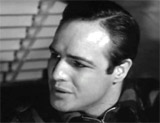
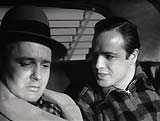
Disappointed longshoreman Terry Malloy (Marlon
Brando) spoke to his mobster brother Charley (Rod Steiger)
in the back seat of a taxi-cab. Charley told Terry that he
had heard a rumor that Terry might testify in court: "The
grapevine says that you got a subpoena." Charley advised
him to keep his mouth shut and not testify ("be a cheese-eater")
about what he knew about the corrupt union bosses - or else!
Terry was offered an easy loft job ("a boss loader slot...on
the new pier") worth up to $400 a week, promising: "You
don't do anything and you don't say anything." But Terry
was uncertain and agitated about the conditions, especially
when his brother threatened there would be serious consequences
- and even held a gun on him.
Terry faced up to the fact that he has made nothing
of his life - he blamed his brother instead of his manager
for his failings. Terry was reminded of how he was given "a
one-way ticket to Palookaville" in his boxing days when
he knew he had a winner inside himself, but was told
to lose in fixed fights. He realized that his brother betrayed
him and sold him out to Palookaville (a reference to a palooka,
an inferior or average boxer) for a quick profit, with these
words expressing his terrible loss:
It wasn't him, Charley! It was you. You
remember that night in the Garden, you came down to my
dressing room and said: 'Kid, this ain't your night. We're
going for the price on Wilson.' You remember that? 'This
ain't your night!' My night! I coulda taken Wilson apart!
So what happens? He gets the title shot outdoors in a ball
park - and whadda I get? A one-way ticket to Palookaville....
You was my brother, Charley. You shoulda looked
out for me a little bit. You shoulda taken care of me - just
a little bit - so I wouldn't have to take them dives for
the short-end money....You don't understand! I coulda had
class. I coulda been a contender. I coulda been somebody,
instead of a bum, which is what I am. Let's face it. (pause)
It was you, Charley.
|
|

|
Sabrina (1954)
Screenwriter(s): Billy Wilder, Samuel Taylor, Ernest Lehman
An
Introduction to the Chauffeur's Daughter and the Larrabees
- "This Was As Close to Heaven As One Could Get on Long
Island"
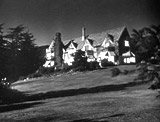
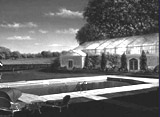
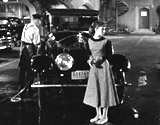
In the film's post-credits opening (in voice-over),
pretty chauffeur's daughter Sabrina (Audrey Hepburn) introduced
the grounds of the large Larrabee estate on Long Island, and
the many servants to take care of the lifestyle required:
Once upon a time, on the north shore of Long
Island, some 30 miles from New York, there lived a small
girl on a large estate. The estate was very large indeed
and had many servants. There were gardeners to take care
of the gardens, and a tree surgeon on a retainer. There
was a boatman to take care of the boats, to put them in
the water in the spring and scrape their bottoms in the
winter. There were specialists to take care of the grounds
-- the outdoor tennis court and the indoor tennis court,
the outdoor swimming pool and the indoor swimming pool.
And there was a man of no particular title who took care
of the small pool in the garden for a goldfish named George.
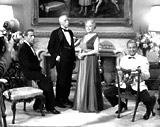
Also on the estate, there was a chauffeur by
the name of Fairchild, who had been imported from England
years ago. together with a new Rolls-Royce. Fairchild was
a fine chauffeur of considerable polish like the eight cars
in his care. And he had a daughter by the name of Sabrina.
It was the eve of the annual six-meter yacht
races, and, as had been tradition on Long Island for the
past 30 years, the Larrabees were giving a party. (Sabrina
spied on the party, climbing a tree for a better view)
It never rained on the night of the Larrabee party. The Larrabees
wouldn't have stood for it.
There were four Larrabees in all -- father,
mother and two sons. Maude and Oliver Larrabee were married
in 1906, and among their many wedding presents was the town
house in New York and this estate for weekends. The town
house has since been converted into Saks Fifth Avenue. Linus
Larrabee, the elder son, graduated from Yale, where his classmates
voted him the man most likely to leave his alma mater $50
million. His brother David went through several of the best
eastern colleges for short periods of time and through several
marriages for even shorter periods of time. He is now a successful
six-goal polo player, and is listed on Linus's tax return
as a $600 deduction.
Life was pleasant among the Larrabees, for
this was as close to heaven as one could get on Long Island.
|

|


 Best
Film Speeches and Monologues
Best
Film Speeches and Monologues