|
Best Film Speeches and Monologues
|
|
Title Screen
|
Film Title/Year and Description of Film Speech/Monologue |
Screenshots
|
|
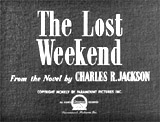
The Lost Weekend
(1945)
Screenwriter(s): Charles Brackett, Billy Wilder
 The
Empowering Benefits of Booze The
Empowering Benefits of Booze
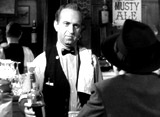
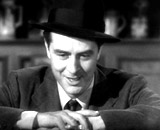
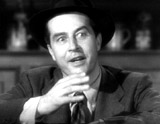
At 3:45 pm, alcoholic, NYC writer Don Birnam
(Ray Milland) was deluded about how drinking improved his mind,
spoken to bartender Nat (Howard da Silva) in his favorite Third
Avenue bar near 42nd Street:
I can't be cut off completely. That's the
devil. That's what drives you crazy...Come on, Nat. Join
me - one little jigger of dreams, huh?... It shrinks my
liver, doesn't it, Nat? It pickles my kidneys. Yes. But
what does it do to my mind? It tosses the sandbags overboard
so the balloon can soar. Suddenly, I'm above the ordinary.
I'm confident, supremely confident. I'm walking a tightrope
over Niagara Falls. I'm one of the great ones. I'm Michelangelo
molding the beard of Moses. I'm Van Gogh painting pure
sunlight. I'm Horowitz playing the Emperor Concerto. I'm
John Barrymore before the movies got him by the throat.
I'm Jesse James and his two brothers. All three of 'em.
I'm W. Shakespeare. And out there, it's not Third Avenue
any longer. It's the Nile, Nat - the Nile, and down it
floats the barge of Cleopatra. Come here.
'Purple the sails, and so perfumed that the
winds were lovesick with them: the oars were silver, which
to the tune of flutes kept stroke.'
Six rings or circles from the drink glasses portrayed
the passage of time - and the number of drinks he had consumed
that afternoon. Soon, there were twelve damp rings visible
- double the amount of drinks consumed from before. |
|
|
|
The Lost Weekend
(1945)
Screenwriter(s): Charles Brackett, Billy
Wilder
How
I Became An Alcoholic: Don the Drunk and Don the Writer
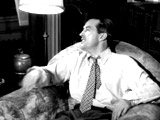
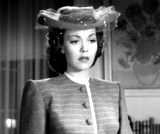
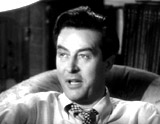
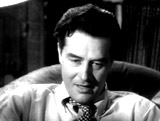
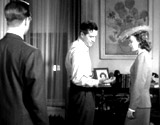
Later, in a flashback, drunkard Don Birnam (Ray
Milland) confessed his drinking problem to girlfriend Helen
St. James (Jane Wyman). He related how his authoring brilliance
as a Hemingway-like writer during his college years was soon
blocked and tarnished, declining after age nineteen with a
recourse to the bottle. He was helplessly schizophrenic, divided
between Don the Drunk and Don the Writer. As an aspiring writer,
he described the soaring, creative juices that flowed with
just a few drinks, and how he spiraled down into despair and
agony when the booze wore off. He began his recollections after
Helen asked: "What is it you wanna be so much that you're
not?"
A writer. Silly, isn't it? You know, in college,
I passed for a genius. They couldn't get out the college
magazine without one of my stories. Boy, was I hot! Hemingway
stuff. I reached my peak when I was nineteen. Sold a piece
to The Atlantic Monthly, reprinted in the Reader's
Digest. Who wants to stay in college when he's Hemingway?
My mother bought me a brand-new typewriter. And I moved
right in on New York. Well, the first thing I wrote, that
didn't quite come off. And the second, I dropped. The public
wasn't ready for that one. I started a third and a fourth.
Only by then, somebody began to look over my shoulder and
whisper in a thin, clear voice like the E string on a violin.
'Don Birnam,' he'd whisper, 'It's not good enough, not
that way. How about a couple of drinks just to set it on
its feet, huh?' So I had a couple.
Oh, what a great idea that was! That made all
the difference. Suddenly, I could see the whole thing. The
tragic sweep of the great novel beautifully proportioned.
But before I could really grab it and throw it down on paper,
the drinks would wear off and everything would be gone like
a mirage. Then there was despair, and I'd drink to counter-balance
despair. And then one to counter-balance the counter-balance.
And I'd sit in front of that typewriter trying to squeeze
out one page that was half-way decent. And that guy would
pop up again...
The other Don Birnam. There are two of us,
you know. Don the Drunk and Don the Writer. And the drunk
would say to the writer, 'Come on, you idiot. Let's get some
good out of that portable. Let's hock it. Let's take it to
that pawn shop over on Third Avenue. It's always good for
ten dollars. Another drink, another binge, another bender,
another spree.' Such humorous words. I've tried to break
away from that guy a lot of times, but no good. You know,
once I even got myself a gun and some bullets. I was gonna
do it on my thirtieth birthday. Here are the bullets. The
gun went for three quarts of whiskey. That other Don wanted
us to have a drink first. He always wants us to have
a drink first. The flop suicide of a flop writer.
Believing that he was a terminal drunk and a "zero" person
who lived off his brother Wick's (Phillip Terry) charity, 33
year-old Don challenged Helen to leave him ("Look Helen,
do yourself a favor. Go on, clear out"), but she lovingly
refused to admit that either of them were defeated: "I'm
gonna fight, and fight and fight..." |
|
|
The Naughty Nineties (1945)
Screenwriter(s): Edmund L. Hartmann, John Grant, Edmund Joseph, Hal
Fimberg
"Who's
On First?" Skit

Play clip (excerpt): 
Complete transcript
of Who's On First?
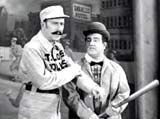
Although not technically a speech or monologue,
Abbott and Costello's radio routine 'Who's On First?' was
reprised in this film, in the roles of Dexter Broadhurst and
Sebastian Dinwiddle, and is considered one of the classic comedy
dialogues and sketches ever written. |
|
|
The Best
Years of Our Lives (1946)
Screenwriter(s): Robert E. Sherwood
A
Speech Arguing For the Redistribution of Wealth
in the Post-War Period
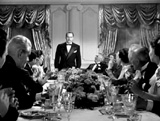
At an elegant welcome-home
banquet attended by stuffy bankers and their wives, returning
veteran Al Stephenson (Fredric March) was honored by bank
president Mr. Milton (Ray Collins) as "one
who has valiantly fought for that freedom" to have a "land
of unlimited opportunity for all."
Already soused,
Al delivered a wartime parable to rectify his generous loan-dealing
in front of his astonished, skeptical audience about how battles
and wars were not won by first demanding collateral from Uncle
Sam. He asked his associates to show more tolerance and acceptance
toward the less privileged veterans returning from the war, and
to not always seek collateral or guarantees for every risk
of expenditure:
I'm sure you'll all agree with me if I said
that now is the time for all of us to stop all this nonsense,
face facts, get down to brass tacks, forget about the war
and go fishing. But I'm not gonna say it. I'm just going
to sum the whole thing up in one word. [His wife Milly (Myrna
Loy) coughed loudly to caution him - worrying that he would
tell off the boss.] My wife doesn't think I'd better sum
it up in that one word. I want to tell you all that the reason
for my success as a Sergeant is due primarily to my previous
training in the Cornbelt Loan and Trust Company. The knowledge
I acquired in the good ol' bank I applied to my problems
in the infantry. For instance, one day in Okinawa, a Major
comes up to me and he says, 'Stephenson, you see that hill?'
'Yes sir, I see it.' 'All right,' he said. 'You and your
platoon will attack said hill and take it.' So I said to
the Major, 'but that operation involves considerable risk.
We haven't sufficient collateral.' 'I'm aware of that,' said
the Major, 'but the fact remains that there's the hill and
you are the guys that are going to take it.' So I said to
him, 'I'm sorry Major, no collateral, no hill.' So we didn't
take the hill and we lost the war.'
I think that little story
has considerable significance, but I've forgotten what it
is.
And now in conclusion, I'd like to tell you
a humorous anecdote. I know several humorous anecdotes, but
I can't think of any way to clean them up, so I'll only say
this much. I love the Cornbelt Loan and Trust Company. There
are some who say that the old bank is suffering from hardening
of the arteries and of the heart. I refuse to listen to such
radical talk. I say that our bank is alive, it's generous,
it's human, and we're going to have such a line of customers
seeking and getting
small loans that people will think we're gambling with the
depositors' money. And we will be. We will be gambling on the
future of this country. I thank you.
|
|
|
|
The Best
Years of Our Lives (1946)
Screenwriter(s): Robert E. Sherwood
Veteran's
Bedroom Admission of Helplessness
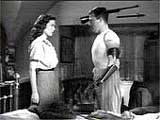
Disabled returning veteran Homer Parrish (Harold
Russell), with prosthetic hooks for hands, gave a touching
bedroom speech to his childhood sweetheart and fiancee Wilma
Cameron (Cathy O'Donnell):
This is when I know I'm helpless. My hands
are down there on the bed. I can't put them on again without
calling to somebody for help. I can't smoke a cigarette
or read a book. If that door should blow shut, I can't
open it and get out of this room. I'm as dependent as a
baby that doesn't know how to get anything except to cry
for it. Well, now you know, Wilma. Now you have an idea
of what it is. I guess you don't know what to say. It's
all right. Go on home. Go away like your family said.
|
|
|
The Big Sleep (1946)
Screenwriter(s): William Faulkner, Leigh Brackett, Jules Furthman
Sexy
Horse-Race Conversation
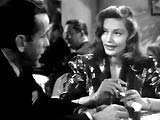
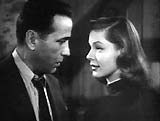
This was one of the most famous scenes of dialogue
in film history - noted for its sharp-edged wit, double entendres,
and sexual innuendo - a slyly flirtatious, sexy horse-race
conversation between detective Philip Marlowe (Humphrey Bogart)
and Vivian Rutledge (Lauren Bacall):
Vivian: "Well, speaking of horses,
I like to play them myself. But I like to see them work
out a little first, see if they're front-runners or come
from behind, find out what their whole card is. What makes
them run."
Marlowe: "Find out mine?"
Vivian: "I think so."
Marlowe: "Go ahead."
Vivian: "I'd say you don't like to be rated. You like
to get out in front, open up a lead, take a little breather
in the backstretch, and then come home free."
Marlowe: "You don't like to be rated yourself."
Vivian: "I haven't met anyone yet that can do it. Any
suggestions?"
Marlowe: "Well, I can't tell till I've seen you over
a distance of ground. You've got a touch of class, but, uh...I
don't know how - how far you can go."
Vivian: "A lot depends on who's in the saddle. Go ahead
Marlowe, I like the way you work. In case you don't know
it, you're doing all right."
Marlowe: "There's one thing I can't figure out."
Vivian: "What makes me run?"
Marlowe: "Uh-huh."
Vivian: "I'll give you a little hint. Sugar won't work.
It's been tried."
|
|
|
|
The Big Sleep (1946)
Screenwriter(s): William Faulkner, Leigh Brackett,
Jules Furthman
"Nothing
You Can't Fix"
In the final scene after everything has been
resolved and the police were being summoned, Marlowe and Vivian
were now together in the darkened parlor of Geiger's house
and waiting for the police's arrival. Vivian appraised the
situation and noticed that there was still some unfinished
business to take care of with Marlowe:
Vivian: "You've forgotten one thing.
Me."
Marlowe (pulling her to him): "What's wrong with you?"
Vivian: (with a smoldering glance) "Nothing you can't
fix."
|
|
|
Gilda
(1946)
Screenwriter(s): Marion Parsonnet, Ben Hecht (uncredited)
"The
Most Curious Love-Hate Pattern I've Ever Had the Pleasure
of Witnessing"
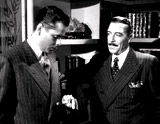
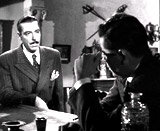
Police inspector Maurice Obregon (Joseph Calleia),
who had been scrutinizing the South American casino's underlying
criminal activities and trailing Ballin Mundson (George Macready)
and Johnny Farrell (Glenn Ford) throughout the entire film,
had still not closed down the casino ("a smart cop doesn't
arrest the purse snatcher if the little thief will lead him
to the bigger crime").
We know you're the head of a tungsten monopoly,
Mr. Farrell. What we want to know is the names of the participants...I'll
wait. You're breaking up in little pieces right in front
of my eyes, you know. Am I wearing you down, I hope?...Something
is.
They were distracted by Gilda's (Rita Hayworth)
bawdy, sexy casino performance/glove striptease while singing
the torchy, defiant number "Put the Blame on Mame, Boys" -
after which Johnny struck Gilda across the face. Obregon again
met with Johnny, after arresting one of the agents of the Nazi-controlled
cartel:
The German has been arrested. He will give
us the information we want. Now, all we want from you are
the patents and the agreements bearing the signatures.
Let me tell you why we must know who these signers are,
Mr. Farrell. So they can be prosecuted legally for breaking
the anti-trust laws. You didn't hear a word of it, did
you? All you can think of is the way Gilda looked at you
when you struck her, isn't it? You two kids love each other
pretty terribly, don't you?.
Johnny responded with three words against his
hateful wife Gilda: "I hate her." Obregon continued his
assessment:
That's what I mean. It's the most curious
love-hate pattern I've ever had the privilege of witnessing.
And as long as you're as sick in the head as you are about
her, you're not able to think about anything clearly. All
right, Mr. Farrell. You're under arrest for illegally operating
a gambling casino. I'm gonna let you stay here under protective
custody. Send for me when you can't stand it anymore. I
intend to have those signatures. I can out-wait you, Mr.
Farrell. You see, I have the law on my side. It's a very
comfortable feeling. It's something you ought to try sometime.
|
|
|
It's
a Wonderful Life (1946)
Screenwriter(s): Frances Goodrich, Albert Hackett, Frank Capra
Words
to Cruel Mr. Potter at the Loan Board In Defense of Deceased
Father
Play clip (excerpt):
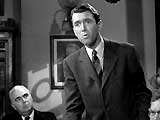
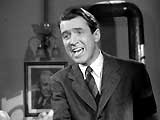
Representing Bedford Falls' Bailey Savings and
Loan, George Bailey (James Stewart) defended his dead father's
name (called "a starry-eyed dreamer") to the tyrannical,
miserly and cruel Mr. Potter (Lionel Barrymore) in an address
before the Loan Board:
...Just a minute - just, just a minute.
Now, hold on, Mr. Potter. Just a minute. Now, you're
right when you say my father was no business man. I know
that. Why he ever started this cheap, penny-ante Building
and Loan, I'll never know. But, neither you nor anybody
else can say anything against his character, because his
whole life was... Why, in the twenty-five years since he
and Uncle Billy started this thing, he never once thought
of himself. Isn't that right, Uncle Billy? He didn't save
enough money to send Harry to school, let alone me. But
he did help a few people get out of your slums, Mr. Potter.
And what's wrong with that? Why -- here, you're all businessmen
here. Don't it make them better citizens? Doesn't it make
them better customers? You, you said that they - What'd
you say just a minute ago? They had to wait and save their
money before they even thought of a decent home. Wait?
Wait for what?! Until their children grow up and leave
them? Until they're so old and broken-down that... You
know how long it takes a workin' man to save five thousand
dollars?
Just remember this, Mr. Potter, that this rabble
you're talking about, they do most of the working and paying
and living and dying in this community. Well, is it too much
to have them work and pay and live and die in a couple of
decent rooms and a bath? Anyway, my father didn't think so.
People were human beings to him, but to you, a warped, frustrated
old man, they're cattle. Well, in my book he died a much
richer man than you'll ever be... I know very well what you're
talking about. You're talking about something you can't get
your fingers on, and it's galling you. That's what you're
talking about, I know. Well, I've - I've said too much. I
-- you're the Board here. You do what you want with this
thing. There's just one thing more, though. This town needs
this measly one-horse institution if only to have some place
where people can come without crawling to Potter.
|
|
|
|
It's
a Wonderful Life (1946)
Screenwriter(s): Frances Goodrich, Albert
Hackett, Frank Capra
Plea
to Investors of the Bailey Building and Loan Society: "We've
Got to Stick Together"
Play clip (excerpt):
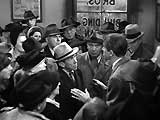
George Bailey (James Stewart) also pled to the
worried investors at Bailey Saving and Loan threatening a bank
run:
Rand...no, Randall, wait. Now wait. Now
listen, now listen to me. I-I beg of ya not to do this
thing. If Potter gets ahold of this Building and Loan,
there'll never be another decent house built in this town.
He's already got charge of the bank. He's got the bus line.
He got the department stores, and now he's after us. Why?
Well, it's very simple. Because we're cuttin' in on his
business, that's why. And because he wants to keep you
livin' in his slums and payin' the kind of rent he decides.
Joe, you had one of those Potter houses, didn't
you? Well, have you forgotten? Have you forgotten what he
charged you for that broken-down shack? Here, Ed. You know,
you remember last year when things weren't going so well,
and you couldn't make your payments. Well, you didn't lose
your house, did ya? You think Potter would have let you keep
it?
Can't, can't you understand what's happening
here? Don't you see what's happening? Potter isn't selling.
Potter's buying! And why? Because we're panicky and he's
not. That's why. He's pickin' up some bargains. Now, we-we
can get through this thing all right. We've, we've got to
stick together, though. We've got to have faith in each other!
|
|
|
The Yearling (1946)
Screenwriter(s): Paul Osborn, Marjorie Kinnan Rawlings, John
Lee Mahin
A
Funeral Eulogy For a Young Boy
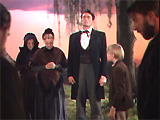
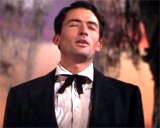
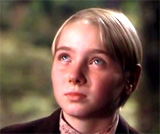
Young 11 year-old Jody's (Claude
Jarman, Jr.) father Ezra "Penny" Baxter (Gregory
Peck) delivered a moving eulogy at the burial site for Jody's
crippled neighbor friend Fodderwing (Donn Gift) who had died suddenly
and unexpectedly. Penny specifically mentioned Fodderwing's kind
treatment of wild creatures, and said that in the Lord's House,
Fodderwing would be healed of his crippling ailment:
"O Lord, Almighty God, it ain't
for us ignorant mortals to say what's right and what's wrong.
If it was any one of us to be doin' it, we'd not have made
this poor boy into a cripple. But, Lord, in a way of speaking,
you made it up to him. You give him a way with the wild critters.
You give him a sort of wisdom, made him knowin' and gentle.
And now you've seen fit to take him where being crookedy
in mind or limb don't matter. But, Lord, it pleasures us
to think now you've straightened out them legs. It pleasures
us to think on him walkin' around as easy as anyone. And,
Lord, give him a few redbirds and maybe a squirrel or a coon
to keep him company like he had here. All of us is somehow
lonesome, and we know he'll not be lonesome do he have them
little wild things around him, if it ain't askin' too much
to put a few varmints in heaven. Thy will be done. Amen."
At the conclusion of the eulogy, Jody looked
skyward toward Heaven. |
|
|
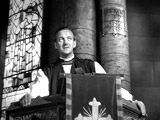
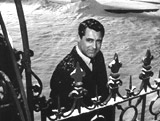
The Bishop's Wife (1947)
Screenwriter(s): Robert E. Sherwood, Leonardo Bercovici
A
Guardian Angel's Profound Yet Simple Rewritten Christmas Sermon
("The Empty Stocking") - Delivered By a Transformed
Episcopalian Bishop
Play clip (excerpt):
After praying for "guidance," Episcopalian Bishop
Henry Brougham (David Niven) received divine help in the
form of a handsome, suave guardian angel named Dudley (Cary Grant).
But Dudley was not there to assist with the Bishop's building
and funding of a new cathedral, but to show Henry what he had
been neglecting in life -- the poor and needy, the boys' choir,
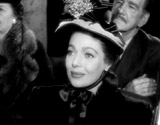
his parishioners and most noticeably, his lovely wife Julia (Loretta
Young), who had the incredible gift, according to Dudley of
"making heaven here on Earth."
Dudley rewrote
Henry's Christmas sermon, dictating while the typewriter took
down his words. When Henry finally publically announced
the importance of Julia in his life to Dudley ("Julia means more
to me than my life, I'm not going to lose her"), the angel promptly
announced his departure. The angel told Henry that he and everyone
else would have no memory of his visit or existence ("When I'm
gone, you will never know that an angel visited your house").
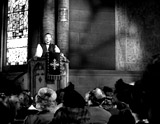
At St. Timothy's Church, the Bishop delivered Dudley's
sermon on Christmas Eve at midnight, while Julia beamed at him
from the pews. From the street outside under a light falling
snow, Dudley listened to the poignant and touching words, satisfied
that his work was complete as he turned and slowly walked away
- bringing the film to a heartfelt close:
Tonight I want to tell you the story of an empty stocking.
Once upon a midnight clear, there was a child's cry. A blazing
star hung over a stable, and wise men came with birthday gifts.
We haven't forgotten that night down the centuries. We
celebrate it with stars on Christmas trees with the sound
of bells, and with gifts. But especially with gifts.
You give me a book, I give you a
tie. Aunt Martha has always wanted an orange squeezer and Uncle
Henry could do with a new pipe. For we forget nobody, adult or
child. All the stockings are filled, all that is, except one.
And we have even forgotten to hang it up. The stocking for
the child born in a manger. It's his birthday we're celebrating.
Don't let us ever forget that.
Let us ask ourselves what He would wish for most. And then,
let each put in his share: loving kindness, warm hearts, and
a stretched-out hand of tolerance - all the shining gifts that
make peace on Earth.
|
|
|
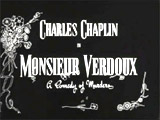
Monsieur Verdoux (1947)
Screenwriter: Charlie Chaplin
Hypocritical
Society Regarding Mass Murder
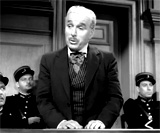
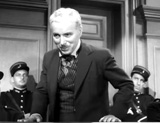
The final courtroom speech by convicted bigamist
serial killer Monsieur Verdoux (Charlie Chaplin) - a response
to the Judge and Prosecutor after being convicted and found
guilty in a trial. He explained how society was hypocritical
and argued that world wars, dictators, and mass genocidal killings
were sanctioned by society and other countries, but his own
crime of killing only a few out of necessity (in order to survive)
brought about a sentence of death by guillotine:
However remiss the prosecutor has been in
complimenting me, he at least admits that I have brains.
Thank you, Monsieur, I have. And for thirty-five years
I used them honestly. After that, nobody wanted them. So
I was forced to go into business for myself. As for being
a mass killer, does not the world encourage it? Is it not
building weapons of destruction for the sole purpose of
mass killing? Has it not blown unsuspecting women and little
children to pieces? And done it very scientifically? As
a mass killer, I am an amateur by comparison. However,
I do not wish to lose my temper, because very shortly,
I shall lose my head. Nevertheless, upon leaving this spark
of earthly existence, I have this to say: I shall see you
all... very soon... very soon.
|
|

 Best
Film Speeches and Monologues
Best
Film Speeches and Monologues