|
Best Film Speeches and Monologues
|
|
Title Screen
|
Film Title/Year and Description of Film Speech/Monologue |
Screenshots
|
|
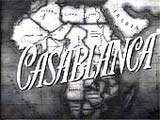
Casablanca
(1942)
Screenwriter(s): Julius J. Epstein, Philip G. Epstein, Howard Koch
 Airport
Farewell Airport
Farewell
Play clip (excerpt): 
Play clip (excerpt):
Play clip (excerpt):
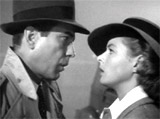
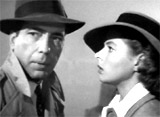
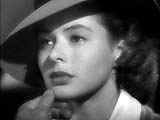
Casablanca cafe owner Rick Blaine (Humphrey Bogart)
sacrificed himself with a
"We'll always have Paris" and "No good at being
Noble"
airport farewell speech to ex-lover Ilsa Lund (Ingrid Bergman):
Rick: Because you're getting on that plane.
(Ilsa: "I don't understand. What about you?")
Rick: I'm staying here with him [Renault] 'til the plane
gets safely away.
(Ilsa: "No, Richard. No. What has happened to you? Last
night...")
Rick: Last night, we said a great many things. You said I
was to do the thinking for both of us. Well, I've done a
lot of it since then and it all adds up to one thing. You're
getting on that plane with Victor where you belong.
(Ilsa: "But Richard, no, I've...")
Rick: Now, you've got to listen to me. Do you have any idea
what you've have to look forward to if you stayed here? Nine
chances out of ten, we'd both wind up in a concentration
camp. Isn't that true, Louis?
(Renault: "I'm afraid Major Strasser would insist.")
(Ilsa: "You're saying this only to make me go.")
Rick: I'm saying it because it's true. Inside of us, we both
know you belong with Victor. You're part of his work, the
thing that keeps him going. If that plane leaves the ground
and you're not with him, you'll regret it. Maybe not today,
and maybe not tomorrow, but soon, and for the rest of your
life.
(Ilsa: "What about us?")
Rick: We'll always have Paris. We didn't have - we'd - we'd
lost it until you came to Casablanca. We got it back last
night.
(Ilsa: "When I said I would never leave you..")
Rick: And you never will. I've got a job to do too. Where
I'm going, you can't follow. What I've got to do, you can't
be any part of. Ilsa, I'm no good at being noble, but it
doesn't take much to see that the problems of three little
people don't amount to a hill of beans in this crazy world.
Someday you'll understand that. Now, now. Here's looking
at you, kid.
|
|
|
The
Magnificent Ambersons (1942)
Screenwriter(s): Orson Welles
"The
Magnificence of the Ambersons"
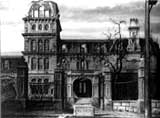
An opening monologue narrated by Orson Welles:
The magnificence of the Ambersons began
in 1873. Their splendor lasted throughout all the years
that saw their Midland town spread and darken into a city.
In that town in those days, all the women who wore silk
or velvet knew all the other women who wore silk or velvet
and everybody knew everybody else's family horse and carriage.
The only public conveyance was the streetcar. A lady could
whistle to it from an upstairs window, and the car would
halt at once, and wait for her, while she shut the window
... put on her hat and coat ... went downstairs... found
an umbrella... told the 'girl' what to have for dinner...and
came forth from the house. Too slow for us nowadays, because
the faster we're carried, the less time we have to spare.
|
|
|
|
The
Magnificent Ambersons (1942)
Screenwriter(s): Orson Welles
The
Source of Everything
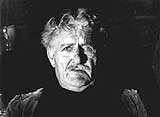
In a rambling, incoherent speech (from Booth
Tarkington's original novel), old Major Amberson (Richard Bennett)
disjointedly mused on the source of life:
It must be in the sun. There wasn't anything
here but the sun in the first place...The Earth came out
o' the sun, and we came out of the Earth. So whatever we
are...
When the light faded, his voice grew silent,
the screen turned slowly to black, and his life ended. |
|
|
Mrs. Miniver (1942)
Screenwriter(s): Arthur Wimperis, George Froeschel, James Hilton,
Claudine West
Vicar's
Patriotic "It is Our War" Speech
Play clip (excerpt): (short)
Play clip (excerpt): (long)
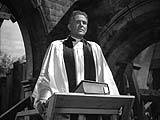
The vicar (Henry Wilcoxon) gave a moving speech
in a bombed out English church, before the congregation sang Onward
Christian Soldiers:
We, in this quiet corner of England, have
suffered the loss of friends very dear to us. Some close
to this church. George West, choir boy; James Ballard,
station master and bell ringer and the proud winner, only
an hour before his death, of the Beldon Cup for his beautiful
Miniver rose. And our hearts go out in sympathy for the
two families who share the cruel loss of a young girl who
was married at this altar only two weeks ago. The homes
of many of us have been destroyed, and the lives of young
and old have been taken. There is scarcely a household
that hasn't been struck to the heart. And why? Surely you
must have asked yourselves this question. Why, in all conscience,
should these be the ones to suffer? Children, old people,
a young girl at the height of her loveliness. Why these?
Are these our soldiers? Are these our fighters? Why should
they be sacrificed? I shall tell you why.
Because this is not only a war of soldiers
in uniform. It is a war of the people, of all the
people, and it must be fought not only on the battlefield,
but in the cities and in the villages, in the factories and
on the farms, in the home, and in the heart of every man,
woman, and child who loves freedom! Well, we have buried
our dead, but we shall not forget them. Instead, they will
inspire us with an unbreakable determination to free ourselves
and those who come after us from the tyranny and terror that
threaten to strike us down. This is the people's war! It
is our war! We are the fighters! Fight it then! Fight it
with all that is in us, and may God defend the right!
|
|
|
Now, Voyager (1942)
Screenwriter(s): Casey Robinson
Inhibitions
About Getting Married - "I Don't Think I'll Ever Marry"
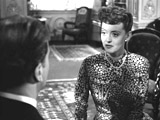
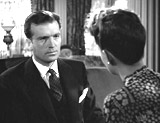
Charlotte Vale (Bette Davis) was being courted
by attractive widower Elliot Livingston (John Loder), but
remained uncertain and indecisive about committing to him.
Her only reason for marrying him would be to have a husband,
a home, and a child - fulfilling her role as a mature, married
woman. She identified more with a woman in one of the forbidden
'novels' that she had once read - with a tale that echoed her
overnight experience with her real lover, Jerry Durrance (Paul
Henreid) in Rio:
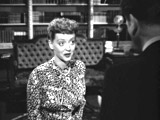
You know what I'd like? I'd like you to take
me to some Bohemian restaurant for dinner some night, where
we can be very gay, have cocktails and champagne. And you
could make love to me...(she stood up and moved to another
chair) Well, what I mean is, if I could just get rid
of some of my inhibitions just for once, I might have more
confidence....
I read a novel once about a woman, a very repressed
woman. She was in an automobile accident with a man. It was
a very cold night. He gave her a drink to keep her warm.
And because of the drink, she lost her inhibitions. You see,
she was just... I'm afraid I sound very depraved.
She realistically broke off her short-lived engagement
with Elliot, realizing that she could only be happy with someone
she was passionately in love with:
You ought to marry someone who would enjoy
what you enjoy. Let's not linger over it, Elliot. (Elliot: "Well,
I-I suppose you'll meet somebody sometime.") No, I
don't think I'll ever marry. Some women just aren't the
marrying kind. But you'll meet someone. Thank you for thinking
it was me. I have that on my record anyway.
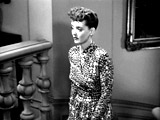
After she courteously said goodbye to him, to
her inner self, in voice-over, she lamented the loss of a marriage
prospect as she climbed her stairs: "It's like the time
when my father died. His breathing just stopped. All over.
Finished. Ended forever. You fool, oh you fool! Now you'll
never have a home of your own, or a man of your own, or a child
of your own." |
|
|
The Pride of the Yankees (1942)
Screenwriter(s): Jo Swerling, Herman J. Mankiewicz
Lou
Gehrig's "Luckiest Man" Farewell Address to Baseball

Play clip (excerpt):
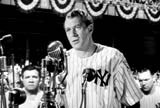
Dying ball player Lou Gehrig (Gary Cooper) delivered
a farewell speech in the New York Yankees baseball stadium
to 62,000 fans:
I have been walking on ballfields for 16
years, and I've never received anything but kindness and
encouragement from you fans. I have had the great honor
to have played with these great veteran ballplayers on
my left - Murderers Row, our championship team of 1927.
I have had the further honor of living with and playing
with these men on my right - the Bronx Bombers, the Yankees
of today. I have been given fame and undeserved praise
by the boys up there behind the wire in the press box -
my friends, the sports writers. I have worked under the
two greatest managers of all time, Miller Huggins and Joe
McCarthy. I have a mother and father who fought to give
me health and a solid background in my youth. I have a
wife, a companion for life, who has shown me more courage
than I ever knew. People all say that I've had a bad break.
But today - today I consider myself the luckiest man on
the face of the earth. (Applause)
|
|
|
Saboteur (1942)
Screenwriter(s): Peter Viertel, Joan Harrison, Dorothy
Parker, and Alfred Hitchcock (uncredited)
Defending
Against Fifth-Column Saboteurs Ready to Destroy America
Wrongly-accused, on the run, Los Angeles-based
aircraft factory worker Barry Kane (Robert Cummings) dared
to confront fifth columnists, led by wealthy mastermind Charles
Tobin (Otto Kruger) who were planning to destroy and disrupt
various American institutions through sabotage, including Hoover
(Boulder) Dam, a naval ship in the Brooklyn Naval Yard, and
others.
Face-to-face with the slimy, fascist ringleader
Tobin, Kane attempted to prove his innocence, argue for democracy,
and fight for freedom. He showed his reluctance to be anti-American
and to bow to saboteurs, their fear-mongering tactics, and
terrorist murders. He explained how he had met decent Americans
who helped him along the way - a friendly truck driver, a blind
composer, a band of "freak" circus performers, and a blonde
model - compared to the corrupt elitists or law officers:
Tobin: "You can't afford to make yourself
that vulnerable, not when you're out trying to save your
country."
Kane: "Why is it that you sneer
every time you refer to this country? You've done pretty
well here, I don't get it."
Tobin: "No, you wouldn't. You're one of the ardent
believers - a good American. Oh, there are millions like you.
People that plod along, without asking questions. I hate to
use the word stupid, but it seems to be the only one that applies.
The great masses, the moron millions. Well, there are a few
of us who are unwilling to just troop along, a few of us who
are clever enough to see that there's much more to be done
than just live small complacent lives, a few of us in America
who desire a more profitable type of government. When you think
about it, Mr. Kane, the competence of totalitarian nations
is much higher than ours. They get things done."
Kane: "Yeah.
They get things done. They bomb cities, sink ships, torture
and murder so you and your friends can eat off a gold plate;
it’s
a great philosophy."
Tobin: "I neither intend
to be bombed nor sunk, Mr. Kane. That’s why I’m
leaving now. And if things don’t arrive for you, if,
uh, we should win, then I’ll come back. Perhaps I can
get what I want then: Power. Yes. I want that as much as you
want your comfort, or your job, or that girl. We all have different
tastes, as you can see. Only I'm willing to back my tastes
with the necessary force."
Kane: "You certainly make it sound smooth and easy. Well,
that's a trick. I know the results of that power you believe
in. It killed my friend, and it's killing thousands like him.
That's what you're aiming at. But it doesn't bother you, I can
see that. Because you really hate all people. Let me tell you
something. The last four or five days, I've learned a lot. I've
met guys like you, and I've met others - people that are helpful
and eager to do the right thing; people that get a kick out of
helping each other fight the bad guys. Love and hate. The world's
choosing up sides. I know who I'm with. There are a lot of people
on my side - millions of us in every country. And we're not soft;
we're plenty strong. And we'll fight standing up on our two feet,
and we'll win. Remember that, Mr Tobin. We'll win, no matter
what you guys do. We'll win if it takes from now until the cows
come home."
|
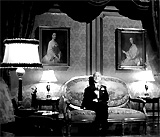
Tobin's Allegiance to Terrorism
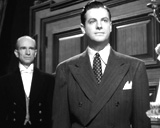
Kane's Reluctance To Bow to Saboteurs
|
|
The Talk of
the Town (1942)
Screenwriter(s): Irwin Shaw, Sidney Buchman
Defense
of Wrongly-Accused Man and the Law
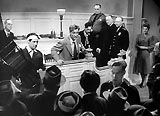
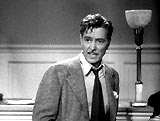
Supreme Court nominee Professor Michael Lightcap
(Ronald Colman) bravely defended wrongly accused fugitive-arsonist
Leopold Dilg (Cary Grant) from an angry mob in the front of
a courtroom:
His (Dilg's) only crime was that he had courage
and spoke his mind...This is your law and your finest possession.
It makes you free men in a free country. Why have you come
here to destroy it? If you know what's good for you, take
those weapons home and burn them - and then think. Think
of this country and of the law that makes it what it is.
Think of a world crying for this very law. Then maybe you'll
understand why you ought to guard it, and why the law has
got to be the personal concern of every citizen, to uphold
it for your neighbor as well as for yourself. Violence
against it is one mistake.
Another mistake is for any man to look upon
the law as just a set of principles. Just so much language
printed on fine, heavy paper. Something he recites and then
leans back and takes it for granted that justice is automatically
being done. Both kinds of men are equally wrong. The law
must be engraved in our hearts and practiced every minute,
to the letter and spirit. It can't even exist unless we're
willing to go down into the dust and blood and fight a battle
every day of our lives to preserve it, for our neighbor as
well as ourselves.
|
|
|
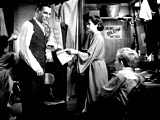
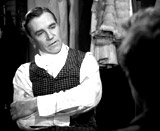
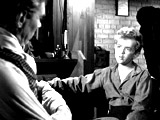
Yankee Doodle Dandy
(1942)
Screenwriter(s): Robert Buckner, Edmund Joseph
Separating
Fact From Fiction on the Stage - A Lesson on Self-Conceit
As a young boy in the performing Cohan family,
young, precocious, and cocky George (Douglas Croft at age 13)
was the star performer as Henry in 'Peck's Bad Boy' - A Rolicking
Comedy." In the play, mischievous Henry pelted grocer
Schults (Harry Jones) and an Irish cop (Roy T. Locket) with
eggs in a slapstick scene. Adults in the orchestra seats and
tough kids in the balcony were amused. The store owner was
paid off by Henry's wealthy father, and Henry was coerced to
promise that he'd be a good boy, yet he vowed: "I can
still lick any kid in town" - causing the kids in the
balcony area to scoff.
After the last curtain for the show, Georgie
was congratulated by backstage crew and other actors, and the
egotistical, big-headed lad boasted about how he had upstaged
his father: "Thanks, but what are you all so surprised
about? You could've told during rehearsals that I'd be a sensation
in this part. Listen, there's nothing to this acting business.
I wonder what took me so long to become a star."
At a backstage door, young Georgie was surprised
by townie kids from the theater gallery hurling objects at
him and scuffling with him in a fistfight. "Let's see
how tough he is!" they shouted. After he was rescued,
George was administered first aid by his mother Nellie (Rosemary
DeCamp) and his sister Josie (Patsy Lee Parsons at age 12)
- he was "almost murdered in cold blood." His father
Jerry (Walter Huston) calmly mentioned:
Well, the way I figure it, it's a fine tribute
to Georgie's acting. The way he plays the part, every tough
kid in America will want to take a punch at Peck's Bad
Boy, just to see what happens.
When Georgie responded: "What! Have
I gotta go through that every night?", his father
saw an opportunity to deliver a lesson to his head-strong son
about conceit and arrogance, and George finally promised to
reform himself:
Yes. And matinees, Wednesdays and Saturdays.
Georgie, those boys did you a great favor and they saved
me a lot of trouble. You know, most actors give their whole
lives to their profession without once scoring a hit. You're
lucky. You're a hit at the age of 13. I've been in this
business a long time, and I've never met a performer who,
in the long run, wouldn't rather be a great guy than a
great actor. That is, until I made your acquaintance.
(Georgie: "Can't I be both?")
The chances are, the way you're going, you won't be either.
If the hoodlums don't get you, a committee of actors will!
Actors are considered a very bad risk by insurance companies.
And any actor with a conceit like yours - well, we just couldn't
afford the premium.
|
|

 Best
Film Speeches and Monologues
Best
Film Speeches and Monologues