|
Best Film Speeches and Monologues
|
|
Title Screen
|
Film Title/Year and Description of Film Speech/Monologue |
Screenshots
|
|
Carefree (1938)
Screenwriter(s): Allan Scott, Ernest Pagano
 Psychoanalysis
Is "The One Way" of Finding Out What We Want and
Why! Psychoanalysis
Is "The One Way" of Finding Out What We Want and
Why!
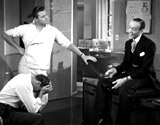
Psychiatrist Dr. Tony Flagg (Fred Astaire) recommended
that his drunken friend Stephen Arden's (Ralph Bellamy) fiancee
Amanda Cooper (Ginger Rogers) seek psychoanalysis like he did
for the positive and life-changing experience. Amanda had just
broken her engagement with him for the third time, and Steve
wanted her to change her mind, although Tony advised about
straightening her out: "Sorry, Steve, I'm no marriage
broker...to me, she's just another maladjusted woman":
Perhaps she's merely trying to escape reality...In
this case, you!...We all try to escape reality. We all
wanna be something entirely different than we really are.
When I was a kid, I wanted to be a fireman...Do you remember
in college how stage-struck I was? I wanted to be a dancer.
Psychoanalysis showed me I was wrong. It's the one way
of finding out what we really want and why we want it.
|
|
|
Holiday (1938)
Screenwriter(s): Donald Ogden Stewart, Sidney Buchman
Why
Be a Drunk
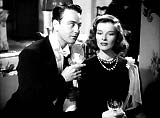
Sweet-tempered Edward 'Ned' Seton (Lew Ayres)
explained to his eccentric sister Linda (Katharine Hepburn)
about why he was a drunk alcoholic:
...Well, to begin with, it brings you to
life. And after a while, you begin to know all about it.
You feel...I don't know...important. (Linda:
"That must be good.") It is. And then pretty soon,
the game starts...A swell game. A terribly exciting game.
You see, you think clear and crystal, but every move, every
sentence is a problem. That gets pretty interesting. (Linda:
"You get beaten though, don't you?") Sure, but
that's good, too. Then you don't mind anything, not anything
at all. Then you sleep. A long while, as long as you last...
(Linda:
"Where do you end up?") Where does anybody end
up? You die. And that's all right, too...
|
|
|
Dark Victory
(1939)
Screenwriter(s): Casey Robinson
Last
Dying Words
Dying Judith Traherne (Bette Davis) comforted
her best friend Ann King (Geraldine Fitzgerald):
Don't, Ann. I'm happy, really I am. Now
let me see, is there anything else? Oh yes, one more thing.
When Michael runs Challenger in the National, oh, and he'll
win - I'm sure he'll win - have a party and invite all
our friends. Now let me see, silly old Alec, if he's back
from Europe, Colonel Mantle and old Carrie and, oh yes,
and don't forget dear old Dr. Parsons. Give them champagne
and be gay. Be very very gay. I must go in now. Ann, please
understand, no one must be here, no one - I must show him
I can do it alone. Perhaps it will help him over some bad
moments to remember it. Ann, be my best friend. Go now.
Please.
She then told her maid Martha to leave her to
die in peace alone - with dignity, as she went upstairs to
her death:
Is that you, Martha? I don't want to be
disturbed.
|
|
|
Gone With
the Wind (1939)
Screenwriter(s): Sidney Howard
"I
Love You - Because We're Alike...Kiss Me Once"
Play clip (excerpt): 
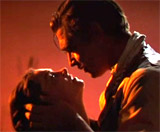
After fleeing a burned down Atlanta, Rhett Butler
(Clark Gable) proposed that he would desert Scarlett (Vivien
Leigh) and leave her abandoned in the open country at the road
which turned toward Tara. He appeared amused when suggesting
that he would leave her and enlist in the beaten and broken
Confederate Army. Scarlett didn't take him seriously, thinking
only of her own predicament. Rhett knew her nature: "Selfish
to the end, aren't you? Thinking only of your own precious
hide with never a thought for the noble Cause..." He insisted
that as a southerner, he had a weakness for lost causes: "I've
always had a weakness for lost causes once they're really lost." In
total disbelief, she didn't think that he could leave her in
a helpless state: "You should die of shame to leave
me here alone and helpless," but he laughed: "You
helpless? Heaven help the Yankees if they capture you."
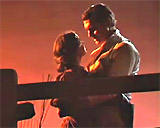
With his arms around her, long-time suitor Rhett
wanted to give her a proper goodbye. She begged that he stay:
"Oh Rhett, please don't go. You can't leave me, please!
I'll never forgive you." Re-enacting the scene of a sweetheart
kissing a soldier goodbye as he returned to the war, he realistically
proposed that if she yielded to his love, he'd stay with her
- but she returned his vow of love with a violent slap:
I’m not asking you to forgive me. I’ll
never understand or forgive myself. And if a bullet gets
me, so help me, I’ll laugh at myself for being an
idiot. There's one thing I do know, and that is
that I love you, Scarlett. In spite of you and me and the
whole silly world going to pieces around us, I love you.
Because we're alike - bad lots both of us, selfish and
shrewd, but able to look things in the eyes and call them
by their right names...
Scarlett, look at me. I've loved you more than
I've ever loved any woman. I've waited longer for you than
I've ever waited for any woman....Here's a soldier of the
South who loves you, Scarlett, wants to feel your arms around
him, wants to carry the memory of your kisses into battle
with him. Never mind about loving me. You're a woman sending
a soldier to his death with a beautiful memory. Scarlett,
kiss me. Kiss me, once.
|
|
|
|
Gone With
the Wind (1939)
Screenwriter(s): Sidney Howard
"I'll
Never Be Hungry Again!"
Play clip (excerpt):
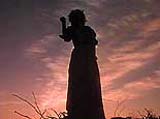
In one of the most famous, iconic speeches in
film history, Scarlett O'Hara (Vivien Leigh) made her defiant
vow to survive, silhouetted against a sunset:
As God is my witness, as God is my witness,
they're not going to lick me! I'm going to live through
this, and when it's all over, I'll never be hungry again
- no, nor any of my folks! If I have to lie, steal, cheat,
or kill, as God is my witness, I'll never be hungry again.
|
|
|
|
Gone With
the Wind (1939)
Screenwriter(s): Sidney Howard
"Tomorrow
Is Another Day!"
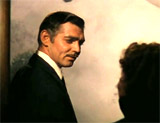
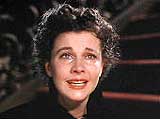
In the film's concluding monologue, Scarlett
reacted to Rhett Butler's (Clark Gable) dismissive departure: "Frankly,
my dear, I don't give a damn."
After she begged him to stay, she was reminded
by voices of Tara's power:
I can't let him go. I can't. There must
be some way to bring him back. Oh I can't think about this
now! I'll go crazy if I do! I'll think about it tomorrow.
But I must think about it. I must think about it. What
is there to do? What is there that matters?... Tara!...Home.
I'll go home, and I'll think of some way to get him back!
After all, tomorrow is another day!
|
|
|
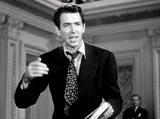
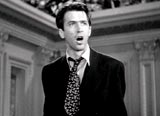
Mr. Smith
Goes to Washington (1939)
Screenwriter(s): Sidney Buchman
Senate
Filibuster Speech (part 1)

Play clip (excerpt):
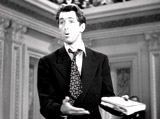
Idealistic Senator Jefferson Smith (James Stewart)
began his lengthy filibuster speech, including home-spun insight
on democratic ideals after reading from the Declaration of
Independence (partially to stall for time):
'We hold these truths to be self-evident,
that all men are created equal, that they are endowed by
their Creator with certain unalienable rights - that among
these are life, liberty, and the pursuit of Happiness....that
to secure these rights, Governments are instituted among
Men, deriving their just powers from the consent of the
governed, that whenever any form of government becomes
destructive to these ends, it is the right of the People
to alter or to abolish......'
I always get a great kick outta that part
of the Declaration of Independence. Now, you're not gonna
have a country that can make these kind of rules work, if
you haven't got men that have learned to tell human rights
from a punch in the nose. (The Gallery applauded)
It's a funny thing about men, you know. They
all start life being boys. I wouldn't be a bit surprised
if some of these Senators were boys once. And that's why
it seemed like a pretty good idea to me to get boys out of
crowded cities and stuffy basements for a couple of months
out of the year and build their bodies and minds for a man-sized
job, because those boys are gonna be behind these desks some
of these days. And it seemed like a pretty good idea, getting
boys from all over the country, boys of all nationalities
and ways of living -- getting them together. Let them find
out what makes different people tick the way they do. Because
I wouldn't give you two cents for all your fancy rules if,
behind them, they didn't have a little bit of plain, ordinary,
everyday kindness and a little lookin' out for the other
fella, too. (Applause)
That's pretty important, all that. It's just
the blood and bone and sinew of this democracy that some
great men handed down to the human race, that's all! But
of course, if you've got to build a dam where that boys'
camp oughta be, to get some graft to pay off some political
army or something, well that's a different thing. Aw no!
If you think I'm going back there and tell those boys in
my state and say: 'Look, now fellas, forget about it. Forget
all this stuff I've been tellin' you about this land you
live in -- it's a lot of hooey. This isn't your country.
It belongs to a lot of James Taylors.' Aw no! Not me! And
anybody here that thinks I'm gonna do that, they've got another
thing comin'.
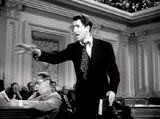
He whistled loudly with his fingers in his mouth,
startling Senators who were dozing or reading other materials.
That's all right. I just wanted to find out
whether you still had faces. I'm sorry, gentlemen. I-I
know I'm being disrespectful to this honorable body, I
know that. I- A guy like me should never be allowed to
get in here in the first place. I know that! And I hate
to stand here and try your patience like this, but EITHER
I'M DEAD RIGHT OR I'M CRAZY.
|
|

 Best
Film Speeches and Monologues
Best
Film Speeches and Monologues