|
Best Film Speeches and Monologues
|
|
Title Screen
|
Film Title/Year and Description of Film Speech/Monologue |
Screenshots
|
|
The Ox-Bow Incident
(1943)
Screenwriter(s): Lamar Trotti
 Lynched
Man's Dying Letter Lynched
Man's Dying Letter
Play clip (excerpt): 
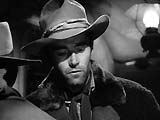
The heart-breaking reading, posthumously by Gil
Carter (Henry Fonda), of a letter written by a lynched man,
Donald Martin (Dana Andrews) to his wife:
My dear wife: Mr. Davies will tell
you what's happening here tonight. He's a good man and
has done everything he can for me. There are some other
good men too, only they don't realize what they're doin'.
They're the ones I feel sorry for, because it'll be over
for me in a little while, but they'll have to go on remembering
for the rest of their lives. A man just naturally can't
take the law into his own hands and hang people without
hurtin' everybody in the world, 'cause then he's just not
breakin' one law, but all laws. Law is a lot more than
words you put in a book, or judges or lawyers or sheriffs
you hire to carry it out. It's everything people ever have
found out about justice and what's right and wrong. It's
the very conscience of humanity. There can't be any such
thing as civilization unless people have a conscience,
because if people touch God anywhere, where is it except
through their conscience? And what is anybody's conscience
except a little piece of the conscience of all men that
ever lived? I guess that's all I've got to say except -
kiss the babies for me and God bless ya. Your husband,
Donald.
|
|
|
Shadow
of a Doubt (1943)
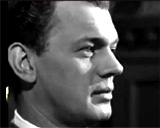
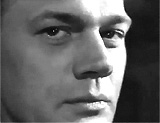
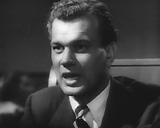
In Alfred Hitchcock's suspense thriller, the chilling,
homicidal character of Uncle Charlie Oakley (Joseph Cotten) - later
identified as the "Merry
Widow Murderer", delivered a key speech at the family dinner
table. It was a contemptuous, misogynistic monologue about rich,
lazily fat, detestable, middle-aged widows (whom he judgmentally
avenged as a serial killer) in cities who were quite different from
small-town women.
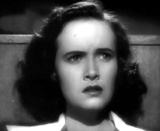
During the speech,
his young beloved niece Charlie (Teresa Wright) confrontationally
and warily watched him in a profile view that moved ever closer:
...Women keep busy in towns like this. In the
cities it's different. The cities are full of women, middle-aged
widows, husbands dead, husbands who've spent their lives making
fortunes, working and working. Then they die and leave their
money to their wives. Their silly wives. And what do the wives
do, these useless women? You see them in the hotels, the best
hotels, every day by the thousands, drinking the money, eating
the money, losing the money at bridge, playing all day and
all night, smelling of money. Proud of their jewelry but of
nothing else. Horrible, faded, fat, greedy women.
Midway, when young Charlie objected to his assessment
("They're alive! They're human beings!"), Uncle
Charlie turned toward the camera, in gigantic close-up and coldly
asked:
Are they? Are they, Charlie? Are they human or are they fat wheezing animals, hmm?
And what happens to animals when they get too fat and too old?
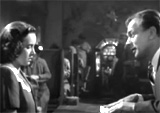
Slightly later, he also lectured young Charlie
in the nearby 'Til-Two cocktail lounge - a smoke-filled,
noisy and dark bar populated by war-time sailors and less-than-respectable,
downtrodden ladies both inside and out. The ominous discussion
between the two Charlies occurred at one of the booths, where
they faced each other as the mentally-disturbed Uncle Charlie
began to act aggressively toward his niece. He told her how she
hadn't experienced - as he had - how the world was a living hell
filled with foul swine within houses;
he began lecturing her, accused her of knowing nothing about
the real world, and confronted her about what she knew about him:
You think you know something, don't you? You
think you're the clever little girl that knows something. There's
so much you don't know. So much. What do you know, really?
You're just an ordinary little girl living in an ordinary little
town. You wake up every morning of your life and you know perfectly
well that there's nothing in the world to trouble you. You
go through your ordinary little day and at night you sleep
your untroubled, ordinary little sleep filled with peaceful,
stupid dreams. And I brought you nightmares! Or did I, or was
it a silly inexpert little lie? You live in a dream. You're
a sleepwalker, blind. How do you know what the world is like?
Do you know the world is a foul sty? Do you know if you rip
the fronts off houses you'd find swine? The world's a hell.
What does it matter what happens in it? Wake up, Charlie! Use
your wits. Learn something.
|
|
|
The Curse of the Cat People
(1944)
Screenwriter(s): DeWitt Bodeen
The
Headless Horseman Legend
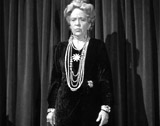
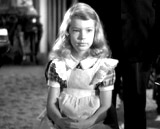
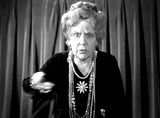
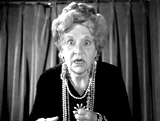
Aging reclusive actress Mrs. Julia Farren (Julia
Dean) enacted her version of the 'Headless Horseman' tale,
to young blonde Amy Reed (Ann Carter):
I'll tell you a story. A lovely story...Do
you know the story of the Headless Horseman?...You live
right here in Tarrytown and you don't know the legend of
Sleepy Hollow? Then you must hear it. I shall tell it to
you. There, now, you sit there. Now, we'll pretend this
is the stage. (She emerged from behind a curtain)
The Headless Horseman...It was shot off long ago in the
great battles that were fought here. With the British on
one side and the Americans on the other....
On the dark nights, on the stormy nights, you
can hear him. He passes like the wind, and the flapping and
fluttering of his great cloak, beating like gaunt wings.
And the thunder of his horses' hooves is loud, and loud,
and louder! At the midnight hour, down the road that leads
to Sleepy Hollow, across the bridge, he goes galloping, galloping,
galloping. Always searching, always seeking. And if you stand
on the bridge at the wrong hour, the hour when he rides by,
his great cloak sweeps around you! He swings you to his saddlebow.
And then forever you must ride. And always his cold arms
around you, clasping you into the cavity of his bony chest.
And then, forever, you must ride, and ride, and ride - with
the Headless Horseman.
|
|
|
Double Indemnity
(1944)
Screenwriter(s): Billy Wilder, Raymond Chandler
Suicide
Statistics Speech
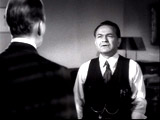
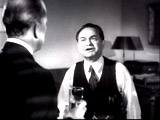
Insurance agent Barton Keyes (Edward G. Robinson)
contemplated the suicide angle, and explained to Insurance
Company President Edward S. Norton (Richard Gaines) how unlikely it
was for someone to commit suicide by jumping off a slow-moving
train. He reeled off an unforgettable, statistical speech about
different kinds of suicidal deaths (each with subdivisions)
to illustrate how the Dietrichson claim was probably a legitimate accident
claim:
You know, you, uh, ought to take a look
at the statistics on suicide sometime. You might learn
a little something about the insurance business...Come
now, you've never read an actuarial table in your life,
have you? Why, they've got 10 volumes on suicide alone.
Suicide by race, by color, by occupation, by sex, by seasons
of the year, by time of day. Suicide, how committed: by
poisons, by firearms, by drowning, by leaps. Suicide by
poison, subdivided by types of poison, such as corrosive,
irritant, systemic, gaseous, narcotic, alkaloid, protein,
and so forth. Suicide by leaps, subdivided by leaps from
high places, under the wheels of trains, under the wheels
of trucks, under the feet of horses, from steamboats. But
Mr. Norton, of all the cases on record, there's not one
single case of suicide by leap from the rear end of a moving
train.
And do you know how fast that train was going
at the point where the body was found? 15 miles an hour.
Now, how can anybody jump off a slow-moving train like that
with any kind of expectation that he would kill himself?
No, no soap, Mr. Norton. We're sunk and we'll have to pay
through the nose, and you know it.
|
|
|
|
Double Indemnity
(1944)
Screenwriter(s): Billy Wilder, Raymond
Chandler
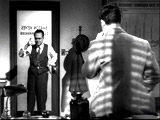
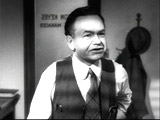
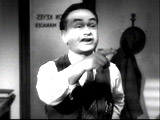
"It's
a One-Way Trip and the Last Stop is the Cemetery"
Insurance agent Barton Keyes (Edward G. Robinson)
pressed further with suspicions, telling fellow insurance worker
Walter Neff (Fred MacMurray) his hunch: "This Dietrichson
business. It's murder, and murders don't come any neater. As
fancy a piece of homicide as anybody ever ran into. Smart,
tricky, almost perfect - but...I think Papa has it all
figured out."
He explained his new theory, exactly similar
to the real murder scheme, a conspiratorial scheme. He felt
that the "perfect" murder was already coming apart
at the seams as he spoke about the two homicidal conspirators
who were on a deadly, one-way trolley "ride together...all
the way to the end of the line":
It's beginning to come apart at the seams
already. Murder is never perfect. It always comes apart
sooner or later. When two people are involved, it's usually
sooner. Now we know the Dietrichson dame is in it and the
somebody else. Pretty soon, we'll know who that somebody
else is. He'll show. He's got to show. Sometime, somewhere,
they've got to meet. Their emotions are all kicked up.
Whether it's love or hate, it doesn't matter. They can't
keep away from each other. They may think it's twice as
safe because there are two of them. But it isn't twice
as safe. It's ten times twice as dangerous. They've committed
a murder. And it's not like taking a trolley ride together
where they can get off at different stops. They're stuck
with each other and they've got to ride all the way to
the end of the line and it's a one-way trip and the last
stop is the cemetery.
|
|
|
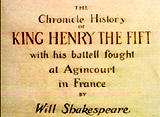
(King) Henry V (1944, UK) (aka The Chronicle
History of King Henry the Fift with His Battell Fought at Agincourt
in France)
Screenwriter(s): Based upon William Shakespeare's play
St.
Crispin's Day Address to the Troops - See also Henry V
(1989)
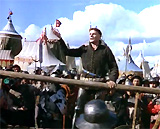
King Henry V (Laurence Olivier) made a stirring
St. Crispin's Day address to his weary troops as they went
into battle at Agincourt against the French in 1415:
This story shall the good man teach
his son and Crispin Crispian shall ne'er go by, from this
day to the ending of the world, but we in it shall be remember'd;
we few, we happy few, we band of brothers; For he today
that sheds his blood with me shall be my brother, be he
ne'er so base. And gentlemen in England now a-bed shall
think themselves accurs'd they were not here and hold their
manhoods cheap whiles any speaks that fought with us upon
Saint Crispin's Day.
|
|
|
Laura (1944)
Screenwriter(s): Jay Dratler, Samuel Hoffenstein, Elizabeth Reinhardt
"I
Shall Never Forget" Speech
Play clip (excerpt):
In voice-over narration, cynical and prickly
society columnist Waldo Lydecker (Clifton Webb) opened the
film as the camera tracked from left to right across glass
cabinets with beautifully-displayed shelves of priceless objets
d'art - in the alcove of his elegantly-expensive, New York
City apartment/penthouse. It was the hottest day of the summer
of 1944, and it was revealed that the story took place in the
recent past, at the time of 'Laura's' (Gene Tierney) death:
I shall never forget the weekend Laura died.
A silver sun burned through the sky like a huge magnifying
glass. It was the hottest Sunday in my recollection. I
felt as if I were the only human being left in New York.
For Laura's horrible death, I was alone. I, Waldo Lydecker,
was the only one who really knew her. And I had just begun
to write Laura's story when - another of those detectives
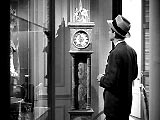
came to see me. I had him wait. I could watch him through
the half-open door. I noted that his attention was fixed
upon my clock. There was only one other in existence, and
that was in Laura's apartment in the very room where she
was murdered.
|
|
|
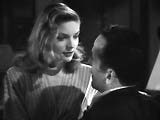
To Have and
Have Not (1944)
Screenwriter(s): Jules Furthman, William Faulkner
"Just
Put Your Lips Together and Blow" Invitation
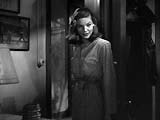
The incredibly sensuous scene between Steve /
Harry Morgan (Humphrey Bogart) and Slim / Marie Browning (Lauren
Bacall), who was trying to seduce him:
Who was the girl, Steve?... The one that
left you with such a high opinion of women? She must have
been quite a gal. You think I lied to you about this, don't
you? Well, it just happens there's thirty-odd dollars here.
Not enough for boat fare, or any other kind of fare. Just
enough for me to say 'no' if I feel like it, and you can
have it if you want it... You wouldn't take anything from
anybody would you?... You know Steve, you're not very hard
to figure. Only at times. Sometimes I know exactly what
you're going to say. Most of the time. The other times,
the other times you're just a stinker.
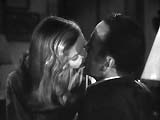
After kissing him a second time after he had
become more receptive, she cooed as she left his room:
It's even better when you help.... Uh, sure
you won't change your mind about this?... This belongs
to me, and so do my lips, I don't see any difference...
Okay, you know you don't have act with me, Steve. You don't
have to say anything, and you don't have to do anything.
Not with me. Oh, maybe just whistle. You remember how to
whistle, don't you? Just put your lips together... and
blow.
|
|

 Best
Film Speeches and Monologues
Best
Film Speeches and Monologues