|
Best Film Speeches and Monologues
|
|
Title Screen
|
Film Title/Year and Description of Film Speech/Monologue |
Screenshots
|
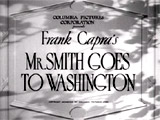
|
Mr. Smith
Goes to Washington (1939)
Screenwriter(s): Sidney Buchman
 Senate
Filibuster Speech (part 2) - "Lost Causes" Senate
Filibuster Speech (part 2) - "Lost Causes"

Play clip (excerpt): 
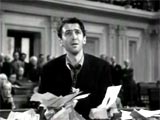
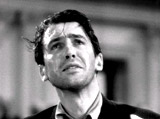
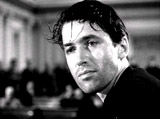
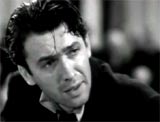
After over 23 hours of filibustering, exhausted
and hoarse-voiced Senator Jefferson Smith (James Stewart) gave
the final segment of his filibuster speech with an exposition
on moral integrity and American democracy:
There's no compromise with truth. That's
all I got up on this floor to say. When was it? A year
ago, it seems like....
Just get up off the ground. That's all I ask.
Get up there with that lady, that's up on top of this Capitol
Dome. That lady that stands for Liberty. Take a look at this
country through her eyes if you really want to see somethin'.
And you won't just see scenery. You'll see the whole parade
of what man's carved out for himself after centuries of fighting.
And fighting for something better than just jungle law. Fighting
so as he can stand on his own two feet free and decent, like
he was created, no matter what his race, color, or creed.
That's what you'd see. There's no place out there for graft
or greed or lies! Or compromise with human liberties! And
if that's what the grown-ups have done with this world that
was given to them, then we'd better get those boys camps
started fast and see what the kids can do. And it's not too
late. Because this country is bigger than the Taylors or
you or me or anything else. Great principles don't get lost
once they come to light. They're right here. You just have
to see them again...
To defeat Smith, hundreds of "Taylor-made"
phony telegrams from constituents in his state were manufactured.
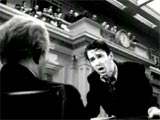
Senator Paine was granted permission to bring in "evidence
of the response" from his state. Baskets, wire barrels
and bundles of stacks of 50,000 wired telegrams from constituents
were deposited in the front of the Senate chamber. Paine
held up a fistful, telling Smith that they all demanded that
he yield the floor and give up his filibuster: "The
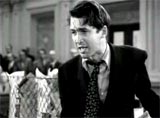
people's answer to Jefferson Smith." Jefferson staggered
forward in disbelief to look at the telegrams, pawing through
them and desperately looking for some evidence of support.
In a symbolic crucifixion stance, he grabbed two large fistfuls
and held them out, and expounded on 'lost causes' before
collapsing to the Senate floor:
I guess this is just another lost cause,
Mr. Paine. All you people don't know about lost causes.
Mr. Paine does. He said once they were the only causes
worth fighting for. And he fought for them once, for the
only reason that any man ever fights for them. Because
of just one plain simple rule: 'Love thy neighbor.' And
in this world today, full of hatred, a man who knows that
one rule has a great trust. You know that rule, Mr. Paine.
And I loved you for it, just as my father did. And you
know that you fight for the lost causes harder than for
any others. Yes, you even die for them. Like a man we both
knew, Mr. Paine.
You think I'm licked. You all think I'm licked.
Well, I'm not licked. And I'm gonna stay right here and fight
for this lost cause, even if this room gets filled with lies
like these. And the Taylors and all their armies come marching
into this place. Somebody will listen to me. Some...
|
|
|
Ninotchka (1939)
Screenwriter(s): Charles Brackett, Billy Wilder, Walter Reisch
"I
Guess One Gets the Face One Deserves"
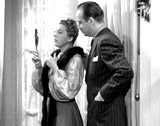
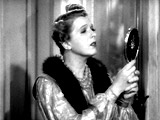
Self-absorbed, ultra-sophisticated noblewoman,
Russian Grand Duchess Swana (Ina Claire), living in exile in
the French capital of Paris, complained to suave, playboyish
boyfriend Count Leon d'Algout (Melvyn Douglas) about what her
face looked like in the morning:
Oh, it's really a wretched morning, wretched.
I can't get myself right. I wanted to look mellow and I
look brittle. My face doesn't compose well. It's all highlights.
How can I dim myself down, Leon? Suggest something. Oh,
I'm so bored with this face. I wish I had someone else's
face. Whose face would you have if you had your choice?
Oh well, I guess one gets the face one deserves.
|
|
|
|
Ninotchka (1939)
Screenwriter(s): Charles Brackett, Billy Wilder,
Walter Reisch
"Surely
You Feel Some Slight Symptom of the Divine Passion?"
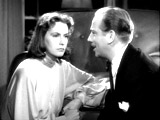
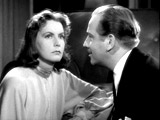
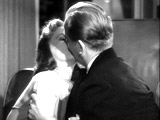
Count Leon (Melvyn Douglas) delivered a wonderful
monologue about passion and love, expressing his overwhelming
desire for the Soviet Union's special enjoy Ninotchka (Greta
Garbo), when the clock struck midnight and he told her: "One
half of Paris is making love to the other half":
Oh, you analyze everything out of existence.
You'd analyze me out of existence, but I won't let you.
Love isn't so simple, Ninotchka. Ninotchka, why do doves
bill and coo? Why do snails, the coldest of all creatures,
circle interminably around each other? Why do moths fly
hundreds of miles to find their mates? Why do flowers slowly
open their petals? Oh, Ninotchka, Ninotchka, surely you
feel some slight symptom of the divine passion? A general
warmth in the palms of your hands, a strange heaviness
in your limbs, a burning of the lips that isn't thirst
but something a thousand times more tantalizing, more exalting,
than thirst?
She only responded: "You're very talkative." Unable
to contain himself, he planted a kiss on her lips - and she
reciprocated. |
|
|
Stagecoach (1939)
Screenwriter(s): Dudley Nichols
Indignation
at the US Government From A Hypocritical Banker
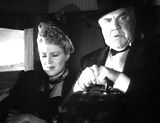
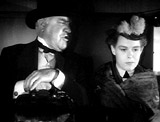
During a stagecoach journey through Indian territory,
pompous, blustering and self-important banker Henry Gatewood
(Berton Churchill) lashed out toward government regulation
of banks, while clutching his large briefcase containing embezzled
funds (amounting to $50,000) in front of him. Gatewood pompously
berated the "impetulance of that young lieutenant" and
his perceived lack of protection from the Army:
I can't get over the impertinence of that
young lieutenant. I'll make it warm for that shave-tail!
I'll report him to Washington. We pay taxes to the government
and what do we get? Not even protection from the Army!
I don't know what the government is coming
to. Instead of protecting businessmen, it pokes its nose
into business. Hmm. Why, they're even talking now about having
bank examiners. As if we bankers don't know how to run our
own banks. Why Boone, I actually have a letter from a popinjay
official saying they were going to inspect my books. I have
a slogan that should be emblazoned on every newspaper in
the country. 'America for Americans.' The government must
not interfere with business! Reduce taxes! Our national debt
is something shocking! Over one billion dollars a year! What
this country needs is a businessman for President.
|
|
|
The
Wizard of Oz (1939)
Screenwriter(s): Noel Langley, Florence Ryerson, Edgar Allan Woolf
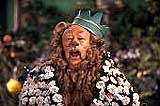
Cowardly
Lion's Words on Courage
Play clip (excerpt):
The Cowardly Lion's (Bert Lahr) speech/song on
courage:
Courage! What makes a King out of a slave?
Courage! What makes the flag on the mast to wave? Courage!
What makes the elephant charge his tusk in the misty mist,
or the dusky dusk? What makes the muskrat guard his musk?
Courage! What makes the Sphinx the Seventh Wonder? Courage!
What makes the dawn come up like thunder? Courage! What
makes the Hottentot so hot? What puts the ape in ape-ricot?
What have they got that I ain't got? (Courage) You can
say that again!
|
|
|
|
The
Wizard of Oz (1939)
Screenwriter(s): Noel Langley, Florence
Ryerson, Edgar Allan Woolf
"I'm
Melting! Melting!"
Play clip (excerpt):
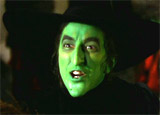
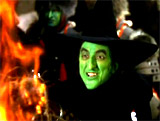
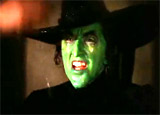
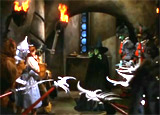
The death scene of the green-faced, cackling
Wicked Witch of the West (Margaret Hamilton) when Dorothy Gale
(Judy Garland) accidentally doused her with water when trying
to put out the Scarecrow's (Ray Bolger) fire from her broomstick:
Ah, ha, ha ,ha, ha. Well! Ring around the
rosy, a pocket full of - spears. Thought you'd be pretty
foxy, didn't ya? Well, the last to go will see the first
three go before her. Ha, ha, ha. And her mangy little dog,
too. How about a little fire, Scarecrow? (The witch
set the Scarecrow ablaze with her broomstick)
Ah, ha, ha, aha... Ahhhhhhhhhhh!!! You cursed
brat! Look what you've done!! I'm melting! Melting! Ohhhhh,
what a world, what a world! Who would have thought that some
little girl like you could destroy my beautiful wickedness.
Ohhhhhh!!! No!!! No!!! I'm going. Ohhhhhhh. Ohhhhhhhhhhhhh...
|
|
|
|
The
Wizard of Oz (1939)
Screenwriter(s): Noel Langley, Florence
Ryerson, Edgar Allan Woolf
Presentation
of Gifts by the Wizard
Play clip 1 (excerpt):
Play clip 2 (excerpt):
Play clip 3 (excerpt):
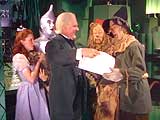
The Wizard's (Frank Morgan) presentation of gifts
to the three companions of Dorothy:
To the Scarecrow, a Brain: (clip 1)
Why, anybody can have a brain. That's a very
mediocre commodity. Every pusillanimous creature that crawls
on the Earth or slinks through slimy seas has a brain.
Back where I come from, we have universities, seats of
great learning, where men go to become great thinkers.
And when they come out, they think deep thoughts and with
no more brains than you have! But they have one thing you
haven't got - a diploma. Therefore, by virtue of the authority
vested in me by the Universitatus Committeatum E Pluribus
Unum, I hereby confer upon you the honorary degree of Th.
D...that's Doctor of Thinkology.
To the Cowardly Lion, Courage: (clip 2)
As for you, my fine friend, you're a victim
of disorganized thinking. You are under the unfortunate
delusion that simply because you run away from danger,
you have no courage. You're confusing courage with wisdom.
Back where I come from, we have men who are called heroes.
Once a year, they take their fortitude out of moth balls
and parade it down the main street of the city and they
have no more courage than you have. But they have one thing
that you haven't got - a medal. Therefore, for meritorious
conduct, extraordinary valor, conspicuous bravery against
Wicked Witches, I award you the Triple Cross. You are now
a member of the Legion of Courage.
To the Tin Woodsman, a Heart: (clip 3)
...Back where I come from, there are men
who do nothing all day but good deeds. They are called
phila-, er, er, philanth-er, yes, er, good-deed doers,
and their hearts are no bigger than yours. But they
have one thing you haven't got - a testimonial. Therefore,
in consideration of your kindness, I take pleasure at this
time in presenting you with a small token of our esteem
and affection. And remember, my sentimental friend, that
a heart is not judged by how much you love, but
by how much you are loved by others.
|
|
|
|
The
Wizard of Oz (1939)
Screenwriter(s): Noel Langley, Florence
Ryerson, Edgar Allan Woolf
"There's
No Place Like Home"
Play clip (excerpt):
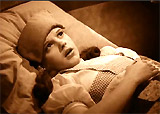
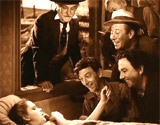
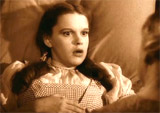
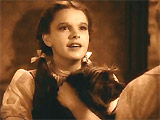
In her Kansas farmhouse bedroom, young Dorothy
Gale (Judy Garland) told everyone that "there's
no place like Home" upon returning from the magical land
of Oz:
But it wasn't a dream. It was a place. And
you and you and you - and you were there. But you couldn't
have been, could you?...No, Aunt Em, this was a real, truly
live place. And I remember that some of it wasn't very
nice, but most of it was beautiful. But just the
same all I kept saying to everybody was 'I want to go home,'
and they sent me home! Doesn't anybody believe me? But
anyway, Toto, we're home! Home. And this is my room, and
you're all here and I'm not gonna leave here ever, ever
again. Because I love you all. And - Oh Auntie Em! There's
no place like home!
|
|

 Best
Film Speeches and Monologues
Best
Film Speeches and Monologues