|
Best Film Speeches and Monologues
|
|
Title Screen
|
Film Title/Year and Description of Film Speech/Monologue
|
Screenshots
|

|
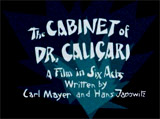
The Cabinet of Dr. Caligari (1920, Ger.) (Silent
film)
Screenwriter(s): Carl Mayer, Hans Janowitz
 The
Promotion of a Somnambulist The
Promotion of a Somnambulist
Outside of his carnival exhibit tent next to a
life-sized poster representation, Dr. Caligari (Werner Krauss)
promoted his deadly somnambulist Cesare (Conrad Veidt) to a
crowd of fairgoers:
Step rrrrright up. Presenting here for the
first time. Cesare, the Somnambulist. The miraculous Cesare,
twenty-three years old, he has slept for twenty-three years
-- Continuously -- Day and Night. Right before your eyes,
Cesare will awaken from his death-like trance. Step right
in!
|

|

|
Metropolis (1927,
Germ.) (Silent
film)
Screenwriter(s): Thea von Harbou, Fritz Lang
Parable
of Babel
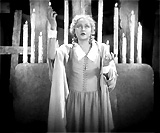
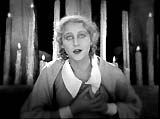
Maria (Brigitte Helm) told the
parable or legend of the Tower of Babel to teach the workers -- and a hidden Freder Fredersen (Gustav Frohlich), about the importance of cooperation and unity, as she clutched her breast:
Come, let us build us a tower whose top may
reach unto the stars! And on top of the tower we will write
the words: Great is the world and its Creator! And great
is Man! ...but the minds that had conceived the Tower of
Babel could not build it. The task was too great. So they
hired hands for wages. But the hands that built the Tower
of Babel knew nothing of the dream of the brain that had
conceived it. BABEL! BABEL! BABEL! One man's hymns of praise
became other men's curses. People spoke the same language,
but could not understand each other..."HEAD and HANDS
need a mediator." "THE
MEDIATOR BETWEEN HEAD AND HANDS MUST BE THE HEART!
|
|
|
All Quiet on the Western Front (1930)
Screenwriter(s): George Abbott
Preaching
the "Glory of the Fatherland"
Play clip (excerpt): 
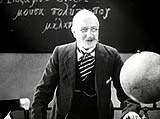
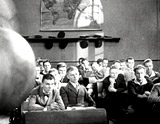
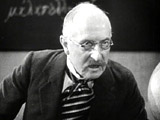
Jingoistic schoolmaster Professor Kantorek (Arnold
Lucy) preached the "Glory of the Fatherland" to his
classroom of young German students, who sat and listened intently
at their school desks. He advocated "glory
for the Fatherland,"
inspiring and rousing the entire class of young boys to enlist in the army
and fight Germany's enemies:
You are the life of the Fatherland, you boys.
You are the iron men of Germany. You are the gay heroes who
will repulse the enemy when you are called upon to do so.
It is not for me to suggest that any of you should stand
up and offer to defend his country. But I wonder if such
a thing is going through your heads? I know that in one of
the schools, the boys have risen up in the classroom and
enlisted in a mass. But, of course, if such a thing should
happen here, you would not blame me for a feeling of pride.
Perhaps, some will say that you should not be allowed to
go yet, that you are too young, that you have homes, mothers,
fathers, that you should not be torn away.
Are your fathers so forgetful of their Fatherland
that they would let it perish rather than you? Are your mothers
so weak that they cannot send a son to defend the land which
gave them birth?! And after all, is a little experience such
a bad thing for a boy? Is the honor of wearing a uniform something
from which we should run? And if our young ladies glory in
those who wear it, is that anything to be ashamed of?
I know you have never desired the adulation of heroes. That
has not been part of my teaching. We have sought to make ourselves
worthy and let acclaim come when it would. But to be foremost
in battle is a virtue not to be despised. I believe it will
be a quick war, that there will be few losses. But if losses
there must be, then let us remember the Latin phrase which
must have come to the lips of many a Roman when he stood
embattled in a foreign land: 'Dulce et decorum est pro patria
mori.' 'Sweet and fitting it is to die for the Fatherland.'
Some of you may have ambitions. I know of one
young man who has great promise as a writer, and he has written
the first act of a tragedy which would be a credit to one
of the masters. And he is dreaming, I suppose, of following
in the footsteps of Goethe and Schiller, and I hope he will.
But now our country calls! The Fatherland
needs leaders!! Personal ambition must be thrown aside in
the one great sacrifice for our country! Here is a glorious
beginning to your lives! The fields of honor calls you.
|
|
|
|
All
Quiet on the Western Front (1930)
Screenwriter(s): George Abbott
In
the Trenches With a Dying Enemy Soldier
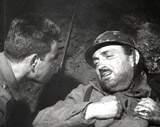
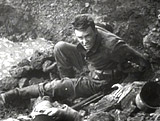
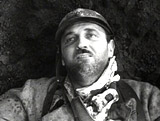
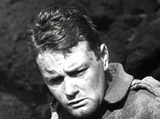
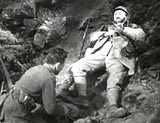
In perhaps the most memorable, painfully bleak
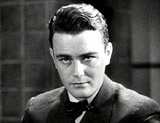
scene of the film, young soldier Paul Baumer (Lew Ayres) became
trapped in a World War I shell hole with a mortally wounded
Frenchman, and he was forced to remain with the groaning, dying
man through the night as life slowly ebbed from the man. Anguished
when the man died, Paul spoke to the corpse - he delivered
an impassioned speech to the man, pleading for forgiveness
from the corpse of the soldier he had killed. In other circumstances,
the Frenchman could have been a friend or a comrade rather
than the enemy:
I want to help you. I want to help you... (He
listened to the dying man's screams) Stop that! Stop
it! Stop it! I can bear the rest of it. I can't listen
to that! Why do you take so long dying? You're going to
die anyway. Oh, no. Oh, no. You won't die. Oh, no. You
won't die. They're only little wounds. You'll get home.
You'll be all right. You'll get home long before I will.
You know I can't run away. That's why you
accuse me. I tell you, I didn't want to kill you. I tried
to keep you alive. If you jumped in here again, I wouldn't
do it. You see, when you jumped in here, you were my enemy
- and I was afraid of you. But you're just a man like me,
and I killed you. Forgive me, comrade. Say that for me.
Say you forgive me! Oh, no. You're dead! Only you're better
off than I am. You're through. They can't do any more
to you now. Oh, God, why did they do this to us? We only
wanted to live, you and I. Why should they send us out
to fight each other? If we threw away these rifles and
these uniforms, you could be my brother just like Kat and
Albert. You'll have to forgive me, comrade. I'll do all
I can. I'll write to your parents. I'll write to --- I'll write
to your wife. I'll write to her. I promise she'll not want
for anything. And I'll help her and your parents, too. Only
forgive me. Forgive me. Forgive me! Forgive me! (sobbing)
|
|
|
|
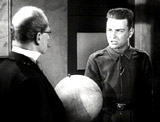
All Quiet on the Western Front (1930)
Screenwriter(s): George Abbott
Realities
of War
Play clip (excerpt):
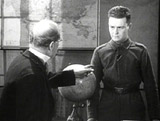
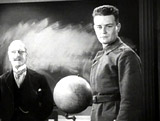
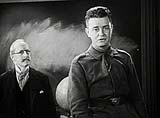
Returning student Paul Baumer (Lew Ayres) was encouraged
to give a speech to his Professor's class of young students
after experiencing warfare's despair. Some were at
first enthusiastic to listen to him, but then thought he was
a coward:
I can't say anything...I can't tell you anything
you don't know. We live in the trenches out there. We fight.
We try not to be killed; sometimes we are. That's all....
I've
been there! I know what it's like.... I heard you in here
reciting that same old stuff, making more iron men, more
young heroes. You still think it's beautiful and sweet to
die for your country, don't you? We used to think you
knew. The first bombardment taught us better. It's dirty
and painful to die for your country. When it comes to dying
for your country, it's better not to die at all. There are
millions out there dying for their countries, and what good
is it?...You asked me to tell them how much they're needed
out there. (to the boys) He tells you, 'Go out and die.' Oh,
but if you'll pardon me, it's easier to say 'go out and die'
than it is to do it....And it's easier to say it than to
watch it happen....
It's
no use talking like this. You won't know what I mean. Only,
it's been a long while since we enlisted out of this classroom.
So long, I thought maybe the whole world had learned by this
time. Only now, they're sending babies, and they won't last
a week! I shouldn't have come on leave. Up at the front,
you're alive or you're dead, and that's all. You can't
fool anybody about that very long. Up there, we know
we're lost and done for, whether we're dead or alive. Three
years we've had of it -- four years. And every day a year,
and every night a century. And our bodies are earth. And
our thoughts are clay. And we sleep and eat with death. And
we're done for, because you can't live that way and keep
anything inside you. I shouldn't have come on leave. I'll
go back tomorrow. I've got four days more, but I can't stand
it here! I'll go back tomorrow. Sorry.
|
|

|
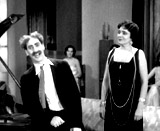
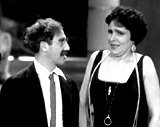
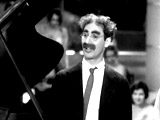
Animal Crackers (1930)
Screenwriter(s): Morrie Ryskind
"How
I Shot An Elephant in My Pajamas"
Before an audience, returning Captain Jeffrey T.
Spaulding (Groucho Marx), a noted African jungle explorer, recounted
a hilarious account of his adventurous African safari:
Friends, I'm gonna tell you of the great, mysterious,
wonderful continent known as Africa. Africa is God's country,
and He can have it. Well, sir, we left New York drunk and early
on the morning of February 2nd. After fifteen days on the water
and six on the boat, we finally arrived on the shores of Africa.
We at once proceeded three hundred miles into the heart of
the jungle, where I shot a polar bear. This bear was six foot
seven in his stocking feet and had shoes on....
Oh you did! Well, this bear was anemic and he
couldn't stand the cold climate. He was a rich bear and he
could afford to go away for the winter. You take care of your
animals and I'll take care of mine! Frozen North, my eye! From
the day of our arrival, we led an active life. The first morning
saw us up at six, breakfasted, and back in bed at seven - this
was our routine for the first three months. We finally got
so we were back in bed at six thirty. One morning, I was sitting
in front of the cabin, smoking some meat...Yes. There wasn't a
cigar store in the neighborhood. As I say, I was sitting in
front of the cabin when I bagged six tigers...Six of the biggest
tigers...I bagged them. I...I bagged them
to go away, but they hung around all afternoon. They were the most
persistent tigers I've ever seen.
The principal animals inhabiting the
African jungle are moose, elks and Knights of Pythias. Of course,
you all know what a moose is. That's big game. The first day,
I shot two bucks. That was the biggest game we had. As I say,
you all know what a moose is? A moose runs around on the floor,
and eats cheese, and is chased by the cats. The elks, on the
other hand live up in the hills, and in the spring they come
down for their annual convention. It is very interesting to
watch them come to the water hole. And you should see them
run when they find it is only a water hole. What they're looking
for is an 'elk-a-hole'.
One morning,
I shot an elephant in my pajamas. How he got in my pajamas,
I don't know. Then we tried to remove the tusks. The tusks. That's
not so easy to say, tusks. You try that some time...As I say,
we tried to remove the tusks, but they
were embedded in so firmly that we couldn't bust them. Of course,
in Alabama, the Tusk-a-loosa. But, uh, that's entirely ir-elephant to
what I was talking about. We took some pictures of
the native girls, but they weren't developed. But we're going
back again in a couple of weeks.
|
|
|
Dracula (1931)
Screenwriter(s): Hamilton Deane, John L. Balderston,
Garrett Fort
Nocturnal
Visitation by Dracula
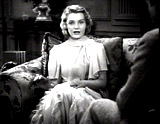
Mina Seward (Helen Chandler) described to her
fiancee John Harker (David Manners) a "dream" she
had -- after a nocturnal visitation by batlike vampire Dracula
(Bela Lugosi) while she was sleeping:
And just as I was commencing to get drowsy,
I heard dogs howling. And when the dream came, it seemed
the whole room was filled with mist. It was so thick, I
could just see the lamp by the bed, a tiny spark in the
fog. And then I saw two red eyes staring at me, and a white
livid face came down out of the mist. It came closer and
closer. I felt its breath on my face, and then its lips,
ohhh, (whimpering)...And then, in the morning, I felt so
weak. It seemed as if all the life had been drained out
of me.
|
|
|
|
Dracula (1931)
Screenwriter(s): Hamilton Deane, John L. Balderston,
Garrett Fort
The
Legend of Dracula
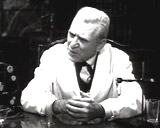
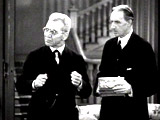
Throughout the second portion of the film, eminent
scientist and middle-European (Netherlands) doctor - Professor
Van Helsing (Edward Van Sloan) spoke about the legendary vampire
Dracula. Having dedicated his entire life to battling the undead,
Van Helsing explained that vampires were
not pure myth or superstition. He identified
Dracula as "our
vampire,"
and then described
the characteristics and habits of vampires. Later, to protect Mina
(Helen Chandler) already under Dracula's influence, he gave instructions
for her safety:
Gentlemen, we are dealing with the undead...Yes,
Nosferatu, the undead, the vampire. The vampire attacks the
throat. It leaves two little wounds, white with red centers.
Dr. Seward, your patient Renfield whose blood I have just
analyzed, is obsessed with the idea that he must devour living
things in order to sustain his own life...I may be able to
bring you proof, that the superstition of yesterday
can become the scientific reality of today...
Dracula is our vampire. A vampire casts
no reflection in the glass. That is why Dracula smashed the
mirror...The strength of the vampire is that people will
not believe in him....A vampire, Mr. Harker, is a being that
lives after its death by drinking the blood of the living.
It must have blood or it dies. Its power lasts only from
sunset to sunrise. During the hours of the day, it must rest
in the earth in which it was buried...he must have brought
his native soil with him, boxes of it. Boxes of earth, large
enough for him to rest in...
Miss Mina is to wear this wreath of wolfsbane
when she goes to bed. Watch her closely, and see that she
does not remove it in her sleep...And under no circumstances
must these windows be opened tonight...You will recollect that
Dracula cast no reflection in the mirror...and that three
boxes of earth were delivered to him at Carfax Abbey...and
knowing that a vampire must rest by day in his native soil,
I am convinced that this Dracula is no legend but an undead
creature whose life has been unnaturally prolonged...If you take
her from under our protection, you will kill her...
Mr. Harker. I have devoted my lifetime to the
study of many strange things, little-known facts which the
world is perhaps better off for not knowing....Our only chance
of saving Miss Mina's life is to find the hiding place of
Dracula's living corpse and to drive a stake through its
heart...
(To Dracula) Should you escape us, Dracula,
we know how to save Miss Mina's soul, if not her life...And
I will have Carfax Abbey torn down stone by stone, excavated
a mile around. I will find your earth box and drive that
stake through your heart.
|
|
|
A Free Soul (1931)
Screenwriter(s): Becky Gardiner
A Drunken, Heart-Stopping Defense
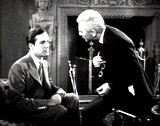
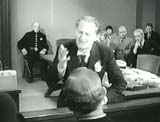
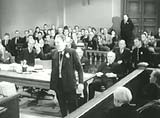
According to various sources, this melodramatic
pre-Code film had the longest take in a commercial film up
to its time. The 14-minute, uninterrupted
monologue scene in the film's conclusion, set in a courtroom,
was played by Best Actor-winning
Lionel Barrymore (as Stephen Ashe). The feat was accomplished
by using two cameras simultaneously.
Ashe was defending his daughter
Jan's (Norma Shearer) noble and steadfast ex-fiancee Dwight Winthrop
(Leslie Howard) from charges of murdering her ex-lover/gambler
Ace Wilfong (Clark Gable), in order to preserve Jan's honor.
Stephen Ashe argued for temporary insanity (because
of Ace's lethal threats), although Dwight claimed non-payment
of a gambling debt as the reason for the murder. His client
was acquitted, but Stephen collapsed of a heart attack as he
finished his eloquent defense:
...I'm going to ask you to listen with your
hearts. Dwight Winthrop knew that from the cradle on, through
all her years, Jan Ashe listened to one man, only one, her
father. Dwight Winthrop knew this too, that she placed no moral
value on this ugly thing until the result and the punshment
threatened the rest of her life. You who have sons should pray
that they might have the nobility and kindness of this young
man. And you who have daughters must believe with him that
she was not to blame. It was through her father that she met
this gambler, this beast. Her father endorsed this unholy friendship, and when
this man threatened the rest of her life, this father wasn't
there to protect his daughter. All this Dwight Winthrop knew.
All this was caught in the whirlpool of his love. The poor
boy went insane. And he's not guilty of cold, deliberate murder.
There's only one breast that you can surely pin the responsibility
of this crime on. Only one! Stephen Ashe is guilty and nobody
else. Stephen Ashe. Your honor. I --
|
|

|
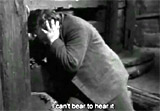
M (1931, Ger.)
Screenwriter(s): Thea von Harbou, Fritz Lang
"Who
Knows What It's Like To Be Me?" - Confessions of a Homicidal
Pedophile
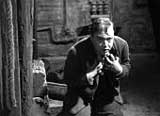
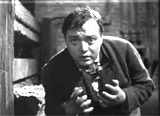
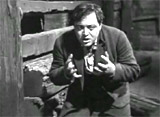
Child-murderer Hans Beckert (Peter
Lorre) delivered an agonizing "I must!" defense of
his actions in front of an underworld kangaroo court:
What do you know about it? Who are you anyway?
Who are you? Criminals? Are you proud of yourselves? Proud
of breaking safes or cheating at cards? Things you could
just as well keep your fingers off. You wouldn't need to
do all that if you'd learn a proper trade or if you'd work.
If you weren't a bunch of lazy bastards.
But I, I can't help myself! I have no control
over this! This evil thing inside me, the fire, the voices,
the torment!... It's there all the time, driving me out
to wander the streets, following me, silently, but I can
feel it there. It's me, pursuing myself. I want to escape,
to escape from myself. But it's impossible. I can't escape.
I have to obey it. I have to run endless streets. I want
to escape, to get away. And I'm pursued by ghosts. Ghosts
of mothers. And of those children. They never leave me. They
are there, always there. Always, except when I do it. When
I - Then I can't remember anything.
And afterwards I see those posters and
read what I've done. Did I do that? But I can't remember
anything about it. But who will believe me? Who knows what
it's like to be me? How I'm forced to act -- How I must!
-- Must!-- Don't want to -- Must! -- Don't want to, but must!
And then a voice screams -- I can't bear to hear it! -- I
can't go on, I can't go on ...
|
|


 Best
Film Speeches and Monologues
Best
Film Speeches and Monologues