|
Best Film Speeches and Monologues
|
|
Title Screen
|
Film Title/Year and Description of Film Speech/Monologue |
Screenshots
|

|
Citizen
Kane (1941)
Screenwriter(s): Herman J. Mankiewicz, Orson Welles
 "News
on the March" Opening Narration "News
on the March" Opening Narration
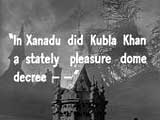
The famous fictional newsreel News on the
March opening that chronicled the complete life of Charles
Foster Kane (Orson Welles) following his death in the opening
"Rosebud" scene:
In Xanadu did Kubla Khan a stately pleasure
dome decree - - Legendary was the Xanadu where Kubla Khan
decreed his stately pleasure dome. Today, almost as legendary
is Florida's Xanadu, world's largest private pleasure ground.
Here, on the deserts of the Gulf Coast, a private mountain
was commissioned and successfully built. One hundred thousand
trees, twenty thousand tons of marble are the ingredients
of Xanadu's mountain. Contents of Xanadu's palace: paintings,
pictures, statues, the very stones of many another palace.
A collection of everything. So big it can never be catalogued
or appraised. Enough for ten museums - the loot of the
world. Xanadu's livestock: the fowl of the air, the fish
of the sea, the beast of the field and jungle. Two of each,
the biggest private zoo since Noah. Like the Pharaohs,
Xanadu's landlord leaves many stones to mark his grave.
Since the pyramids, Xanadu is the costliest monument a
man has built to himself...
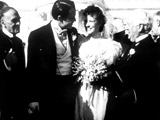
(continuing later) Twice married, twice divorced.
First to a president's niece, Emily Norton, who left him
in 1916. Died 1918 in a motor accident with their son. Sixteen
years after his first marriage, two weeks after his first
divorce, Kane married Susan Alexander, singer at the Town
Hall in Trenton, New Jersey. For wife two, one-time opera
singing Susan Alexander, Kane built Chicago's Municipal Opera
House. Cost: $3 million dollars. Conceived for Susan Alexander
Kane, half-finished before she divorced him, the still-unfinished
Xanadu. Cost? No man can say...
|
|
|
|
Citizen
Kane (1941)
Screenwriter(s): Herman J. Mankiewicz,
Orson Welles
Publisher
Kane's Self-Portrait Described His Double Identity
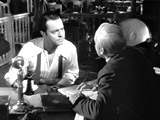
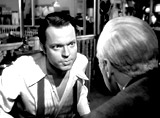
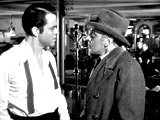
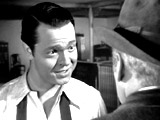
Powerful Inquirer publisher Charles Foster
Kane (Orson Welles) explained to Thatcher (George Coulouris)
how he was really "two people"
- he was both a major stockholder in the Public Transit Company
(he owned "eighty-two thousand, three hundred and sixty-four
shares of Public Transit Preferred"), a trust he was attacking,
and the dutiful publisher of a newspaper representing the interests
of the public against the trust. Kane stood up by the end of
the scene, towering over Thatcher, explaining:
The trouble is, you don't realize you're
talking to two people. As Charles Foster Kane, who has
82,634 shares of Public Transit Preferred. You see, I do
have a general idea of my holdings. I sympathize with you.
Charles Foster Kane is a scoundrel. His paper should be
run out of town. A committee should be formed to boycott
him. You may, if you can form such a committee, put me
down for a contribution of $1,000 dollars. On the other
hand, I am the publisher of the Inquirer! As such,
it's my duty - and I'll let you in on a little secret,
it's also my pleasure - to see to it that decent,
hard-working people in this community aren't robbed blind
by a pack of money-mad pirates just because - they haven't
anybody to look after their interests. (Mr. Thatcher
rose to get his coat and hat)
I'll let you in on another little secret, Mr.
Thatcher. I think I'm the man to do it. You see, I have money
and property. If I don't look after the interests of the
underprivileged, maybe somebody else will. Maybe somebody
without any money or property. And that would be too bad.
Thatcher reminded Kane he had seen his financial
statement that his philanthropic paper enterprise was losing
a million dollars a year. Kane blithely joked and grinned that "at
the rate of a million dollars a year, I'll have to close this
place - in sixty years."
You're right, Mr. Thatcher. I did lose
a million dollars last year. I expect to lose a million
dollars this year. I expect to lose a million dollars next year.
You know, Mr. Thatcher, at the rate of a million dollars
a year, I'll have to close this place... in sixty years.
|
|
|
|
Citizen
Kane (1941)
Screenwriter(s): Herman J. Mankiewicz,
Orson Welles
Unforgettable
Memories of a Girl in a White Dress With a Parasol
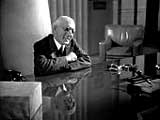
Mr. Bernstein's (Everett Sloane) sublime monologue
to reporter Mr. Thompson (William Alland) when he reminisced
about an unforgettable moment years earlier:
A fellow will remember a lot of things you
wouldn't think he'd remember. You take me. One day, back
in 1896, I was crossing over to Jersey on the ferry. And
as we pulled out, there was another ferry pulling in. And
on it there was a girl waiting to get off. A white dress
she had on. She was carrying a white parasol. I only saw
her for one second. She didn't see me at all. But I'll
bet a month hasn't gone by since that I hadn't thought
of that girl.
See also an incredibly similar speech in Indecent
Proposal (1993) by Robert Redford. |
|
|
|
Citizen
Kane (1941)
Screenwriter(s): Herman J. Mankiewicz,
Orson Welles
Speech
to Executives on the Inquirer's Success

Play clip (excerpt): 
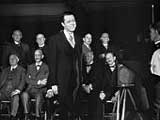
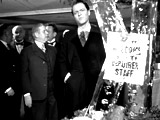
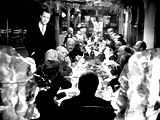
Charles Foster Kane (Orson Welles) gave a speech
to his newspaper's executives:
Six years ago, I looked at a picture of the
world's greatest newspaper men. I felt like a kid in front
of a candy store. Well, tonight, six years later, I got
my candy -- all of it. Welcome, gentlemen, to the Inquirer!
Make up an extra copy of that picture and send it to the Chronicle,
will you please? It'll make you all happy to learn that
our circulation this morning was the greatest in New York,
684,000.
(Mr. Bernstein: "Six hundred and eighty-four
thousand one hundred and thirty-two!")
Right! Having thus welcomed you, I hope you'll
forgive my rudeness in taking leave of you. I'm going abroad
next week for a vacation. I've promised my doctor for some
time now that I'd leave when I could, and I now realize that
I can't.
(Mr. Bernstein:
"Say, Mr. Kane, as long as you're promising, there's a
lot of pictures and statues in Europe you haven't bought yet.")
You can't blame me, Mr. Bernstein. They've
been making statues for two thousand years, and I've only
been buying for five.
(Mr. Bernstein: "Promise me, Mr. Kane.")
I promise you, Mr. Bernstein.
(Mr. Bernstein: "Thank you.")
Mr. Bernstein?...You don't expect me to keep
any of those promises, do you?
|
|
|
|
Citizen
Kane (1941)
Screenwriter(s): Herman J. Mankiewicz,
Orson Welles
Contradicting
Kane's Arrogant and Eccentric Philosophy: "You Want
Love On Your Own Terms"
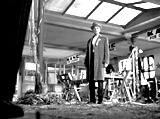
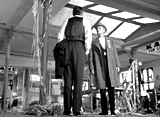
After Kane (Orson Welles) ran for political office
(governor) and lost to Jim Gettys (Ray Collins), he reflected
on his loss (when his scandalous affair was publicized) in
his empty campaign headquarters. Drunken ex-supporter/employee
Jedediah Leland (Joseph Cotten) confronted and accused him
of being a self-serving egomaniac - patronizing in his political/civic
relationships with his readership (and in his personal relationships).
Leland was disillusioned and disgusted by Kane's arrogance
in assuming that the people would vote for him despite the
scandal:
You talk about the people as though you owned
them. As though they belong to you. Goodness. As long as
I can remember, you've talked about giving the people their
rights, as if you can make them a present of Liberty, as
a reward for services rendered...You remember the working
man?
When Kane suggested getting drunk with him, Leland
replied:
Aw, it won't do any good. Besides, you never
get drunk. You used to write an awful lot about the workingman...He's
turning into something called organized labor. You're not
gonna like that one little bit when you find out it means
that your workingman expects something is his right, not
as your gift! Charlie, when your precious underprivileged
really get together, oh boy! That's gonna add up to something
bigger than your privileges! Then I don't know what you'll
do! Sail away to a desert island probably, and lord it
over the monkeys!...(sneering) Mmm, you may not
always be so lucky...You don't care about anything except
you. You just want to persuade people that you love 'em
so much that they oughta love you back. Only you want love
on your own terms. It's somethin' to be played your way,
according to your rules.
|
|
|
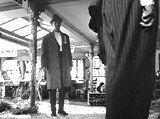
The Devil and Daniel Webster (1941) (aka
All That Money Can Buy)
Screenwriter(s): Dan Totheroh, Stephen Vincent Benet
Courtroom
Defense of Farmer Jabez Stone against Mr. Scratch by Daniel
Webster
19th century New Hampshire farmer Jabez Stone
(James Craig) bargained injudiciously with the Devil (Mr. Scratch)
(Walter Huston) for seven years of "good luck...and all
that money can buy" - in exchange for his soul. Jabez
required the services of famous lawyer-orator Daniel Webster
to win back his soul in a climactic trial. Members of the Webster-chosen
jury included Americans - all rebels who had bargained away
their lives and lost their freedom:
Gentlemen of the jury, tonight it is my privilege
to address a group of men I've long been acquainted with
in song and story, but men I had never hoped to see. My
worthy opponent, Mr. Scratch, called you Americans all.
Mr. Scratch is right. You were Americans all. Oh, what
a heritage you were born to share!
Gentlemen of the jury, I envy you, for you
were present at the birth of a mighty Union. It was given
to you to hear those first cries of pain - and behold the
shining babe, born of blood and tears. You are called upon
tonight to judge a man named Jabez Stone. What is his case?
He's accused of breach of contract. He made a deal to find
a short cut in his life - to get rich quickly. The same kind
of a deal all of you once made. You, Benedict Arnold! I speak
to you first because you are better known than the rest of
your colleagues here. What a different song yours could have
been. A friend of Washington and LaFayette - a soldier -
General Arnold, you fought so gallantly for the American
cause, till - let me see, what was the date? - 1779, a date
burned in your heart. The lure of gold made you betray that
cause.
And you, Simon Girty, now known to all as Renegade!
A loathsome word - you also took that other way. And you,
Walter Butler, what would you give for another chance to
see the grasses grow in Cherry Valley without the stain of
blood? I could go on and on and name you all but there's
no need of that. Why stir the wounds? I know they pain enough.
You were fooled like Jabez Stone, fooled and trapped in your
desire to rebel against your fate.
Gentlemen of the jury, it's the eternal right
of every man to raise his fist against his fate, but when
he does, there are crossroads. You took the wrong turn. So
did Jabez Stone. But he found it out in time. He's here tonight
to save his soul. Gentlemen of the jury, I ask you to give
Jabez Stone another chance to walk upon this earth, among
- the trees, the growing corn, and the smell of grasses in
the spring. What would you all give for another chance to
see those things you must all remember and often yearn to
touch again? For you were all men once. Clean American air
was in your lungs and you breathed it deeply for it was free
and blew across an earth you loved. These are common things
I speak of, small things, but they are good things. Yet without
your soul, they mean nothing. Without your soul, they sicken.
Mr. Scratch once told you that your soul meant
nothing, and you believed him. And you lost your freedom.
Freedom isn't just a big word. It is the morning and the
bread and the risen sun. It was for freedom we came to these
shores in boats and ships. It was a long journey and a hard
one and a bitter one. Yes, there is sadness in being a ma,
but it is a proud thing, too. And out of the suffering and
the starvation and the wrong and the right, a new thing has
come - a free man. And when the ships of the oppressors are
broken and their names forgotten and destroyed, free men
will be talking and walking under a free star. Yes, we have
planted freedom in this earth like wheat. And we have said
to the skies above us, 'A man shall own his own soul...'
Now, here is this man. He is your brother. You were Americans
all.
(pointing at the Devil) You can't be on his
side, the side of the oppressor. Let Jabez Stone keep his
soul - a soul which doesn't belong to him alone, but to his
family, his son, and his country. Gentlemen of the jury,
don't let this country go to the devil! Free Jabez Stone!
God bless the United States and the men who made her free!
|
|
|
How Green Was
My Valley (1941)
Screenwriter(s): Philip Dunne
Opening
Voice-Over
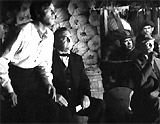
In the opening monologue, Huw (pronounced Hugh)
Morgan (Roddy McDowall as the winsome boy) idealistically looked
back (in flashback with offscreen narration in a first-person,
singular, adult voice-over provided by the eloquent, mellifluous
voice of Irving Pinchel) about life in his Welsh mining town:
I am packing my belongings in the shawl
my mother used to wear when she went to the market. And
I'm going from my valley. And this time, I shall never
return. I am leaving behind me my fifty years of memory.
Memory. Streams that the mind will forget so much of what
only this moment has passed, and yet hold clear and bright
the memory of what happened years ago - of men and women
long since dead. Yet who shall say what is real and what
is not?...
|
|
|
The Lady Eve (1941)
Screenwriter(s): Preston Sturges
"I've
Never Loved Anyone But You"
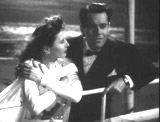
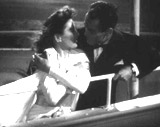
On the windy bow of the boat in the moonlight
in a romantic scene, rich and naive Charles Pike (Henry Fonda)
delivered a love speech about his intentions to be engaged
to con-artist Jean Harrington (Barbara Stanwyck) - he imagined
her as a "little girl." In frank terms, they both
agreed that they wished they were married and on their honeymoon.
At its conclusion, Charles kissed her passionately:
I've just understood something. You see,
every time I've looked at you here on the boat, it wasn't
only here I saw you. You seemed to go way back. I know
that isn't clear but I, I saw you here and at the same
time further away, and then still further away; and then
very small, like converging perspective lines. No, that
isn't it, it's like, like people following each other in
a forest glade. Only way back there, you're a little girl
with a short dress and your hair falling to your shoulders
and a little boy is standing with you holding your hand.
In the middle distance I'm still with you, not holding
your hand anymore because it isn't manly, but wanting to.
And then still further, we look terrible. You with your
legs like a colt and mine like a calf. What I'm trying
to say is -- only I'm not a poet, I'm an ophiologist --
I've always loved you. I mean I've never loved anyone but
you. I know that sounds dull as a drugstore novel, and
what I see inside I'll never be able to cast into words,
but that's what I mean. I wish we were married and on our
honeymoon now.
|

|
|
The Maltese Falcon
(1941)
Screenwriter(s): John Huston
"When
A Man's Partner Is Killed, He's Supposed to Do Something
About It"
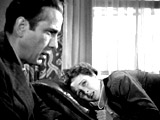
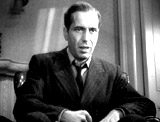
Private detective Sam Spade (Humphrey Bogart)
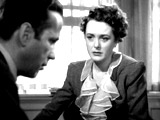
dealt with deceitful, ruthless, and amoral Brigid O'Shaughnessy
(Mary Astor), and was planning to turn her into police for
the murder of his partner Miles Archer (Jerome Cowan) - "Don't
be silly. You're taking the fall...I won't play the sap for
you...You killed Miles and you're going over for it":
When a man's partner's killed, he's supposed
to do something about it. It doesn't make any difference
what you thought of him. He was your partner, and you're
supposed to do something about it, and it happens we're
in the detective business. Well, when one of your organization
gets killed, it's - it's bad business to let the killer
get away with it, bad all around, bad for every detective
everywhere.
The manipulative Brigid attempted to save herself:
"You don't expect me to think that these things you're saying
are sufficient reasons for sending me to the...," but Spade
interrupted:
Wait'll I'm through. Then you can talk. I've
no earthly reason to think I can trust you. And if I do
this and get away with it, you'll have something on me
that you can use whenever you want to. Since I've got something
on you, I couldn't be sure that you wouldn't put a hole
in me some day. All those are on one side. Maybe some of
them are unimportant. I won't argue about that. But look
at the number of them. And what have we got on the
other side? All we've got is that maybe you love me and
maybe I love you.
|
|
|
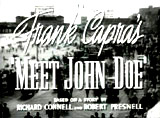
Meet John Doe
(1941)
Screenwriter(s): Robert Riskin
"Wake
up, John Doe. You're the Hope of the World!"
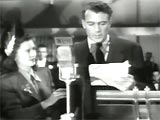
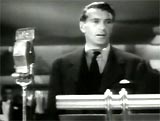
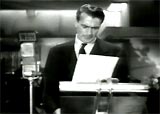
The fictional John Doe (Gary Cooper) (aka Long
John Willoughby) delivered a radio address - an idealistic
appeal to the common man - all the John Does ("the little
punks") in the world - to get up on their feet and pull
together as a team:
Ladies and Gentlemen, I am the man you all
know as John Doe. I took that name because it seems to
describe, because it seems to describe the average man
- and that's me. (He cleared his throat) And that's
me. Well, it was me before I said I was gonna jump off
the City Hall roof at midnight on Christmas Eve. Now I
guess I'm not average anymore. Now I'm getting all sorts
of attention, from big shots too, the mayor and the governor,
for instance. They don't like those articles I've been
writing...
Well, people like the governor, people like
the governor and that fellow there can stop worrying. I'm
not going to talk about them. I'm gonna talk about us - the
average guys, the John Does. If anybody should ask you what
the average John Doe is like, you couldn't tell him because
he's a million and one things. He's Mr. Big and Mr. Small,
he's simple and he's wise, he's inherently honest but he's
got a streak of larceny in his heart. He seldom walks up
to a public telephone without shovin' his finger into the
slot to see if somebody left a nickel there. (Laughter)
He's the man the ads are written for. He's the fella everybody
sells things to. He's Joe Doakes, the world's greatest stooge
and the world's greatest strength.
Yes sir, yes sir, we're a great family, the
John Does. We are the meek who are, who are supposed to inherit
the earth. You'll find us everywhere. We raise the crops,
we dig the mines, work the factories, keep the books, fly
the planes and drive the buses, and when a cop yells, 'Stand
back there you,' he means us - the John Does...We've existed
since time began. We built the pyramids. We saw Christ crucified,
pulled the oars for Roman emperors, sailed the boats for
Columbus, retreated from Moscow with Napoleon, and froze
with Washington at Valley Forge. Yes sir, we've been in there
dodgin' left hooks since before History began to walk. In
our struggle for freedom, we've hit the canvas many a time,
but we always bounced back because we're the people - and
we're tough. (Applause)
They've started a lot of talk about free people
goin' soft, that we can't take it. That's a lot of hooey!
A free people can beat the world at anything, from war to
tiddly-winks if we all pull in the same direction. (Applause)
I know a lot of you are saying, 'What can I do? I'm just
a little punk. I don't count.' Well, you're dead wrong. The
little punks have always counted because in the long run,
the character of a country is the sum total of the character
of its little punks. (Applause)
But we've all got to get in there and pitch.
We can't win the old ball game unless we have teamwork. And
that's where every John Doe comes in. It's up to him to get
together with his teammate. And your teammate, my friends,
is the guy next door to ya. Your neighbor - he's a terribly
important guy, that guy next door. You're gonna need him
and he's gonna need you, so look him up. If he's sick, call
on him. If he's hungry, feed him. If he's out of a job, find
him one. To most of you, your neighbor is a stranger, a guy
with a barkin' dog and a high fence around him. Now you can't
be a stranger to any guy that's on your own team. So tear
down the fence that separates you. Tear down the fence and
you'll tear down a lot of hates and prejudices. Tear down
all the fences in the country and you'll really have teamwork.
(Applause)
I know a lot of you are saying to yourselves:
'He's askin' for a miracle to happen. He's expecting people
to change all of a sudden.' Well, you're wrong. It's no miracle.
It's no miracle because I see it happen once every year and
so do you - at Christmas time. There's something swell about
the spirit of Christmas, to see what it does to people, all
kinds of people. Now why can't that spirit, that same warm
Christmas spirit, last the whole year round? Gosh, if it
ever did, if each and every John Doe would make that spirit
last 365 days out of the year - we'd develop such a strength,
we'd create such a tidal wave of good will that no human
force could stand against it. Yes sir, my friends, the meek
can only inherit the earth when the John Does start loving
their neighbors. You'd better start right now. Don't wait
till the game is called on account of darkness. Wake up,
John Doe, you're the hope of the world!
|
|
|
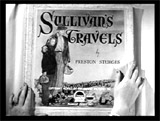
Sullivan's Travels
(1941)
Screenwriter(s): Preston Sturges
Thoughts
on the Reality of Poverty - "It Is To Be Shunned"
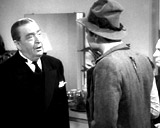
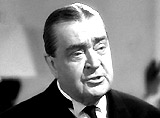
Escapist film director John Sullivan (Joel McCrea)
planned to take an experiential journey to find out what it
was like to be poor and needy before filming a picture about
it. Burrows (Robert Grieg), Sullivan's butler coldly disapproved
of Sullivan's 'caricaturized' disguise as a down-and-out hobo
wearing shabby clothes, because the poor insisted upon their
privacy and didn't want any intruders. He also told Sullivan
some of the less-than-romantic symptoms of poverty - a futile
speech to dissuade his employer from journeying out since poverty
was "to be shunned":
The poor know all about poverty and only
the morbid rich would find the topic glamorous...They rather
resent the invasion of their privacy. I believe quite properly,
sir. Also, such excursions can be extremely dangerous,
sir. I worked for a gentleman once, who likewise, with
two friends, accoutred themselves, as you have, sir, and
then went out for a lark. They have not been heard from
since...
You see, sir, rich people and theorists, who
are usually rich people, think of poverty in the negative,
as the lack of riches -- as disease might be called the lack
of health. But it isn't, sir. Poverty is not the lack of
anything, but a positive plague, virulent in itself, contagious
as cholera, with filth, criminality, vice and despair as
only a few of its symptoms. It is to be stayed away from,
even for purposes of study. It is to be shunned.
|
|

 Best
Film Speeches and Monologues
Best
Film Speeches and Monologues