|


|
Disclosure (1994)
Director Barry Levinson's R-rated corporate thriller was based upon Michael Crichton's 1993 novel of the same name. The main themes of this mid-1990s mystery-thriller and message movie were sexual harrassment in reverse, and office power-struggle intrigue and malfeasance. Its main tagline combined the two ideas: "Sex is power." A controversy and debate ensued - was this politically-incorrect film an example of the male backlash against feminism? It was the third film in which actor Michael Douglas was threatened by a scary villainess (Fatal Attraction (1987), and Basic Instinct (1992)). Monday: The main technology company involved in the plot was Seattle-based DigiCom, a leading software firm whose founder and president Bob Garvin (Donald Sutherland) was about to appoint a new VP due to a lucrative $100 million merger with Conley-White. DigiCom was about to launch two products: a new faster stand-alone Arcamax CD-ROM drive player, and a new virtual-reality based database storage system. Two individuals being considered for the promotion in the company were:
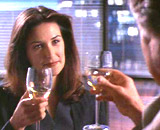
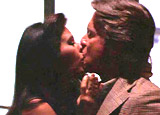
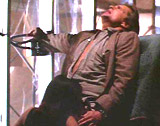
When Tom arrived at the office expecting to be promoted, he heard a rumor that he was being "passed over" and that he might be out of a job after the Advanced Products Group was spun-off as a result of the merger. He met Garvin's VP choice from outside his division - Meredith, his own attractive ex-girlfriend from many years earlier. She told Garvin: "Sanders and I go way back. He broke my heart." Garvin had selected her because "the spin-off was Meredith's idea" and it had saved the threatened merger. In the plot-twisting story, amoral, treacherous and ruthless femme fatale Meredith invited Tom to her office at 7 pm to discuss business, the same day as her new appointment. In the sexy seduction scene (without nudity), she told him as they clinked wine glasses together: "I like all the boys under me to be happy." She reminisced about the hot sex they used to have, including when he took her from behind in the shower. She came up behind him (he was on the phone, thinking he was leaving a message for colleague Mark Lewyn (Dennis Miller)) and proposed: "Let's get down to business" - and forced a kiss upon him ("There, was that so bad?"). She unbuttoned her blouse, and then urged him to touch her breasts and bottom through her clothing. She opened his shirt and suggested that he just lie back so she could take him. She began rubbing his crotch, and although he slightly protested, she continued: "You've got something I want." She unzippered his pants, put his penis in her mouth, and provided him with oral sex:
As he kept resisting, she responded: "Look, nobody has to know. Nobody gets hurt." Becoming aggressive, Tom asked: "Wanna get f--ked, huh? Is that what you want?" He ripped open his own shirt, then forcefully pulled her blouse apart, grabbed her large breasts within her black bra, kneaded them, and buried his face in them. He angrily ripped off her panties and touched her privates, as she urged: "You bad boy. Come on, baby." As he was on the verge of penetrative intercourse, she said: "Come on. You gonna f--k me? You gonna f--k me? Put it in...I want you inside me...Do it! Now, now!" But at the last moment, he vacillated and had a change of heart, while looking at himself in a glass reflection ("Oh God, look at us"). She was frustrated: "You can't just stop! Come on!" He turned her down, pulled himself together and began to leave, while she threatened to get even: "You stick your dick in my mouth and then you get an attack of morality?" She retaliated as she leaned over the stair's railing with her breasts heaving:
Tuesday: Meredith considered pursuing Tom with a sexual harrassment suit, but then pressured him into leaving the company with a "lateral move" reassignment in Austin, Texas - threatening his career, stock options and family life. Tom counter-argued that Meredith had sexually-harrassed him. Garvin was worried the Meredith incident (a sex scandal) could potentially cause PR and "disclosure" problems for the company and its proposed merger proceedings. Tom had second thoughts about leaving the company after receiving a mysterious email from an unidentified FRIEND:
The page indicated in the email was a newspaper article about a million-dollar case of sexual harrassment ("illegal behavior"), tried by Seattle defense attorney Catherine Alvarez (Roma Maffia). Alvarez had defended a female employee who refused to have sex with her supervisor, and was abruptly terminated. Tom contacted the hard-nosed attorney, who told him: "Sexual harassment is not about sex. It is about power. She has it; you don't." She agreed to file a sexual harrassment suit on Tom's behalf, although warned that the company would continue pressuring him. Then, Tom found that his computer user privileges at Digicom had been reduced to zero, and his files had been cleaned out, making him even more powerless. At home, he confessed to his wife, and then received a second email from the FRIEND. The email hinted to him that he should "Solve the Problem" himself, rather than being told what to do - to avoid giving away the identity of the writer:
Wednesday: During a mediation over the issues to resolve the dispute between the two parties, Tom gave a full and true confession about having been pressured into having oral sex - but not intercourse. It was revealed that in the past, Tom and Meredith used to have sex every day, in public places, sodomy, viewing of pornography, and the use of sexual toys (vibrators and other mechanical devices). During Meredith's tearful testimony, she painted Tom as the sexual aggressor, concluding with a statement that she kneed him in the groin to end it. Then Tom received a third email:
The source of the emails was a dead end - they were coming from the locked office of Chemistry Professor Dr. Arthur Friend from the University of Washington - who had been trekking through Nepal for three weeks. But then Tom realized that his wrong number cell-phone call, the night of the seduction, had accidentally recorded the entire sexual incident - not on Mark Lewyn's answering machine, but on colleague John Levin's voice-mail. Tom instructed Catherine Alvarez:
Thursday: After the tape was played during a continuation of mediation hearings, Alvarez had a heated argument with the predatory Meredith, who defended her sexual aggressiveness - even though Tom had said "No" 31 times:
Tom scored an apparent victory. His job was reinstated - with $100K for "pain and suffering," plus lawyer's fees and expenses ("total and complete vindication"). Meredith was to be retained through the merger, and then quietly dismissed. But it wasn't over. There was one more attempt to oust Tom and consolidate Meredith's power. He received a fourth email from the same "Friend" - who knew that Tom would be charged with incompetence, and then fired:
Meredith's dangerously-ambitious tactic to again focus on Tom was to cover up real problems in the company. To reach his inaccessible files, Tom snuck into the 11th floor Four Seasons hotel room suite where the VR system's Corridor was set up for demos for the Conley group. He donned special glasses, and entered the prototype for a virtual reality database (a file-search mechanism) - containing complete records of the company, including Operations in Malaysia. In a revisions file, he found incriminating memos and proof that Meredith was responsible for cost-cutting production changes that compromised quality in the Malaysian plant. While online, an avatar of Meredith confronted him (she was in the system too) - and he watched as she deleted all of the Malaysian files, and conspired to oust him. He would be the scapegoat - set up and blamed for serious quality control production problems in the Malaysian manufacturing of the company's high-speed Arcamax CD-ROM drive players - that she had ordered. Friday: Armed with backed-up data (faxed to Tom's office from Malaysia), Tom arrived prepared at a Friday morning shareholder meeting with Conley-White executives. He was victorious over Meredith after distributing copies of her memos, to expose her lies and deceptions. When fired by Garvin, she thought of herself as a victim. She blamed male higher-ups for the conspiracy - who punished her when she failed, although Tom gave himself the credit: "Did it ever occur to you, Meredith, that maybe I set you up?" Tom again was passed over as Meredith's replacement (and the company's successor), while Stephanie Kaplan (Rosemary Forsyth), one of the members of DigiCom's upper management, was appointed by Garvin as the company's new vice-president. In her acceptance speech, she appointed Tom as her "right hand" person. In the conclusion, Tom figured out that Stephanie's son Spencer (David Drew Gallagher), a first-year graduate student and research assistant to Dr. A. Friend, had written the "A Friend" emails from the professor's office. Tom spoke knowingly to Spencer, asking:
Obviously, Stephanie had told Spencer what to write in the emails, because she couldn't e-mail Tom directly and risk having them traced back to her. In the final scene, Tom received a colorful email from his family: "Daddy, We miss you. A Family." |
      The Seduction of Tom Sanders By Meredith Johnson 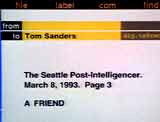 The First Email 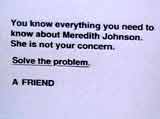 The Second Email 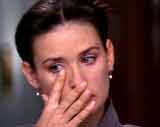 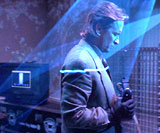 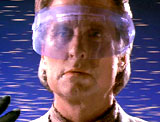 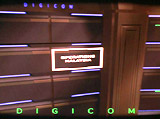 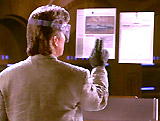 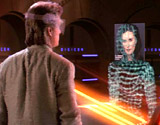 Meredith's Avatar 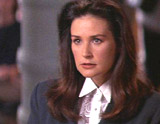 Meredith Exposed and Fired 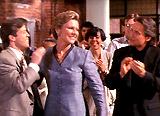 Stephanie: Appointed the New VP 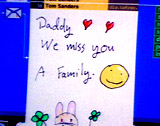 Tom's Colorful Email From Family |
||||||||||||

|
District 9 (2009, US/NZ/Can./S.Afr.)
Neill Blomkamp's gritty science-fiction film was part-apartheid allegory, mock documentary and tense action thriller. It told about the arrival of a large space ship that hovered above Johannesburg, South Africa, and was found to contain sickly prawn-like alien creatures (bi-pedal and taller than humans, with facial tendrils). The extra-terrestrials were segregated in District 9 within the city, a heavily-guarded and militarized slum-internment camp that had existed for 20 years, after which plans by the MNU (Multi-National United) were underway to move the 1.8 million oppressed aliens to a new camp (District 10) over 200 kilometers away, with enforcement provided during the eviction by sadistic mercenary Colonel Koobus Venter (David James). The operation to peaceably evict the prawns was headed up by bumbling, incompetent, bureaucratic field operative Wikus van de Merwe (Sharlto Copley), who accidentally sprayed himself with black liquid from a canister (a fuel cell) found in the shack of intelligent alien Christopher Johnson (Jason Cope). Wikus had infected himself with a virus, and began a harrowing experience of slowly mutating into one of the aliens (his left hand developed a claw). When Wikus was apprehended by the MNU and they learned he could operate powerful, non-human weaponry, they were determined to perform experimental surgery upon him and "harvest" everything from his partially-mutated body, and in the process kill him: "This body represents hundreds of millions, maybe billions of dollars worth of biotechnology. There are people out there, governments, corporations, who would kill for this chance."
He resisted and became a fugitive from the nefarious MNU, after they published a falsified news report claiming that Wikus had raped one of the aliens and contracted a disease. He sought refuge in the shack of Christopher Johnson and his young son, and found himself losing his hair, nails, and teeth, and that he liked prawn 'cat food.' Wikus found out that the mysterious liquid in the canister had been gathered over 20 years, and could power a submerged command module shuttle to return to the mother ship hovering dormant over the city, and allow it to be reactivated. In the film's exciting conclusion, Wikus and Christopher retrieved the canister from MNU, fought off a Nigerian warlord and his gang of armed men within District 9 who wanted Wikus' powers (through animistic cannibalism!), and evaded MNU forces led by Colonel Koobus. Although seriously wounded, beleaguered Wikus remained behind (encased in a massive mechanical metal battle suit) to sacrificially allow Christopher (and his son) to escape in the downed command module and return to the reactivated mother ship (and then leave Earth). The prawns came to Wikus' rescue and viciously tore off the head of Koobus and ripped him apart as he was about to kill Wikus. However, the twist was that it would take 3 years for Christopher to journey to his home planet and then return to reverse Wikus' genetic transformation and cure him. As the mother ship departed, questions were pondered:
In the film's epilogue, more interviews with various people revealed that Wikus had disappeared - had he been recaptured by MNU or by another government, or by "some shady government agency and is actually being held in captivity"?
Wikus' co-worker had exposed MNU's "illegal genetic research programme," and District 9 was demolished after the alien resettlement operation was completed. Wikus' wife Tania (Vanessa Haywood) discovered a small metal flower on her front door step (similar to ones Wikus used to make). She wondered if her husband was still alive:
On a trash heap in District 10 (now with 2.5 million aliens), an alien with a bandaged left hand was seen holding up a flower out of metal - was Wikus still alive?! |
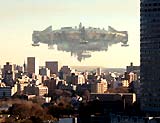 Large Spaceship Above Johannesburg 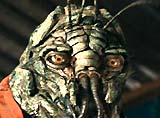 Alien Creature Christopher Johnson 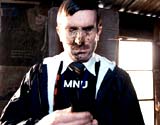 Wikus (Sharlto Copley)   Wikus' Massive Battle Suit 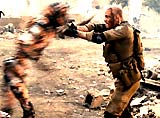 Prawns to Rescue 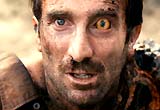 Wikus - Seriously Wounded and Remaining Behind |
||||||||||||
|
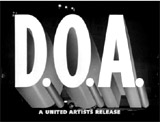
D.O.A. (1950)
This classic noir detective story was remade as Color Me Dead (1969, Australia) and as D.O.A. (1988), starring Dennis Quaid and Meg Ryan in a completely-revised story. Its main premise was also the basis for the action thriller Crank (2006). It opened with an unlikely and innovative shocking premise -- the protagonist hero, a tax accountant-notary public named Frank Bigelow (Edmond O'Brien), was already dead. Filmed with a lengthy tracking shot, Bigelow entered a Los Angeles police station, walked to the Homicide Division door, entered, and told the Captain (Roy Engel) in charge: "I want to report a murder" - and when asked about where, when and who was murdered, he replied: "In San Francisco, last night...I was." To Frank's surprise, the LA Captain had already been alerted with an APB (All-Points Bulletin) from Inspector Bannet in the Homicide Division in San Francisco about a Missing Person named Frank Bigelow. In flashback, he described how he had been slowly "murdered" after he had just arrived in San Francisco for a one-week vacation. [His drink was swapped in a San Francisco jazz or "jive" night-club (The Fisherman) - doctored by a lethal dose of glow-in-the-dark "luminous toxin" (radiation poisoning by iridium).] He learned of the shocking toxology report in a Doctor's office: "Our tests reveal a presence in your body of a luminous toxic matter... A poison that attacks the vital organs...Your system has already absorbed sufficient toxin to prove fatal. I wish there was something that we could do...There is nothing anyone can do. This is one of the few poisons of its type for which there is no antidote" - Bigelow was told that he was already "dead" and that he had maybe a day or a week or two to live. The remainder of the film was an investigation by the doomed and dying man (with only a few days to live) into why he was lethally poisoned. He was aided in the case by his blonde secretary-girlfriend Paula Gibson (Pamela Britton), who was interested in a serious relationship with him, although he kept putting her off (until the film's conclusion when it was too late). Bigelow rationalized his refusal to get serious: "I don't want you to get hurt, darling. More than anything in the world, I don't want you to get hurt." Paula relayed news to Bigelow about an alleged suicide - owner Eugene Phillips of the Los Angeles-based Phillips Import and Exporting Company - who had suspiciously jumped off the balcony of his six-story high-rise apartment a day before. After leaving San Francisco, Bigelow followed evidence to try to find out why Eugene Phillips had been trying to contact him before his death. He abruptly flew back to Los Angeles and met with four individuals:
Bigelow learned from Stanley, the deceased Eugene's younger brother, that Eugene was in "a jam" and faced a long prison term - he had been arrested two days earlier (but then was released on bail) for illegally selling a shipment of stolen iridium (a very costly and rare metal) through his company associate George Reynolds to a "dealer by the name of Majak" (Luther Adler). The exchange had been made six months earlier in Palm Springs, CA. Bigelow had notarized the bill of sale for the shipment of iridium from Phillips' company associate George Reynolds (acting falsely on behalf of Eugene) to Majak. Bigelow had become involved because he had inadvertently and innocently notarized the bill of sale, but Reynolds had now disappeared. If the original bill of sale surfaced, then Reynolds would be revealed to be the one who was illegally selling iridium and would face a prison term, not Eugene. That would discredit Eugene's apparent suicide. The critical bill of sale, seemingly stolen and/or destroyed by Reynolds (or someone else, revealed later!) around the time of his disappearance could prove that the original legitimate transaction was not made by Eugene - and was not the motive for Eugene's 'suicide'.
And then by sleuthing at a photographic studio with a picture of the alleged George Reynolds, Bigelow discovered through Reynolds' acquaintance - photo model Marla Rakubian (Laurette Luez) (who also had an affair with Eugene in the past), that his real name was Raymond Rakubian. As Bigelow left the studio, he was fired at by an unidentified figure from a nearby warehouse. A clue was left at the scene - a matchbook from The Fisherman jazz club in SF - signifying that the shooter was the one who had poisoned Bigelow's drink -- (Spoiler: Halliday!)
Bigelow was taken away at gunpoint by Majak's psychopathic henchman Chester (Neville Brand) to eliminate him because he knew too much about Raymond and Majak's drug-dealing relationship: (Majak: "You know too much, and I am in danger.") Chester threatened Bigelow:
Fortunately, Bigelow was able to escape and Chester was shot dead by a policeman in a downtown LA drug store. And then brother-in-law Stanley also turned up poisoned (with only a few days to live), after having dinner with his sister-in-law Mrs. Phillips and Halliday, when he had confronted them with an incriminating letter of the two year affair between Halliday and Eugene Phillip's wife. In reality, Eugene had been pushed off the sixth story balcony to his death by Halliday because Eugene had just found out about his wife's affair. Mrs. Phillips and her conspiratorial secret lover Halliday faced a possible murder conviction of plotting to kill Eugene. Therefore, all evidence of the sale was being systematically eliminated by the two of them, it appeared, as a cover-up or diversion for the murders. Mrs. Phillips admitted to stealing the bill of sale herself. And anyone else who was involved with or could prove that there was a bill of sale for the illegal substance was to be eliminated. Mrs. Phillips confessed everything to Bigelow about why he had been targeted with the poison (administered by Halliday in SF): "My husband had no reason to commit suicide. Halliday was desperate. After he killed my husband, he found out about the phone calls to you. He thought you spoke to him. That you knew enough to involve him." The film returned to the opening scene after Bigelow's crazed, gun-blasting face-off with slick but ruthless murderer Mr. Halliday as he left his downtown office (wearing the same coat and scarf he had worn in the SF club bar) and was shot multiple times on the stairway. The story (told in flashback) returned to the police station, where Bigelow finished describing how he had just solved his own murder case:
Then as he struggled to his feet, leaned on the Captain's desk, and uttered his last words (referencing his beloved secretary: "Would you...Paula"), he fell dead to the floor. The police Captain responded to a question from a deputy about making out the Missing Persons APB report on him:
In close-up, Bigelow's Missing Persons APB report was stamped: D.O.A., before the end credits. |
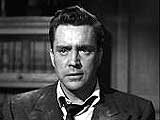 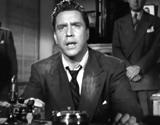 Frank Bigelow (Edmond O'Brien) - in Homicide Division of LA Police Station: "I want to report a murder...I was (murdered)." 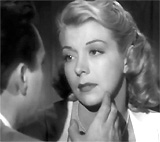 Bigelow's Secretary-Girlfriend Paula Gibson (Pamela Britton) 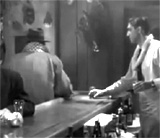 Bigelow's Fateful Drink Swap in a SF Nightclub 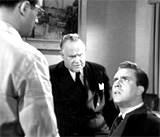 The Devastating Toxology Report from Dr. Schaefer on Bigelow's Poisoning 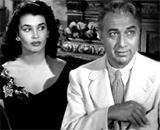 Gangster Majak (Luther Adler) with Mistress Marla Rakubian (Laurette Luez) 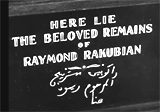 George Reynolds' (aka Raymond Rakubian) Remains 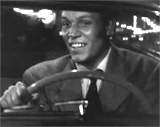 Gangster Majak's Lead Henchman Chester (Neville Brand) 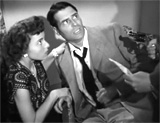 Stanley Phillips Divulging Incriminating Letter to Bigelow About Halliday's Affair with His Brother Eugene's Wife 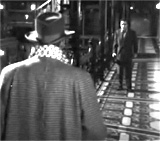 The Deadly Standoff and Shootout With Mr. Halliday Outside his Downtown LA Office 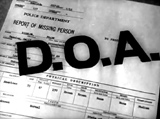 Last Image: Missing Persons Report Stamped D.O.A. |
||||||||||||

|
Dogville (2003, Danish)
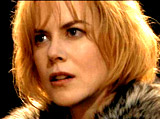
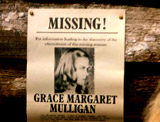
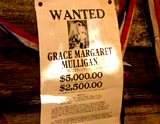
Director Lars von Trier's 3-hour stage-bound drama was composed of nine chapters and a prologue (which introduced the town of Dogville and its residents). It was set in the 1930s and opened in the small Rocky Mountains mining town of Dogville, Colorado (near an abandoned silver mine), with a central thoroughfare named Elm St. The main character was the town's philosopher and self-appointed moralist Thomas Edison, Jr. (Paul Bettany). Suddenly, he heard strange gunshots in the distance, and soon befriended frail yet kind Grace Margaret Mulligan (Nicole Kidman), when alerted to her presence by the sound of the town's barking dog, Moses. She had fled to the isolated town to escape from mobsters in a black limousine. Tom helped her hide in the mine to avoid detection. The unseen boss in the back seat offered his card to Tom and a "considerable reward" for the location of a "very precious" young girl, who may have entered the town in her confusion. He claimed: "I don't want any harm to come to her." As a stranger and fugitive needing shelter and in exchange for protection, Grace helped the townsfolk during a two-week trial period, arranged by Tom at a town meeting, although she was first greeted with reluctance and hostility. She was to work in each household one hour per day, doing physical labor (odd jobs and chores), including weeding, lengthy discussions with the town's blind man, looking after children, etc. As time went on, she was accepted and allowed to stay after two weeks (signified by 15 bell tollings or votes in a second town meeting) - she believed she had found true friendship. She used some of her wages to purchase a series of seven tiny china figurines in the town's shop, and she moved into the town's mill. Pressure on her increased when her status was changed from "Missing" to "Wanted" - indicated by successive flyers brought by a local policeman (although she couldn't have possibly committed the alleged crimes - some bank robberies on the West Coast). She was pressed and exploited to do more arduous work, and her pay rate was cut. She began to be treated more harshly, exploitatively and abusively by the men and women, especially by Chuck (Stellan Skarsgård) and his wife Vera (Patricia Clarkson). After blackmailing Grace and threatening to turn her in, Chuck raped her. She was also accused of spanking one of Vera's boys, Jason (Miles Purinton), who had provoked her to punish him, and Vera vengefully destroyed all of Grace's seven figurine dolls - when Grace could not stoically hold back her tears. During a failed escape attempt, Grace was raped (as an additional surcharge for being a "dangerous load") by apple freight truck driver Ben (Željko Ivanek), and then returned to town. He claimed that he had found her hiding in his truck. To prevent her escape again, Grace was further downgraded with an "escape prevention mechanism" - a large collar that she was required to wear around her neck, attached to a heavy iron wheel that she dragged around. Her presence to the vindictive and suspicious townsfolk was signaled by a bell on the collar. And to make matters worse, "most townspeople of the male sex now visited Grace at night to fulfill their sexual needs." To assuage his own guilt regarding Grace's victimized and degraded treatment, Tom summoned the townsfolk at another meeting to listen to Grace deliver a speech. She would truthfully describe her condition (a "web of misunderstanding and injustice") to them. He urged: "Don't be hateful. Don't be reproving...And from there, it's only one small step to forgiveness." But Grace's words were not received kindly by the defensive and indignant townspeople - Grace's speech was interpreted as lies and accusations, and some urged that the troubled girl should leave town. In the film's conclusion, the gangsters were summoned to the town by Tom (for a "long-awaited visit"), after he had once again been rebuffed by Grace for wanting to have sex with her. In the back seat of a black Cadillac limousine, Grace was convinced by her regretful and apologetic father, the boss (James Caan), that he was accepting her back as his daughter. They talked about how the evil and cruel town of Dogville and its mistreating, transgressive residents deserved judgment - they should be eliminated. (Grace: "If there's any town this world would be better without, this is it"). For the "sake of humanity" and for her own sake, she became a "conspirator with him and his gang of thugs and felons" to shoot the residents of Dogville and burn down the town. She assented to the wholesale slaughter, specifying:
She watched from the limousine as flames roared through the town, and the townsfolk were machine-gunned to death by the gangsters.
The town's only spared resident was the barking dog Moses - the only one that didn't wrong Grace ("His survival was astonishing, a miracle") - Grace ordered: "Just let him be." |
   Grace Mulligan (Nicole Kidman): WANTED 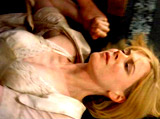 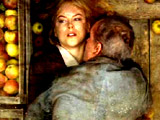 Grace Raped 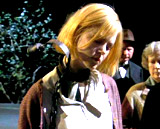 Forced to Wear Collar 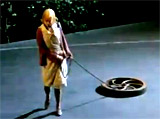 Attached to Heavy Iron Wheel 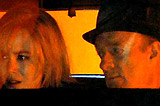 Grace in Limousine with Father (James Caan) |
||||||||||||

|
Domino (2005, UK/Fr.)
Director Tony Scott's excessively-stylish and experimentally-showy film, subtitled "I Am a Bounty Hunter," was a dramatic and violent action-crime thriller. The semi-biopic was "sort of" based on the true story of the life of Domino Harvey (Keira Knightley), the real-life daughter of British actor Laurence Harvey (who died when she was 8 years old) and model Paulene Stone ("Sophie Wynn" - played by Jacqueline Bisset), who chose to forego her life as a fashion model. After moving to Beverly Hills when her mother remarried, she attended college before being quickly expelled and joined the services of "legendary bail bondsman" Claremont Williams III (Delroy Lindo), working as a bounty hunter ('bail recovery agent'). She worked in a team along side:
She told them: "I want to have a little fun." Later she admitted: "We may have been dysfunctional, but we worked. We were family." As a bounty hunter, she accepted an opportunity to tell her story and receive recognition by appearing in a new WB network reality TV show titled Bounty Squad (produced by Mark Heiss (Christopher Walken)) about the trio (although later stated: "It was the beginning of the end"). The hard-to-follow story began with her questioning by the FBI's criminal psychologist Taryn Mills (Lucy Liu) after her arrest - with flashbacks to tell the story - and her involvement in the hijacking and heist of $10 million cash from an armored truck 36 hours earlier. The truck was enroute from LA to Vegas. Domino promised: "I'll tell you everything I know." The money in the truck ostensibly belonged to Drake Bishop (Dabney Coleman) - wealthy owner of the Stratosphere Hotel and Casino in Las Vegas, but actually, the money belonged to the Mob and was being laundered ("Bishop's clean reputation was a great cover for laundered cash"). To collect a $300K finder's fee for Williams, Domino (in a trio of bounty hunters working for Williams - who also ran an armored car service as well as a bounty hunter service) had been sent to track down and capture the four thieves, wearing "First Lady" masks during the heist. The film's twist was that the entire botched theft was actually orchestrated by Williams and his "sassy black" mistress - DMV clerk Lateesha Rodriguez (Mo'Nique) - to pay for an expensive operation (costing $300K) for her terminally-ill granddaughter Mika suffering from a rare blood-disease. (The "inside job" heist was falsely blamed on Frances and three other college students at Cal West LA - unfortunately two of them were related to a Mafia crime boss - when Frances was targeted as he happened to be in the wrong place at the wrong time, acquiring counterfeit drivers licenses at the DMV.) The bounty hunters delivered the four alleged thieves (set up as "Lateesha's patsies") to Needles, CA (where they were intercepted by Bishop's men to be executed). Domino complained to Williams:
The bounty hunters retrieved the stolen money hijacked by armored truck getaway driver Locus Fender and hidden in his mother Edna's trailer in the Nevada desert - the opening sequence of the film seen in flashback. They drove away to deliver the money to Bishop in Vegas in their Bounty Squad Winnebago. $300K of the money was given to Lateesha to fund her baby's operation before a rendezvous with Bishop. There were a series of misunderstandings (the college kids weren't actually killed), double-crosses, and further involvement by the FBI. A bloody showdown occurred at the top of the Stratosphere Casino between the bounty hunters, Drake Bishop and his men, and the mobsters (wrongly believing that Bishop had killed the college boys). Multiple deaths occurred when the Stratosphere Casino was blown up by explosives set by Alf (he had switched the money bags with explosives) - and Domino was the sole survivor. Traitorous Alf had also sent the money to Afghanistan to aid revolutionary freedom fighters there. Afghani children opened bundles of US bills and tossed them into the air - corrupt Las Vegas money fluttered down on them. All the incidents of the film reflected Domino's life philosophy - everything was a coin toss, with only a 50-50 chance of survival or death. In the conclusion of the film, Domino narrated (offscreen):
|
     Domino Harvey (Keira Knightley) |
||||||||||||

|
Donnie Darko (2001)
This mystifying cult science fiction drama, a coming-of-age tale by director Richard Kelly (his directorial debut film), had the tagline:
It was filled with unusual ideas and characters, including:
The main character was Donnie Darko (Jake Gyllenhall), a disturbed and troubled teenager with 'paranoid schizophrenia' and experiencing doomsday visions, while living in Middlesex, Virginia. He was receiving ongoing counseling from psychotherapist Dr. Thurman (Katharine Ross), who thought he was classically schizophrenic. The fantasy sci-fi film's premise was voiced by the 'new-girl-in-town' Gretchen Ross (Jena Malone) - Donnie's girlfriend, who told him:
In an earlier part of the film, on October 2, 1988, Donnie was saved from death when a detached jet engine crashed into his second-story bedroom while he was out sleep-walking and summoned by life-sized rabbit "Frank" onto a golf course. Because of Donnie's detachment from reality and personality issues, and his belief that the world was about to end, he exhibited strange behaviors. He flooded his school, and committed arson - presumably following directions from "Frank." Midway through the film while on a date with Gretchen at a Halloween Frightfest showing of "The Evil Dead," Donnie saw the rabbit "Frank" remove his mask - revealing a teenager with a bloody right-eye wound (a foreshadowing). At the end of the film as Donnie and his older sister Elizabeth (Maggie Gyllenhaal) were holding a celebratory Halloween party at their parents' house, Gretchen was accidentally run over outside Grandma Death's house and killed by a red car driven by Elizabeth's boyfriend Frank Anderson (James Duval) - wearing the rabbit costume (similar to Donnie's "Frank"). Angered, Donnie shot Frank in the eye and killed him, using his father's gun, and then carried Gretchen's body home. Above the town, Donnie saw a time tunnel portal or vortex forming in the sky. He also saw that an airplane was descending in the sky - it was his mother Rose's flight returning from Los Angeles from a "Star Search" competition (Rose had served as a chaperone) with his sister Samantha (Daveigh Chase), a contestant dancer in a dance troupe. One of the plane's engines became detached and emerged from the time portal. According to the time travel theory, Donnie willed the Earth to reverse itself from October 30 back to October 2nd - 28 days (as forecast by "Frank") - the day that Donnie had earlier been spared. The plane's jet engine crashed into the Darko house - a second time - but this time, Donnie was in his bedroom sleeping and perished in the disaster. As a result, the course of history had been changed - as Gretchen had stated earlier. She was saved from death (and so was Frank). Donnie also revealed the contents of a letter written to Grandma Death:
In the final scene the next day, Gretchen (who hadn't died) rode her bike by Donnie's house and waved to his distraught mother Rose (Mary McDonnell). The film's last line was from a young boy named David (Scotty Leavenworth) asking Gretchen whether she knew Donnie or not:
|
 Detached Jet Engine 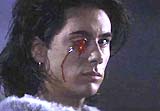 Teenager With Bloody Right Eye Wound 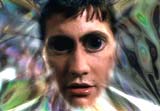  Envisioning the Vortex  Time Tunnel Portal  Crashing Jet  Ending: Gretchen Waving at Donnie's Mother After Donnie's Death |
||||||||||||
|
Director Nicolas Roeg's dramatic psychic horror film was based on a short story by Daphne De Maurier. It had the tagline:
The supernatural, mysterious, eerie, psychological thriller told about a British couple in Venice:
Following the tragic, accidental drowning of their blonde daughter Christine (Sharon Williams), the couple had traveled to Venice where he worked on restoring a church, still shattered and haunted by their child's death. In the off-season resort, they met two elderly sisters, Wendy and Heather (Hilary Mason and Clelia Matania), one of whom was blind but claimed to be psychic. She insisted that, in visions, she saw the spirit of the Baxters' red-coated daughter, and possessed a message of warning from the dead child. Although foreshadowed by earlier events, John had a shocking death scene in the film's conclusion. Grieving, haunted art restoration expert John sighted an elusive small figure in a bright red hooded coat in a dark Venice alleyway. Although skeptical and resistant, he thought it was his recently-drowned blonde daughter brought back to life. He followed after the enigmatic figure and was confronted by what turned out to be his nemesis - the serial killer who was stalking Venice. He ascended a swirling staircase, assuredly telling the figure with its back to him:
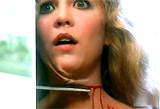
It wasn't his daughter - but a murderous, androgynous dwarf (Adelina Poerio) - the one pictured sitting in the pew in the slide in the film's opening - who turned around, withdrew a long sharp knife from her right coat pocket, and deftly sliced his throat with one quick swing. He fell onto the stone floor and bled to death - punctuated by the peals of bells, swirling camera angles, and quick images from earlier in the film. John's funeral at a Venetian canal-side church ended the film. |
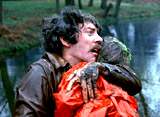 Drowning Death of Baxter Daughter in Red Raincoat 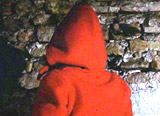 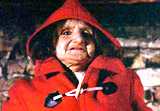 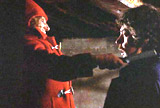  The Murderous Dwarf in Venice, Stabbing John Baxter to Death |
||||||||||||

|
Dr. Strangelove, Or: (1964, US/UK)
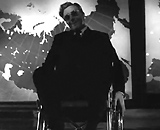
Kubrick's apocalyptic dark comedy featured mad German scientist Dr. Strangelove (Peter Sellers), with thick dark sunglasses. He also had a black-gloved mechanical, robotic right hand, and his left hand shakily held his cigarette. Seated in a dark area at the circular War Room table, he wheeled his shape into view, to describe how the US had abandoned its own plans for a Doomsday mechanism, yet added:
Strangelove asserted that the essence of the Doomsday Machine was that it could be "triggered automatically" and also "impossible to untrigger." With fervent, Nazi-like ardor, he theorized :
Later, as the Doomsday Machine was triggered - and Major 'King' Kong's (Slim Pickens) H-bomb was detonated, Strangelove described his absurd 100 Year Plan (including a mine-shaft survivalist proposal):
With an absurd grin on his face, his own sexual pleasure was kindled as he excitedly talked about selective sexual breeding at a ratio of 10 females to one male, for those who were chosen to live underground. He described the sexual implications: "The women will have to be selected for their sexual characteristics which will have to be of a highly stimulating nature." As he was more and more stimulated by his thoughts, Strangelove's right arm reflexed into a Nazi salute - he pulled it back into his lap and beat at it.
And then ecstatic over the total annihilation of the Earth, Strangelove "resurrected" himself, miraculously regaining his ability to walk when his mechanical, robot-like body rose out of his wheelchair, and he cried exultantly in the War Room:
A climactic chorus of H-bomb mushroom clouds spread as multiple explosions detonated around the world, annihilating and causing oblivion by bringing radioactive fallout to millions of people. The popular, comforting WW II tune, Vera Lynn's We'll Meet Again Some Sunny Day ("We'll meet again / Don't know where, don't know when / But I know we'll meet again / Some sunny day") played in incongruous juxtaposition. |
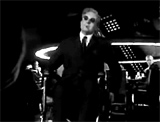  Dr. Strangelove (Peter Sellers) 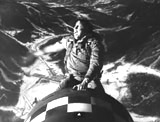  Major Kong (Slim Pickens) Riding the H-Bomb to His Death  The Ending ("We'll Meet Again...") |
||||||||||||

|
The Double (2011)
Director/writer Michael Brandt's predictable political spy thriller with a Cold War theme. It had some similarities to the early twisting thriller No Way Out (1987) with Kevin Costner. Its tagline was:
The espionage film opened with the assassination of US Senator Dennis Darden (Ed Kelly) (R, Kansas) in an alley behind a Washington DC warehouse. The unknown assassin slit his throat with a metal-wire garrote pulled from his wristwatch - a trademarked murder. CIA director Tom Highland (Martin Sheen) called upon retired CIA operative Paul Shepherdson (Richard Gere) to reluctantly investigate the inexplicable murder (although Darden had numerous business interests inside Russia).
The killing was possibly committed by former Soviet operative and elusive double-agent assassin, code-named Cassius. Shepherdson had spent 20 years tracking the notorious Cassius and eliminating members of his Cassius Seven group, a vicious hit squad code-named after the Roman senators who killed Julius Caesar. But Shepherdson had never located the man himself who was presumed to be dead.
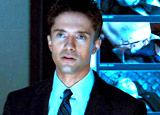
Shepherdson was 'odd-coupled' or paired with fresh-faced, eager, obsessive young rookie FBI agent Ben Geary (Topher Grace), who suspected that international Russian spy Cassius had retired in the US, resurfaced and committed the killing. The educated, hotshot recruited agent had written his Harvard Master's thesis on Cassius and Shepherdson's tracking of him. Then, the plot's twist was revealed fairly early on at about the 30 minute mark - Paul was super-assassin Cassius. [Note: The film's trailer gave away this important plot point and presented almost an entire summary of the film.] Paul Shepherdson divulged that he was the "double" during his killing (with his trademark wristwatch-garotte) of Cassius' thuggish protege Brutus (Stephen Moyer), aka Igor Ivanovich Kozak, who had been incarcerated in Brinkerman Penitentiary and was in the process of escaping during treatment at a hospital. Meanwhile, both Paul and Ben pursued Russian KGB terrorist and hit-man murderer Johann Bozlovski (Tamer Hassan), one of the last remaining Cassius Seven. He had entered illegally into the US by being smuggled in through Mexico (in the film's opening). He was identified as the assassin who had killed Shepherdson's wife and child in Geneva in 1988. During a game of cat and mouse for the remainder of the film, Ben began his own separate investigation and strongly suspected that Paul was Cassius ("the entire time, he's been hunting himself"), especially after realizing that Shepherdson had returned to the scene of many of his crimes (throat-slit killings) over the years. As Ben got closer to his target, Paul tried to warn Ben's pretty wife Natalie (Odette Yustman/Annable) to urge her husband to drop the case against Cassius:
A second twist (or double-cross) was then presented about a second 'double' - Ben was a Russian spy with orders to eliminate Cassius. Shepherdson discovered that Ben had received his instructions through a coded crossword puzzle with Russian words, translated: "Cassius, Eliminated, Exit." Shepherdson then accused Ben of equal duplicity: "You've been a double your whole life." Ben's intent, for his bosses back in Moscow, was to expose Shepherdson as Cassius after killing him. He divulged his specific orders: "My orders are to kill you and return to Moscow" - without his family. His mission was to "make the landscape safe for our new arrivals." Ben was the one who had killed Senator Darden (by using Cassius' technique) to flush Shepherdson out of retirement in order to complete his task. But then Ben, in a striking turnabout, decided with Shepherdson to pretend that Bozlovski was Cassius. The two worked together to corner Bozlovski in a warehouse, where a mortally-wounded Shepherdson (shot by Bozlovski) vengefully slit Bozlovski's throat with his garrote-watch, and died after telling Ben: "Go home." In his report to CIA director Highland, Ben claimed that Bozlovski was Cassius, by showing him Cassius' watch on Bozlovski's wrist. By doing so, he kept Paul's reputation intact and recognized his dying heroism. As the film ended with another gimmicky last-second surprise, Highland asked the stunned Ben if he would like to work for the CIA:
|
 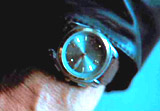 Paul With Cassius' Trademark Wristwatch-Garotte 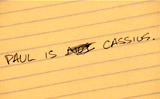 "Paul is...Cassius."  Wounded Paul Shepherdson (aka Cassius) Slitting Russian Bozlovski's Throat With Watch  Ben (a "Double-Agent" Russian Spy) Being Asked to Work for the CIA by Director Highland |
||||||||||||
|
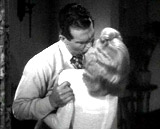
One of the greatest film noirs of all time was Paramount's and director Billy Wilder's definitive film, based upon James M. Cain's novel. The flashbacked film told of a sizzling relationship that developed between two murderous conspirators:
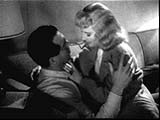
Phyllis described the suffocating relationship she had in her marriage. "Crazy" about each other, she persuaded Neff to join her in scheming to kill her husband and help her make it look like an accident - to collect on her husband's accident insurance policy. The film ended with a final confrontation between the two plotters. A gunshot rang out, and Walter staggered at her window as he turned and was hit by the bullet in the shoulder. He dared her to finish the job with another shot, but she hesitated and was unable to kill him for some reason (because of her love for him, or because of her conscience?). She admitted to being "rotten to the heart" after shooting him, but he didn't "buy" her act. She asked him to hold her close - and when she surrendered in his arms, she drew slightly back in surprise and fear, realizing that it was her final moment when she sensed the barrel of his gun against her chest. Cold-heartedly, he told her: "Good-bye baby." Walter grimly shot her twice at point-blank range - during their erotic embrace. The film returned to the present (4:30 am) in Neff's office, where he was recording his dying confession, and where he admitted his guilt to insurance colleague Barton Keyes (Edward G. Robinson). The two colleagues concluded their 'game' of concealment and detection:
Walter struggled to light a crumpled cigarette he had pulled out of his pocket. Keyes identified with the criminal - he assisted Walter by ritualistically lighting his cigarette for him.
|
  Femme Fatale Phyllis Dietrichson (Barbara Stanwyck) Seducing Walter Neff 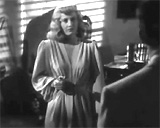 Phyllis With Gun 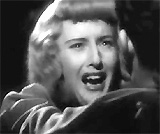 Neff: "Good-bye Baby." 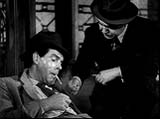 The Ending: Neff Confessing to Barton Keyes (Edward G. Robinson) |
||||||||||||
|
Dream House (2011)
This confusing and disjointed psychological horror-thriller from director Jim Sheridan had a troubled production history. The overwrought, misfiring film told of the psychological distress and healing of a troubled man whose family was involved in a multiple homicide. One point of contention was that the film's official trailer gave away one of the most important plot points and twists. Its tagline was:
The film had elements borrowed from The Amityville Horror (1979) (the strange house), The Shining (1980) (the two girls, the book writing), The Sixth Sense (1999), The Others (2001) (ghosts), and Shutter Island (2010) (confused-identity). At the beginning of the film, successful NY publishing house editor Will Atenton (Daniel Craig) believed he was a writer named Will Atenton with a family. Atenton family members included two children:
He was mistaken - he was actually named Peter Ward. Members of the Ward family had actually been murdered in an unsolved multiple homicide in their suburban Connecticut 'dream house" in the town of New Ashford. The trauma had left Will/Peter out of touch with reality and delusional. He was reliving, reimagining, or hallucinating (in flashback) a time when his family was alive. Will's identity as Peter Ward was revealed after the first 40 minutes of the film (and spoiled in the film's official HD trailer). He was in denial and grief-stricken about the 'slaughter' of the Ward family exactly five years earlier, so much so that he had created a new identity for himself. Using the codes on his wrist band, he had invented a new name: "Will Atenton" [W1-1L 8 - 10 - 10].
The film revealed that the killers five years earlier were his across-the-street neighbor's angry and vengeful husband, Jack Patterson (Martin Csokas) and his hired hitman Boyce (Elias Koteas). Jack was divorcing his blond-haired wife Ann Patterson (Naomi Watts), and was angry that she would get everything, including custody of their teenaged daughter Chloe (Rachel G. Fox). Boyce messed up the proposed hit-murder when he entered the wrong house - a case of mistaken identity. Will/Peter's two daughters and Libby were shot during a struggle, and Libby accidentally shot Will/Peter in the head, allowing Boyce to escape after Libby died. It looked like Peter, left injured at the scene, had committed the crime. In a last vindicating confrontation with Jack and Boyce who were again attempting to kill Ann, Jack first took revenge on Boyce by shooting him in the stomach ("You've tormented me for five goddamn years. Child killer"). The ghost of Peter's wife helped him to fight back against Jack and save Ann. Jack was going to make it look like Will/Peter killed Ann, and then set the house on fire after pouring gasoline everywhere. Peter saved Ann by carrying her out of the flame-engulfed house, while Jack (and a wounded Boyce) were caught inside and burned to death. Peter had one last moment with his wife Libby inside the burning house. After she told him that he must go and leave them, he kissed his daughters goodbye. Libby told him of her abiding love ("I love you. I'll always be with you...But you know that"). Before rushing out, Peter retrieved his journal that he had hidden earlier under one of the wooden stair-steps. At the end of the film, an undisclosed amount of time later, Peter was living back in New York City. His novel "Dream House" based on the murders (the movie's plot) was a best-selling book (displayed in a bookshop window). It was inferred that Peter had started to come to grips with his family's death and was ready to move on and live his life again. The above appears to be the most straight-forward explanation, although some critics have written that the entire movie was the fictional, fantasy creation within the mind of writer Peter Ward - and everything never happened. Others have speculated that Peter Ward (Will Atenton) actually killed his family - and the film's plot was a journey through his twisted mind as he invented an alternate reality to shield himself from the awful truth. |
 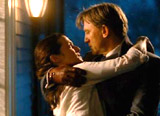 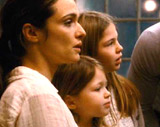 The Ward Family 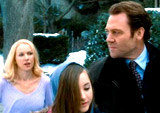 Angry Next Door Neighbors: The Pattersons 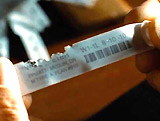 Peter's New Name From Wrist Band ("Will Atenton")  Patterson's Hired Hitman Boyce (Elias Koteas) 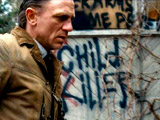 Peter/Will Accused of Being "Child Killer" - Graffiti  Peter/Will - Had He Come to Grips With Family's Death? |
||||||||||||
|
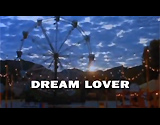
Dream Lover (1994)
Writer/director Nicholas Kazan's suspenseful erotic thriller was his directorial debut film, about a scheming and seductive "dream lover" who went on to completely destroy a man. It was similar to director Curtis Hanson's psychological thriller Bad Influence (1990) with Rob Lowe as the negative and fatal influence (upon co-star James Spader again!), and the wildly-popular Basic Instinct (1992). Upon meeting the beautiful and sensual Lena Mathers (Madchen Amick), successful architect and recent 27 year-old divorcee Ray Reardon (James Spader) was spellbound by her beauty after sex and dream dates. During lovemaking, she hinted at her true nature:
A storybook romance ensued, they married - and soon had children. Afterwards, however, his mysterious wife's past became questionable and suspicious - and he realized that he had been duped by the femme fatale. She had deliberately gotten close to him to hastily marry him and acquire his money. The increasingly-paranoid and distrustful Ray was soon accusing her of being a perpetual and deceitful liar ("If the things you tell me aren't true, then what is true?") regarding her identity, her friends, the bruises on her leg, her afternoon disappearances to conduct an affair with friend Larry (Frederic Lehne), and her past. He accused her of stealing his house, his children, and of being a psychopath, intent on having him declared insane. After he slapped her, she was able to have him committed in an institution for six months of observation - where he faked insanity and sedation, while he was scheming with Larry's wife Elaine (Bess Armstrong) to find revenge. In the film's twist ending, Lena visited him at the institution for his birthday party, and he lured her away to talk alone, unseen by attendants. She admitted: "You still don't have the faintest clue who I am or what I do." He responded: "Likewise." He complimented her on being "so beautiful, ravishing." He then told her: "This is the last time we're gonna see each other, right?" He described how he felt "alive" and "inspired" finally - and grabbed her. She threatened to scream, but he cautioned her that she wouldn't get what she wanted or deserved. He suggested that he wanted to help her by telling her the flaw in her plan, so that she wouldn't repeat her error the next time around. He first demanded a real kiss: "Kiss me and I'll tell, only it has to be a real kiss. Something to remember." After he kissed her, he stated: "Who are you, Lena? Who will you be when you die?" Before strangling her to death, he told her there would be no consequences for his actions. He claimed that since he had been declared insane, he couldn't be held accountable for her death:
He strangled her, and then laid her body on the lawn. The film abruptly ended with the credits atop images of Ray and Lena wildly revolving on a dance floor. In the extended version of the film, Ray was released from the hospital and was with his children at the zoo. |
 Scheming Lena (Madchen Amick) 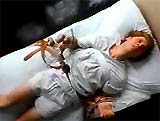 Ray Institutionalized For Observation     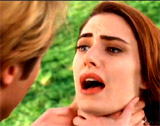 Ray's Final Meeting With Lena - Strangling Her |
||||||||||||
|
Dressed to Kill (1980)
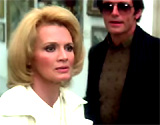
The main protagonist in this erotic thriller was sexually-unfulfilled Kate Miller (Angie Dickinson), who was in therapy with respected psychologist Dr. Robert Elliott (Michael Caine) - later revealed to be a murderous trans-sexual. During a session with Dr. Elliott, Kate told him: "I like to turn men on. I must do a pretty good job, because they pay me alot." She began seducing him, telling him that she often made sex to men that aroused her, without accepting money: "A mature, doctorly type, like you." She boldly proposed: "How about some sexual assistance? Do you wanna f--k me?" She admitted having sex with a lot of married doctors in her time, countering his resistance. She removed her coat "and the rest too," showing off black lingerie, asserting why she did it: "Because of the size of that c--k in your pants" - and she found herself in a dangerous situation after arousing him - because of his split-personality. He rebuffed or declined her advances.
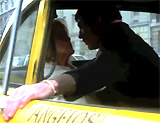
During a brilliant, 10-minute sequence in the Metropolitan Museum of Art, Kate played a dangerous 'cat-and-mouse' flirting game with a nameless stranger (Warren Lockman (Ken Baker)). Then she was seduced in a taxi-cab en route to the man's apartment (she left her panties in the taxi), where she had adulterous sex. The film was remarkable for the post-seduction scene in which Kate found a Department of Health letter in the stranger's drawer stating that he had a venereal disease. After her tryst when she left in an elevator (and returned to retrieve her wedding ring), she suffered a vicious razor-slashing - her punishment or fate for 'free love'? - from a presumed blonde female with dark glasses that was witnessed by high-class prostitute Liz Blake (Nancy Allen). In this film's early horrific murder sequence in Brian DePalma's ripoff/homage of Psycho (1960), she was slashed to death in the enclosed space of the elevator. She was presumably murdered by a mysterious black-coated woman wielding a sharp razor (seen in the elevator's convex mirror) and wearing sunglasses. Later, the killer also threatened to kill blonde prostitute Liz Blake (Nancy Allen) - a witness to Kate's murder and a prime suspect. Liz and Kate's clever son Peter (Keith Gordon) schemed together to set up traps to track Dr. Elliott's patients. At one point, they entered Elliott's office where Liz sexily stripped down to her black lingerie, when she was attacked by the knife-wielding "Bobbi." It was revealed that the homicidal murderer with a split personality was Dr. Elliott whose other trans-gendered persona (representing his female side) was an unhinged patient named "Bobbi" - he literally was 'dressed to kill' as murderously-jealous "Bobbi" by wearing a blonde wig and dark glasses for his brutal killings. "Bobbi" was the female side of his personality that felt threatened by sexual arousal. The film ended with another nightmarish shower sequence in which Liz dreamed that the insane and vengeful doctor had escaped from a mental hospital after strangling a nurse, and wore the nurse's shoes as disguise. He killed her with a sharp razor blade after she had stepped out of a shower -- similar to a violent rape/sex fantasy scene in the film's opening shower scene - however, Liz woke up screaming (and holding her neck) to end the film.
|
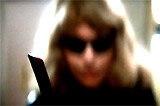 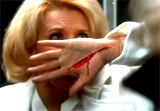 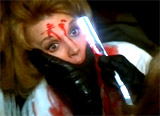 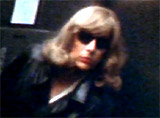 The Blonde Killer "Bobbi", Seen During the Murder of Kate Miller (Angie Dickinson) in an Elevator   Witness to Kate's Murder: Blonde Prostitute Liz Blake (Nancy Allen) 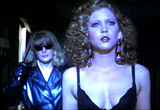 Liz Blake Attacked by Knife-Wielding Bobbi |
||||||||||||
|
Driving Miss Daisy (1989)
Director Bruce Beresford's Best Picture-winning drama told of the long-time devotion of two Southern individuals as they aged through life, in Atlanta, Georgia:
By film's end, they had developed a deepening friendship. In one of the last scenes, a mentally-dislocated Daisy told Hoke: "Hoke...you're my best friend...no, really, you are," and then took his hand in hers.
After being placed in a nursing home, during a Thanksgiving scene, an enfeebled 97 year-old Daisy was spoon-fed her Thanksgiving pumpkin pie by Hoke. |
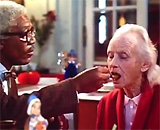 Thanksgiving Dinner Scene |
||||||||||||





 The
Four E-Mails That DigiCom's 'Passed Over' Production Manager Tom Sanders
Received Were Sent From an Unidentified "Friend" - Who Was
Revealed at the End to be the Son of His Company's Executive Female
Attorney, Stephanie Kaplan. Indirectly, She Had Successfully Urged
Tom to Defend Himself From Charges of Sexual Harrassment, and to Play
His Own Game Against Aggressor Meredith and "Solve the Problem." Tom
Countered More Serious Claims Brought Against Him Regarding Faulty
Foreign Manufacturing of His Company's CD-ROM Drive Player, Due to
Meredith's Conniving
The
Four E-Mails That DigiCom's 'Passed Over' Production Manager Tom Sanders
Received Were Sent From an Unidentified "Friend" - Who Was
Revealed at the End to be the Son of His Company's Executive Female
Attorney, Stephanie Kaplan. Indirectly, She Had Successfully Urged
Tom to Defend Himself From Charges of Sexual Harrassment, and to Play
His Own Game Against Aggressor Meredith and "Solve the Problem." Tom
Countered More Serious Claims Brought Against Him Regarding Faulty
Foreign Manufacturing of His Company's CD-ROM Drive Player, Due to
Meredith's Conniving