|

|
|
|||||||||||
|
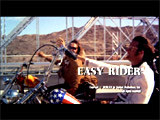
One of the first unexpected events in this film was the bludgeoning death of drunken lawyer George Hanson (Jack Nicholson) in his sleeping bag during the dark of night by unknown attackers. He was accompanying two cross-country, drug-dealing bikers out to find America, who admitted they had spiritually blown it (Wyatt: You know, Billy. We blew it."):
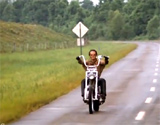
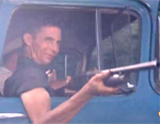
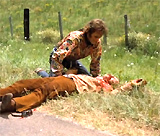
This foreshadowed the completely unexpected, anti-climactic and quick ending for the bikers. On one of the last stretches of roadside where American industry had not yet sprawled, two armed rednecks (David C. Billodeau and Johnny David) in a small pickup truck on a country road thought they'd have some fun with the two bikers (Arnold: "We'll scare the hell out of 'em"). Arnold asked: "Do ya want me to blow your brains out?" Billy responded by flipping off the gun-wielding shooter. The redneck responded: "Why don't you get a haircut?" and then suddenly shot at Billy with a gun blast. The bike skidded to a crash, and Billy was mortally wounded in the stomach. After Wyatt turned around and saw how injured Billy was, he pursued the truck - which had stopped and reversed itself further down the road.
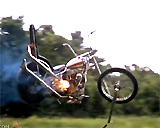
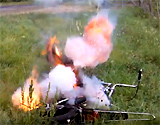
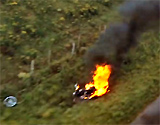
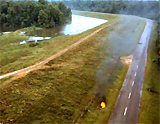
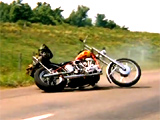
Suddenly, Wyatt's leather American flag-decorated bike exploded in flames (metaphorically?) (after a brief flash of red) when his gas tank was shot, but his body didn't appear in the wreckage of the bike that went sailing through the air. The film ended with the pull-back helicopter view of the winding river alongside the highway. |
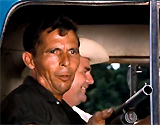 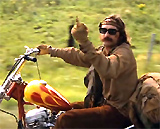    The Death of Billy |
|||||||||
|
Eddie and the Cruisers (1983)
Director Martin Davidson's film told about the aftermath for many years following the 'death' (disappearance) of charismatic lead band singer Eddie Wilson (Michael Paré) of the 60's rock band Eddie & The Cruisers. Its tagline was: "Rebel. Rocker. Lover. Idol. Vanished." Another longer description included this:
Just before the breakup of the band and Eddie's 'death' in 1964, the band's record company, Satin Records, refused to release the Cruisers' unheard second album titled Season In Hell. Master tapes for the album had also vanished from the vaults of Satin Records at the same time as Eddie's demise. One revelation later in the film was that Eddie's girlfriend Joann Carlino (Helen Schneider) was the one who had taken the tapes from the vault, and stashed them in one of Eddie's favorite places - the Palace of Depression (an unusual building manufactured with junk, and located in Vineland, NJ). By film's end, Joann turned over the tapes to an appreciative Doc Robbins (Joe Pantoliano), the band's manager who had been the one hunting for the missing master tapes for the album. He hugged them to his chest as he thanked her. The famous twist ending revealed that long-lost Eddie was still alive. He had faked his own suicidal death by driving his Chevy convertible over the side of the South Jersey Raritan Bridge almost two decades earlier, although his body was never found.
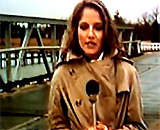
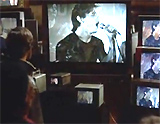
Eddie was seen (with a beard) in a TV store window display's reflection. He was the last spectator left watching the credits roll in a documentary tribute to himself on a bank of TV sets. Television reporter Maggie Foley (Ellen Barkin) narrated the documentary, ending with these words (backed by the band's singing of their song Season in Hell):
|
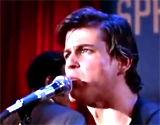 Eddie Wilson (Michael Pare) 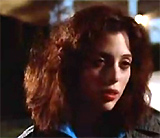 Joann Carlino (Helen Schneider) 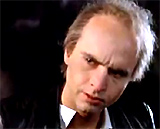 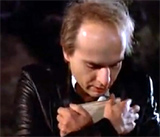 Doc Robbins (Joe Pantoliano) |
|||||||||
|
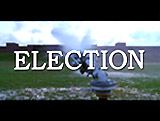
Election (1999)
By the end of director Alexander Payne's satirical dark comedy about an Omaha, Nebraska high school election and its personal and political ramifications, all of the Carver HS characters were profoundly affected (often they narrated their thoughts in voice-over). Its tagline was: "Reading. Writing. Revenge." The three candidates for the highly-competitive school election were:
The election was supervised by conscientious civics teacher and student government advisor Jim McAllister (Matthew Broderick). Also affected by events at the school were McAllister's best friend, neighbor and math teacher Dave Novotny (Mark Harelik) who had a career-ending and marriage-ending affair with Tracy. After the affair was revealed, Dave was fired from his job and divorced by his wife Linda Novotny (Delaney Driscoll). Pitting himself against Tracy's annoying overachieving dominance (and suspecting that Tracy destroyed competitor Paul's campaign posters), Jim attempted to sabotage and fix the close election (and cause Tracy's defeat) by discarding two of her ballots into a wastebasket. The thrown-away ballots were discovered by the disgruntled custodian - McAllister was caught and forced to resign from Carver High. At the same time, he was in the midst of an extra-marital affair with Linda, who informed Jim's wife Diane (Molly Hagan) about their motel rendezvous plans and precipitated an immediate divorce ("In the end, she took almost everything, including the house. I got the car"). How did everything turn out for the futures of the main election candidates?
Jim McAllister left Omaha, and moved to New York where he took a job in the Natural History Museum's Education Department as a tour guide, and found a new co-worker/girlfriend named Jillian (Jillian Crane), who worked in "Signs and Signage." One day in Washington DC, Jim happened to see up-and-coming post-grad Georgetown University student Tracy in the company of a Nebraskan congressman as his assistant. He mused to himself (in voice-over):
|
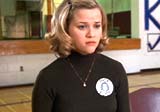 Tracy Flick (Reese Witherspoon) 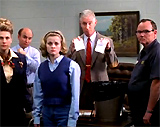 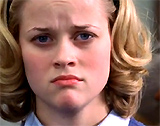 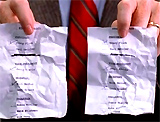 The Two Discarded Election Ballots  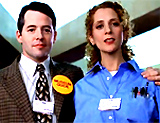 McAllister as a Museum Tour Guide, and with new girlfriend Jillian (Jillian Crane) 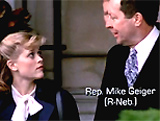 Tracy as a Congressman's Assistant |
|||||||||
|
Electra Glide in Blue (1973)
This mid-70s counter-culturally themed action/crime film, now a cult movie, from director James William Guercio (his debut feature film), was representative of the New Hollywood of the 70s. Robert Blake starred as John Wintergreen - a short-statured, virile, honorable and tactful rookie motorcycle patrolman (and ex-Vietnam Vet) on the beautiful desert roads of Northern Arizona. He rode on an Electra Glide Harley Davidson bike, serving as a traffic enforcement officer. His career objective was to become a homicide detective. The poster's tagline described:
His two colleagues were not as ambitious, conscientious, honest, and friendly as Wintergreen:
Both "Zipper" and Detective Poole enjoyed harrassing, framing (with planted drugs) and busting hippies during the film's major mystery (a murder-suicide of a hermit and the theft of $5,000). Problems arose during the case over differing opinions about the killer, suspected incidents of framing, and conflict when Wintergreen began to sleep with Poole's big-busted girlfriend Jolene (Jeannine Riley). The murder case was solved, with two findings:
In the film's unpredictable, abrupt and surprise ending (reminiscent of Easy Rider (1969), although a reversal), Wintergreen shot an intoxicated "Zipper" in self-defense when his buddy was dangerously brandishing and firing a gun at him and others. Then, shortly later, Wintergreen lost his own life to two long-haired hippies driving a VW van. He stopped the brightly-painted van (with "Love It or Leave It" stickers on the back) for a minor infraction (a missing front bumper), and then Wintergreen let the driver go ("Don't I know you? I owe you one, don't I?") with only a warning - he realized that they had been unjustly harrassed earlier by "Zipper." But he forgot to return the man's driver's license. The hippies feared that they were to be arrested when Wintergreen chased after them and was trying to flag them down a second time. The hippie passenger, who had moved into the back of the van, shot him to death, aiming through the bike's windshield, and Wintergreen fell from the back of the bike. Bloodied, he tumbled to a sitting position on the pavement, and was left to die on the road.
The film ended with the song "Tell Me," written by the director and sung by an uncredited Terry Kath. |
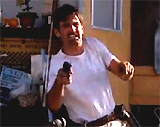 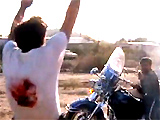 Death of "Zipper" (Billy 'Green' Bush) Shot by Wintergreen in Self-Defense 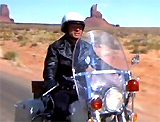 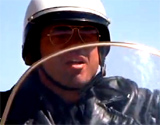   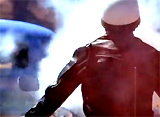 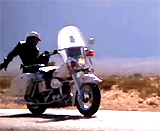 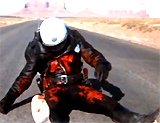 The Death Scene of Wintergreen |
|||||||||

|
Elvira Madigan (1967, Swe.)
There was a suicidal conclusion to this beautiful romantic melodrama based on a true but tragic love affair in the 19th century. It occurred between two doomed lovers during one summer:
Elvira told Sixten that they had no other alternative but to commit suicide together. When he couldn't pull the trigger on her at point-blank range, she was shot and killed (off-screen) during a freeze-frame image of her grasping for a butterfly in a golden field. He then shot himself with a second blast from his revolver during the same freeze-frame image before the film ended with a black screen. |
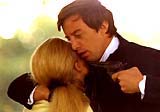 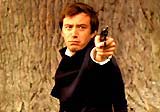 The Double-Suicide  Freeze-Frame Ending |
|||||||||

|
Star Wars, Episode V: The Empire Strikes Back (1980)
One of the most startling and stunning plot twists ever devised appeared in this second film in the second trilogy -- it was a moment of paternal revelation when the evil dark lord Darth Vader (David Prowse, voice of James Earl Jones) emotionlessly admitted a surprise relationship to young Luke Skywalker (Mark Hamill) -- after cutting off Luke's hand:
Luke gave a horrified reaction: "No, no. That's not true. That's impossible!" Darth Vader also urged Luke to join him: "Join me and together, we can rule the galaxy as father and son." |
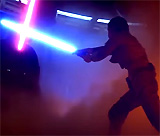 Saber Lunges During the Light-Saber Duel 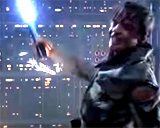 Luke Skywalker's (Mark Hamill) Hand Cut off 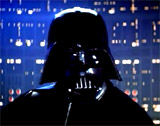 "No, I am your father." |
|||||||||





 Lawyer
George Was Bludgeoned To Death; The Two Bikers Were Shot-gunned to Death
by Rednecks
Lawyer
George Was Bludgeoned To Death; The Two Bikers Were Shot-gunned to Death
by Rednecks