|

|
|
||

|
Tin Cup (1996)
Director Ron Shelton's hit sports-related romantic comedy had the tagline:
It was named after its title character:
He managed (and lived in) a run-down driving range with sidekick and caddy Romeo Posar (Cheech Marin) in the small town of Salome in West Texas. Because of increasing debts, he had signed over ownership to a madam of 'show girls' to pay off debts. In the unconventional ending, he threw away his chance of winning the PGA's US Open in North Carolina. In the fourth round of play on the 18th hole, he needed a birdie to win, and par to force a playoff:
On the sidelines, his love interest, a clinical psychiatrist named Dr. Molly Griswold (Renee Russo), one of his novice golf pupils, encouraged him: "Go for it, Roy! Just knock it on." Rather than getting to the green in two shots and playing it safe, he attempted a near-impossible, all-or-nothing shot. When his first shot landed on the green, but then rolled downhill into the water hazard, his caddy Romeo wanted him to "go up there, we'll take our drop, we'll tie, we'll win it in a playoff," but Roy refused -- he continued to shoot the same difficult shot, missing each one and landing in the water hazard. He broke the record for strokes, causing further consternation and embarrassment from the announcers and fans with each failure. Finally, Molly laughed hysterically and yelled: "He's crazy. Oh, God. He's right. You're right, Roy! Just knock it on! Let her rip!" On the twelfth shot (his last ball before being disqualified), he miraculously made the shot into the hole ("That was a twelve"), causing a massive celebration. When Roy came to his senses, he realized, aghast: "I just gave away the US Open," but Molly was ecstatic and put his reckless performance in perspective:
Smug, play-it-safe, conservative, and sarcastic golfing nemesis David Simms (Don Johnson) (Molly's previous boyfriend) walked by and told Roy: "I gotta hand it to you. When you go down, you go down in flames." Roy responded by kissing Molly and carrying her away into the crowd, after retorting with a smile to Simms:
Later back in Texas in his RV with Molly on the sofa, Roy was surprised to know that he was still an automatic entry for next year's U.S. Open, for finishing in the top 15 players. In the conclusion, Roy summed up what he had learned with Molly - now his live-in girlfriend (and swamped by new clients who wanted assistance with their golf games too):
|
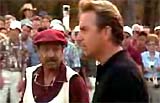 Golfer Roy "Tin Cup" McAvoy (Kevin Costner) With Caddy Romeo (Cheech Marin)   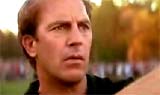 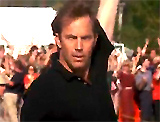  Persistence - "That Was a Twelve!" 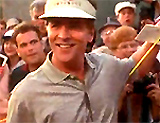 David Simms (Don Johnson) 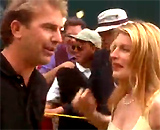  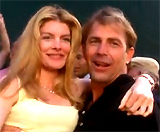 Roy With Molly (Renee Russo) 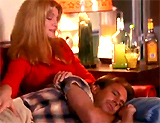 Back in Texas with Molly |
|
To Die For (1995)
This thriller and media satire was filmed as a mockumentary by director Gus Van Sant. It was based upon real-life reporter Pamela Smart, who was convicted and imprisoned for life for conspiring to kill her 24 year-old husband, with the help of her 15 year-old lover. The main character in this intelligent film was:
The film's tagline was very revealing:
She began to plot to have her obstructive Italian-American bartender husband Larry Maretto (Matt Dillon) eliminated. His objective was to have children and raise a family with her - meaning an end to her news career. Suzanne seduced dim-witted, infatuated loser teen Jimmy (Joaquin Phoenix) to kill her sweet-natured husband on their first anniversary. Although Suzanne was undeniably guilty (and was taped during a confession of her involvement), the case was thrown out against her - because of a ruling of improper wire-tapping and entrapment. When freed, Suzanne began to trash-talk her dead husband (and received lots of interest from news networks and movie studios, and offers to buy her story) - she falsely accused him of turning into a drug addict ("My husband had a serious cocaine problem") who became the victim of other drug dealers when he threatened to turn them in. She then said about her bold-faced lie:
Later in angry revenge, Suzanne was killed (off-screen) by a hit man (posing as a "Hollywood producer" - a cameo by director David Cronenberg) who was hired by her husband's father Joe (Dan Hedaya) (with Mafia connections). The hitman led Suzanne to the surface of a frozen pond - she was later seen dead in a lingering closeup under the ice of a frozen pond where she was deposited after the murder. Ironically, Jimmy's unassuming friend Lydia Mertz (Alison Folland), whom Suzanne always criticized as trailer trash, acquired fleeting fame for telling her side of the story on TV talk shows such as Oprah and Phil Donahue:
In an ironic scene immediately before the credits, Larry's sister Janice (Illeana Douglas) practiced her ice skating on the frozen lake (above the location of the frozen body and literally 'dancing on her grave') to the tune of Donovan's "The Season of the Witch." |
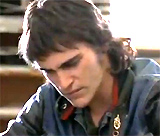 Jimmy (Joaquin Phoenix) Confessing 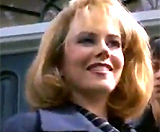 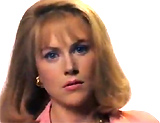 Suzanne Stone Maretto (Nicole Kidman) Acquitted 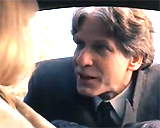 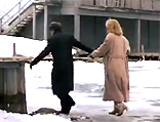 The Hit Man (David Cronenberg) 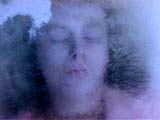 Suzanne's Body Buried Under the Ice   Lydia Interviewed  Janice Practicing Ice Skating on Frozen Ice Pond Above the Body |
|
Total Recall (1990)
This violent science-fiction action thriller from director Paul Verhoeven was set in the futuristic world of 2084 (announced on the VHS-tape box cover). Its tagline was:
The film's teaser trailer hinted at the film's twist, as the narrator spoke:
The teaser was related to the Philip K. Dick story upon which the film was loosely based: "We Can Remember It for You Wholesale." The film's premise was that a construction worker Doug Quaid (Arnold Schwarzenegger) was experiencing recurring nightmares of exploring the reddish planet of Mars with an unnamed brunette, and almost dying when his helmet glass shattered. From news reports, the planet had deposits of the mineral terbinium, and a troubling mutant terrorist Resistance leader named Kuato. To fulfill his longings and "be somebody," Quaid chose to embark on an "ideal vacation" with a strange travel agency named Rekall, Inc. that offered "the memory of a lifetime," although he had heard rumors that if things went wrong, he could become lobotomized. He chose an expensive 'virtual' trip to the human colonies on the planet of Mars, composed of two full weeks of detailed, "first-class" implanted memories valued at 899 credits ("private cabin on the shuttle, deluxe suite at the Hilton, plus all the major sights, Mount Pyramid, the Grand Canals, and, of course, Venusville"). The ending of the film was telegraphed by fast-talking Rekall salesman Bob McClane's (Ray Baker) pitch to Quaid about having an extra Ego-trip Memory Implant procedure. It would offer a "choice of alternate identities" during his trip, for 300 more credits. Quaid chose the fourth option, to be a secret agent (a "deep cover" operative) who would meet a beautiful "exotic woman" - and he was promised:
An additional feature of the trip would be the introduction of "alien artifacts" dating back a million years. The memory implantation procedure was supervised by technician Ernie (David Knell) and programmer Dr. Renata Lull (Rosemary Dunsmore). Ernie was tossed a disc, noting its dream title: "That's a new one. Blue Sky on Mars." Quaid selected the option of being paired with an athletic, demure and sleazy brunette (model 41A). Something went awry however during the procedure - Lull reported "another schizoid embolism" to salesman McClane. Quaid yelled: "You blew my cover" before being tranquilized. [Note: Quaid was referring to his previously repressed memories of being a double agent named Hauser (see below).] Lull thought Quaid, by his rantings, had already traveled to Mars, although McClane thought: "He's just acting out the 'secret agent' portion of his Ego-trip." She sharply quipped back that he was wrong and that was impossible: "We haven't implanted it yet." She added: "Someone has erased his memory" - referring possibly to the "Agency." Rekall programmer Dr. Lull was ordered to cover up and erase any of Quaid's memories about them or Rekall. After being sedated and having his memory wiped, Quaid was dumped onto the street, with no recall of what had happened. For much of the film, Quaid was the object of tracking and deadly pursuit by his friend-colleague Harry (Robert Costanzo), his duplicitous wife of eight years Lori (Sharon Stone), and others. Lori told him that their marriage was a sham: "Those assholes at Rekall have f--ked up your mind. You're having paranoid delusions." But then, Lori tried to assassinate him, and claimed she and their marriage was only a 6-week memory implant: "They erased your identity and implanted a new one...Your whole life is just a dream." On Mars, the evil Federal Colony administrator/governor was tyrannical Vilos Cohaagen (Ronny Cox), assisted by brutish operative Richter (Michael Ironside), and fighting against the rebels. Richter was sleeping with Lori - he was her real husband - and he had sent her to monitor Quaid. Cohaagen feared that Quaid's memory of his identity would return:
Quaid learned that his real name was Carl Hauser - he had been a Mars secret agent previously doing "dirty work" for the oppressive Cohaagen. After an encounter with a brunette on Mars, later identified as Resistance member Melina (Rachel Ticotin), it caused Quaid to rethink and change sides ("I've been playing for the wrong team"), and join Kuato and the freedom fighters. (Kuato was a small baby-humanoid- in reality a parasitic twin attached to a man named George (Marshall Bell).) Now that Quaid wanted to bring down Cohaagen, he was targeted for reimplantation of memories. Hauser made everyone on Mars believe that he had been captured, tortured, and killed, so that he could lead Quaid there to fulfill his mission for him (with a fake ID). As Hauser instructed, Quaid flew to the Mars Federal Colony, and was led to the sleazy Last Resort sex club/bar in Venusville's red-light district to contact Melina. Later in his Hilton Hotel suite, Quaid met with Rekall spokesman Dr. Edgemar (Roy Brocksmith), who observed that Quaid was in the middle of his dream vacation: "You're not here and neither am I." He told Quaid he was monitoring him while he was strapped into an implant chair (reminding him "You paid to be a secret agent"). At that moment, Edgemar claimed that he had been "artificially implanted as an emergency measure" to talk Quaid down and return him to "reality," since Quaid was suffering from a schizoid embolism, and was trapped in a fantasy world. He forecast the remainder of the film (and Quaid's experiences) with his statements, when Quaid threatened to kill him:
Quaid was offered a red pill to bring him back to reality. Noticing a drop of sweat on the fearful Edgemar's forehead, Quaid reasoned that Edgemar wasn't an implanted memory but a real person. Quaid killed both Edgemar and his wife Lori ("Consider that a divorce!"), but then was rescued by Melina when threatened by Richter and his men. Quaid unwittingly led Cohaagen's men to Kuato at the Resistance's headquarters, where the rebel leader was killed. In his last words, Kuato told Quaid: "Start the reactor. Free Mars." After Cohaagen captured Quaid, he revealed that Hauser was his ally and "bosom buddy" - used as a ploy to infiltrate the psychic mutants and destroy the rebels:
Allegedly, Quaid had been used and set up by Hauser to lead Cohaagen's forces to Kuato. Cohaagen's final planned step was to restore or reimplant Hauser's memories back into Quaid's body and mind (by erasing Quaid's memories) with a Rekall machine. And Melina would be programmed as Hauser's obedient wife. In the film's ending after Quaid and Melina escaped, they were at the site of the alien device/machine. The alien artifact, built by an ancient Martian civilization, was revealed to be a terraforming reactor made out of terbinium - "Cohaagen's secret" - it would melt the glacier in Mars' core to provide oxygen for the planet. Melina and Quaid realized that the abusive Cohaagen had a monopoly on breathable Mars air, and wanted to keep it that way:
After a shootout, and a face-off with Cohaagen who told Quaid: "You're a nothing. You're nobody! You're a stupid dream," an explosion spewed all of them out into the airless atmosphere of Mars. Cohaagen, who was expelled first, died when his eyes bulged out and face swelled due to the lack of oxygen, but Quaid and Melina managed to survive by breathing the activated machine's freshly-created oxygen. Melina gazed at the breathtaking vista with blue sky: "I can't believe it. It's like a dream," to which Quaid responded: "I just had a terrible thought. What if this IS a dream?" Melina replied invitingly: "Well then, kiss me quick before you wake up!" As they passionately kissed, the screen faded to a brilliant white from the sun, hinting at previous hidden clues that the entire film was indeed a fantasy memory implanted by Rekall, as promised by the Blue Skies on Mars dream vacation.
|
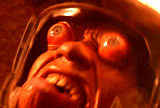 Recurring Nightmare 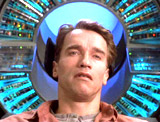 Doug Quaid (Arnold Schwarzenegger) 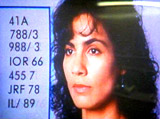 Brunette Model 41A 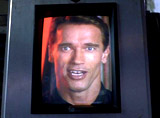 Video: Quaid = Double Agent Hauser 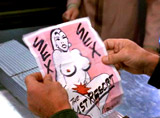 The Last Resort Sex Club/Bar 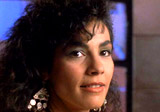 Melina (Rachel Ticotin) 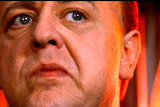 Rekall Spokesman Dr. Edgemar (Roy Brocksmith) 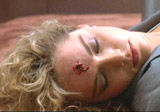 Death of Lori (Sharon Stone): "Consider that a divorce!" 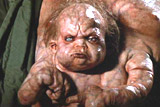 Resistance leader Kuato, a Parasitic Twin 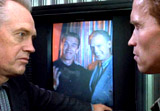 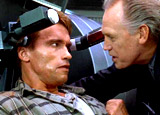 Vilos Cohaagen (Ronny Cox) With Quaid 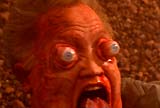 Death of Cohaagen 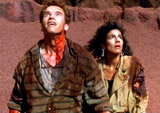 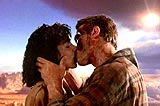 Quaid and Melina Saved |

|
The Tourist (2010)
In this romantic paranoid thriller film directed by Florian Henckel von Donnersmarck, intrigue, romance, assumed identities, and espionage was evident, as summarized in the film's tagline:
An erotic relationship developed between the two main characters:
At a Parisian cafe, Elise received enigmatic instructions (a note from a courier) from a central 'unseen' character:
It said: "Find a man and make them think he is me." She burned the note, and then as a ruse to distract and mislead the authorities, she boarded a train bound for Venice, picked out a strange gentleman who resembled Pearce, and caused the police to think that the decoy or fall-guy was Pearce.
She picked out vacationing US high school math teacher Frank from Wisconsin, in a supposedly chance encounter, and invited him to be with her in her elegant luxury room in Hotel Danieli in Venice. He was getting over a failed relationship from his past. Along with Elise, Frank (now Pearce) soon found himself pursued by:
Midway through the film, it was learned that Elise was actually in the financial crimes unit of Scotland Yard, but had been suspended. She was now working undercover in order to reveal the financial misdeeds being conducted by Pearce on the behalf of the mob. It now appeared though, that Elise was willing to do her job (even though she had fallen in love with Frank/Pearce) and hand him over to the authorities. In the film's conclusion, Frank/Pearce opened a safe in the rendezvous room, revealing to a surprised Elise that he had knowledge of the code - and was therefore identified as Alexander Pearce.
The two took the bank records and money and departed, leaving behind in the safe a check for the full amount of the taxes owed. Meanwhile, police had detained a look-alike for Pearce (an Englishman that Frank/Pearce had been paying to be his clone). With the tax debt paid, the case against them was closed. Frank and Elise (who quipped briefly about having to get used to his new $20 million dollar face) boated happily away to a new life together. |
 Elise Burning Note  Elise Clifton-Ward (Angelina Jolie) 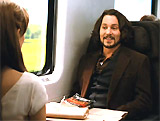 Frank Tupelo (Johnny Depp) 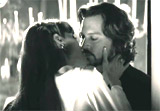 Frank = Pearce  Opening Safe - Concluding Revelations |

|
Triangle (2009, UK)
Writer/director Christopher Smith's psychological horror film was suitably scary, with numerous taglines:
The film's title was the name of a yacht, indirectly referring to the famed Bermuda Triangle. Although filmed in Northern Australia in tropical Queensland, it was set off the coast of Miami, Florida - one of the three points of the ominous triangle. The paradoxical, mind-bending film paid some homage to Kubrick's The Shining (1980) with obvious references, such as the infamous number 237 (twice!), long hallway tracking shots, a ballroom with illusory food and drink, and bloody words scrawled on a mirror. It also had similarities to other time-travel films at the time, including the superior Timecrimes (2009, Sp.), Moon (2009), the earlier film Primer (2004), as well as a horrific version of Groundhog Day (1993). The death of the seagull also had symbolic and foreboding significance as the harbinger of doom and death - reminiscent of English poet Samuel Coleridge's The Rime of the Ancient Mariner, when the shooting of an albatross before sailing brought back luck. In the first lines of the film, diner waitress and troubled/disturbed single mother Jess (Melissa George) spoke to her autistic son Tommy (Joshua McIvor) - big clues to the entire film being a "bad dream" in a deadly cycle:
During the credits in short flashes, there were lots of incomplete hints of future events or themes. A spinning lawn sprinkler watered some grass (in her front lawn). Jess collected laundry and picked up a toy boat. She cleaned up a paint spill, answered the door (her home was # 237) to find no one there (spoiler: another version of Jess rang her own doorbell but ran away), and threw a big black bag in the truck of her car (spoiler: the bag contained Jess' own corpse). Significantly, she told her son: "I cleaned everything away, sweetheart. Everything is exactly the way it was before." Later, she described her routine - a complete one-sentence description of the plot:
She also expressed her overriding guilt: "I just feel guilty when I'm not with Tommy." Jess (without son Tommy, who was strangely "at school" although it was Saturday!) was rushing to the nearby harbor to arrive at 8:30 am. She had been invited by her 30-something friends to take a sailing trip on the Triangle. As she drove to the marina, a white CGI seagull floated above her car. She met the others there, including:
The Trip On the Boat There were a number of ominous occurrences as the boat hit open waters on Saturday for a short excursion:
Repeating Time Loop (On the Boat) Things turned very strange when Jess (Jess # 1) saw herself (Jess # 2) and the rest of the group atop the overturned yacht, approaching the cruise liner once again and calling out for rescue. [She was the shadowy figure seen on deck] There was a repeating time-loop that she and everyone were apparently trapped in. The loop repeated itself once everyone on the ship was dead. Jess' intention was to modify the self-perpetuating loop, although she didn't realize that she couldn't alter the loop, because she was doomed to participate in the events. A few more versions of the same incidents were revealed in this loop:
NOTE: It was no surprise that Jess was the masked killer. Even one of the film's posters gave it away. Axe-wielding Jess walked on the ship's deck - where her reflection in a pool of blood on the deck revealed that she was the masked killer. Repeating Time Loop (At Home) Jess # 1 eventually woke up on a shoreline as if from a dream, hitchhiked, and returned to her nearby home. Jess # 1 witnessed an abusive version of herself losing her temper and beating Tommy for spilling his art paint. She bashed this version of herself to death with a hammer, and then comforted Tommy: "You're just having a bad dream...Bad dreams make you think you've seen things that you haven't." With the abusive Jess' corpse in her car's trunk and Tommy in the car as a passenger, she drove to the pier for the sailing trip (passing a "GOODBYE PLEASE RETURN" sign), assuring him that the Mommy who was driving was "nice." A seagull struck the windshield and bloodied it. When Jess # 1 pulled over and picked up the dead bird to throw it into the ocean over an embankment, she saw multiple versions of rotting dead seagulls below her. When distracted by an upset Tommy, Jess # 1 had a head-on collision with a garbage truck in the oncoming lane. Jess # 1 watched as a bystander as she saw the bodies of herself and Tommy lying on the road. A nearby mysterious taxi driver ("Just a driver") observed: "No point trying to save the boy. There's nothing anyone can do that's gonna bring him back. Can I give you a ride?" The taxi driver took her to the harbor, where he said: "I'll leave the meter running. You will come back, won't you?" She responded: "Yes, I-I promise." Repeating Time Loop (On the Boat)
|
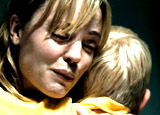 Jess with Tommy  Jess with Greg    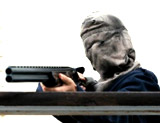 The Masked Shooter  Jess # 1  Jess # 2 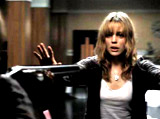 Jess # 1 (with shotgun) Aiming at Jess # 2 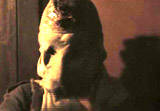 Masked Figure 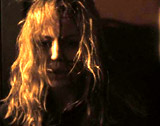 Masked Figure Unveiled as Jess 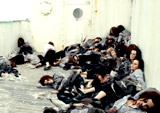 Multiple Sally Corpses  Jess Killing Herself in Her Own House 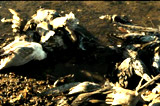 Multiple Dead Seagulls 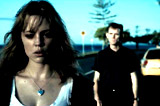 Jess as Bystander to Her Own Death with Taxi-Driver |
|
Trois Couleurs: Rouge (1994, Fr./Pol./Switz.) (aka Three Colors: Red)
The last film of Polish director Krzysztof Kieslowski's Three Colors trilogy or triptych was a tale of destiny, chance, freedom of will, and coincidences. It told of the emerging soulmate friendship and parallel connectedness ("Fraternity", based upon the third color, red, in the French flag) between two main characters, in Carouge (outside of Geneva):
And it told about Valentine's next door neighbor (whom she had not met yet), who was also having romantic problems:
In the surprise ending, director Kieslowski attempted to provide witty closure and harmony to his entire trilogy. A news report on the Judge's television announced that there was a boating disaster in the English Channel on the ferry going to England, carrying 1,435 passengers. Surprisingly, there were only seven apparent survivors on a lifeboat (the same number as Rita's puppy litter). They were characters from all three films, including Valentine and Auguste (who finally were to meet for the first time). Other pairs included:
The seventh survivor was an unseen English bartender named Steve Killian. This contrived yet karmic and hopeful conclusion appeared to reinforce how things usually happen for a reason. It appeared that the older Judge (who had found new hope himself) knew somehow that Valentine was destined in her future to meet a younger version of himself. One of Valentine's earlier ad shoots for bubble gum resulted in a massive red billboard whose image was supernaturally echoed at the end of the film, on the rescue boat. Karin and her new boyfriend went yachting in the Channel the same day as the ferry disaster - and they too were killed. One of the last images was of the older Judge looking positively out on life from a broken window of his home (neighbors had taken some revenge). A single tear rolled down his cheek. |
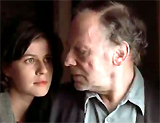 Valentine (Irene Jacob) and Joseph Kern (Jean-Louis Trintignant) 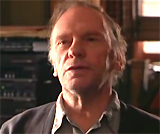 Joseph Kern - The Judge 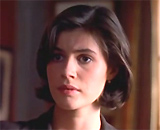  Valentine 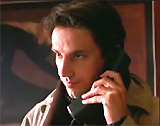 Auguste (Jean-Pierre Lorit)  Karin (Frédérique Feder) 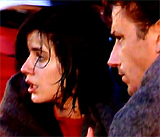 Survivors On the Ferry 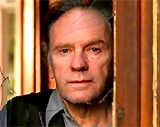 A Single Tear |
|
The Truman Show (1998)
Director Peter Weir's film was a prophetic, thought-provoking story rife with symbolism about pop voyeurism and processed reality, with the tagline:
The existentialist, biting social satire's themes were about reality TV, consumerism in a dystopia, loss of privacy and media surveillance. Megalomaniac, charismatic, beret-wearing, 'world's greatest televisionary' network owner Christof (Oscar-nominated Ed Harris) delivered an opening speech to the camera in the Lunar Room studio (hidden in the movie set's moon) about the world being bored by "phony emotions," while expounding the virtues of TV's The Truman Show and its "nothing fake about Truman" star:
This was followed by fake opening credits for the show itself (Truman Burbank as himself, created by Christof, Hannah Gill as meryl, etc.). The film comprised 5 days in his life, from Day 10,909 to Day 10,913. The premise of the film was that a person - a good-natured Life & Casualty Insurance adjuster/salesman named Truman Burbank (Jim Carrey) - was adopted by a TV network as a reality-TV star to film his entire life 24 hours a day without his knowledge with 5,000 concealed cameras. Truman's 50's era ever-smiling wife Meryl (Laura Linney) (actress name Hannah Gill) gave viewers a self-congratulatory interview as a star celebrity: "Well, for me, there is no difference between a private life and a public life. My life, is my life, is The Truman Show. The Truman Show is a lifestyle. It's a noble life. It is a truly blessed life."
Truman first appeared (filmed with a microscopic hidden camera) in front of his bathroom mirror, and then as he was leaving for work, greeted his stereotypical black neighbors with the catchphrase: "Good morning...Oh, and in case I don't see ya, good afternoon, good evening, and good night!" He often spoke in cliches, e.g., "That's the whole kit and kaboodle." The first clue that he was the subject of a TV show was when a stage-light (labeled Sirius 9 (Canis Major)) fell and cracked on the pavement in front of him, although it was explained away by a radio broadcast as a part shed from an aircraft. The second clue was a malfunctioning rain shower that only doused him. [And there were two chubby security guards who complained about the camera panning away when Truman had sex with his wife Meryl.] Later, problems with his car radio's frequency provided him with a stage manager's account of his commuter route in town, alerting props and other actors (with screeching feedback on their earpieces) to be prepared. The massive artificial set in Hollywood ("enclosed in the largest studio ever constructed...one of only two man-made structures visible from space") was a biospheric-planned community built in an enormous soundstage with too-manicured lawns, perfect buildings and blue sky. It was located in the idyllic island town of Seahaven in Florida (voted "The Best Place on Earth" and "The Planet's Top Town"). [All the street names contained actor's names, and the first names of cast members were all names of movie-stars.] Interwoven in the show were advertisements for products: free-range Kaiser chicken, a Chef's Pal (grater, dicer, peeler all in one), Penn Pavels Beer, etc. to name a few. [Truman merchandising also ensured programming without commercial interruptions: Truman pillows, sweatshirts, plates, action figures, etc.] Truman's dream objective in life was to see the world, explore and travel to Fiji on the other side of the globe ("You can't get any further away before you start coming back"). He suffered crippling flashbacks from his youth of sailing in a rowboat with his father Kirk (Brian Delate) when a storm struck and his father drowned, causing a water phobia (that kept him on the island). In his classroom, young Truman was also discouraged by his teacher from venturing out: "There's really nothing left to explore." Two troubling events began to turn things around, when he realized that the 'world' he lived in revolved around his actions ("It feels like the whole world revolves around me somehow"), and everything was a hoax:
It was a magical moment when Truman stopped traffic with his outstretched hand and saw a snack table for backstage crew behind an elevator. He discovered that his life of almost 30 years was being filmed, and he was imprisoned and manipulated within a choreographed setting with other actors, who had earpieces and were coached on some of their lines of dialogue by Christof. [In bars, homes, and bathtubs, viewers watched monitors broadcasting the show.] Becoming increasingly hostile, paranoid, crazed and skeptical, Truman's behavior caused his on-screen marriage to Meryl, a local hospital nurse, to slowly crumble (his actress-wife Hannah was upset by his unpredictableness and left the story), and the actor who played Truman's 'father' was brought back into the drama to keep him from leaving - he had only suffered from amnesia. Other major obstacles were invented to keep Truman from leaving to travel away to Fiji or anywhere else: major problems with flights at a travel agency with posters alerting customers to the hazards (!) of travel, an overheating bus to Chicago, traffic jams, a forest fire warning, and a potential nuclear power station meltdown. [Former cast-member Sylvia was part of a disgruntled viewership that joined a movement to cheer on Truman to escape: "Free Truman."] An exclusive interview with Christof was aired on a talk show called TruTalk (a derivative spawned from the 30 season show), hosted by Mike Michaelson (Harry Shearer). Christof was introduced as the "designer and architect of the world within a world that is Seahaven island." Self-justifying Christof proclaimed about the repressive, closed-off town: "Seahaven is the way the world should be." Truman outwitted the film-makers by sneaking out of his home and attempting to triumphantly escape the virtual prison of Seahaven by sailboat (named Santa Maria, one of Christopher Columbus' New World boats), to find his identi-kit representation of lost love Sylvia - his 'map'. The show was temporarily cut off, then restored as omniscient, God-like producer Christof ordered light ("Cue the sun") and summoned a torrential storm to prevent him. Fugitive Truman, nearly drowning and capsizing, cried out: "Is that the best you can do? You're gonna have to kill me." He ultimately reached the literal edge of the fabricated, enclosed set when his bow pierced the dome's painted and clouded blue sky, and he climbed a stairway. On an amplified sound system, Christof spoke to Truman with a "voice of God" speech, identifying himself: "I am the creator of a television show that gives hope and joy and inspiration to millions." He claimed that Truman, the show's "star," was "real - that's what made you so good to watch." Rejecting Christof's plea to remain in the artificial world (where he had "nothing to fear" - "You belong here with me") rather than venture into the real world (with "the same lies, the same deceit"), Truman smiled beatifically at the camera, and sarcastically uttered his cheerful catchphrase: "In case I don't see ya, good afternoon, good evening, and good night!" He then took a deep farewell bow, and exited from the massive set through the stage door to freedom (to the sounds of Philip Glass' stirring "The Opening from Mishima") and a new existence. TV's Truman Show ceased transmission. In the final scene, two chubby pizza-eating security guards viewing the show, now cut off, talked together about changing the channel (- "What else is on?" - "Yeah, let's see what else is on?" - "Where's the TV Guide?") |
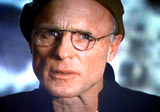 Christof (Ed Harris) 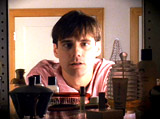 Truman Burbank (Jim Carrey) - Filmed by Hidden Camera 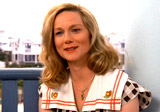 Meryl (Laura Linney) 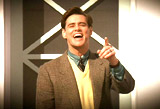 "Good morning..." 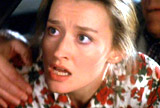 Lauren (Natascha McElhone)  "How's It Going to End?" Button 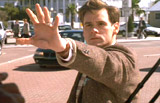 Stopping Traffic  Director Christof  Constant Monitoring   Escape By Sailboat  The End of the Set - Climbing a Stairway  "Voice of God"  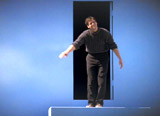 Deciding to Exit 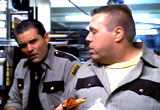 Two Security Guards: "What else is on?" |
|
12 Monkeys (1995) (aka Twelve Monkeys)
This sci-fi-thriller was a remake of the short French science-fiction featurette film, La Jetee (1962, Fr.). In the early 1960s film, a prisoner from a post-apocalyptic future in Paris was sent back in time to rescue the future. During his time travels, he had an obsessive memory of a Woman (Hélène Chatelain) during a deadly shooting incident on the pier (jetty) at the Orly airport. When he returned to that past time period later in the film, he found the Woman but realized that he was about to be murdered. In his final moments of life, he realized that the haunting shooting which he witnessed as a child was of his own death. In this similar circular story by director Terry Gilliam, time-traveling, mentally-unstable prison convict James Cole (Bruce Willis) was sent back in time from the virus-plagued, post-apocalyptic world of 2035 to 1996, to observe the past and collect information - and possibly create a better future. The tagline for the film was related to the plot:
In exchange for being pardoned, his mission was to obtain a pure sample of the horrible virus that had killed 5 billion people and forced humanity to live underground (the surface of the Earth was unliveable) for many decades, so that a cure might be found.
Cole's many time travels first went awry when he ended up in Baltimore in 1990 (rather than 1996) and was placed in a mental institution where he met eccentric, insane animal activist Jeffrey Goines (Brad Pitt), the son of prominent virologist Dr. Goines (Christopher Plummer), and was treated by psychiatrist Dr. Kathryn Railly (Madeleine Stowe). The delusional Cole also time-traveled to the WWI era in France, and then to late 1996, where he and Dr. Railly eventually joined together in Philadelphia, and she began to believe his story about a future virus plague. By film's end, it was revealed that Jeffrey Goines and his "Army of the 12 Monkeys" were never the cause of the worldwide plague that was first released in Philadelphia in December 1996. They were instead just "a bunch of dumb kids playing revolutionaries" who freed wild animals from Philadelphia's Garden Zoological Society (and locked Dr. Goines in the gorilla cage) the night before when Dr. Railly and James had donned disguises. He glued on a mustache, wore a long-haired wig and a tropical-designed shirt, and she wore a blonde wig. They were planning to fly together to a dream vacation destination - the Florida Keys, from the Philly airport. At the Philadelphia airport, they both realized that red-haired, pony-tailed bio-terrorist and "apocalyptic nut" Dr. Peters (David Morse), Dr. Goines' lab assistant, had just taken a sticker-covered carry-on suitcase through security in front of them that contained live samples of the deadly virus. He was about to embark on a worldwide tour to spread the virus, beginning there. In the security line, he had just exposed the security guard and himself to the virus by opening up his carry-on suitcase and one of the vials. When gun-brandishing Cole pursued the madman through security (after Dr. Railly yelled out: "There he is! That man! He's carrying a deadly virus. Stop him! Somebody, please stop him!"), Cole was fatally gunned down from behind by airport police; madman Peters got away and boarded his plane to San Francisco - with the goal of infecting the world one city at a time. Cole's repeated dreams/memories were now made clear - as a young boy (Joseph Melito), he had witnessed the shooting (and his own death), with Dr. Railly (from the 1990s) grieving above him - who at one point knowingly noticed young Cole when their eyes met. The film concluded with Dr. Peters seating himself on an airplane next to a woman who introduced herself as Jones (Carol Florence): "I'm in insurance" - she was one of the female scientists from the future year of 2035 who was guiding Cole's time travels. It was a hopeful sign that she would retrieve a pure sample of the virus and bring it back to the future as a backup plan to help save the world. |
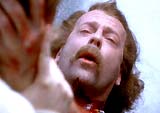 The Concluding Airport Shooting Scene: Dying James Cole (Bruce Willis) 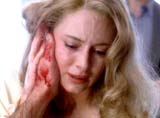 Dr. Kathryn Railly (Madeleine Stowe) 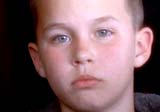 Cole as a Young Boy  A Knowing Look 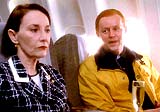 (l to r): Jones (Carol Florence), and Terrorist Dr. Peters (David Morse) on Airplane |
|
Twisted (2004)
Director Philip Kaufman's twisting thriller and murder mystery had the tagline:
It opened in foggy San Francisco, with Ashley Judd as short-haired SF police cop Jessica Shepard - her neck held at knife-point by a tormenting, psychotic serial killer Edmund Culter (Leland Orser), until she disarmed and handcuffed him. She was promoted to the position of Inspector in the Homicide division, and her loyal black friend and patrol buddy Wilson (Richard T. Jones) was replaced by:
Self-important SFPD commissioner John Mills (Samuel L. Jackson), the former cop-partner of Jess' deceased father George, arrived at her bar-party and reprimanded her for improper procedures in her acclaimed take-down of Culter ("You almost f--ked it up...there's no more room for mistakes"). As her father's partner, he had functioned as her mentor and father-figure after her father's death when she was younger. During mandated counseling with police psychiatrist Dr. Melvin Frank (David Strathairn), it was learned that Mills had raised Jess from age six, after her father went on a killing spree 25 years earlier in the 1970s - he reportedly murdered Jess' adulterous mother (and her partners), and then suicidally took his own life. [To minimize the pain, Jess would tell people that her parents were killed in a car crash.] Mills told Jess that because of her father's "twisted" love for his wife, he "went off" after being told about his nymphomaniacal wife's numerous affairs. Although she considered herself in "perfect mental health," Jess' unstable mental character (and her genetic disposition for sex and violence, with additional anger issues) was conveyed through her endless and adventurous pursuit of sexual partners every night in bars, after which she would return to her apartment to open her memento box and study B/W crime photos of her father's corpse (with a bullet hole in his forehead), and eventually blackout from extreme alcohol consumption. Following in her father's footsteps by taking up his profession ("you've devoted your life to tracking killers"), the current homicidal victims (and suspected serial killer) that she was pursuing in an investigation with Mike happened to all be her own past one-night-stand bed-partners or ex-boyfriends - each with a single cigarette burn mark (a signature brand) on their hand. Jess was suspected of killing them off during blackout periods. With one of the victims, she admitted: "I think I know him." She told her doctor:
She realized that she had the "capacity to kill" and experienced violent dreams of killing all of the victims, telling Mike:
She had "the fear of being the bad seed" because of her upbringing, and her father's reputation as a serial killer. Although there were various red herrings proposed, such as Jess' ex-boyfriend Jimmy Schmidt (Mark Pellegrino) (until he became the fourth victim) and her own partner Mike, the film's twists and turns eventually revealed the real killer. Mills proposed that Mike had drugged Jess with the date rape drug Rohypnol and set her up as the killer. He also tried to pin the murders on Mike, claiming the cop had a girlfriend who had OD'd on the stuff. Mills drugged Mike's wine glass with Rohypnol, and planted evidence in Mike's place - a pack of Rohypnol and a Yawara (a Japanese martial arts weapon used in the killings, that Jess often practiced with), but Jess figured out the deception and held her gun on Mills. He confessed what had really happened in the past - he had told Jess' father about his promiscuous wife ("I told him she was f--king that hippie scum"), causing Jess' enraged father to kill her. Mills branded Mike's hand with his cigarette, and then admitted that he had actually "killed them all" (all of Jess' lovers, and both of her parents). He told Jess that she was like her mother: "You have her disease. I've tried to cure you." Mills had killed Jess' mother, out of jealous love ("she was ruining my life...I loved her. I couldn't let her keep doing those things"). Mills and Jess faced each other with guns drawn in a tense stand-off on the dock's pier outside Mike's place (Mills: "I kill you. I kill a fleeing felon. You kill me, you commit murder"), when Jess revealed that she had phoned Wilson on her cellphone and he had heard the Commissioner's entire confession. Mills admitted: "You outsmarted the master" - before she was forced to protect Mike from being shot. Jess shot Mills in the chest, and his body was propelled backwards into the water, to float dead in the bay's harbor. Holding her partner in her arms, Jess apologized to Mike: "I'm so sorry. I'm sorry I thought you were the guy." He replied, before passing out: "I am the guy. I'll see you later, stranger." |
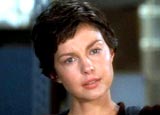 Jessica Shepard (Ashley Judd) 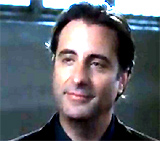 Mike Delmarco (Andy García) 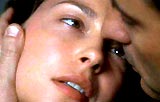 With Partner Mike 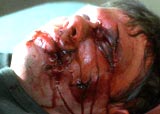 Another Victim 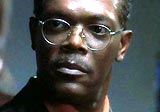 John Mills (Samuel L. Jackson) 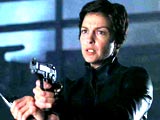 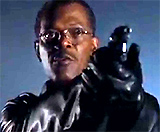  Jess' Stand-off With Mills 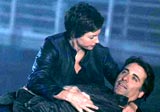 Jess' Apology to Mike |
|
The Two Jakes (1990)
Actor Jack Nicholson directed this neo-noir sequel to Chinatown (1974) set in post-war Los Angeles. The scripter for this film was again Robert Towne. The main plot device in the convoluted film was an incriminating wire recording of a tryst that wasn't supposed to be fatal. It was recorded by LA private detective J.J. "Jake" Gittes (Jack Nicholson) for his client - another man named "Jake":
Berman claimed that his objective was to 'incriminate' his own 'unfaithful' wife Kitty Berman (Meg Tilly). She was allegedly having an affair in the Bird of Paradise Motel in Redondo Beach with:
The opening scene was more than just a recording of the tryst, however. Berman fatally shot Mark Bodine in cold-blood as he fled into the motel's bathroom. In the tape recording, a mysterious reference to Katherine Mulwray between the two adulterers stirred up memories of the past for Gittes.
By film's end, it was revealed that Gittes had unwittingly been set up in a murder-for-profit scheme. During the entire investigation in which Gittes was involved, he was also trying to convince authorities that he shouldn't be charged as an accomplice. It was entirely possible that the murder of Bodine was not justifiable homicide because Berman had deliberately killed his partner - he had a gun conveniently planted under a chair delivered to the room - in order to commit pre-meditated murder, a capital crime. For business reasons, Bodine's will had excluded his sexpot widowed wife, Lillian Bodine (Madeleine Stowe). Instead, the will named "surviving partner" Berman as the sole beneficiary of B&B Homes' enormously profitable real estate business (tract housing in San Fernando Valley). Lillian's attorney Chuck Newty (Frederic Forrest) stated that his angry client was entitled to her husband's wealth if the murder could be proven to be pre-meditated.
During convoluted developments in the plot, Gittes discovered that Berman's and Bodine's tract housing sub-development, located in an orange grove (the same irrigated location that Gittes visited in the original film), was also being surreptitiously drilled for its vast underground oil resources by greedy oil baron Earl Rawley (Richard Farnsworth), Bodine's business associate. It was unclear at this point who owned the land's mineral rights. In a preliminary court public hearing or inquest regarding the recording, the tape was played, but the evidence was obviously tampered with by Gittes to hide Berman's cold-blooded guilt and to protect Mrs. Berman (Gittes reasoned: "splashing Katherine Mulwray's past all over the LA Times wouldn't do anybody any good"). After hearing the tape, the judge ruled there was no reason to suspect Berman of murder. (Gittes had perjured himself in court to protect the daughter of the woman that he was unable to protect in the first film.) Red-haired Kitty Berman was actually the elusive blonde Katherine Mulwray - which Gittes figured out when he realized that she had dyed her hair red. Through various legal and title documents, Katherine was shown to be the original owner of the orange grove and of the mineral rights to the subdivision land, but was forced to sign over a quit-claim deed to the land solely to criminal nightclub owner Michael 'Mickey Nice' Weisskopf (Rubén Blades), Berman's gangster associate, on July 17, 1946. Land rights were set up this way to ensure that Kitty was protected once Berman died. Bodine was blackmailing Berman about the real identity of his wife, threatening to expose her if she didn't sign over the mineral rights to him. In addition, Bodine was, as Berman admitted, engaged in a real affair: "He was f--king my wife." That was the real motivation for killing Bodine - jealousy, although it was also pre-meditated and not a crime of passion. Berman also divulged to Gittes why he was personally unconcerned about the outcome of the case. He revealed that he was terminally ill (with advanced syphilis viewed on X-rays and under a microscope, unsuccessfully treated with radium implants which were also causing cancer) - but had not told his wife Kitty about his condition. To ensure that she would definitely inherit his real-estate fortune (his intention all along) - he deliberately and suicidally blew himself up and ended his life in one of the development's tract homes by lighting a cigarette in the volatile, natural gas-filled environment after a shaky earthquake. That way, an autopsy could not be conducted, and his terminal condition wouldn't be revealed, and affect Kitty's inheritance. In the film's final scene, Gittes spoke to Kitty/Katherine about their mutual pasts as she left his office, in the final line of dialogue (it was his belated answer to her earlier question: "Does it ever go away, the past?"):
|
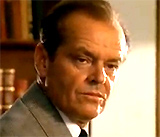 J.J. "Jake" Gittes (Jack Nicholson) 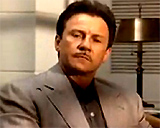 Julius "Jake" Berman (Harvey Keitel) 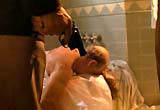 Murder of Mark Bodine (John Hackett), Berman's Real-Estate Partner 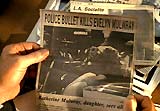 Old Clipping: "Police Bullet Kills Evelyn Mulwray" 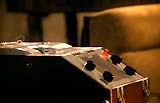 Gittes' Tape Recording of the Tryst and Murder 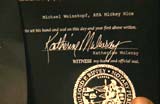 Katherine's Notarized Signature on Quit-Claim Deed 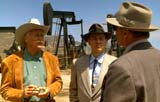 Oil Tycoon Earl Rawley (Richard Farnsworth)  Berman Afflicted with Syphilis 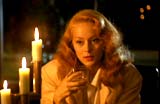 Red-Haired Wife Kitty Berman (Meg Tilly) = Katherine Mulwray 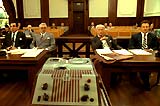 Court Public Hearing or Inquest 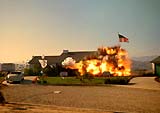 Berman's Suicidal Immolation 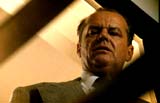 "Jake" Gittes Speaking to Kitty/Katherine |
|
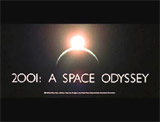
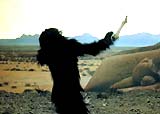
Director Stanley Kubrick's work was a profound, visionary and astounding film (a mysterious Rorschach film-blot) and a tremendous visual experience. This epic film contained more spectacular imagery (about what space looked like) and special effects than verbal dialogue. Viewers were left to experience the non-verbal, mystical vastness of the film, and to subjectively reach into their own subconscious and into the film's pure imagery to speculate about its meaning. The metaphoric, thought-provoking, grandiose, science-fiction landmark film included space travel to Jupiter, the mysterious appearance of four enigmatic monoliths, and the presence of the film's major protagonist - an omniscient super-computer. It was a three-act, visionary, visually dazzling, wide-screen masterpiece, with mind-blowing special effects, about the process of evolution. The first black rectangular monolith appeared to prehistoric ape-men, awakening them to the use of tools as killing weapons. A second monolith on the Moon seemed to coax humankind to make further evolutionary leaps and transcend bodily and technological limits. A team of robotic-like astronauts Bowman (Keir Dullea) and Poole (Gary Lockwood), during a voyage to Jupiter to investigate a radio transmission, were terrorized by the arrogant, humanistic, on-board computer HAL 9000 (voice of Douglas Rain). It was evident that HAL needed to be deactivated. Bowman incapacitated-lobotomized the sentient HAL-9000 computer (voice of Douglas Rain) by turning off his higher functions as HAL begged: ("Dave, stop. Stop, will you? Stop, Dave. Will you stop, Dave? Stop, Dave. I'm afraid. I'm afraid, Dave. Dave, my mind is going. I can feel it. I can feel it. My mind is going. There is no question about it. I can feel it. I can feel it. I can feel it. I'm a-fraid..."). HAL's end of life came as he mindlessly sang "Daisy" or "A Bicycle Built for Two." The disconnection triggered the playing of a pre-recorded televised briefing recorded prior to the Discovery's departure, previously known only by HAL. It was revealed that a second monolith had been discovered on the Moon's surface:
Was HAL deliberately entrusted with the secret about the mission - to follow the alien, high-frequency radio signal beamed directly to Jupiter by the monolith found on the Moon and explore the possibility of extra-terrestrial life - while the mission's purpose was purposely withheld from the astronauts? Completely human and vulnerable without a crippling dependence upon the ship's computer, Bowman completed the flight to Jupiter alone to find the life-source of the Universe. Another striking orbital alignment occurred in a spectacular line-up with a third monolith that hurtled through space toward the moons of Jupiter:
Bowman left the spaceship in one of the space pods to pursue and investigate the monolith orbiting Jupiter. During Bowman's passage through a psychedelic light-show in the Stargate, he was mysteriously transfigured (or "reborn") into a higher form of intelligence or universe of evolutionary life on his way to the alien planet. After seeing himself aging and dying, a fourth black monolith at the foot of his bed assisted Bowman in being reborn within an embryonic divine life form ("Space-Child") that floated in space. |
 The Ape-Man 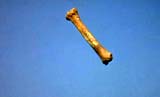 The Bone  The Spacecraft  Super-Computer HAL's Eye 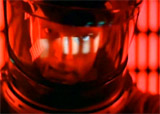 Astronaut Bowman (Keir Dullea) - Deactivating HAL 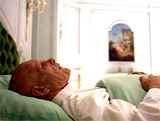 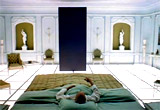 Death of Bowman in Front of 4th Black Monolith 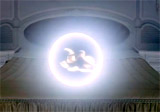 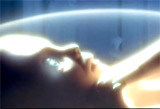 The Space-Child |





 On
the 18th Hole in the Final Round of the US Open, Roy "Tin Cup" McAvoy
Shot a Very Memorable 12 - But Lost the Golf Tournament; However, He
Gained a New Girlfriend
On
the 18th Hole in the Final Round of the US Open, Roy "Tin Cup" McAvoy
Shot a Very Memorable 12 - But Lost the Golf Tournament; However, He
Gained a New Girlfriend