|

|
|
||||||||||||||
|
Session 9 (2001)
This paranoic thriller from writer/director Brad Anderson was similar to The Shining (1980). Its tagline was:
An asbestos cleaning crew worked at a condemned mental institution (closed since 1985), although built in 1871 as the Kirkbride Mental Health Hospital. [Note: The setting was the real abandoned Danvers Lunatic Asylum.] The institution held a dark past, tortured patients, and a psychologically-unsettling feeling of dread within every corridor and room. The job was conducted by a team of workers including:
During their cleaning work, Mike discovered recorded audio interviews in a box marked "evidence" in a file room. In the film's scariest and most disquieting moments, he progressively listened to nine psychotherapy session audio-tapes from 1974. They chronicled the case history of a disturbed former patient's hypnotherapy and psychiatric sessions:
The recorded tapes were labeled Session 1 to Session 9, and were more and more chilling as they progressed. Her repressed and hidden memories from her troubled past, brought out by hypnosis, revealed that the cause of her insanity was domestic abuse from her father. She had three personalities:
It was learned that something evil happened with a knife ("he cut her up real bad") and a China doll one Christmas night in 1951 in Lowell, Massachusetts.
By film's end, the tapes began to mirror the modern-day story. The plot twist (the true mystery) centered on the hallucinating, possessed, beleaguered and stressed-out Gordon Fleming of the cleaning team. He was a struggling new father who seemed to have come under the dark spell of the haunted hospital's cruel past. He was given the contract for the hazardous work, promising to have it completed in a week. At the end of the first work-day, he had not only hurt but murdered his family (his wife Wendy and young child Emma), and was now alone, living in Mary's hospital room (with family pictures on the wall). However, he seemed to talk to his wife on the phone from time to time afterwards, asking for her forgiveness. He had also murdered all of his fellow crew workers, one-by-one:
In the film's voice-over, semi-surprise ending, the recording of Session 9 was heard. The voice of alternate personality "Simon" spoke. He described the circumstances of the 1951 murders - when Mary had murdered her brother and the rest of her family. In the recording, the doctor asked 'Simon': "And where do you live, Simon?" Simon (with Mary's voice) replied:
Presumably, the grief-stricken, deeply-conflicted Gordon - as a way to protect himself from the horror of his own crime - had in parallel fashion, been possessed by "Simon" and murdered his family, reflecting what Mary had admitted to the psychotherapist about her own murders. [Note: There was also the possibility that the abandoned mental hospital was also physically haunted by one of its former patients.] |
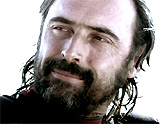
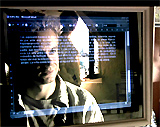
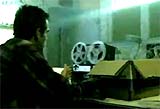 Mike Studying Recorded Interviews in Asylum 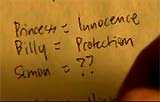 Personalities: Princess, Billy, Simon 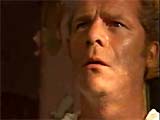 Homicidal Gordon Fleming (Peter Mullan), as "Simon" 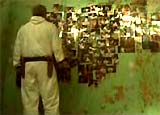 Mary's Hospital Room With Pictures on Wall 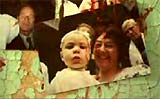 Murdered Wife Wendy and Child Emma |
||||||||||||

|
Se7en (1995)
In the unforgettable, nail-biting, concluding climax, maniacal but methodical serial killer John Doe (Kevin Spacey) offered to confess. He led arrogant, hotshot replacement rookie Detective David Mills (Brad Pitt) and retiring veteran Detective Somerset (Morgan Freeman) to another sick and gruesome crime scene. All of the killer's seven murders in the film were inspired by the legendary Seven Deadly Sins (Gluttony, Greed, Sloth, Lust, Pride, Envy, and Wrath). The last two crimes included a souvenir - "her pretty head" (a severed head, never shown) delivered in a bloody cardboard box, demonstrating the last two of the Seven Deadly Sins. Doe confessed to the sin of Envy before killing Mills' wife Tracy (Gwyneth Paltrow) and having her head delivered to their location in the middle of the desert (although Mills was skeptical at first):
Somerset knew that Mills was being set up to shoot and kill Doe (Doe: "Become vengeance, David...Become Wrath"). And then Doe added a crucial detail:
To demonstrate Wrath, anguished and angered Lt. Mills vengefully shot Doe in the head, and then emptied his gun of bullets into Doe's body, in exchange for his pregnant wife's beheading, although Somerset had cautioned: "If you kill him, he will win." As Mills was taken into custody for the shooting and driven away, Somerset offered that he wouldn't be retiring: "I'll be around." Somerset's voice-over ended the film:
|
 The Box - Evidence of "ENVY"  ENVY (Confessed by Serial Killer John Doe) to Lt. Mills: "I wish I could have lived like you did"  Mills Angrily Holding a Gun to Doe's Head, Calling Him a Liar  Mills Realizing That Doe Had Killed Both Tracy and Her Unborn Child That He Didn't Know About  Det. David Mill's WRATHful Vengeful Execution of Doe |
||||||||||||

|
Seven Pounds (2008)
Italian director Gabriele Muccino's unbelievable emotional drama hopscotched around within the plot (moving back and forth in time), so that major details and spoilers regarding the heavy-handed and dark film were deliberately kept obscured until the very end. It was about a sacrificial quest for redemption and atonement following a fatal accident. The grim and cryptic film opened with a 911 call to an LA operator, of an unknown individual who was suicidal, reporting his impending death in his Travel Inn hotel room: "I need an ambulance...There's been a suicide." The operator asked: "Who's the victim?" and he replied: "I am." A voice-over continued: "In seven days, God created the world. And in seven seconds, I shattered mine." The narrator was referring to his flashbacked (in only bits and pieces) memory of a fatal car accident, caused by his texting-while-driving. The driver, Tim Thomas (Will Smith), an MIT graduate and ex-aeronautical engineer for Apogee Aeronautics, had crossed a highway dividing line, spun out of control, and caused a van to roll. A total of seven individuals were killed: six strangers in the van, and his wife Sarah Jensen (Robinne Lee). Tim (from San Luis Obispo) was the sole survivor of the Cojo Highway crash.
Following the crash, about a year later, the tormented, moody, distraught and austere man had adopted the identity of his brother Ben Thomas (Michael Ealy), an IRS agent. He was on a mysterious and puzzling mission at various hospitals and rest homes to provide help to seven worthy individuals, although his motivations and actions were made to be appear officious and related to his new Dept. of Treasury occupation. Will had stolen his brother Ben's IRS credentials, and was impersonating him to repugnantly investigate (or audit) possible tax evaders (or candidates) - indebted people who needed penalty-free tax extensions (or suffered from a terminal illness or lived in mortal danger). He was to decide whether or not they deserved his generosity or charity: "It is within my power to drastically change (their) circumstances." (All the while, he cared for a deadly, venomous pet - a box jellyfish, an important future plot-point.) In the far-fetched, often maudlin and overbearing tale (told in bits and pieces), seven altruistic gifts or donations (mostly of Tim's own vital organs, not tax-related relief) to 'good people' began to occur:
To save his unexpected love-interest Emily, Tim committed suicide, by stepping into an ice-cold bathtub (to preserve his organs) where he was stung by his jellyfish. Ezra and Emily received Tim's vital organs following his death. [Factually, this would be impossible - Tim's organs would be unfit for transplant after poisoning.] Letters he had written to each of the recipients he had benefited were to be delivered to them. In the tear-jerking, feel-good, emotional finale set in an outdoor park some time later, Emily met up with now-sighted Ezra - he was playing the piano for a student concert. Ezra sensed who she was and spoke: "You must be Emily." She nodded: "Yes" as tears came to her eyes when she realized that his eyes belonged to Ben/Tim. He continued: "It's so nice to meet you" - and they hugged.
|
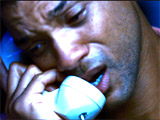 Suicide Call 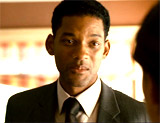 Tim/Ben Thomas (Will Smith)  Impersonating IRS Agent Ben Thomas, His Brother  Emily Posa (Rosario Dawson) 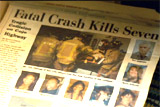 Fatal Crash News  Love Interest Emily 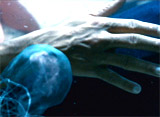 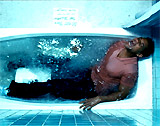 Box Jellyfish Deadly Sting in Icy Bathtub 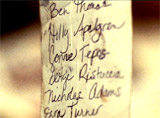 Gift Recipients |
||||||||||||

|
Sex and Lucia (2001, Sp.) (aka Lucia y El Sexo)
Julio Medem's intriguing and poetic (and very sexy) art-house film was told with a very twisting, non-linear, and non-logical plot which moved back and forth in time. It basically started in the middle of the entire tale (six years into the story), when "screwed up" and troubled Lorenzo Alvarez (Tristan Ulloa) was introduced as he spoke to his live-in girlfriend on the telephone. She was a lusciously beautiful Madrid waitress named Lucia (Paz Vega) speaking from her busy restaurant. He admitted to her that she was right about her diagnosis of his problems:
When she suggested that they visit the sun-washed, remote Mediterranean island together off the coast of Spain (Balearic Islands) that Lorenzo had often talked about, he said he didn't want to visit it with her, and didn't want to discuss it ("I'm sorry, I can't tell you about it. You don't deserve this. You shouldn't know"). Shortly later, Lucia received a phone call from the police with "bad news" about an accident involving Lorenzo. She thought her lover had killed himself, hung up, and didn't wait to learn any more. Then, she read Lorenzo's despairing quasi-suicide note and feared the worst:
Believing (wrongly) that Lorenzo had died, Lucia ran away grief-stricken, traveling by train and boat to the remote Balearic Islands to search the reason for Lorenzo's sorrow and lostness while writing his second novel ("the one about the island and the Valencian girl"). She wished to explore the dark corners of her abandoned relationship with him. While swimming naked on the island, she told herself: "I'll live alone with no one else. I don't need people." Then the film flashbacked - and returned to a time six years earlier with a key idyllic scene - it was an explanation why Lorenzo had abandoned Lucia. Two anonymous lovers made love underwater in the sea in the moonlight - the nameless female (later revealed to be Elena (Najwa Nimri)), a "world-class cook" and paella chef from Valencia, described the encounter with "birthday boy" Lorenzo Alvarez from Madrid as "the best f--k of my life." However, she didn't know his identity when he impregnated her ("I don't even know your name") and only had a few hints about him. Then the film jumped to follow the beginnings of the passionate involvement between novelist Lorenzo and Lucia. When they first met in her restaurant workplace before they fell passionately in love, she told him that she had read his first novel, and had been secretly stalking him (although he hadn't noticed her):
What followed was an unabashedly sexy series of erotic sequences between the oft-nude Lucia and Lorenzo. They took Polaroids of each other making love, and she performed a striptease for him. The film became very ambiguous:
As Lucia orgasmed with Lorenzo and screamed: "I'm dying!", the film abruptly cut to Elena's screams as she was giving birth to Lorenzo's love-child daughter - named Luna (Silvia Llanos), whom he subsequently met and visited on the island without telling her that he was her father. While on the island, Lorenzo also struck up an acquaintance with:
Calling him her boyfriend, Belen invited Lorenzo to Elena's home for the evening while Elena was out, to have sex with him -- and while they were in the bedroom, the young girl Luna was tragically killed by Elena's rottweiler dog. Subsequently, Lorenzo went into a deep depression - this was at the time he became uncommunicative with Lucia.
During Lucia's visit to the island, unbeknownst to her, she was invited to live in an island guest house (in a third floor room) with two people closely tied to Lorenzo:
Elena would often have "wild sex" without intimacy with lover Carlos, who she bragged had an enormous dick. Lucia also experienced a full-body naked mud-bath massage on the island's beach from Carlos. Lucia had secretly read Lorenzo's writings while he slept and learned that he had fathered the child with Elena. She also thought that his writings about having sex with Belen were fictional. Hospitalized and comatose, Lorenzo suffered from a cranial hematoma, possibly as a result of stress following the tragic death of Luna. Elena and Lucia discovered online through a wanted poster that the police had been searching for six months for Antonio and mother/daughter Manuela and Belen (with the revelation that the two women were missing and possibly dead). The film's circuitous connectedness was evidenced by these revelations:
In the film's conclusion, when Lorenzo awakened from his 3-4 week coma, he returned to the island with his friend Pepe (Javier Camara), and was reunited first with Lucia at the guest house, and then with Elena. A voice-over narration told about the magic of story-making as the film concluded:
The last images combined the two females in Lorenzo's life. Lorenzo was composing on his computer (with a computer-screen reflection of Elena walking behind him to his window). When Lorenzo walked to the window - he lovingly hugged Lucia from behind. |
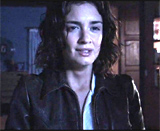 Grief-Stricken Lucia Paz Vega) After News of Lorenzo's Accident-'Death'  Lorenzo Underwater Sex with Nameless Female (Elena) - Fathering Child    Sexy Lucia (Paz Vega): "I'm Dying!" 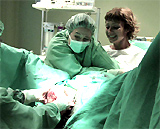  Elena Giving Birth to Lorenzo's Love-Child Luna  Luna (Silvia Llanos) 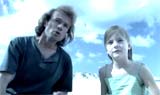 Lorenzo with Daughter Luna  Belen (Elena Anaya)  Belen Having Sex with Lorenzo  Mud Bath Scene 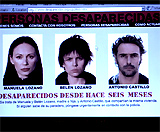 Wanted Poster: Mother Manuela, Daughter Belen, Manuela's Boyfriend Antonio 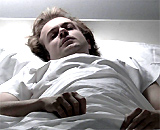 Lorenzo Hospitalized After Accident  Lorenzo Reunited with Lucia 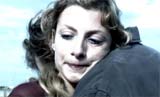 Lorenzo Reunited With Elena |
||||||||||||

|
Shallow Grave (1994, UK)
The directorial debut film of Scottish filmmaker Danny Boyle came in the form of this very black comedy. The nihilistic Hitchcock-like crime thriller (similar to Sam Raimi's A Simple Plan (1998), and to Huston's The Treasure of the Sierra Madre (1948)), opened with an introduction to a nefarious, cold-hearted group of three Edinburgh flatmates sharing an apartment. Their welcome mat read: "Not Today, Thank You." The trio were educated, smug, self-centered, and arrogant elitists:
After a series of humiliating interviews for a prospective 4th roomer, they decided upon a mysterious, black-clad writer named Hugo (Keith Allen) - who in flashback was involved in the grisly demise of a cash machine customer (David Scoular). Soon after, they found Hugo's naked body, presumably dead from a drug overdose, in his locked room. In a number of disturbing scenes, they greedily and amorally kept Hugo's suitcase full of money found under the bed. They drew straws, with the short one designating the person to dispose of the body in a shallow grave in the woods late at night. The normally-quiet, bespectacled David selected the short straw. Soon, he was scarily transformed into an insane maniac as the film progressed, due to monetary greed. While drooling, he bloodily hack-sawed the arms and legs off the corpse of the deceased, and plummeled the body's teeth with a sledge hammer to prevent identification from dental records. The body parts were incinerated at Juliet's hospital, and the bloody tools were rinsed off in their bathtub. Due to greed, fear, mistrust, increasing paranoia, backstabbing, and jealousy of all the roommates, the film with multiple twists ended with a vicious, murderous fight between the roommates.
Alex survived the ordeal when police arrived at the apartment. In a clever camera shot, the money was revealed below the knifepoint sticking through the floor (with blood dripping down), where Alex had hidden it. |
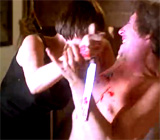
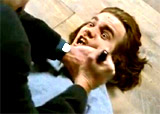 David Stabbed Alex 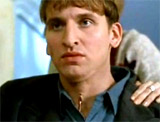  Juliet Stabbed David 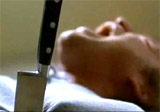 Alex Pinned to Floor 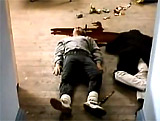  The Money Shot |
||||||||||||

|
The Shawshank Redemption (1994)
During the life sentence of Andy Dufresne (Tim Robbins) for a murder he didn't commit, he became buddies with prison fixer Red (Morgan Freeman), who feared that a despairing Andy would commit suicide one night. However, in the morning Andy had disappeared from his cell after having spent a painstaking nineteen years carving a hole in the wall with a rock hammer and hiding the evidence behind a Rita Hayworth/Raquel Welch poster. His digging efforts were accidentally discovered by corrupt Warden Norton (Bob Gunton). Then as his escape was being investigated, Andy entered nearly a dozen banks in the Portland area with "all the proper ID" - identifying himself as the 'phantom' Randall Stephens. He withdrew and closed all his accounts (with the warden's money) and accepted a cashier's check, purportedly to live abroad.
The warden blew his brains out when his corruption was uncovered and publicized by Andy. To fulfill his Mexican dream of freedom, a redeemed Andy settled on the beach at Zihuatanejo awaiting his friend Red, who was finally released in 1967 from prison. In the final scene on the Mexican beach, Red walked bare-footed on the sand toward an old wreck of a boat, where he found Andy patiently and meticulously sanding the old paint from the boat's ancient surface. Both were reunited and free. |
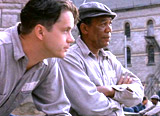 Andy Dufresne with Red 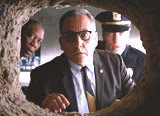 Warden Norton (Bob Gunton) - The Prison Escape Hole 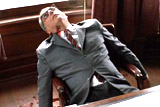 Warden's Suicide   Red Meeting Up With Andy on Mexican Beach |
||||||||||||

|
There were many twists and revelations in this Stanley Kubrick film adaptation of Stephen King's 1977 horror novel:
|
 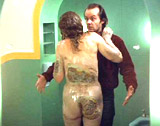 The Bathroom Scene   Jack Frozen to Death |
||||||||||||

|
Shutter Island (2010)
From the very start, director Martin Scorsese's plot twisting psychological thriller, based upon Dennis Lehane's book, was playing tricks with its audience regarding the identity of its main character:
In 1954, Teddy was investigating a psychiatric facility known as Ashecliffe Hospital on isolated Shutter Island in Boston Harbor, accompanied by his newly-assigned buddy Chuck Aule (Mark Ruffalo). There were suspicions that the facility, an institution for the criminally insane, was a government mind-control operation (with "Nazi experiments... satanic OR's"). Supposedly, they were there to look into the recent disappearance of a criminally-insane patient named Rachel Solando (Emily Mortimer) from a locked ward room in the hospital. (Daniels was told that the war widow was a murderess who had been hospitalized after drowning her three children in a lake behind her house.) Teddy was experiencing demons from his own life - including frequent migraine headaches and hallucinations related to his violent war-time past. The film's main plot twist was that he was actually Andrew Laeddis (aka patient 67), a disturbed Shutter Island inmate for two years who was being rehabilitated by Dr. Cawley (Ben Kingsley), through a very complex and experimental form of therapy - a "radical, cutting-edge" role-playing game.
Teddy's cop partner "Chuck" was actually Teddy's primary shrink-doctor - the "missing" Dr. Lester Sheehan (who had conveniently left on vacation after Rachel's disappearance). The goal of Teddy's two-day non-invasive therapy by Cawley was to prove that patient Andrew could be extracted from his fantasy delusion of being "Teddy Daniels" without being subjected to more radical forms of therapy, such as:
Suffering from post-traumatic war syndrome (with remembrances of the liberation of the death camp at Dachau for one) and from the effects of drinking, Andrew had ignored the signs that his blonde manic-depressive wife Dolores Chanal (Michelle Williams) was insane and suicidal, and had committed arson at their city apartment building. When she broke down and murdered their three children (the only daughter was named Rachel) by drowning at the cabin by the lake, he murdered Dolores with a gunblast to the abdomen after she said: "Set me free." Entering a fantastical world and believing that Andrew Laeddis was instead a maintenance man (and "firebug") at their apartment (and that "Laeddis got away with it and then he disappeared" after being transferred to Ashecliffe), Andrew invented the persona of "Teddy Daniels" out of tremendous guilt (he later said "survival instincts are defense mechanisms"), to deny the crime had ever existed. He had disassociated himself from his heinous crime as Laeddis, and reestablished himself as a war hero, working in his former occupation as a federal marshal - now investigating conspiracy theories involving Shutter Island. At the film's conclusion, Cawley revealed the game:
In the final scene, the entire delusionary world was described by Dr. Cawley in an upper office in the island's lighthouse. Cawley feared and realized that Andrew's therapy had failed to cure him, and he was still considered the facility's "most dangerous patient" after injuring guards, orderlies, and other patients. He could not live with the guilt of killing his wife Dolores. Although Andrew admitted his monstrous crime, he regressed again the next morning and reverted back to his "Teddy" identity. But then, he seemed to voluntarily and calmly accept the lobotomy surgery (without need of a straitjacket) and have his guilt, dreams and memories permanently removed rather than live as the wounded and monstrous Andrew. He uttered the enigmatic last line to "Chuck" before being led off by hospital officials and orderlies for a lobotomy:
His buddy called after him: "Teddy?" The camera panned over to the island's lighthouse (a "sewage treatment facility"). |
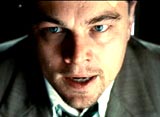 "Teddy" Daniels, aka Andrew Laeddis (Patient 67 at Shutter Island) 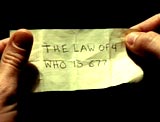 The Law of 4  Andrew's/Teddy's Wife Dolores Chanal (Michelle Williams) - Who Had Murdered Their 3 Children 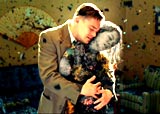  Daughter Rachel Solando (Emily Mortimer) 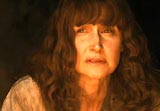 Imaginary Daughter Rachel Solando (Patricia Clarkson)  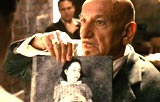 Dr. Cawley (Ben Kingsley) Revealing Andrew's Therapy 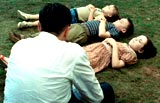 Andrew's Three Murdered Children 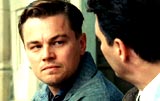 Andrew Laeddis Calmly Accepting a Lobotomy |
||||||||||||
|
Siesta (1987)
This film was an overly-ambitious, free-associating mystery/psychological thriller - the directorial debut film of Mary Lambert. The conclusion with its stereotypical death-dream ending plotline resembled An Occurrence at Owl Creek Bridge (1962), Carnival of Souls (1962), Jacob's Ladder (1990), The Sixth Sense (1999), The Others (2001), and many other films. It opened with a startling scene - an unidentified female (Ellen Barkin) awakened at the edge of an airport runway near Madrid. It was the Fourth of July. She was wearing a bright red dress, and her body was covered in someone else's blood. After washing her naked body in a stream and rinsing the blood from her dress, she hailed a taxi, and in voice-over exclaimed: "I'm in Spain! Aw, jeez. What the f--k am I doing here?" Her passport, money and everything else were in her bag - which she didn't have: "My god, what's happened to me?...I remember coming here, and I don't remember anything else."
Suffering from amnesia and not knowing her past, she was apparently being pursued by local police who believed that she had murdered someone. The film then flashbacked (with mixed-up or scrambled memories including flash-forwards) to five days earlier, to reveal her identity. She was a professional daredevil stuntwoman at Death Valley, CA named Claire, who was lovelessly married for six years to Del (Martin Sheen), her shameless, Southern-drawling promoter. Del was pressuring Claire to perform a free-fall stunt (death-defying without a parachute) on July 4th into a giant safety net stretched over an artificial, man-made volcano - the event was heralded as "Claire on a Dare." Before the July 4th event, Claire had hurriedly abandoned Del and traveled to Spain to see her old boyfriend - Spanish trapeze-artist Augustine (Gabriel Byrne) who had trained her for aerial acrobatics as his "star pupil." In Spain, she met up with Augustine and wanted to reignite their love affair despite the fact that he was married to a very jealous Marie (Isabella Rossellini), a wealthy woman. He warned her: "Go away from here, Claire. Please! There will be trouble if you stay." She expressed her confused worries: "I killed someone. I'm in love with a man, and I killed his wife." When Claire met Marie, Marie stated that Claire's death-jumps without a parachute meant: "Perhaps being closer to death, it makes her feel more alive." One afternoon during 'siesta' time, Claire approached Augustine and propositioned him: "Make love to me," but he declined, although he suggested they get together at the same time in the future. Meanwhile, Claire was also experiencing premonitions of her own murder, although she didn't realize it. Claire seemed to have a death-wish - exemplified by her daredevil-jump: "When I jump, I know that if I make a mistake, I won't have to account for it later." During a fateful sexual rendezvous between Augustine and Claire at siesta time, she requested that he run away with her. The sequence was interspersed with the cabbie's rape-assault on Claire, as he beat her and yelled: "You're no good!" After Claire removed her panties, Augustine touched her breasts as he pulled down on her red dress. They were both naked and began to make love, with deadly consequences the result. Police sped to the scene of a murder, and Claire was swept along with a group of townspeople who rushed through the streets to view the crime scene. Kit appeared along side Claire and advised her: "Don't fight it any more, love. Go where you're being taken." When she awoke in Augustine's arms after sex, Claire was attacked by a crazed Maria wielding a knife, and viciously stabbed in the abdomen. Augustine fought off Maria, and then crouched over the body of his loved one. The killer Maria was arrested and led away by the authorities - much later it was revealed - after having disposed of Claire's body at the airport: ("Maria, why did you leave her body at the airport?"). Augustine walked by Claire, but he didn't see her as she spoke the film's final line of dialogue to him:
The film's often-used gimmicky plot twist at the end was that Claire had been murdered by Augustine's jealous wife and her experiences were only the jumbled, fantasy thoughts and dreams of her final moments before her death. |
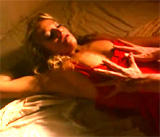
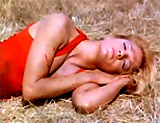 Unidentified Female (Ellen Barkin) 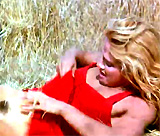  Beginning of Film  On the Street in Madrid 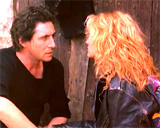 Visiting with Augustine (Gabriel Byrne) - Her Ex-Boyfriend/ Acrobatic Trainer  Claire to Augustine: "Make love to me"  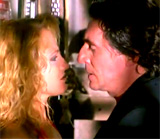 Fateful Sexual Rendezvous with Augustine 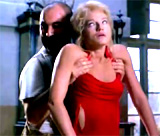 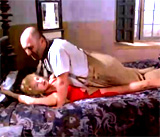  Sex with Augustine Interspersed with Scene of Cabbie's Rape of Claire |
||||||||||||





 Asbestos
Cleaner Gordon Fleming and His Cleaning Crew, During a Job at an Abandoned
Insane Asylum, Encountered The Haunting Ghost of a Disturbed Past
Patient Named Mary With Multiple Personality Disorder; By Film's
End, Gordon Had Murdered His Family and His Crew of Workers; He
Was Staying in Mary's Room Surrounded With Pictures of
His Family; He Was Possessed by Mary's Most Evil Personality
Named 'Simon' - Heard on Mary's Session 9 Tape
Asbestos
Cleaner Gordon Fleming and His Cleaning Crew, During a Job at an Abandoned
Insane Asylum, Encountered The Haunting Ghost of a Disturbed Past
Patient Named Mary With Multiple Personality Disorder; By Film's
End, Gordon Had Murdered His Family and His Crew of Workers; He
Was Staying in Mary's Room Surrounded With Pictures of
His Family; He Was Possessed by Mary's Most Evil Personality
Named 'Simon' - Heard on Mary's Session 9 Tape