|

|
|
||||||||||||||||||

|
Wild Things (1998)
Director John McNaughton's 'guilty pleasure' erotic, film-noirish thriller was a film that featured many twists and turns - and prominent younger stars in sexy/dirty and scheming situations in a South Florida Everglades town named Blue Bay. Greed, betrayal, and seductive manipulation were the film's main themes, exemplified by the tagline:
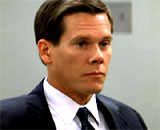
The main characters were:
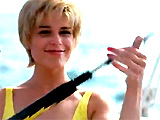
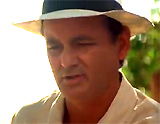
Included early in the film, a dripping-wet Kelly performed seductively while washing Sam's Jeep in a wet T-shirt, charity-fundraising, car-wash sequence to the tune of Lauren Christy's "I Want What I Want" - and afterwards, Kelly lingered (in a dripping-wet T-shirt) to collect Sam's coupon inside his house - with a knowing look. Kelly looked ready to seduce Sam inside his home, but the sequence abruptly ended with a fade to black; the outcome of the scene was truncated and raised some doubts, when the distraught Kelly (with a ripped T-shirt) left the house and ran off; had she been raped, or had she engaged in consensual sex, or had she been rebuffed? [Note: Later, it was clearly revealed what happened!] This sequence provided Kelly with the grounds for making an accusation of rape against Sam. In the wealthy Miami, Florida suburb of Blue Bay, the film's major plot involved a rape case including three of the cast's characters - Sam, Kelly, and Suzie. Accusations were made by the two females that Sam raped Kelly and also raped Suzie. In the trial, Sam was defended by free-lance lawyer Kenneth Bowden (Bill Murray).
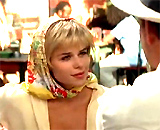
Under cross-examination, Suzie broke down on the witness stand and confessed that Kelly had pressured her to join her and to falsely accuse Sam of rape: ("Sam Lombardo didn't rape me. He didn't rape Kelly either. He didn't do anything...I just wanted to hurt Mr. Lombardo"); Suzie had spitefully and vengefully pressed charges against Sam, because he hadn't bailed her out of jail (on minor narcotics charges), and she had to serve 6 months in the state's correctional facility; Suzie also claimed that Kelly had angry and jealous motivations designed to double-cross her widowed mother - by getting involved with her mother's lover Sam, her own HS guidance counselor. (It was later discovered that both females were accomplices). Sam was acquitted, and had a perfect opportunity to make counter-charges of defamation and the ruination of his life; the trial's settlement payout awarded Sam $8.5 million dollars (from Kelly's trust fund established by her mother Sandra); Kelly was upset by the decision: "You know how my Mom's paying you off? She's breaking my trust. I can't touch it until she's dead, and now she's breaking it to pay you"; [Note: Spoiler -- Sam was also in cahoots with his two accusers to share in the payout.] In the midst of the plotting was a highly-publicized, champagne-drenched menage a trois sequence with Sam to celebrate their newfound wealth and success, although Sam warned the conspiratorial and scheming trio not to be seen together again. In the midst of the scheming, Kelly exited a school swimming pool - filmed in sensuous slow-motion to the tune of Morphine's "I Had My Chance" (lyrics: "I had my chance and I let it go, I had my chance and I let it go, Well if I ever have myself another chance like that, I'm going to grab it and I won't look back"). She was confronted by suspicious Sgt. Duquette who was keeping the two females under surveillance; he complimented her: "Nice stroke"; she jokingly asked if he was interested in improving his "breast stroke." He questioned her about a possible conspiracy between her and Sam to get rid of Suzie ("pill-head") and take off for the Caribbean now that Sam had been awarded the settlement money. He was trying to create a wedge between the two females to reveal the scam. Duquette also visited with Suzie to create more of a wedge between the two females; he also suggested that she was in jeopardy because Sam and Kelly were planning on abandoning her and escaping to a Caribbean island (where Sam had transferred most of the payoff); he raised her fears: "You don't think Kelly and Sam are gonna share that money with you, do you?" After a catfight between Kelly and Suzie due to Suzie's fears that she would be eliminated, Kelly then unexpectedly celebrated lesbianism with Suzie in a swimming pool (extended only in the uncut version). Suzie untied the straps of Kelly's bikini top, as they kissed, and soon they were both topless and in each other's arms - while the perverted Ray watched from the shadows videotaping their escapades. But then, one by one, suspicion and distrust led to a number of betrayals, double-crossing murders and unexpected events. The twists and turns included the following:
(In reality, Sam and Suzie had conspired together to fake her death; Suzie revealed herself to be a double-crosser when she appeared to side with Sam against Ray; Suzie was very motivated to get back at Sgt. Duquette - for his previous mistreatment of her; Sam was also upset for Ray's murder of Kelly.) Suzie congratulated Sam ("We won. Sam, it's over"), but then Sam paused when she handed him a drink; he was paranoid, but she convinced him that she had no idea how to sail the boat back to shore; after he took a drink, she revealed that she had poisoned Sam with a doctored drink - and hinted to him about what she had done - she never intended to be on Sam's side; she gave him a multiple-choice pop quiz: ("Before Medea sailed away on the Helios she killed king Creon and the princess, with what? A: A rock. B: Spear-gun or C: A bit of Poison"); Sam was right when he guessed choice C - poison; Suzie released the sailboat's rigging-boom and knocked him overboard; Suzie was left as the only survivor. Suzie had a high IQ of 200 ("That girl could do just about anything she put her mind to"), although she had always been underestimated for her abilities due to her lowly upbringing, poverty, and lack of education. The film formally ended with "THE END. " But then additional scenes during the end credits (and in the unrated version) showed off-screen sequences (some of which were explained above) and other details - rewinding the film to show scenes that hadn't been shown earlier in the film to further explain the plot; Suzie was the plot's mastermind and had planned the entire vengeful scheme, beginning with the rape allegations and the trial, to make it look like Sam was the mastermind, and to set up Kelly for her own murder; she was a masterful manipulator who had orchestrated three murders, and ended up with the pay-off money.
The film's epilogue was at a beach where Sam's unscrupulous lawyer Kenneth Bowden handed sole surviving Suzie the payoff - a case loaded with cash and a separate check in an envelope: "Cash is just walkin'-around money. The check is the balance of the numbered account minus the million we set aside for Ruby and Walter, less my usual fee. Case closed"; she kissed him and then strolled off with the briefcase; he murmured to himself: "Suzie, be good." |
 Wet T-Shirt Scene: Kelly Van Ryan (Denise Richards)  Kelly's Confession to Her Mother Sandra (Theresa Russell) That Sam Had Raped Her  Goth Suzie Toller (Neve Campbell) Reporting Another Rape Allegation Against Sam Lombardo 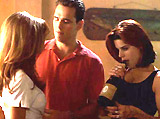 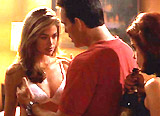 The Schemers - A Drunken Celebration  Kelly's Sexy Exit From Swimming Pool  Kelly Confronted by Sgt. Duquette  Start of Catfight Between Kelly and Suzie  Catfight Turned Into Kissing  Suzie's Death (Faked)  Ray Duquette - Shot in the Upper Left Arm  Kelly Murdered by Ray (Who Shot Himself in the Shoulder to Make It Look Like Self-Defense)  (l to r): Sam Collaborating with Ray  Suzie Toller - Disguised on a Beach  Meeting With Sam's Lawyer Kenneth Bowden |
||||||||||||||||
|
Witness for the Prosecution (1957)
The studio's publicity campaign requested that viewers not reveal the stunning plot twist in this film, although it was one of Agatha Christie's most famous, well-known short stories/plays (first published as a four-character short story in 1933). A voice-over narrator at the end of the film stated:
[There was a TV remake in 1982 with Ralph Richardson and Deborah Kerr.] The setting for this convoluted courtroom drama was Britain in 1952. Crafty, cynical, weak-hearted barrister/attorney Sir Wilfrid Robarts (Charles Laughton) accepted a challenging case to take on the criminal defense of:
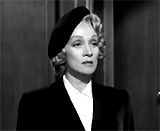
It was something not recommended by his doctors who wanted him to only take "bland civil suits." The defendant Vole was accused of murdering a 56 year-old lonely, and wealthy widowed acquaintance, Emily Jane French (Norma Varden), in order to inherit her property (80,000 pounds) as her will's beneficiary (in the recently-changed document a week before her death) - there was only circumstantial evidence implicating him in the crime. Vole attempted to use his only alibi -- his enigmatic, glamorous wife/lover Christine Helm/Vole (Marlene Dietrich), an ex-German beer hall performer in Hamburg (whom he had married after WWII), to defend him. She would claim that she was home with him when Mrs. French was murdered. However, she could not, as the defendant's wife, be considered a very credible witness (as the "wife of the prisoner").
When called to the stand by the prosecution as a "surprise witness", Christine said that she could provide evidence against her 'husband' Leonard Vole. She vowed: "I cannot go on lying to save him":
However, she was not even a credible witness for the prosecution. When she was on the stand, Robarts accused her of committing perjury for much of her life:
Soon after, the barrister Sir Wilfrid was called to meet a mysterious Cockney woman who offered to supply him with evidence against "that German wife." The woman on the phone said to meet him at a train station in 30 minutes: "If you want the lowdown on that German bag, get yourself here." When they met, the heavily-accented woman offered Sir Wilfrid love letters that Christine had written to a mysterious lover named Max (so she could get rid of Leonard and be with him). The letters would suggest that Christine was actually having an affair and was an unreliable witness. She then proposed: "Wanna kiss me, duckie?" - and raised her hairline, to show disfiguring scars on the right side of her face, deep cuts inflicted by Christine's new lover/boyfriend who turned against her, when Christine stole him away. Now, she was getting her revenge ("Cold-blooded vindictiveness") by turning over the letters. When the trial resumed, Sir Wilfrid called Christine to the stand and confronted her with the letters recently written to Max (with evidence she was on "intimate terms"), to prove that she had lied. One of the damning letters was read outloud for the jury by Sir Wilfrid:
She broke down on the stand and admitted: "I wrote the letter." Therefore, she had lied in earlier testimony. Having proven Christine to be a liar and unreliable witness, Leonard was declared 'not guilty' by the jury. After the case was closed, Christine revealed her strategy. She explained that the only way to absolutely guarantee her husband's acquittal and get her guilty husband off the hook was to become a "witness for the prosecution":
Then came one of the film's many plot twists -- she revealed that she had masqueraded as the Cockney woman by repeating her accent to Sir Wilfrid: "Wanna kiss me, duckie?" Christine said that she was disguised as the Cockney woman who devised the ploy of love letters to get Vole acquitted. She explained to him that her all of her fraudulent letters and lies about Max (who didn't exist) were the only way to have the jury believe that Leonard was innocent. But then, in the shocking ending set in the courtroom, a second, ultimate twisting revelation was that acquitted American Leonard Vole was actually guilty of Emily French's murder. The defendant, who entered and hugged Christine, was gloating about his solid verdict to Sir Wilfrid: "You got me off and I can't be tried again for this." Obviously, Leonard had indeed murdered the elderly wealthy woman - the suspected charge that was made against him from the start. With his newfound inheritance, Leonard said he would take care of everyone (including paying for Christine's perjury defense) - and then he admitted another major double-cross:
Flabbergasted and shocked, Christine cried out: "Don't, Leonard! Don't leave me!" And then, in furious anger, Christine stabbed Leonard to death. This climactic murder was followed by Sir Wilfrid's classic line when he corrected his nurse Miss Plimsoll (Elsa Lancester) about the killing:
Sir Wilfrid would now serve as Christine's defense lawyer. |
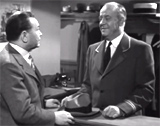
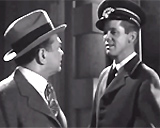
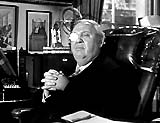 Sir Wilfrid Robarts (Charles Laughton) 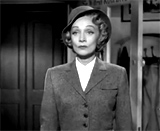 Christine Helm/Vole (Marlene Dietrich) 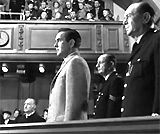 Leonard Vole (Tyrone Power): Charged With Murder 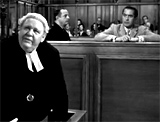 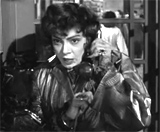 Phone Call from Cockney Woman to Sir Wilfrid From Train Station 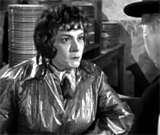 New Evidence: Christine's Love Letters 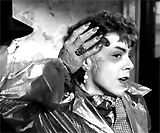 "Wanna kiss me, duckie?" 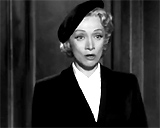 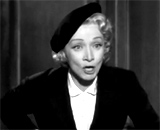 Christine Recalled to the Stand - To Be Proven a Liar 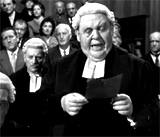 Sir Wilfrid Reading Christine's Love Letter 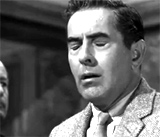 Leonard's Relief at 'Not Guilty' Verdict 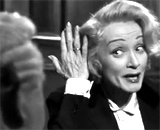 2nd Time: "Wanna kiss me, duckie?" 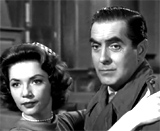 Diana (Ruta Lee) and Leonard 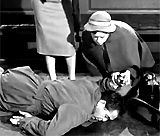 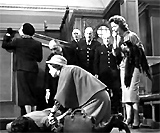 Leonard Stabbed to Death |
||||||||||||||||
|
In this classic film's ending, it was discovered that Kansas teenager Dorothy Gale's (Judy Garland) adventures in the Wonderful Land of Oz were only imagined in a fanciful dream, after she had suffered a concussion during a Kansas tornado-twister. In Oz-land before she clicked her ruby slippers together to return home, it was revealed that the Wizard (Frank Morgan) was fraudulent. Her three friends already possessed the qualities they were hoping for: intellect, courage, and a heart:
Dorothy insisted to her family and friends that her journey was real and not just a "bad dream":
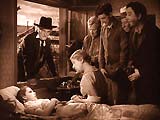
She was reassured at her bedside while surrounded by the anxious faces of her three familiar farmhands, and relatives. Dorothy was very grateful to be back in her own home:
|
 |
||||||||||||||||
|
The Woman in the Window (1944)
Director Fritz Lang's dark noir masterpiece originally was to end with a suicide, but this conclusion was substituted with one more suited for the Production Code at the time. It was not a coincidence that Fritz Lang made another similarly-plotted film noir with the same three stars, Robinson, Duryea and Bennett, titled Scarlet Street (1945) a year later - his follow-up film. The film's tagline was detailed:
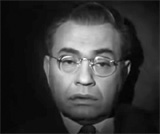
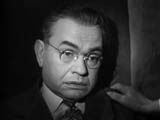
Soon to become enamoured by the requisite femme fatale was the film's main character:
While his family was away on vacation, he risked his future after meeting up with the femme fatale, when she emerged as a reflection next to a painting in an art gallery window:
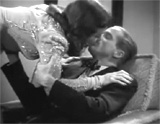
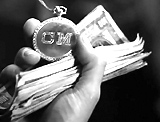
Invited back to her mirrored apartment where she was wearing a diaphanous dress, they sipped champagne and talked. Then, at 1 am, a taxi pulled up, and Alice's hot-tempered and jealous boyfriend "Frank Howard" (Arthur Loft) abruptly arrived. (Later, he was revealed to be a wealthy and prominent Wall Street financier/businessman of World Enterprises Inc. named Claude Mazard, with initials CM.) He immediately slapped Alice after accusing her of infidelity - and had misinterpreted Wanley's presence. He fist-punched the Professor and began choking him on the sofa. With a pair of scissors handed to him by Alice, Wanley stabbed "Howard" to death in the back. The conservative Professor had become embroiled in a crime due to his unintentional self-defense murder of an assailant. Wanley suddenly found himself on the run when he and Alice decided to avoid contacting the police, and instead opted to put the body in his car's back seat (rolled into a blanket) and dump it far away in the country. During the cover-up, Wanley left a trail of clues (a muddy tire track) and other witness sightings (the garage attendant, a policeman, Alice's upstairs neighbor, a toll booth collector, etc.). Alice planned to thoroughly clean her apartment, and discard the dead man's personal belongings (including his monogrammed CM pocketwatch) into the river the next day. The headlines from the New York paper read: "MAZARD MURDERED: Body Discovered by Boy Scout in Suburban Woods." There were tense scenes when Wanley listened as his friend District Attorney Frank Lalor (Raymond Massey) took the case and began to discuss his findings - and Wanley became increasingly-desperate, paranoid, and tense during a visit to the crime scene with Lalor. He worried that there was evidence of a scratch on his right hand from barbed wire and a case of poison ivy acquired while he was dumping the corpse in the woods. Alice (and Wanley) were soon marked as the killers and blackmailed by Mazard's sleazy bodyguard Heidt (Dan Duryea), nicknamed "Pappy," a wanted ex-cop and "known crook with a blackmailing record." Alice's attempt to be cooperative with Heidt, pay him off, and poison him failed. Realizing that he had been double-crossed, Heidt proposed an even heftier blackmail sum from Alice of $5,000 more dollars.
However, as he left Alice's apartment, Heidt was shot to death in a gun battle with police (he was assumed to be the financier's murderer after the incriminating "CM" pocketwatch and Alice's $5,000 in cash were found in his pocket - that he had just absconded from Alice). Meanwhile, Wanley felt that he had come to the end of his rope - and was preparing to commit suicide with an overdose of his own prescription drug in his easy chair in his home. In the comic (cop-out and fizzling) ending, now set in Wanley's men's social club, Wanley awoke to find that the entire plot had been a dream of his subconscious! And the hat-check attendant Charlie (Arthur Loft) at the club was none other than "Howard"/Mazard! Wanley exclaimed: "I can't tell you how happy I am to see you alive and in such good health." And Ted, the doorman was Heidt (Dan Duryea)!
The film's ending was the direct result of a discussion Wanley had in the film's opening with his two close club friends, Frank Lalor and Dr. Michael Barkstane (Edmund Breon) about the opportunities of 'bachelorhood' freedom (with his wife and children away), but also the dangers of amorous temptation for stodgy middle-aged elderly men who quit acting their age and ended up tragically:
Wanley surmised that he had learned his lesson about being tempted by adventure; in the actual ending on the street, when a female (hooker?) came up to him in front of the painting and innocently asked: "Pardon me, uh, will you give me a light?", he steadfastly refused and hurriedly fled: "No, oh, no. Thank you, indeed. Not for a million dollars!" The film ended on a close-up of the painting. |
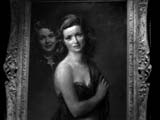 Portrait Painting of a Woman in the Window - With an Additional Reflection  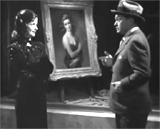 Painting Model Alice Reed (Joan Bennett)  At a Late-Nite Club For a Drink 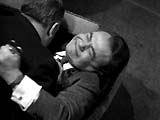 The Stabbing of "Frank Howard" -- Claude Mazard (Arthur Loft)  Alice and Wanley Covering Up the Crime 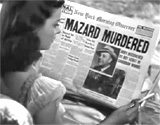 "Mazard Murdered"  District Attorney Frank Lalor (Raymond Massey) 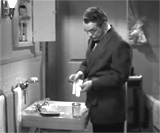 Wanley Preparing to Commit Suicide With an Overdose of Sleeping Powder 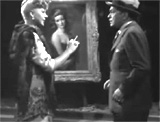 Female Passerby to Wanley: "Will you give me a light?" |
||||||||||||||||

|
The World is Not Enough (1999)
The 19th installment of the official James Bond films featured a 'Bond Girl' that was a female - the first instance in a Bond film in which the major villain was a female:
She was first seen at the Scottish funeral of her billionaire industrial father Sir Robert King (David Calder), an oil baron who had recently been murdered. He was killed by a massive blast activated by the radio-transmitter in his lapel-pin (someone on the "inside" had switched it with the original). Sympathy was aroused for the pretty daughter. In her past, heiress daughter Elektra (with a "wild-child image") had previously been kidnapped and held for ransom for $5 million dollars, but M (Judi Dench), James Bond's (Pierce Brosnan) boss, had advised not to negotiate with the terrorist, Victor Zokas - aka Renard (Robert Carlyle), and pay the ransom. She escaped from her captors, but as the film progressed, it appeared that Renard, a treacherous, international terrorist and anarchist, hadn't quite had full revenge in the King incident, and was still targeting Elektra. Bond was assigned to be Elektra's protective bodyguard after her father's assassination (to protect her from any further harm), and to find out who had switched the lapel-pin. However, she denied wanting Bond's help. In the course of his mission, he fell in love with Elektra, who had taken over her father's oil pipeline business. She explained her objective to the agent - to take over her father's work and build an 800-mile pipeline from the Caspian Sea through Turkey, past the terrorists in Iraq, Iran and Syria. In a northern area, the Russians already had three competing pipelines. Although it seemed that Elektra's oil pipeline was being sabotaged, it covered up the fact of her collaboration with Renard to steal plutonium, set off a catastrophic meltdown in Istanbul, Turkey, and provide her with a monopoly on oil transport in the region by putting her competitors out of business. Bond was the first to suspect Elektra's involvement with Renard. Bond diagnosed Elektra as suffering from Stockholm syndrome -- common in kidnappings. She had been a:
He cautioned M: "Perhaps that girl isn't as innocent as you think." He thought that she might have switched her father's lapel pin to kill him. M was incredulous: "She kills her own father and attacks her own pipeline?" The twist was revealed when Elektra presented M with a "gift" - repayment for how M had compassionately advised her father on "the best course of action" when she had been kidnapped - it was her father's original lapel pin. She had mercilessly killed her own father: "I just couldn't let it explode with the rest of him." Elektra remained spiteful over her abandonment by M, who she then seized and held as hostage: "Your people will leave you here to rot, just like you left me. You and my father." She believed she was the rightful owner of her father's oil empire, and was revealed as the sociopathic villain who was orchestrating events with her lover, Renard. In a final confrontation with Bond, Elektra tortured the agent (and kissed him simultaneously). She uncovered an ancient Spanish torture device - a bench-chair with a neck-breaking garrotte, to hold Bond, and she taunted him as she continued to tighten the screw-bolt of the neck garrotte. She argued that her father had killed her ("He killed me the day he refused to pay my ransom"). She exclaimed: "It is my oil. Mine, and my family's! It runs in my veins, thicker than blood. I'm going to redraw the map. And when I'm through, the whole world will know my name, my grandfather's name, the glory of my people!" She was deluded and assured of her own success: "You understand? Nobody can resist me." But then Bond escaped, freed M, and challenged her to radio Renard and "call him off" - to stop the nuclear launch. Bond was persistent: "I won't ask again." She looked seductively at Bond, hoping to change his mind. She taunted and doubted that he would kill her: "You wouldn't kill me. You'd miss me." When she refused to comply, he cold-bloodedly shot her, then quipped: "I never miss." He leaned over her body lying on her bed - he touched her hair, momentarily sorry for the loss. [Note: Elektra was the first 'Bond Girl' in the series that Bond personally killed.] In the conclusion, Bond and his rescued partner, nuclear physicist Dr. Christmas Jones (Denise Richards) confronted Renard in the submarine where he was preparing to load the plutonium rod into the reactor. Bond manipulated a pressure hose to cause the reactor to backfire (Bond taunted that Elektra was already dead: "She's waiting for you"). The rod was ejected at high-speed, impaling straight into Renard's chest, and killing him. Bond and Jones escaped from the sub before its reactor harmlessly detonated underwater. |
  Elektra King (Sophie Marceau) 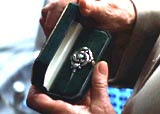 Lapel-Pin  Falling in Love 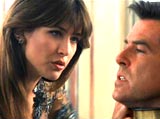   Bond Tortured 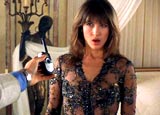 "Call Him Off"  "You wouldn't kill me. You'd miss me." 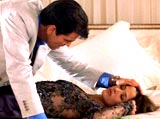 Bond After Killing Elektra |
||||||||||||||||





 The
Rape Allegations Against Sam by Both Kelly and Suzie Were Bogus
- All Three were Co-Conspirators to Claim a Defamation Payout from
Kelly's Mother; Sgt. Ray Duquette then Murdered Kelly; Sam Tried
to Double-Cross and Kill Ray By Causing Him to Fall Overboard From
His Sailboat, But Ray Was Ultimately Killed By Two Shots From Suzie
(Who Had Faked Her Death with Sam) With a Spear Gun; Suzie Also
Poisoned Sam; By Film's End, Mastermind Suzie Walked Away With
a Suitcase Filled With Cash
The
Rape Allegations Against Sam by Both Kelly and Suzie Were Bogus
- All Three were Co-Conspirators to Claim a Defamation Payout from
Kelly's Mother; Sgt. Ray Duquette then Murdered Kelly; Sam Tried
to Double-Cross and Kill Ray By Causing Him to Fall Overboard From
His Sailboat, But Ray Was Ultimately Killed By Two Shots From Suzie
(Who Had Faked Her Death with Sam) With a Spear Gun; Suzie Also
Poisoned Sam; By Film's End, Mastermind Suzie Walked Away With
a Suitcase Filled With Cash