|

| |
|||||||||||||||||||||||||||||||||||

|
Android (1982)
Director Aaron Lipstadt's science-fiction film was set in the year 2036, in a satellite laboratory on a remote space station in deep space, orbiting around the Earth. Obsessed and eccentric, Frankensteinish research scientist Dr. Daniel (Klaus Kinski) was working with his 5 year-old shy, assistant prototypical android Max 404 (scriptwriter Don Keith Opper), and carrying out illegal research (androids were outlawed on Earth). In his spare time, coming-of-age Max engaged in learning about 20th century humans by playing computer games, watching old movies, reading sex manuals, and listening to rock 'n' roll and soul music. Dr. Daniel was worried that Max might grow insubordinate. In order to complete a perfect, more upgraded, superior android, Dr. Daniel was working on a new model that would render Max obsolete (but he needed the life essence of real female to activate it):
A runaway spaceship with three escaped convicts-fugitives (posing as the transport's crew) docked at the space station, including:
Dr. Daniel wanted to use Maggie as a model and sex-electrical power source. When the sexual chemistry from Maggie and Max sparked life into Cassandra, she came alive. However, most of the space crew ended up dead:
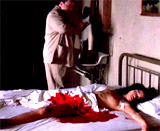
In the film's twist ending, it was revealed that Dr. Daniel was also a robotic android when his head was ripped off by Max and Cassandra during another struggle. The film concluded with Max and Cassandra returning to Earth posing as Dr. Daniel and his assistant. |
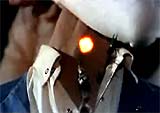 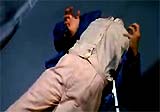 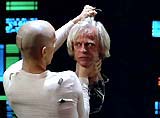
Dr. Daniel's Android Head Ripped Off by Max |
|||||||||||||||||||||||||||||||||
|
And Then There Were None (1945) (aka Ten Little N-----s, UK)
In this most-popular of Agatha Christie's detective film adaptations, a mysterious "Mr. U.N. Owen" (read as "Mr. Unknown") had created a remote Indian Island deathtrap, off the coast of Devon, England. He had invited ten guests there (eight strangers and the butler and cook Mr. and Mrs. Thomas (Ethel) Rogers) - all accused of having caused the death of others while escaping punishment. A summary of the ten guests, their crime, and mode of death, presented in the order in which they died at the mansion. All of the murders were inspired by the children's song Ten Little Indians, aka Ten Little N-----s in the 1939 novel ("Ten little n----r boys went out to dine; One choked his little self and then there were Nine..."):
One by one, the guests started dying (off-screen) - by poisoning, drug overdose, stabbing, axing, by a hypodermic needle, a shot to the head, death by a crushing load of bricks, etc. Judge Francis J. Quinncannon, one of the guests, was revealed as the perpetrator of the killings - and identified as the enigmatic Mr. Owen. He revealed that he was dying of a terminal illness. Quinncannon had faked his own death (bullet hole in the head) with the help of one of the unsuspecting victims, Dr. Edward Armstrong, who he then later killed on the beach. At film's end, Quinncannon told surviving guest Vera Claythorne how he had planned and perpetrated all of the killings - part of a scheme in his search for 'perfect justice':
He then told her that he was dying of a terminal illness and would be the 10th corpse ("I choose to leave this wicked world with a powerful record of good deeds"). He offered Vera the option of hanging herself with a noose rather than waiting to be hanged publically (for committing all of the murders and being left as the only survivor!), and then committed suicide by swallowing poisoned whiskey. Only two guests managed to survive - those who didn't commit murder and were innocent of the crimes they were accused of: Vera (who had confessed to a crime committed by her sister) and Philip Lombard (actually Charles Morley) who had attended in place of his friend Lombard who had committed suicide when threatened by Owen. The two survivors left with an old fisherman (Harry Thurston), who arrived and was ready to pick up everyone on Monday morning. |
 Centerpiece: Ten Little Indians 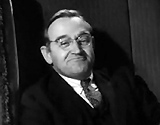 Judge Quinncannon (Barry Fitzgerald) (aka Mr. Owen) 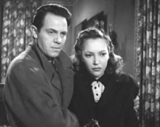 Charles Morley (Louis Hayward) and Vera Claythorne (June Duprez) - the Two Innocent Survivors 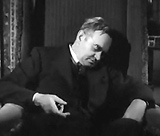 Mr. Owen - Dead of Whiskey Poisoning 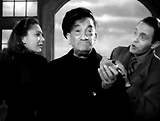 The Old Fisherman (Harry Thurston): "Ready to leave now?...Are the others ready too?" |
|||||||||||||||||||||||||||||||||

|
Angel Heart (1987)
Writer/director Alan Parker's supernatural-mystery-horror neo-noir was a twisting, metaphysically-confusing film set in the mid-1950s in NYC and in New Orleans, LA. Parker's own screenplay was adapted from the 1978 novel Falling Angel by William Hjortsberg, and included black (and voodoo) magic, a Satanic figure and Faustian theme ("Mephistopheles is such a mouthful in Manhattan"), soul transference, and multiple bloody murders. The unsettling plot line was simple but still very complex and twisting - a Brooklyn NY private investigator was hired by an enigmatic, black-clad Satanic-like businessman to conduct a missing persons case (for a singer named Johnny Favorite) from the war years. The PI was haunted by various sights during his investigation in Harlem and in the New Orleans area (dripping blood into a bowl, a dark-clad and hooded figure, bloody walls being scrubbed clean, malfunctioning rotating fans, bloody voodoo rituals, one red-lit window in a tenement building apartment, a winding staircase, a descending freight elevator (to Hell), a singer's tune "Girl of My Dreams," a shattered mirror image, etc.), and he soon left behind a trail of five corpses. Those he questioned and interacted with during his quest ended up brutally murdered due to an attempted cover-up of his own past.
Its tagline was:
The main protagonists were:
Ragged PI Harry Angel was hired by Louis Cyphre to find the whereabouts of a missing person, disgraced singer/bandleader Johnny Favorite (nee John Liebling), known as the "guy with the golden tonsils." Favorite, who was reportedly suffering neurological damage from war injuries, was a "disappearing act" in post WWII after signing a contract with Cyphre. Favorite had skipped out without re-paying Cyphre for his bargained fame and fortune.
During Harry Angel's investigations in upstate NY (Poughkeepsie) and in New Orleans, where he delved into the black arts of voodoo, each of Harry Angel's contacts was brutally murdered after he spoke to them:
The twist or revelation in the film was that Favorite had transferred his soul through a bloody, Satanic ceremonial ritual, with the help of Margaret Krusemark, into the original Harry Angel's body twelve years earlier. Favorite had randomly picked WWII GI Angel in Times Square on New Years' Eve in 1942, and assumed Angel's identity and inhabited Harry's body. Then, because of the war, he was traumatically brain-injured, hospitalized, and had extensive facial surgery so that he was unrecognizable. He also suffered amnesia and couldn't remember who he was, even after Margaret's failed plan to drop him off in Times Square a year later on 12/31/1943 to force him to remember who he was. Favorite was fooled into believing he was Harry Angel for his entire life (and henceforth fooled others about his real identity). Harry Angel was actually Johnny Favorite, the evil man he was being paid to find, who had fathered Epiphany with her mother Evangeline. And Louis Cyphre was a gloating and knowing 'Lucifer' - who had been waiting for Angel to realize or remember that his true identity was Favorite. Harry, however, was convinced that Cyphre was framing him for the murders:
Actually, Harry was the murderer of all the people he discovered dead - all magic and voodoo practitioners who were involved in Johnny Favorite's cover-up. Harry had been 'guided,' however, by Cyphre to commit the numerous murders:
Then, Cyphre challenged Harry to look back at his own actions: "Take a good look! However cleverly you sneak up on the mirror - your reflection always looks you straight in the eye." Cyphre played a 78 rpm phonograph record of "Girl of My Dreams" during a flashbacked montage of all of the murders Harry had committed (Fowler, Margaret, Toots, Ethan, and Epiphany); Harry killed all of them -- all magic and voodoo practitioners who were involved in Johnny Favorite's transfer out of the hospital, cover-up, and transfer of his identity; he had failed in an attempt to keep his identity as Johnny Favorite a secret - both a secret from others and a secret from himself! In the shocking ending, it was also revealed that Favorite/Angel had actually killed his own daughter Epiphany, the daughter of Evangeline Proudfoot, but he had no memory of committing the crime; he rushed back to his hotel room - the murder/crime scene (notice the hooded and black-cloaked figure sitting on the veranda - revealed to be a clean-shaven Cyphre!); he viewed Epiphany's half-naked body, and the bed drenched in blood; after having incestuous intercourse with the young teenager, he had fired his gun into her groin area in the rape-murder. She died wearing his military dog tags around her lifeless neck. Angel revealed to Detective Sterne (Eliott Keener) that he was the murderer - the film's final lines of dialogue:
At the crime scene, Det. Deimos carried Epiphany's toddler son, Harry's/Johnny's grandson, into the bedroom. The boy had glowing eyes - strongly hinting that the boy was probably fathered by 'Lucifer' (during a orgiastic, voodoo ceremony briefly viewed) - and he pointed at Harry.
Presumably, Harry - who descended down a very lengthy elevator shaft as the film ended (during the entire credits sequence) - was convicted of the murder of Epiphany and doomed to the electric chair - and afterwards fated to burn in Hell. When the elevator reached its destination at the end of his ride, the soundtrack's fast-beating heartbeat stopped; with the final black screen, one could hear a very faint conversation whispered by Cyphre (in voice-over), who asked about the two souls he had acquired: "Harry?" "Johnny?" |
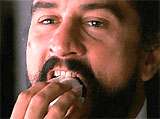 Egg-Biting Louis Cyphre (Robert De Niro) - "Luc-i-fer" 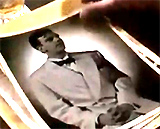 Picture of Crooner Johnny Favorite 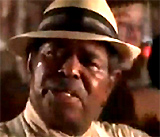 Blues Guitarist Toots Sweet (Brownie McGhee) 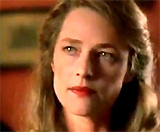 Psychic in New Orleans, LA - Margaret Krusemark (Charlotte Rampling)  Evangeline's Daughter Epiphany Proudfoot (Lisa Bonet)  Harry Angel Love-Making in Hotel Room with Epiphany 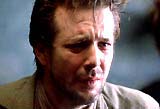 Harry Angel = Johnny Favorite (Mickey Rourke) 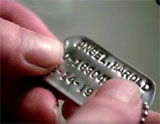 Dog Tags of 'Harold Angel' - "I know who I am" 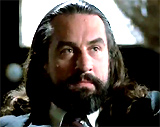 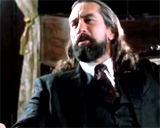 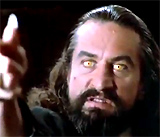 Murders Were Guided by Cyphre: "Only the soul is immortal - and yours belongs to ME!"  Harry Weakly Repeating His Words to Cyphre: "I know who I am"  Playing of 78 rpm record: "Girl of My Dreams" During a Flashbacked Montage of All of Harry's Murders 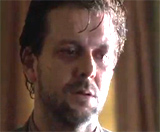 Harry Angel to Detective: "I live here"  Harry Angel Descending in Elevator Before and During Closing Credits |
|||||||||||||||||||||||||||||||||

|
Angels & Demons (2009)
Director Ron Howard's mystery-thriller action sequel to The DaVinci Code (2006) was also based upon another best-selling Dan Brown novel of the same name, published in 2000. It was written as a prequel to the earlier book, but filmed as a sequel. The film opened with a spectacular prologue, in which a tubular capsule of anti-matter ("the God particle"), experimentally created at CERN Laboratories in Geneva, Switzerland, was stolen from a high-security area (where nuclear physicist Silvano Bentivoglio (Carmen Argenziano) was murdered and branded with the ambigram Illuminati). The capsule was used as a terrorist bargaining chip - a bomb to create a "blinding explosion," planted somewhere in Rome. In the meantime, a progressive Vatican Pope had just died (from a stroke, or from some other nefarious plot?) and the red-garbed College of Cardinals was assembling in a highly-secure conclave to choose a successor. The CERN scientist's particle physicist partner, Dr. Vittoria Vetra (Ayelet Zurer) joined recruited Harvard University symbologist Dr. Robert Langdon (Tom Hanks) to decipher cryptic messages to follow a hidden path. It was feared that the ILLUMINATI, an 'enlightened' yet radical society of free-thinking scientists, a brotherhood that had been persecuted and driven underground by the Catholic church many centuries earlier, was behind the terrorist plot (in 1668, four Illuminati scientists were kidnapped, branded, and executed by the Church). Now, four preferiti Cardinals (the "four pillars" - favored successors to the Pope) had been kidnapped, and were to be branded on their chests with the names of the four fundamental elements of science (EARTH, AIR, FIRE, WATER). They were to die on the "altars of science" of four public churches (set in a cross-shaped pattern overlaying Rome, where the Illuminati had met in secret in the past), in executions every hour at 8, 9, 10, and 11, before the midnight unleashing of the anti-matter capsule as a cataclysmic bomb, to explode in a burst of light and destroy the Vatican ("Vatican City will be consumed by light. A shining star at the end of the Path of Illumination"). It would be a repeat of the "ancient Illuminati threat" - "Destruction of Vatican City through light...Science obliterates religion." The executions were in the style of the four elements (Earth, Air, Fire, Water):
It was now clear that there was a paid, rimless glasses-wearing psychopathic Assassin (Nikolaj Lie Kaas) working for the Illuminati who was committing the dirty-work, including cutting out the entire eyeball of CERN physicist Bentivoglio, Vetra's research partner, in order to bypass the security's retinal scan in the opening scene. The assassin's hiding place was in the "Church of Illumination" or Castel Sant'Angelo (The Castle of the Angel), an ancient hideout and prison for enemies, connected to the Vatican by a secret tunnel-passageway. There, the Assassin spared the lives of Langdon and Vetra, but was betrayed by the Illuminati when blown up by a car-bomb. There were many suspected individuals during the course of the film:
After Langdon and Vetra had raced around Rome, deciphering clues to the four execution sites and saving only the fourth Cardinal's life, another key location was the anti-matter capsule itself. It was in St. Peter's Tomb in the Necropolis, but Vetra didn't have enough time to change the battery before midnight. The Camerlengo volunteered to take the canister and heroically fly it away in a Vatican helicopter. He parachuted to safety, saving the city from the massive explosion, and was hailed as a possible papal successor. However, Langdon and Vetra viewed a hidden security videocreen in Richter's office desk which revealed that the Camerlengo was the mastermind plotting to become the next Pope - he had branded himself as the final victim with a fifth brand, the symbol of two upside-down crossed keys (the brand referred to St. Peter being crucified upside down - a clue that the anti-matter canister was under the Vatican where St. Peter was buried). The Camerlengo blamed Richter and others, leading to their deaths by police fire. He had also killed the Pope with an injection overdose of Tinzaparin, turning his tongue black a week later as a telltale sign. When confronted by the disapproving conclave, the Camerlengo self-immolated, pouring oil on himself from one of the ninety-nine holy lamps inside St. Peter's Basilica and igniting it. The film ended with the fourth and only surviving preferiti, Cardinal Baggia (Marc Fiorini), selected as the new Pope, to be named Luke, and Cardinal Strauss the new Camerlengo. The Vatican had covered up what had actually happened. Strauss thanked Langdon, and they spoke in the film's final words:
The new Pope greeted the crowd in St. Peter's Square below. |
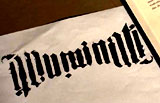 Illuminati 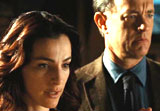 Dr. Vetra (Ayelet Zurer) With Dr. Langdon (Tom Hanks) 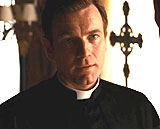 Camerlengo Patrick McKenna (Ewan McGregor) 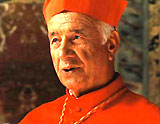 Cardinal Strauss (Armin Mueller-Stahl) 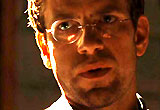 Assassin (Nikolaj Lie Kaas) 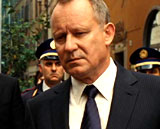 Commandante Richter (Stellan Skarsgard) 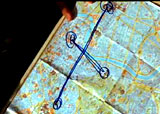 Four Execution Sites 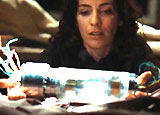 The Anti-Matter Capsule 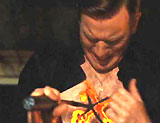 Carmerlengo Branding Himself 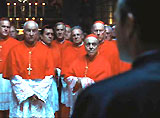 Carmerlengo Confronted 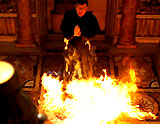 Self-Immolation |
|||||||||||||||||||||||||||||||||

|
Anger Management (2003)
Director Peter Segal's disappointing comedy (he was known for Tommy Boy (1995) and Nutty Professor II: The Klumps (2000)) was another mostly-unfunny, contrived Adam Sandler film, with predictable gross-out teen humor, vulgarities, lots of penis references and jokes, homophobia, and slapstick cartoonish violence. The main character was ultra-meek and mild-mannered Dave Buznik (Adam Sandler), a NYC clothes designer for overweight feline pets (Fat Cat), who worked for an ungrateful and abusive boss named Frank Head (Kurt Fuller). Dave had issues with showing public affection for his adoring girlfriend Linda (Marisa Tomei), a poetry teacher, and wouldn't stand up to her former college boyfriend Andrew (Allen Covert), a work colleague. She was frustrated about Dave's lack of assertiveness and continued embarrassment. She told him: "You gotta stick up for yourself sometimes." And Dave kept putting off asking Linda to get married. A number of odd coincidences led to Dave having an altercation with an air marshal regarding his simple request for a headset from a flight attendant named Patty (Nancy Walls) during a business trip to St. Louis. The flight was turned around and he was arrested at JFK. Found guilty and ordered by Hon. Court Judge Brenda Daniels (Lynne Thigpen) to 20 hours of anger management therapy, Dave began treatments with surly, unorthodox, and threatening specialist Dr. Buddy Rydell (Jack Nicholson), a best-selling author ("Temper's the one thing you can't get rid of by losing it").
After another violent incident in a bar, Rydell was further ordered to provide 30 days of intensive, round-the-clock therapy for Dave - and even moved into his apartment as a "bunkmate." One of self-help guru Buddy's unconventional techniques, part of his strange multi-step program, was to force Dave to stop morning commuter rush hour traffic on the Queensboro Bridge and serenade him with West Side Story's "I Feel Pretty." Buddy also suggested that Linda and Dave have a "trial separation" to strengthen their relationship, while he began dating Linda himself. Dave jealously assaulted Buddy after he asked: "Is it all right if I date your ex?" and was again court-ordered to go on trial for attempted murder in three weeks. He was also given a restraining order to stay 500 feet away from both Buddy and Linda. The most amusing parts of the film were the surprise cameos, including John Turturro as Chuck - an angry, paranoid and psychotic Grenada War veteran (Dave's "anger ally" during therapy), two adult film star patients and lesbian lovers: Stacy (Krista Allen) and Gina (January Jones), Harry Dean Stanton as a Blind Man, Woody Harrelson as Galaxia - a German drag-queen she-male (known for coming from the German town of "Lickin Zee Dickin"), Heather Graham as attractive Boston "hot babe" Kendra (one of Buddy's ex-patients), John C. Reilly as a Buddhist monastery monk named Arnie Shankman (a bully from Dave's childhood 5th grade who humiliated him), and those playing themselves, including John McEnroe, ex-Mayor Rudy Giuliani, Roger Clemens, Derek Jeter and Bobby Knight. The film's plot twist was revealed in a climactic scene set at Yankee Stadium where Buddy had taken Linda for a game-date - to borrow Dave's own "proposal idea." Provoked to anger one final time, Dave charged onto the field where he was apprehended by security guards. Allowed to speak by Mayor Giuliani ("Let this man finish what he came here to say") before being forcibly ejected, Dave proposed marriage to Linda ("Please marry me, Linda"). She challenged him to kiss her in public view (encouraged by the Mayor: "You can do it, David. Give her a five-second Frencher! Kiss her, David") before accepting. The crowd witnessed their kiss and applauded, and Buddy congratulated them on a scoreboard screen. And then Linda announced that Dave had just graduated from Buddy's anger management therapy. Linda admitted that she had set up everything that had previously happened with some of Buddy's friends, including the flight attendant incident, the judge's sentencing, therapy by Buddy, and the ball-game finale. In the final scene during a celebration of Dave's graduation in Central Park, Dave pulled a fast one on everyone else. A man approached him with a gun and Dave proposed to take the shot:
Dave was shot - but it was only a squirt gun wielded by one of Dave's friends. |
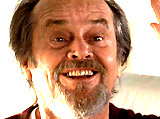 Dr. Buddy Rydell (Jack Nicholson) 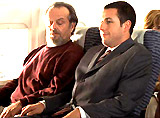 Dr. Rydell With Dave Buznik (Adam Sandler) 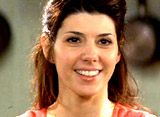 Dave's Girlfriend Linda (Marisa Tomei) 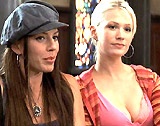 Stacy (Krista Allen) and Gina (January Jones) 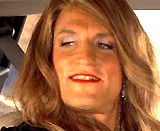 German Drag Queen Galaxia (Woody Harrelson)  Kendra (Heather Graham) 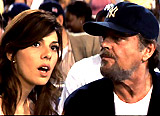 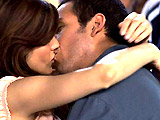 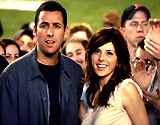 Climactic Scene at Yankee Stadium 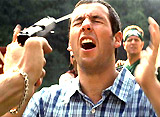
Squirt-Gun Ending |
|||||||||||||||||||||||||||||||||
|
April Fool's Day (1986)
This tongue-in-cheek slasher horror film by director Fred Walton had the tagline:
Eight college students, who liked to play April Fool's jokes on each other, met during spring break at the secluded island home of heiress hostess Muffy St. John (Deborah Foreman), to celebrate her 21st birthday (on April Fool's Day) during a 'bloody unforgettable' weekend.
The oddly-behaving Muffy reportedly had a deranged, violent twin sister named Buffy who was in an institution. One by one, the students died (off-screen) by decapitation, throat cutting, castration, stabbing, and hanging, with one suspected killer being the injured ferry worker Buck Williams (Mike Nomad) from the film's opening. Only Kit and Rob were left at film's end as the final victims, chased by the suspected killer Buffy (who had reportedly escaped from the asylum) into the living room, where she (and Rob slightly later) found all the others resurrected and alive. It had all been an elaborate hoax or ruse for April Fool's Day, explained when Muffy/Buffy showed that the knife wasn't sharp, but retractable - causing the freaked-out Kit (and then Rob) to be angered at everyone for the ruse. Muffy thanked everyone for being such "good sports." The entire weekend had been her test for future bed & breakfast 'murder weekends' she was planning for the mansion, in order for her to inherit and keep the house:
When Rob asked: "So I guess there's no twin sister, Buffy?", Muffy explained: "There is a crazy twin, but his name isn't Buffy." Skip was revealed as Muffy's brother, in on the trick, and Buck Williams (on the ferry) was actually "make-up artist par excellence" (who had employed decapitated heads and fake blood). Kit Graham was Muffy's uncle Frank St. John, and Cal (Lloyd Berry) was the "regular ferryman." She told everyone that paying guests in the future would know what they had signed up for - "and the scenario won't be so extreme." She brought out champagne and passed around bottles to celebrate. Later after everyone had drunkenly celebrated, a completely-soused Muffy returned to her bedroom, where she opened a wrapped gift box found on her bed. In it was a Jack-in-the-Box toy, which popped out when she turned the handle. In an additional twist, Nan - supposedly angered by Muffy's reference to an abortion - slit Muffy's throat at the same time, but then revealed that the knife and blood were fake as she wished Muffy: "April Fools," chuckled, kissed her, and smiled at the camera/audience. The film ended with the Jack-in-the-Box winking. |
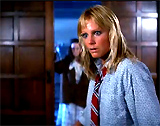 Kit (Amy Steel) - Shocked 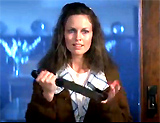 Killer Buffy/Muffy With Retractable Butcher Knife 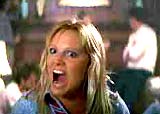 Kit: "Ha, ha, ha. That's really funny, you guys." 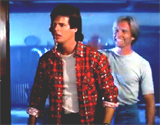 Rob (Ken Olandt) - Angry at Being Fooled 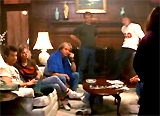 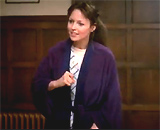 The Group of Guests - All Alive (The Revelation of the Ruse by Muffy) 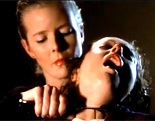 Nan (Leah Pinsent) Slitting Throat of Muffy 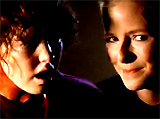 Nan: "April Fools"  The Jack-in-the-Box Wink |
|||||||||||||||||||||||||||||||||
|
Arlington Road (1999)
Director Mark Pellington's dramatic crime thriller was very effective, with the plot-revealing tagline: "Fear Thy Neighbor." The main character was:
He was still grieving the death of his wife Leah, an FBI agent killed in the line of duty, and raising their 9 year-old son Grant (Spencer Treat Clark) as a single father. Over time, he became extremely suspicious of the dubious activities of his suburban Virginia, across-the-street neighbors:
Faraday was especially cautious after the strange and unexplained circumstances surrounding the car-accident death of his girlfriend and former student, Brooke Wolfe (Hope Davis), who was helping him to investigate Lang. Then, towards the conclusion of the film, Faraday became convinced that his son Grant had been kidnapped by Lang - now revealed for certain to be a dangerous extremist. When he saw a Liberty Van Service vehicle that he believed was holding a kidnapped Grant and heading into the secure underground parking lot of the FBI headquarters, he drove his rented red vehicle through barricades and parked. He yelled hysterically to FBI officers: "In the van! In the van!...Everyone out of the building! There's a bomb, in the van!" When the van was opened and found to be clean, Faraday raced with officers to his own vehicle. He discovered - too late - that his neighbor had set him up and duped him with a destructive bomb planted in the trunk of his car. After running to the car's trunk, he re-heard the words of FBI agent Whit Carver (Robert Gossett) (the ex-partner of Michael's wife) informing him that he was the only unauthorized person in the building area: "Everyone except you!" To his horror, he opened his car's trunk and saw the bomb. It exploded and killed him, and wounded and killed many others. The real terrorist killer, Oliver Lang, watched the massive destruction from afar. The resultant news coverage blamed Faraday as the lone criminal, although the real criminal was his psychotic, terrorist neighbor. This film's twist ending was similar to the one in The Parallax View (1974).
In the final scene, the Langs were in their front yard (with a For Sale by Owner sign), staring at their next-door neighbor's boarded-up home (with Keep Out and No Trespassing signs) surrounded by yellow crime tape. They were planning to move to another state, where ironically wife Cheryl Lang hoped to "someplace nice...someplace safe." |
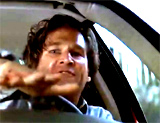 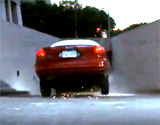 Michael Faraday's Pursuit of Van Into Underground Parking Lot  "The van's clean!"    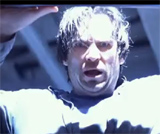  The Explosion 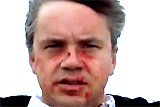 Terrorist Oliver Lang (Tim Robbins) Watching Blast |
|||||||||||||||||||||||||||||||||
|
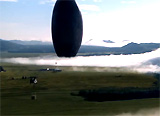
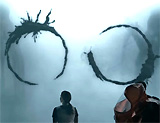
Arrival (2016) Director Denis Villeneueve's thoughtful, intelligent alien invasion and dramatic, suspenseful mystery-thriller - the transcendent and complex film with a screenplay by Eric Heisserer was based on co-scripter Ted Chiang's 1998 short story "Story of Your Life." The tagline was composed of a simple question that needed answers - what was the purpose of the aliens' 'first-contact' visit in the film?:
The film's many complicated themes included linguistics, space-time theory, communication with an alien species, and the Saphir-Whorf Hypothesis (that the perception of reality was either altered or determined by the language spoken). There was also the realization that although humans mostly thought and/or acted linearly, they could also have non-linear timeline experiences. Serious questions were raised, such as: "Is the universe deterministic?" and "Do humans really have free will, or are their destinies pre-determined?"; if all events were pre-determined, wouldn't knowledge of the future be incompatible with free will?, and "Would you proceed with your life if you knew how it was all going to end?" The underlying theme of the film was that it was palindromic, similar to the name of one of the characters (H-A-N-N-A-H). The plot began and ended similarly - reflecting the film's non-linear, circular timeline, and similar to how the main protagonist was aware of her future. It strongly advocated for humanity to understand the cerebral benefits of perceiving time non-linearly, like the alien heptapods in the story. The film was also book-ended by Max Richter's classical music piece "On the Nature of Daylight," part of the highly-praised musical score by Jóhann Jóhannsson. It received eight Academy Award nominations, but was the only Best Picture Oscar nominee that year not nominated in any of the acting categories. Besides the Best Picture, Best Director, and Best Adapted Screenplay nominations, the others were technical in nature (Best Cinematography, Best Film Editing, Best Sound Mixing, and Best Production Design). Its sole Oscar win was for Best Sound Editing. On a budget of $47 million, the film made revenues of $100.5 million (domestic) and $212.6 million (worldwide).
|
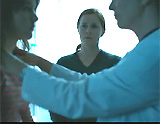 Prologue: Louise's Daughter Hannah - Diagnosed with Terminal Illness - Dying in Hospital 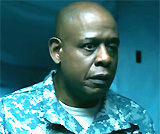 US Army Colonel Weber (Forest Whitaker) 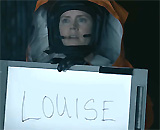 Linguistics Professor Louise Banks' (Amy Adams) Early Communications with Aliens Using Written Words on a Whiteboard 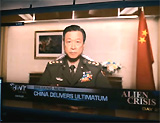 "China Delivers Ultimatum" - General Shang (Tzi Ma) of the People's Liberation Army Threatening Aliens 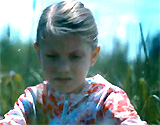 One Remembered 'Flashback' of Louise's Daughter Hannah  Later Revelation: Hannah's 'Flashbacks' Were Images of Louise's Future 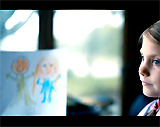 Hannah's School Drawing of Her Mommy and Daddy Talking to Animals 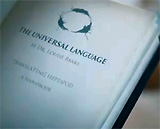 Louise's Future Book: "The Universal Language - Translating Heptapod" 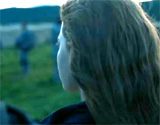 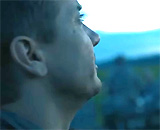 Ian's and Louise's Final Conversation (With Their Backs Turned To Each Other) |
|||||||||||||||||||||||||||||||||
|
Atonement (2007, US/UK)
Director Joe Wright's romantic, war-time costume drama - a lush epic of thwarted romance (based on Ian McEwan's acclaimed saga), had the intriguing tagline - which actually gave away the ending:
The film's plot centered on two privileged sisters in 1935's England, at the family's country estate:
Briony kept coming across what she falsely identified and misunderstood as improper behavior between Cecilia and:
When a piece of a broken antique vase (a family heirloom) fell in an outdoor fountain, the lithe Cecilia stripped down to her underwear to retrieve it, and revealed her almost-naked body through her soaked, transparently-wet undergarments - in front of Robbie. Their romantic connection was also evidenced by Robbie's expression of sexual lust for Cecilia causing a twist of fate - when he typed an apology note to Cecilia about wishing to ravish 'your sweet wet cunt' - shown in extreme close-up on his typewriter. He also handwrote a second apologetic note with a sincere expression of regret, but misdelivered the note. He mistakenly picked up the raunchier note ("the wrong version" - with "anatomical" details) and gave it to Briony to give to Cecilia. When he realized his mistake, it was too late. Briony had read the racy love note, and concluded that Robbie was a "sex maniac." And then, in the library, for the first time, Robbie and Cecilia emotionally and physically expressed their unbridled erotic love for each other. Just before love-making, Cecilia confessed to Robbie:
Briony was shocked when she came upon the couple making love (in her green dress, Cecilia was pressed against a stack of books and awkwardly positioned on a ladder). Subsequently, the highly-jealous Briony also mistakenly identified and accused Robbie of 'raping' her 15 year-old cousin Lola Quincey (Juno Temple), one night in the darkness of the garden.
Cecilia protested Robbie's innocence, but to no avail. Robbie was tried, convicted, and dragged off to jail and then released four years later to join the British forces at the start of World War II. During the war years, Cecilia (who was now estranged from her family) served as a nurse in London, while Robbie fought in the struggle at Dunkirk. In the film, it was portrayed that they met one final time during the conflict and pledged their love to each other, and planned on settling down after the war in a seaside cottage near Dover. It was also shown that an 18-year-old Briony reconciled and apologized to Cecilia. At the end of the film, older, terminally-ill (with vascular dementia) novelist Briony (Vanessa Redgrave) was interviewed about her latest and last book - an autobiographical work titled Atonement - when she confessed as an act of penance that much of the end portion of the novel was fabricated in order to bring the two lovers together and make amends. However, she told the interviewer it was "the absolute truth, no rhymes, no embellishments." She had invented the reunion scene of Robbie and Cecilia - and a scene of reconciliation between 18 year-old nursing student Briony (Romola Garai) and her estranged sister (and Robbie). All of the sequences was "imagined, invented" - includng Briony's promise to make a written apology and officially recant her false accusation. Both Robbie and Cecilia died during the war, never to experience the happiness they desired. Robbie died of septicemia on the last day of the Dunkirk evacuation before returning home, and Cecilia died a few months later when bombs flooded the London (Balham train station) underground tunnel where she was seeking shelter. The final scene was an idealized look at the lovers cavorting on the beach near a beach house, as Briony stated:
|
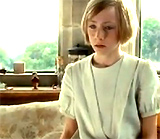 Briony Tallis (Saoirse Ronan) 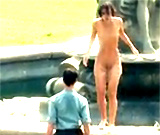 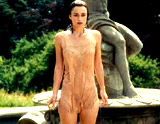 Cecilia Tallis (Keira Knightley)  The Incriminating Typewritten Apology Note 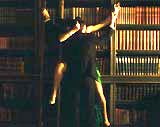 Love in the Library  The Misunderstood "Rape" - A False Accusation  Interview with Novelist Briony Tallis (Vanessa Redgrave) 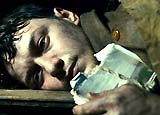 Robbie's (James McAvoy) Death 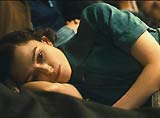 Cecilia Tallis 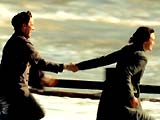 Idealized Look at Two Lovers: Robbie and Cecilia |
|||||||||||||||||||||||||||||||||
|
Audition (1999, Jp./S.Kor.) (aka Odishon)
A shocking transformation and character reversal was the almost-unbelievable plot twist in this Takashi Miike-directed, unsettling horror-romantic drama. Its enigmatic tagline was about the film's title - an audition - (and a hint to severed body parts!):
The main character was middle-aged, lonely widower Aoyama (Ryo Ishibashi) who had lost his wife seven years earlier, and was raising a teenaged son Shigehiko (Tetsu Sawaki). With his film producer-friend Yoshikawa (Jun Kunimura), Aoyama - who was seeking a bride-to-be - held a fake "audition" for the role of a movie wife. His finalist choice was:
There were numerous clues that Asami was not what she appeared to be. She lacked references, had an unusual work history, and she lived in a sparse apartment furnished only with a giant burlap sack (with a living person inside!) and a telephone. She claimed that she had been abused as a child, and past co-workers or associates recalled strange instances of dismemberment and torture. Asami turned into a vengeful, sadistic torturer who exacted her revenge on Aoyama for tricking him. In the film's harrowing conclusion, she first drugged and temporarily paralyzed him (with a syringe), and then terrorized him with acupuncture needles (stuck into his eyelids) and piano wire (used to amputate or wire-saw off his left foot). When she heard his son coming home while she was sawing off Aoyama's right foot, the film abruptly became Aoyama's psychotic nightmarish dream. He woke up with Asami in his bed after they had made love for the first time, following the audition, when she accepted his marriage proposal (although he asked: "Proposal?"). She continued:
Then after he awoke from the idealized dream, Asami herself broke her neck (and became paralyzed from the neck down) after being kicked down the stairs by the widower's son during a struggle. Aoyama remembered his earlier assurance to Asami in a dream sequence after she described her loneliness and childhood abuse:
|
 "Auditioned" Asami Yamazaki (Eihi Shiina) 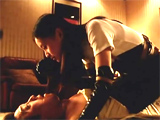  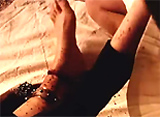 The Torture of Widower Aoyama 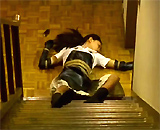 Asami's Broken Neck at Foot of Stairs |
|||||||||||||||||||||||||||||||||
|
Awake (2007)
First time writer/director Joby Harold's bloody psychological suspense thriller (his feature film debut) was about a phenomenon known as "anesthetic awareness" - being paralyzed although conscious and feeling surgical pain. However, the film's tagline on a poster (besides revealing a crucial plot twist) grossly misrepresented statistics about it, and should have said one in about 14,000:
The film opened with an explanation about how 21 million people each year receive general anesthesia: "The vast majority go to sleep peacefully. They remember nothing. 30,000 of these patients are not so fortunate. They find themselves unable to sleep. Trapped in a phenomenon known as anesthesia awareness. These victims are completely paralyzed. They cannot scream for help. They are awake." Most of the characters in the film defied their initial impressions and betrayed each other. [Note: The film received two Razzie Awards nominations: Worst Screen Couple (Christensen and Alba), and Worst Actress (Alba).] 22 year-old socially-minded billionaire Wall Street capital investment banker Clayton "Clay" Beresford (Hayden Christensen) was being pressured by his fiancee, adorable Samantha "Sam" Lockwood (Jessica Alba) (his mother's personal assistant!), to get married. He was portrayed as a good son to his doting, loving (but domineering, smothering and possessive) mother Lilith (Lena Olin) who disapproved. After the couple secretly married, Clay learned a donor heart had become available for him. Despite the fact that his best friend and black surgeon Dr. Jack Harper (Terrence Howard), who had previously saved his life, was facing four malpractice suits and Lilith objected (considering him a "second-rate" doctor), Clay was determined to have Jack perform the surgery. He declined her choice - prominent world class heart surgeon friend of 15 years, Dr. Jonathan Neyer (Arliss Howard). At the last minute for Clay's open-heart surgery, substitute anesthesiologist Dr. Larry Lupin (Christopher McDonald) (with an apparent drinking problem) arrived to replace sick colleague Dr. Fitzgerald. During surgery, a disembodied, anesthesized (although aware) Clay overheard a conspiracy against him. Through out-of-body "imagined" dream experiences (he rose from the surgical table, watched himself, then entered the hospital's corridor - barefooted and wearing blue hospital scrubs). He was mobilized to piece together and uncover troubling coincidences, preposterous mistakes, and conspiratorial betrayals:
The film ended with Dr. Harper in his locked office, with a regretful voice-over:
|
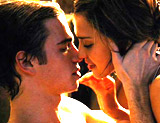 Clayton Beresford (Hayden Christensen) with Samantha Lockwood (Jessica Alba) 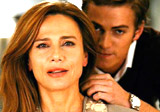 Clayton with Lilith (Lena Olin)  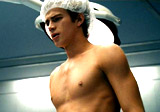 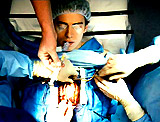 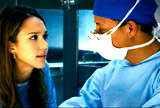 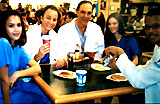 The Conspirators 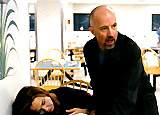 Deadly Suicide 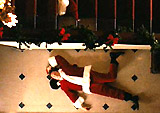 Death of Father  |
|||||||||||||||||||||||||||||||||





 Dr.
Daniel Was an Android
Dr.
Daniel Was an Android