|
Film Spoilers and Surprise Endings The Harry Potter Films |

| |
||||||
|
Harry Potter and the Sorcerer's Stone (2001)
In all of the fantasy-adventure Harry Potter films, the title character - orphaned Harry Potter (Daniel Radcliffe) with a lightning bolt-shaped scar on his forehead, battled against darkly evil cruel wizard Lord Voldemort (played by various characters in the films, although usually Ralph Fiennes) or He-Who-Must-Not-Be-Named, who had killed Harry's parents. In this first installment by director Christopher Columbus, Voldemort (Richard Bremmer) was plotting a comeback by acquiring the Sorcerer's Stone:
At Hogwarts School for Witchcraft & Wizardry, where Harry was a student, he made life-long friends with Ron Weasley (Rupert Grint) and Hermione Granger (Emma Watson). It was made to appear that devious Potions Master Professor Severus Snape (Alan Rickman), the Head of Slytherin House, was the ominous villain of the story who was attempting to steal the Stone. As it turned out by the film's ending, turbaned, Defense Against the Dark Arts teacher Professor Quirrell (Ian Hart) confessed to Harry that it wasn't Snape who was trying to kill him. Voldemort had become Quirrell's Master, commanding him to serve him and do his bidding. When Quirrell unwrapped his turbaned head, the face of Voldemort was revealed talking on the back of his head. A disembodied Voldemort had parasitically possessed the body of the turbaned teacher.
Although Harry was tempted to join Voldemort by seeing his parents again, he refused to hand over the Stone and give in. Quirrell was commanded by Voldemort to seize the Stone, but Harry's magical power of touch caused Quirrell's flesh (on his hand and face) to sizzle, burn and disintegrate, and his body collapsed in a pile of crumbled dust. As Harry squeezed the large reddish Stone in his hand, Voldemort's ghostly spirit knocked him backwards on the floor, rendering him unconscious, and then flew off, but Harry was able to retain the Stone. Quirrell couldn't survive Harry's magical touch because of the power of his mother's love. When Harry asked if Voldemort would return, with the Stone gone, he was told:
|
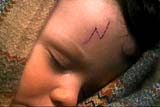 Young Baby Harry's Forehead 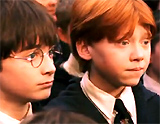 Harry Potter (Daniel Radcliffe) with Ron Weasley (Rupert Grint) 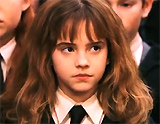 Hermione Granger (Emma Watson) 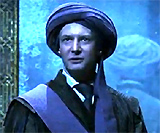 Turbaned Professor Quirrell (Ian Hart) 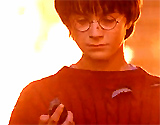 Harry With the Stone 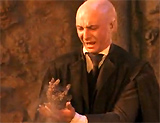 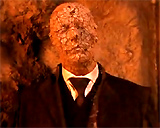 Quirrell's Hand and Face (and Body) Disintegrating From Harry's Magical Touch |
||||
|
Harry Potter and the Chamber of Secrets (2002)
In this second film in the series (again by director Christopher Columbus), young Hogwarts witchcraft and wizardry student Harry Potter (Daniel Radcliffe) was close friends with the Weasley family, including classmate Ron (Rupert Grint) and his younger sister Ginny (Bonnie Wright). Once at Hogwarts School, only Harry began to hear strange voices saying "Blood," "I smell blood," "Let me rip you," "Let me kill you," "Kill!," "It's time." With his friends Ron and Hermione Granger (Emma Watson), he saw a threat written in blood on the castle wall, reading:
According to legend, Slytherin, one of the school's co-founding wizards, had built a mysterious, hidden sealed Chamber of Secrets in the Hogwarts Castle that could only be opened when his own true Slytherin Heir returned to the school to "unleash the horror within," and purge the school of all those who, in Slytherin's view, were "unworthy to study magic" - muggle-born (non-magical), or aka Mudbloods. A diary with blank pages was discovered, once belonging to 16 year-old student Tom Marvolo Riddle (Christian Coulson) when he was at the school 50 years earlier. Through the book's pages, Harry was taken back in time to be shown that Moaning Myrtle - a Mudblood girl at the school, was killed when the Chamber was then opened and an "ancient creature" attacked. It was feared that the school's Chamber - "home of a monster" - could cause the closure of the school. Eventually, it was determined that the monster in the Chamber of Secrets was a basilisk, a giant deadly venomous snake, causing death to anyone who looked directly into its eye. The Basilisk's latest snatched victim was Ron's sister Ginny who had become malevolently possessed and was taken underground into the Chamber itself (to do the spirit's evil deeds, such as writing bloody messages). The entrance to the chamber was located behind the girls' lavatory sinks, with faucets marked with a snake design. In the chamber, Harry discovered Ginny's barely-alive body, controlled and under the trance-like spells of Tom Marvolo Riddle, who revealed himself as "a memory, preserved in a diary for 50 years." Tom also further admitted that he had preserved his 16 year old self in the diary's pages for 50 years, vowing one day to open the Chamber again and "lead another to finish Salazar Slytherin's noble work." Tom announced that his new target was Harry himself - he then revealed and admitted that he was Lord Voldemort, the Heir of Slytherin: "Voldemort is my past, present, and future." The words of his name were an anagram for "I AM LORD VOLDEMORT" and he planned to be "the greatest sorcerer in the world." Riddle then threatened Ginny's death, in order to steal her soul and regain power: "I will cease to be a memory. Lord Voldemort will return very much alive." Riddle summoned his own monstrous beastly force - the Basilisk snake creature, to battle against Harry Potter. Harry battled victoriously against it (with the aid of Headmaster Dumbledore's (Richard Harris) red-feathered Phoenix named Fawkes that blinded the snake's eyes, and with Godric Gryffindor's Sword from the Sorting Hat). Harry was able to pierce the Basilisk's head through its mouth, but was bitten in the arm by its large venomous fang. As the monstrous creature died, Harry sliced its fang from its mouth before it dropped dead. Then, Tom Riddle mocked him as Harry was slowly dying - "You'll be with your dear mud-blood mother soon, Harry." Then, Harry defeated Tom Riddle by plunging the snake's bloody fang into the diary. Ginny regained consciousness, and Harry's wound was quickly healed and he was rescued. |
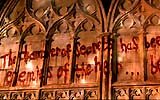 Threat Written in Blood on Castle Wall 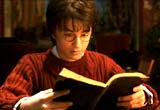 Diary of Tom Riddle 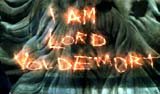 "I AM LORD VOLDEMORT" 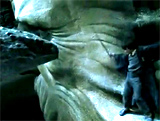 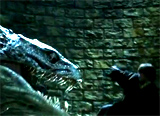 Harry Battling The Monstrous Basilisk (A Deadly Snake) 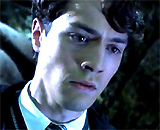 Tom Marvolo Riddle (Christian Coulson) - aka Lord Voldemort 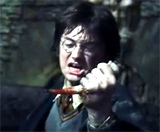 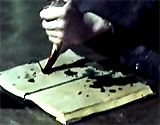 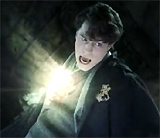 Defeating Tom Riddle By Plunging Snake's Fang into The Diary |
||||
|
Harry Potter and the Prisoner of Azkaban (2004)
In this third part of the long-running film series (with new director Alfonso Cuarón), Harry Potter (Daniel Radcliffe) - before the start of his third year at Hogwarts, was repeatedly warned that he was "in grave danger." An enemy of his parents, convicted murderer Sirius Black (Gary Oldman), was regarded as a suspected "faithful servant" and supporter of Lord Voldemort ("You-Know-Who"). Black was originally Harry's own godfather and his parents' best friend before betraying them. He had just escaped from twelve years of imprisonment at Azkaban and was rumored to be targeting Harry for death, to avenge the Dark Lord. The new Defense Against the Dark Arts teacher, Professor Remus J. Lupin (David Thewlis) was introduced at the school, which was on the alert. Dementors, unforgiving guards that were vile and "vicious creatures," were posted around the school at its many entrances to protect against the return of fugitive Black. Harry also learned that Black had allegedly murdered (or "destroyed") their mutual friend, buck-toothed Peter Pettigrew (Timothy Spall), who had tried to warn the Potters. Angered and shocked by Black's betrayal, Harry vowed to kill Black ("I hope he finds me, because when he does, I'm gonna be ready. When he does, I'm gonna kill him!"). Harry consulted with Professor Lupin to teach him a defensive Patronus Charm ("Expecto Patronum") to conjure up a protector and shield himself from the Dementors. As it turned out, Pettigrew was alive and the real villain. He had transformed himself into a rat twelve years earlier (and disguised himself in Ron's pet rat Scabbers), after traitorously betraying Harry's parents. Pettigrew had "sold James and Lily to Voldemort." He had acted as the Dark Lord Voldemort's servant, and was able to escape after falsely accusing and framing Sirius Black for the crime of murdering Harry's parents, and having him sent to prison for 12 years at Azkaban. Now, Black had escaped from prison and sought revenge against Pettigrew (not Harry), along with his friend Lupin (who could change into a werewolf). When Sirius and Harry were threatened to die by attacking Dementors at a lakeside, Harry called upon his Patronus spell for a protective shield and saved their lives. (At first, he thought the mysterious figure casting the Patronus spell to save them was his dead father - later, he realized it was himself.) It was a surprise to learn that Hermione used her Time-Turning necklace device (with three turns) to spare "more than one innocent life" - she and Harry retraced their steps by going back three hours in time to repeat the events of the night and positively alter them. As a result, the innocent Sirius was freed by Hermione and Harry from the prison cell of the Dark Tower. After being saved from a terrible fate, he rode off on the back of saved magical creature Buckbeak, although he was still a fugitive. |
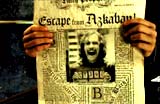 Sirius Black Escaped from Prison at Azkaban 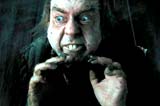 Peter Pettigrew (Timothy Spall) - The Real Villainous Traitor 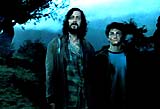 Sirius Black with Harry 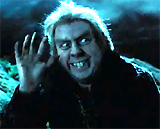 Pettigrew Just Before Transforming Into Rat and Escaping 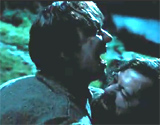 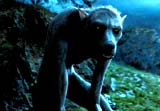 Professor Lupin (David Thewlis) - A Werewolf in Disguise 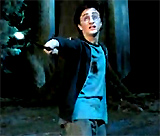 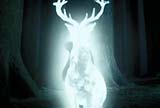 Harry Calling Upon Patronus Spell at Lakeside 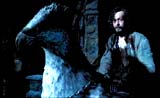 Sirius Black Freed and Riding Off on Buckbeak |
||||
|
Harry Potter and the Goblet of Fire (2005)
In this fourth film (directed by Mike Newell), a prologue established the evil plan of three characters, to conspire, plot and scheme to capture and then murder Harry Potter (Daniel Radcliffe), a fourth year student at Hogwarts:
The school was hosting the Triwizard Tournament, a series of magical contests with each school represented by one student (contestants were chosen by the magical "Goblet of Fire"):
Alastor "Mad-Eye" Moody (Brendan Gleason) was the new Defense Against the Dark Arts teacher. Harry was informed by Sirius Black that Mr. Barty Crouch, Sr. (Roger Lloyd-Pack), who had sent his own son Barty Crouch, Jr. to Azkaban, might be targeting Harry for death. During the third contest of the tournament, both Harry and Cedric - deciding to share the final prize - touched the TriWizard cup at the exact same moment and were unexpectedly transported to a graveyard - since the cup was a Portkey. The tournament was rigged so that Harry would be favored - part of Voldemort's scheme to capture him. There in the graveyard (the burial plot of the Riddle family), Wormtail/Peter Pettigrew (Timothy Spall) was carrying a deformed infant (Lord Voldemort). He was commanded by the evil lord to kill Cedric. Wormtail used the Killing Curse ("Avada Kedavra"), the third Unforgiveable Curse, to kill Cedric, and then dumped the infant into a boiling cauldron. He uttered an elaborate spell and potions mix of three ingredients (including some of Harry's blood) to regenerate Voldemort into body form: "The Dark Lord shall rise again." Voldemort then summoned his "friends," the Death Eaters, and confronted his long-time famous nemesis Harry Potter - "the boy who lived" - to a duel of wills and wands, and threatened death: "I'm going to kill you, Harry Potter." The forces from their respective wands simultaneously met each other when they both commanded spells at the same time: "Expelliarmus" and "Avada Kedavra." A Priori Incantatem connection between them was caused - it called up the reappearance of the protective spirits of Voldemort's recent victims, including Cedric and Harry's own parents. Harry heard them say to let go and return to the Portkey - the TriWizard cup. He obeyed, escaped Voldemort's presence, and was immediately transported by the Portkey back to the school, along with Cedric's body. His return as winner of the third test was applauded and congratulated but at first misunderstood, until he told Headmaster Dumbledore (Michael Gambon) about Voldemort's return ("He's back. He's back") and his responsibility for the death of Cedric. Back at Hogwarts, Harry realized that Moody was behind all the evil-doings - among other things arranging for him to be in the graveyard to give his blood to rejuvenate and revive Voldemort. It was revealed, in an amazing transformation scene, that Moody was actually Barty Crouch, Jr. (who had been sentenced to Azkaban by his father but then escaped), using Polyjuice potion to disguise himself. All along, Barty Crouch, Jr. had been impersonating Moody so that he could function as Voldemort's servant. Crouch Jr. had imprisoned Moody before assuming Moody's appearance and position to infiltrate Hogwarts as the new Defence Against the Dark Arts teacher. The real Alastor Moody was trapped in a multi-tiered magical trunk and released, and Barty Crouch, Jr. was sent back to prison at Azkaban. |
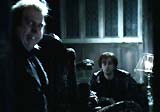 The Prologue: Voldemort's Schemers: (l to r): Wormtail, Nagini, Barty Crouch, Jr. 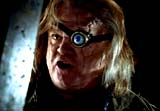 Professor Alastor "Mad-Eye" Moody (Brendan Gleason)  Cedric Diggory (Robert Pattinson) Murdered in Graveyard 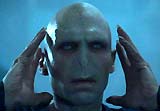 Lord Voldemort (Ralph Fiennes)   Dueling Wands - Voldemort vs. Harry Potter (Daniel Radcliffe)   The Transformation: Barty Crouch, Jr. (David Tennant) - Impersonating Alastor Moody |
||||
|
Harry Potter and the Order of the Phoenix (2007)
In this fifth film (by director David Yates), Harry Potter (Daniel Radcliffe) was in his fifth year of studies at Hogwarts School of Witchcraft and Wizardry. In London, in the home of Harry's godfather Sirius Black (Gary Oldman), a secret meeting was held in the headquarters of Order of the Phoenix (a society composed of a group of wizards, founded by Headmaster Albus Dumbledore (Michael Gambon)), formed fourteen years earlier. Sirius explained how there was a sinister smear campaign by the Ministry of Magic against anyone who claimed that the Dark Lord (Voldemort, or You-Know-Who) had returned. Harry and Dumbledore believed that Voldemort was again building up his army of witches, wizards, and dark creatures, but few other students and parents believed them. Harry was fortunately cleared of disciplinary charges (and threat of expulsion) by the Ministry for unauthorized use of a Patronus Charm in the presence of a Muggle. At the school, the newly-appointed Defense Against the Dark Arts teacher was pink-clad Professor Dolores Umbridge (Imelda Staunton). She was one of the senior Ministry officials who had voted for expelling Harry during his hearing/trial. Pressure exerted by the Ministry and by the teachings of Umbridge ultimately led to the expulsion of Dumbledore and the take-over of the school. A group of Harry's friends formed Dumbledore's Army (DA) to learn special defensive magic skills. Harry experienced another nightmarish vision within the Department of Mysteries, of Sirius Black being tortured with a "Crucio" curse by Lord Voldemort (Ralph Fiennes). He (and other DA students) were lured to the Dept. of Mysteries in the Ministry of Magic by a fake vision - to save Harry's godfather Sirius Black, who was trapped there. In the Hall of Prophecies at the Ministry, Harry found an orb with his name attached. He picked it up, and Death Eaters appeared. The orb contained a prophecy, stating to Harry: "For neither can live while the other survives" - the fact that Voldemort and Harry couldn't co-exist. Harry was confronted by Death Eaters and Lucius Malfoy (Jason Isaacs), who demanded that he turn over his orb (with a prophecy contained in it). Fortunately, the Order of the Phoenix members, led by Sirius Black, appeared and battled against the Death Eaters - but the sphere dropped and broke. During their conflict, Sirius was murdered by his own deranged cousin Bellatrix Lestrange (Helena Bonham Carter) with an "Avada Kedavra" Curse. Harry pursued her for revenge and was confronted by Voldemort himself. As the Dark Lord was about to kill Harry, Dumbledore appeared and engaged in a fierce duel with the Dark Lord - but it was a stalemate. Harry's agonized body was briefly possessed by Voldemort, until he repelled the Dark Lord by using his memories of his love and friendship for Sirius, Cedric, his friends Hermione and Ron, his parents, and others. Cornelius Fudge (Robert Hardy) and other Ministry of Magic officials arrived, via the Floo Network, and witnessed Voldemort as he disappeared: "He's back." The Ministry was proven wrong and humbled, and Hogwarts was returned to Dumbledore's control. |
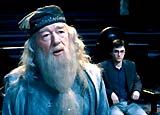 Headmaster Dumbledore (Michael Gambon) 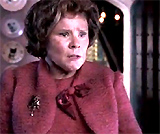 Professor Dolores Umbridge (Imelda Staunton) - Defense Against the Dark Arts Teacher 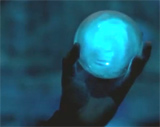 The Spherical Orb 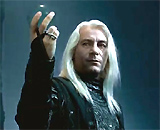 The Orb Handed Over by Harry to Lucius Malfoy (Jason Isaacs) 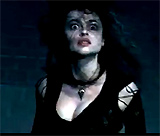 Bellatrix Lestrange (Helena Bonham Carter) - With "Avada Kedavra" Curse 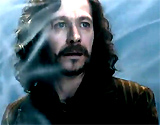 Death of Sirius Black (Gary Oldman) 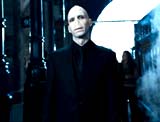 Confronted by Lord Voldemort (Ralph Fiennes) 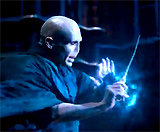 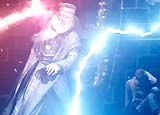 Dumbledore's Duel with the Dark Lord 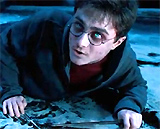 Harry Temporarily Possessed |
||||
|
Harry Potter and the Half-Blood Prince (2009)
In this sixth film (director David Yates' second film), with Harry Potter (Daniel Radcliffe) in his sixth and final year at Hogwarts, former Hogwarts teacher Professor Horace Slughorn (Jim Broadbent) was persuaded to return to the school as Potions Professor. The deceptive, unpleasant Defense Against the Dark Arts Professor Severus Snape (Alan Rickman) had been directly contacted by the Dark Lord, and assuringly agreed to aid in a deadly assignment given to blonde student Draco Malfoy (Tom Felton), son of imprisoned Lucius Malfoy - to kill Headmaster Albus Dumbledore (Michael Gambon). If Draco should fail, Snape vowed to carry out the deed himself. There were two failed assassination attempts on Dumbledore's life. There were also suspicions that a vanishing cabinet in Hogwarts' Room of Requirement was part of Draco's plan to allow Death Eaters to be smuggled into Hogwarts with its power of transport. Harry glimpsed, through magically stored memories, the nefarious student years of the young Lord Voldemort (known then as Tom Riddle, and a student of Slughorn). Harry knew that a clue to Voldemort's plan could be learned from a tampered memory in the mind of Professor Slughorn's regarding restricted Dark Arts "rare magic." He finally discovered the secret -- the "Horcrux" -- a "very dark," powerful magical object that ensured immortality. A Horcrux was a common-place object that concealed and stored part of the creator's split soul, a way to ensure immortality. The way to split one's soul was to commit murder. Voldemort had splintered his soul into six fragments or pieces attached to Horcruxes, while leaving a seventh piece in his body. Dumbledore surmised that if all of the Horcruxes were destroyed, "one destroys Voldemort." Suspecting that young Draco was an assassin, Dumbledore confronted the young student, who insisted that he was chosen by Voldemort to kill him ("He trusts me. I was chosen"), and that he must fulfill his deadly mission. When he was joined by a group of Death Eaters, Draco hesitated to murder Dumbledore. In a very surprising death scene, Snape joined the Death Eaters and cast the Avada Kedavra Killing curse with his wand against Dumbledore, who fell dead off Hogwarts' Astronomy Tower. Harry pursued and cast an Incarcerous spell at Snape, although it was deflected. Harry further cast the Sectumsempra spell at Snape, but was again fended off. Snape admitted why it didn't work - he admitted that he was the Half-Blood Prince and the creator of the spell ("You dare use my own spells against me, Potter?"). The film ended on a down note. At Hogwarts, the entire student body and staff mourned and grieved over Dumbledore's death. Atop the Astronomy Tower, Harry told Hermione Granger (Emma Watson) that the Horcrux locket that was retrieved from the island was a fake. It contained a written message (signed with the initials R.A.B.), describing what had happened to the real Horcrux:
Harry was not intending on returning to school the next year, but was planning on locating an individual identified by the initials R.A.B. and hunting for the remaining real Horcruxes by himself:
|
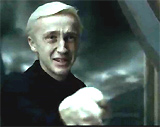 Assassin Draco Malfoy (Tom Fenton) Hesitating 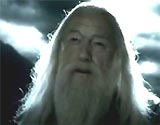 Headmaster Albus Dumbledore (Michael Gambon) 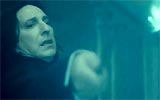 Snape's "Avada Kedavra" Curse 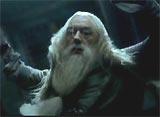 The Murder of Dumbledore by Professor Severus Snape (Alan Rickman) 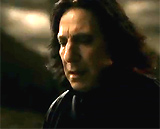 Snape: "I am the Half-Blood Prince" 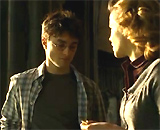 Reading The Message Signed by R.A.B. |
||||
|
Harry Potter and the Deathly Hallows, Part 1 (2010)
As the seventh film opened (director David Yates' third film), Dark Lord Voldemort (Ralph Fiennes) had returned to power. Violence was spreading as Muggles were murdered, and Death Eaters were on the prowl. The trio of friends were journeying out after graduating from Hogwarts to track down and destroy more Horcruxes (objects holding bits of Voldemort's soul and power, to prevent death):
They each left their homes, protected by members of the Order of the Phoenix for a short while. Each one in the trio received willed items from dead Hogwarts Headmaster Albus Dumbledore, objects that were to come into play during their perilous quest for Horcruxes.
The trio first attempted to locate the stolen Salazar Slytherin locket (an "evil object," one of Voldemort's horcruxes), and later, the Sword of Gryffindor. Meanwhile, the Ministry of Magic had been taken over by Death Eaters and the Dark Lord's supporters, including Dolores Umbridge (Imelda Staunton) who was wearing the locket. She had recently been appointed to head the Muggle-born Registration Commission in the Department of Ministry, serving as Senior Under-Secretary under Pius Thicknesse (Guy Henry), a Death Eater accomplice. The "chosen one" Harry Potter was declared: "UNDESIRABLE NO. 1" - wanted on posters. At the same time, throughout the entire film, Voldemort was on his own intense quest to locate a legendary, very powerful Elder Wand (one of the three Deathly Hallows). The trio were able to successfully snatch the Slytherin Locket after impersonating members of the Ministry, but were unable to destroy it. They learned that Severus Snape (Alan Rickman) was newly-appointed as Headmaster of Hogwarts, with strict house rules, bearing little resemblance to Dumbledore's school ("Snape's curriculum is severe, reflecting the wishes of the Dark Lord, and infractions are dealt with harshly by the two Death Eaters on staff"). Hermione had a sudden realization about the missing Sword of Gryffindor. It had basilisk venom on its blade, from The Chamber of Secrets installment - a substance that could destroy the Locket horcrux - she concluded: "That's why Dumbledore left it to you in his will." Basilisk venom could irreparably damage a Horcrux. Once Harry had retrieved the Sword of Gryffindor from the bottom of a pond, Ron was able to destroy the Slytherin Locket-horcrux with the Sword. The group found many reoccurrences of a mysterious symbol - the symbol of the Deathly Hallows. It was composed of:
They learned about the legend of the Deathly Hallows (read in a children's tale in Hermione's storybook) by Xenophilius Lovegood (Rhys Ifans). The Deathly Hallows referred to the three powerful, magical objects in a story given by Death to Three Brothers:
If the three objects were brought together simultaneously, they would make one the Master (Conqueror, Vanquisher) of Death (with the power of immortality). When the group was betrayed by Lovegood and he attempted to detain them, they were almost apprehended by Death Eaters, but then decisively caught by Snatchers in the forest. The three were taken to Malfoy Manor and imprisoned. Freed house-elf Dobby (voice of Toby Jones) saved everyone, but lost his life and died in Harry's arms as they escaped to Shell Cottage beach. In the final scene, Voldemort visited Albus Dumbledore's White Tomb (located near Hogwarts), opened the coffin, and stole the Elder Wand. The film ended abruptly... |
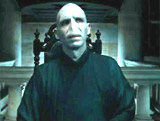 Dark Lord Voldemort (Ralph Fiennes) 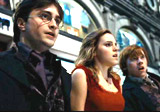 Harry, Hermione, and Ron 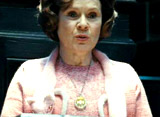 Evil Dolores Umbridge (Imelda Staunton) Wearing Salazar Slytherin Locket (a Horcrux) 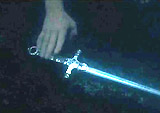 Retrieving the Sword of Gryffindor 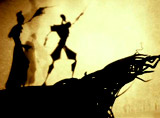 The Legend of the Deathly Hallows 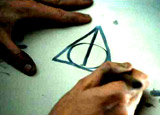 A Magical Symbol - The Symbol of the Deathly Hallows Engraved on the Surface of the Resurrection Stone 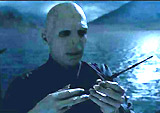 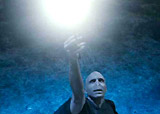 Final Scene: Voldemort's Theft of the Elder Wand from Dumbledore's Tomb |
||||
|
Harry Potter and the Deathly Hallows, Part 2 (2011)
Both this film and the previous film, Harry Potter and the Deathly Hallows, Part 1 (2010), told of Harry Potter's (Daniel Radcliffe) continuing search (with his friends Ron (Rupert Grint), and Hermione (Emma Watson)) to find and destroy Lord Voldemort's (Ralph Fiennes) remaining Horcruxes. In all of the Potter films, the seven horcruxes included:
It was also about the battle between the forces of good and evil, culminating in a cataclysmic double showdown. Lord Voldemort, an evil wizard and the leader of the Death Eaters, stole the Elder Wand (one of the three Deathly Hallows) from Albus Dumbledore's (Michael Gambon) opened tomb (in the conclusion of Part 1). Severus Snape (Alan Rickman), the former Potions and Defence Against the Arts Professor, was now Headmaster of the dark and dismal Hogwarts wizardry school. Harry had two wands in his possession now under his allegiance that he had stolen from Malfoy Manor:
The trio stealthily entered the Gringotts Wizarding Bank to seize the Horcrux inside Bellatrix's vault - Helga Hufflepuff's Cup, a small golden cup earlier stolen by Tom Riddle and made into a Horcrux. Afterwards, their next plan was to get to Hogwarts to destroy the next Horcrux. At the same time, Voldemort plotted to invade Hogwarts to protect the hidden Horcrux. The Horcrux was discovered to be Rowena Ravenclaw's lost Diadem, or tiara-like crown, now hidden in the Room of Requirement. Preparations were made for defensive battle by securing the Hogwarts castle and providing Harry with time to locate and destroy the Horcrux. Ron and Hermione acquired a basilisk fang in the Chamber of Secrets, and used it to stab into the Helga Hufflepuff's Cup Horcrux. During the assault on Hogwarts, Voldemort cast a powerful spell which caused the castle's shield to lose its potency and dissolve, although his Elder Wand cracked along its length from the pressure. Meanwhile, Harry located the Diadem in a wooden box in the Room of Requirement, and eventually stabbed it with another basilisk fang from Hermione. Visionary Harry told his friends that he thought the last Horcrux was Voldemort's snake Nagini. The trio overheard Voldemort speaking to Severus Snape in the boathouse about his wish to have total control of the Elder Wand. Snape was mortally wounded by four or five strikes from Nagini, and as he lay dying, he advised Harry to take his tears (his memories), captured in a glass flask, to the Pensieve. During a brief pause in the fighting, Harry retreated to the Headmaster's office to use the Pensieve, a stone basin with a detached shallow metal dish, to examine Snape's memories. There were some amazing revelations:
Therefore, because of the Horcrux in Harry, he had to die "at the proper moment" - and "Voldemort himself must do it." Destroying the fragment of Voldemort's soul within Harry would be another step toward killing Voldemort. On his way to the Forbidden Forest to confront Voldemort, Harry opened the Golden Snitch, and inside was the Resurrection Stone, one of the Deathly Hallows. Voldemort muttered "Come to die" as he raised his Elder Wand at Harry, who stood still with his eyes closed as he was blasted with the Killing Avada Kedavra curse. In a vision, Harry realized that the fragment of Voldemort that lived within Harry, a Horcrux (a small bloodied baby creature), had just been destroyed by Voldemort himself. Harry returned to the forest, but faked being dead to mislead Voldemort and the other Death Eaters. Back at Hogwarts castle, a triumphant and gloating Voldemort announced his victory ("Harry Potter is dead") to the stunned students. Harry 'came to life' - to everyone's surprise and relief. Voldemort was shocked and furious by the new revelation, and hurled more killing curses at him. Harry fled with the others into the castle (and ordered: "We have to kill the snake"), while the disillusioned followers of Voldemort began to desert him. Voldemort and Harry engaged in a one-on-one duel with their wands (the Elder Wand vs. Harry's wand that he had taken from Draco), while Ron and Hermione pursued Nagini, the last Horcrux. Molly Weasley (Julie Walters) used curses to disintegrate Bellatrix Lestrange (Helena Bonham Carter), as Neville Longbottom (Matthew Lewis) retrieved the Sword of Gryffindor and used it to decapitate Nagini. During one-on-one combat, Harry finally defeated the weakened Voldemort with the Elder Wand - it flew from the Dark Lord's hands and landed in Harry's grasp. The spell rebounded on Voldemort, engulfed him, and disintegrated him into nothingness. In the film's epilogue, 19 years later, the trio had grown up:
At the train station, both couples were saying goodbye to departing children. |
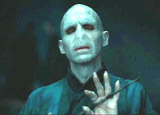 Lord Voldemort with the Elder Wand  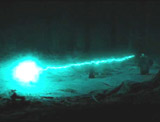 First Showdown 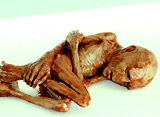 Voldemort Horcrux as a Mutilated Baby Trapped in Limbo for Eternity 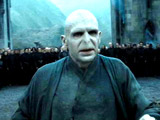 Voldemort Threatening 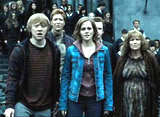 Student Onlookers 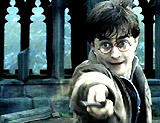 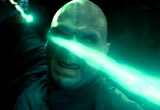 The Final Combat With Wands 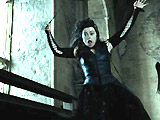 The End of Bellatrix Lestrange (Helena Bonham Carter) 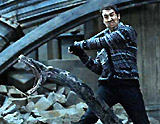 Neville Decapitating Nagini Snake With Sword of Gryffindor 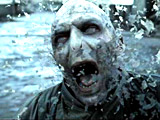 Voldemort's Disintegration 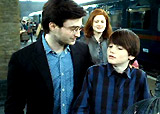  The Train-Station Epilogue: 19 Years Later |
||||





 The
Sorcerer's Stone Was Located Through A Trapdoor Near the 3-Headed
Beast; Voldemort Possessed Professor Quirrell, Who Tried to Acquire
the Stone, But Was Turned To Ash When He Touched Harry (Protected
By His Mother's Love)
The
Sorcerer's Stone Was Located Through A Trapdoor Near the 3-Headed
Beast; Voldemort Possessed Professor Quirrell, Who Tried to Acquire
the Stone, But Was Turned To Ash When He Touched Harry (Protected
By His Mother's Love)