|

|
|
|||||||||||||||||||||||||||||

|
Clue (1985)
There were many other films with the simple premise of a killer murdering people one-by-one in an isolated or confined setting - for example, The Bat Whispers (1930), The Old Dark House (1932), One Frightened Night (1935), The Cat and the Canary (1939), Hold That Ghost (1941), And Then There Were None (1945), Ten Little Indians (1965), and Murder by Death (1976). This triple-ended murder-mystery spoof set in the mid-1950s in a remote New England mansion was a comic adaptation of the popular Parker Bros. board game. It was revealed in the third ending ("This is what really happened"), the most complex and believable of the multiple endings to the film, that:
In summary, everyone except surprise FBI plant Mr. Green (Michael McKean), actually posing as a homosexual State Department employee, had murdered someone that night. But then he exclaimed when the film was concluding that he had also killed master blackmailer Mr. Boddy, in the Hall with a Revolver:
He then ordered the Chief of Police to take all the murderers away: "Okay, Chief, take them away. I'm gonna go home and sleep with my wife." Recapping the murders:
|
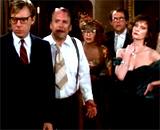 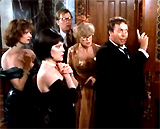 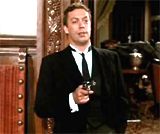 Mr. Boddy (Tim Curry) 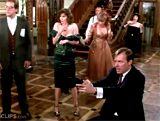 Mr. Green Shooting Mr. Boddy in Hall With Revolver  Death of Mr. Boddy  Mr. Green Revealing His True Identity  "They ALL did it!" |
|||||||||||||||||||||||||||

|
Color of Night (1994)
This psychological thriller by director Richard Rush began with the suicidal death of disturbed, self-hating patient Michelle (Kathleen Wilhoite) while being counseled by NYC psychoanalyst Dr. Bill Capa (Bruce Willis) in his high-rise Manhattan office. Distraught at the site of her dead body in a bright green dress lying on the concrete in a pool of blood after she jumped ("It was the reddest blood I ever saw, pooled around her green dress"), he began to suffer from psychosomatic, stress-induced color blindness - and couldn't see the color red. The divorced doctor was told by his therapist Larry Ashland (Jeff Corey): "To deny red is to deny emotion." He quit his practice and traveled to LA to stay with therapist/author friend Dr. Robert Moore (Scott Bakula) and figure out if he was going "crazy." Bill said he felt a "distinct absence of pain" and admitted he was troubled and felt sexually-dead. When Moore - who was receiving death threats possibly from a patient - was violently stabbed to death by an unidentified black-clad hooded assailant in his office after-hours, Bill took over Bob's ultra-modern vacated home and his Monday group therapy sessions, and was quickly considered a suspect by case investigator Lt. Hector Martinez (Ruben Blades) with all the other members of Moore's therapy group. This caused him to try and find the murderer himself. One of his five newly-acquired patients was 16 year-old bespectacled drug user Richie Dexter (Jane March), a volatile "genuine nut case" who had gender-confusion and identity issues ("gender dysphoria"), a social phobia, and spoke with a stutter. Meanwhile, Bill was seduced by an exotic young female - a torrid, provocative, sexually-advancing and insatiable Rose (Jane March in a dual role), calling herself Miss Fender Bender after she rear-ended his car. She unexpectedly reappeared at his home, invited herself to a dinner date, and made out with him as they called for a taxi. Later, when she reappeared at the house wearing a red dress, she made passionate love to him in the pool and bedroom. After a pause for a meal of steak and vegetables, she joined him in a steamy shower but then she mysteriously disappeared from his bed. As Bill researched his five patients, he zeroed in on the background of bespectacled drug user Richie Dexter, whose older over-protective legal guardian was her brother Dale (Andrew Lowery), a welder in an ironworks-furniture shop. Dale vainly pleaded with Dr. Capa to release Richie from court-mandated therapy. Capa found out that all of the Dexter children, who had suffered from abuse and abandonment, had been assigned six years earlier to child psychiatrist Dr. Niedelmeyer in Pasadena, but Niedelmeyer couldn't be questioned - he had died within the last year. During therapy, Dr. Capa learned that four of his five patients (except Richie) had recently taken on relationships, like he had with Rose:
Dr. Capa experienced an attempt on his life on the freeway by a driver in a red car. In the meantime, lesbian girlfriend Bonnie (who was remarkably close in resemblance to Rose) was cavorting with oversexed Sondra Dorio (Lesley Ann Warren), one of the therapy patients. A little later in the film, Rose again surprised Dr. Capa for more sex - meeting him in his kitchen (where she cooked him a meal wearing only an apron), and joining him in a soapy bathtub, etc. Capa then discovered that his patient - painter Casey - was gagged, strangled, hung upside down, and had his throat slashed by someone who had cut out and burned the faces from his paintings. During Rose's next impromptu visit, she seductively appeared for more sex. Then, a discrepancy regarding the number of books on Dr. Moore's office shelf over a few weeks revealed that Sondra had temporarily borrowed a Van Gogh book and then returned it, without looking at it. The book inside the Van Gogh jacket cover was actually Dr. Moore's hand-written diary (he had deliberately hidden his diary there) - with a single photograph of a half-naked Rose tucked inside. On the back of the picture was a description of Rose modeling for Dr. Moore:
The individual in the photograph was recognized as the relationship partner of Sondra, Buck, and Clark - and the same person as Capa's and Bob Moore's "Rose" - with another personality named "Bonnie," who was obviously a sociopathic female with a multiple personality disorder. Rose was revealed to be role-playing the sexually-confused "Richie," whose overprotective brother Dale had committed two murders (Dr. Moore and Casey), fearing that Rose's identity would be revealed. The film's twist was that the main killer was "Richie's" deranged brother Dale, who had forced his pretty sister Rose Dexter to play-act the role of their deceased brother "Richie." [Note: Dr. Capa learned a breakthrough clue from Mrs. Edith Niedelmeyer (Shirley Knight) that her dead psychiatrist husband had been a sexual molester, who had caused the real 12 year-old patient Richie to commit suicide: "Richie Dexter is dead! He killed himself four years ago...Because he couldn't stand what my husband was doing to him."] When Capa went to confront Dale, he found "Richie," who removed her wig disguise, emerged as Rose, and rescued her from her torturing and kidnapping brother Dale, who suddenly attacked with a nail-gun. Lt. Martinez (who appeared out of nowhere) was pinned to a wall, while Dale captured Capa with a belt around his throat and threatened to kill him with a mechanical blade. Dale explained his motive - he was increasingly disturbed that Rose (with her secondary personality of "Bonnie") was overtaking the "Richie" side of her personality, and he feared that "Bonnie's" modeling for Dr. Moore might cause him to link "Bonnie" to "Richie" and destroy Rose's masquerade. To protect Capa from dying, the traumatized Rose killed her brother with a nail-gun shot to the forehead, ran to the top of the factory tower during a raging storm and was saved by Capa from jumping and committing suicide when he grabbed her hand during a leap - he simultaneously recovered from being color-blind. |
 Dr. Bill Capa (Bruce Willis) 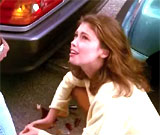 First View of Rose - After Rear-Ending Capa's Car  Second Appearance at the House - Wearing a Red Dress   Rose (also Jane March in Dual Role) 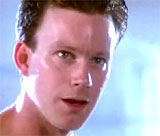 'Richie's' Brother Dale (Andrew Lowery)  Rose - With Telltale Rose Tattoo on Her Rear 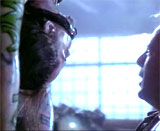 Painter Casey Found Gagged With Slit Throat Hanging Upside Down in His Studio  Revealing Photograph of Rose - A Sociopathic Female With the Personality Name of "Bonnie" - Suffering From Multiple Personality Disorder 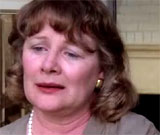 Revealing Confession About Richie From Widowed Mrs. Edith Niedelmeyer (Shirley Knight) 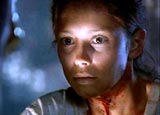 Dr. Capa's Removal of Richie's Wig, Revealing Rose Underneath 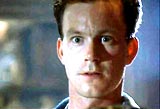 Rose's Brother Dale Revealed to be Deranged 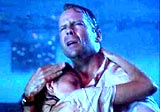 Dr. Capa's Rescue of Rose on Top of Factory Tower |
|||||||||||||||||||||||||||
|
Coma (1978)
Director Michael Crichton's suspenseful medical mystery-thriller was about a series of mysterious deaths of normal patients during routine surgery, at Boston's Memorial Hospital. The tagline was intriguing:
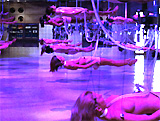
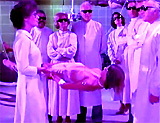
Spunky surgical resident Dr. Susan Wheeler (Genevieve Bujold) was introduced with her chauvinistic and sexist boyfriend Dr. Mark Bellows (Michael Douglas). She was arguing with him in his apartment as she showered naked and asserted to him: "Don't call me honey." Their antagonism toward each other left open the question of whether he was on her side, and/or involved with the problems at the hospital that she would soon uncover. She became suspicious when her married best friend and aerobics dance partner Nancy Greenly (Lois Chiles) went in for a D & C abortion and ended up in a coma, followed shortly by a second healthy patient Sean Murphy (an early role for Tom Selleck) who also became brain dead. Although overly paranoid, somewhat hysterical and reactive, she followed the trail of twelve similar surgical accidents, involving a number of other patients over a period of time. She roamed around the hallways and offices of the hospital, investigated private database records, asked lots of confrontative questions, ruffled feathers, and was quickly jeopardizing her job. There were lots of red herrings: the menacing head of Anesthesiology Dr. George (Rip Torn), the icy and emotionless Mrs. Emerson (Elizabeth Ashley) at the concrete monolith and experimental facility known as the Jefferson Institute (established to reduce the cost of long-term care for coma patients, although it was revealed to be a place to keep them alive until they could be harvested for healthy organs), and the seemingly-sympathetic authoritarian hospital administrator Dr. George Harris (Richard Widmark). There were some classic set-pieces - the electrocution murder of a maintenance man-informant who was about to tell Dr. Wheeler about the conspiracy, her climb up a hospital's ladder (shedding her shoes and pantyhose) to follow the path of a tube that carried carbon monoxide from the hospital's basement to Operating Room # 8, her tour visit to the Jefferson Institute where long-term comatose vegetative patients were taken from the hospital and suspended in a naked state by wires from the ceiling - and the pursuit-chase after her by security guards ending with her escape atop a EMR vehicle, her stalking in the hospital's amphitheatre and an anatomy classroom by a hired assailant - and their confrontation in a morgue freezer filled with cadavers, and the concluding scene of Dr. Wheeler being unnecessarily operated on for appendicitis by Dr. Harris himself, who wished to silence her forever.
When Dr. Wheeler met with Dr. Harris for a third time, she now confronted him and accused him of "killing people." She realized that his first name "George" had confused her, because it was also the last name of the head of Anesthesiology, Dr. George. Dr. Harris drugged her drink, and as she began to hallucinate and pass out, he mumbled incoherently to justify his philosophy about the importance of doctors making decisions for society's greater good:
During Dr. Wheeler's surgery, last-minute hero Dr. Bellows (who had finally realized that Susan was threatened and that there was a sinister plot occurring in O.R. # 8, where Dr. Harris had insisted on performing the operation) raced to the pipe and smashed the control box before the carbon monoxide gas could harm Susan. He returned to Susan and they grasped hands together as she was wheeled from her unnecessary but successful surgery, while a flabbergasted Dr. Harris was disbelieving that his patient was still alive. In the final scene, Dr. Harris was arrested in the now-deserted operating room (Offscreen: "We're waiting for you, Dr. Harris"), as he took off his operating cap and the room turned dark - knowing that he had been caught. |
  Dr. Wheeler (Genevieve Bujold)  Dr. Mark Bellows (Michael Douglas)  Dr. George Harris (Richard Widmark) 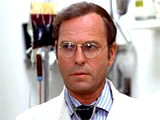 Dr. George (Rip Torn) 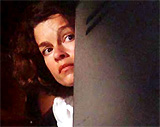 Stalked by Hired Killer 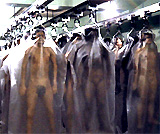 The Morgue Freezer 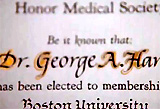 "Dr. George" Harris  Sue's View of Dr. Harris While Drugged  
|
|||||||||||||||||||||||||||

|
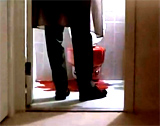
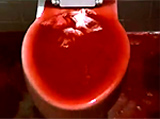
In this brilliant crime story, professional wire-tapper Harry Caul (Gene Hackman) spied (and listened) to the conversations of a young couple, Ann (Cindy Williams) and Mark (Frederic Forrest), during clandestine meetings, especially in the opening sequence set in San Francisco's Union Square. He thought they were potential victims because of her marital infidelity, because they kept referring to a rendezvous at a hotel room in a few days. There was a murder committed in Room 773 of San Francisco's Jack Tar Hotel at the agreed-upon time heard in the conversation. However, the couple weren't the victims! They were actually cold-blooded murderers of "the Director" (Robert Duvall) of a secretive company - the man who had commissioned Caul to do surveillance on the couple. Ann was "the Director's" wife - a femme fatale who orchestrated the homicide (with Mark's hard-to-decipher sentence: "He'd kill us if he got the chance") by luring her husband to the hotel room, where Mark murdered him. It was frightening for Caul, who was listening to the commotion (he had rented the room next door), and then the next day picked Room 773's lock and discovered evidence of the murder. After flushing the toilet, it backed up with bloody water. Ann later made the bloody murder look like an accidental automobile crash to inherit her husband's fortune.
The film ended with the revelation that a frightened, neurotic and paranoid Harry was also under surveillance the entire time:
He frantically tore up his entire apartment to vainly attempt to find a bugging device - the final scene found Harry playing his tenor saxophone alone in his destroyed home. |
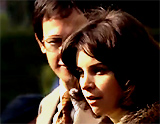 The Couple: Ann and Mark 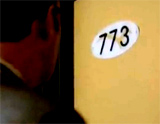 The Jack Tar Hotel Room 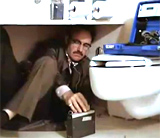 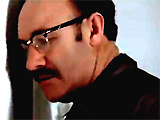 Harry Caul Listening Next Door 
|
|||||||||||||||||||||||||||
|
Crimes of Passion (1984)
British director Ken Russell's erotic thriller was a neon-lit, dark, "guilty pleasure" cult tale. Its tagline was: "Her name is China Blue. She is watched. She is worshipped. And, she must remain a mystery." In the film's opening sequence, 30 year-old home electronics shop owner Bobby Grady (John Laughlin), with his own store (Grady Home Electronics), attended a group sex-therapy session for the first time where he claimed, unlike the other attendees, that he had been happily married for 11 years and had two children with his wife Amy (Annie Potts) and had no hang-ups; he asked himself: "What the hell am I doing here?"; however after some prodding, he admitted he had a dull and failed marriage and that his wife was frigid; he blamed a loss of sexual interest: "I am not the one who complains how tired I am every night. Getting her to make love is like asking her to run the Boston Marathon, and then those times that we actually do go through with it, I don't know whether to embrace her or embalm her." The main protagonist was a moonlighting, kinky, street-walking, pill-popping LA prostitute named China Blue (Kathleen Turner); China Blue's entrance in the film began with a closeup of her face, as the camera slowly pulled back, while she was servicing her first male client - a man named Carl (John G. Scanlon) who was kneeling between her spread-eagled legs. He insisted that she role-play for him a beauty pageant contestant named Miss Liberty 1984 - and then euphemistically, he told about how she play her "instrument" (a flute) and could also blow his "instrument" - she tantalized him with her sex-talk while unzipping his pants:
The film's other central character was initially observed watching a red-light district peep-show striptease (with other men pleasuring themselves while peering through rectangular slits at the stripper (Janice Renney)) while also snorting amyl-nitrate - he was deranged, perversely psychotic, self-proclaimed preacher Reverend Peter Shayne (Anthony Perkins); when he wasn't watching a strip show (and imagining a naked dancer dead), he was preaching sermons on his soap-box outside about how the wicked would be punished: "Dear God, the heathen are come into thine inheritance..." China Blue plied her fleshy wares in a grungy downtown Los Angeles area filled with XXX adult stores, bars, live nude and peep shows; wearing a platinum wig and a light-blue silky dress; she came up to the Reverend who announced: "I've been sent by the Lord to save you and to rid the earth of that plague. I am his holy messenger... Save your soul, whore." She frequented the Paradise Isle Hotel for tricks, where her second client had a sexual fetish of pretending to stalk and attack her before "raping" her in her room in the hotel; during sex, she imagined Japanese erotic art prints or other exaggerated drawings of enlarged male genitals. When Bobby returned home late from work, his wife Amy complained about their dire financial situation; to earn extra funds, Bobby was hired to moonlight as a part-time PI and nighttime-surveillance security expert (on top of his day job at the electronics store); he secured work for a ladies' sportswear company owner named Lou Bateman (Norman Burton); one of Bateman's employees was Joanna Crane - China Blue's alter-ego; Joanna was working during the day as a prim but workaholic sporting fashion designer for Bateman's company for the previous two years, but was also secretly moonlighting as a prostitute; it was suspected that she was in the business of selling patented design patterns and secrets to Bateman's competition, although she was a compulsive, ambitious and hard-working employee; the job was described to him: ("Follow her - where she goes at night, what she does...She must be hiding something"). During his first night of surveillance, Grady followed Joanna after work from her apartment home in a taxi to the downtown Paradise Isle Hotel, where she transformed into her second profession as a prostitute; he videotaped her and watched as she was again accosted by the deranged Reverend who invited himself up to her "Holy of Holies" room, where he ranted that he was her Savior: "I deal in truth. I'm bringing you something greater than a hard-on"; she proposed that he have sex with her and explained how her profession completely fulfilled all of her clients' fantasies:
He rejected her repeated requests to have sex ("My purpose here is strictly humanitarian....To make you see through the bulls--t"); Grady was on the outer fire-escape and listened in on their conversation. China Blue grabbed for his black doctor's-styled bag and was shocked to discover that it contained sex toys ("the devil's playthings") - including a rubber breast-shaped pacifier, an artificial foam-rubber vagina, a battery-operated auto-suck mechanism, a red 'beat-me, eat-me' licorice whip, and a chrome-steel, razor-tipped, titanium vibrating dildo (dubbed "Superman") - she was flabbergasted: "What the hell? Is this a cruise missile or a Pershing? What are you going to do, f--k someone to death?" [Her question was a prophetic foreshadowing.] As he left, he promised: "All you need to know about me is that I intend to save you...Trust me. I'll free you." When China Blue left the room, Grady entered and snooped around in drawers and the closet and found only sex-related items (zippered panties, handcuffs, and her book of erotic Japanese artwork, and an X-rated adult video, etc.), and no evidence that Joanna was selling design secrets; in fact, another employee named Phil Chambers (Thomas Murphy) confessed to selling the patterns.
Grady visited her as a client and entered into an obsessive, erotic relationship with her during Grady's first intense sexual encounter (for $50) with China Blue, she fantasy role-played as a flight attendant: "Good evening. Welcome to China Blue Airlines Flight 69, non-stop service to Paradise. We'll be taking off shortly. I'll be unbuckling your belt and seeing that big bird rise and rise, finally settling into the comfort only this wide body can provide. We're here to serve you. Please remember that although we may run out of Pan Am coffee, we'll never run out of T-W-A-Tea." She sucked on his bare toe and then had sexual intercourse with him in multiple positions (viewed as silhouettes behind a gauzy curtain), while the Reverend peeped on them through a peep-hole from an adjoining room that he had rented. After sex with Grady, China Blue was reluctant to admit her true affection for him, but didn't want an attached relationship and claimed she had only been play-acting with him: ("There are three things you have to know to make it as a 50-buck hooker. You have to act, you have to f--k and you have to know how to count to 50. You're lucky. You've seen all three"); she realized that Grady had a lot of emotional baggage as a family man and their contacts would put him at jeopardy with his wife. Next, the annoying and misguided Reverend appeared in her hotel room with a $50 dollar bill for sex; she dressed up in a nun's outfit (singing "Onward Christian Soldiers") to taunt his hypocritical, sham game of being 'self-righteous' with a desire to save her; she shouted out that she was cured and "free at last" as condemnation for his hypocrisy; she accused the Reverend of being full of flowery words with no manly substance: ("A man of words! He makes up in diction what he lacks in dick!") and finally threw him out: ("Take your goddamn truth and get outta here!"); outside the hotel, Grady intervened when he saw the Reverend bullying China Blue, but was knocked down; she sincerely thanked Grady for the help, but advised: "Now, go on home to your wife." China Blue was involved in a short threesome in a limousine with two upper-class snobs Claudia (Louise Sorel and Arthur (John Rose) before demanding to be dropped off on a curbside; meanwhile, the psychotic Reverend simulated the killing of a peep-show stripper by stabbing a full-sized blow-up doll with his giant dildo in his rented room. Due to continuing issues between Grady and his wife over their intimate sex life, Grady soon moved out and they officially separated; he sought the advice of Joanna at her apartment - where she became extremely uncomfortable about being unmasked with all her secrets and shortcomings ("I'm never horny here"); she had obvious friendship issues in her real-life and preferred her alter-ego China Blue, although she slowly softened to the idea of being friends with him. One night late at work, the Reverend appeared during a freight elevator ride next to Joanna, prefaced by his vibrating giant dildo; he fondled his sex-toy as he babbled about saving her: ("No more deceptions, Joanna. I know who you are. We're the same, don't you see? The same rage. The same fear. We hurt the same. We escape the same. But we don't have to anymore. We have a chance, both of us, together...I want to love and care and need just like you do. We could help each other. We don't have to grow old alone"); she fled from him as he promised to return. To seek satisfaction elsewhere, China Blue engaged in dominatrix S & M scene with a policeman (Randall Brady) who was handcuffed to a bed and then aggressively sodomized with his own nightstick during intercourse, as he bled from his restrained wrists and from her spiked stiletto heels [Note: the unrated-uncensored video version contained non-theatrical (semi-pornographic) extras and deleted scenes - including a scene (deleted from some versions to avoid an X-rating)]; next door, the Reverend stroked his dildo and watched inside a candle-lit religious shrine he had erected to China Blue.
During another encounter with Joanna in her apartment late at night, Grady spoke about how he wanted her to "grow up" and have a real relationship with him; she explained her deepest fears about real-life romance: ("It's so hard, Bobby. No man's ever given me that kind of faith before, that kind of respect. That hotel is the safest place in the world. I can do anything there. I can be anything I can dream of, because it's not me"); he proposed making love: ("What we did in that hotel room we can do here") while outside, the Reverend sat in the bushes and prayed for God's punishment upon the sinners: "O God to whom vengeance belongs, how long shall the wicked triumph?"; however, shortly later, Joanna felt conflicted about breaking up Grady's marriage, and how their relationship might not work out either: "Maybe in a month or so, you'll start feeling guilty about leaving the kids. Maybe I'll start feeling crowded and trapped." In the startling conclusion with a twist, the Reverend violently assaulted Joanna inside her apartment for one "final" game to free her forever; his excuse was that he desired to save her: "The Reverend's gonna save you tonight once and for all...I'm a messenger of God and I only want to heal you...One more game, the final one, the one that will free you forever. Do I have your trust? Because we can only play if I have your trust"; while wielding his razor-tipped dildo to be used to exorcise her demons', he spoke about his calling: "My calling is the ultimate salvation, and its ends are sacrosanct. With my ecclesiastic gift, plus the grace of God, and a little help from Superman here, I shall bestow upon you the supreme humanitarian blessing and give you your freedom. You, uh, you do want that, don't you? I knew you would...My issue has always been your salvation"; he tied her down on her drafting table, and played demented songs on a piano. It appeared that China Blue would be his victim - stabbed by his "Superman" dildo: "I looked at you and I saw myself. I saw the same escape, the same malignancy. But I know the cure and I know how desperately you need it. And only I can give it to you." But then surprisingly, they reversed roles and she was released; she approached him with the dildo as he sunk to his knees in a prayful position and pleaded to be killed: "...Kill me Joanna, give my life value. Give me something to die for. Save me. You are me! One of us has to die so the other can live. Kill me, you worthless c--t. I'm all the men who ever hurt you, who made you feel like s--t, who stole your self-respect and turned you into China Blue. Kill me! Release the rage. Get it out. Get even!" However, he grabbed her wrist and the roles switched again: "Too late!" He forced her to strip ("Strip, bitch!"), and ordered her to put on her blue dress; at that same moment, Grady arrived and heard a scuffle inside; he burst through the door to save Joanna; he watched as the character wearing China Blue's dress (presumably Joanna) was stabbed in the back by the razor-tipped dildo/vibrator (dubbed "Superman"); the stabbed individual rose up and threatened to attack Grady with a pair of sharp scissors. A role reversal and costume twist were revealed -- the stabbed Reverend was wearing the China Blue dress and a wig, while she was wearing his Reverend's outfit; Joanna had saved Grady from being assaulted by stabbing the Reverend in the back with his own "Superman" dildo - his last parting words were: "Goodbye, China Blue." The film ended with Grady again attending the marital therapy group where he admitted he had separated from his wife and was in a new relationship with Joanna:
|
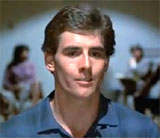 Bobby Grady (John Laughlin) In Group Therapy Session  Bobby's Wife Amy (Annie Potts)  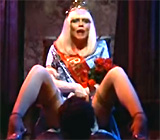  China Blue (Kathleen Turner) With Male Client Carl, Pretending to be Miss Liberty 1984  One Client's 'Chase and Rape' Fetish 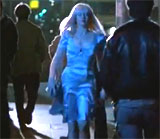 Streetwalker China Blue By Night 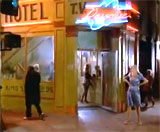 In Front of Paradise Isle Hotel 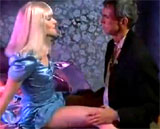 China Blue Proposing Sex With the Reverend as a Paying Customer: "I'm as healthy as a horse..." 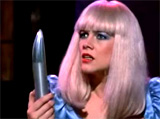 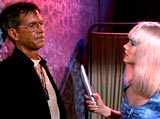 The Reverend's Dildo: "Is this a Cruise Missile or a Pershing?" 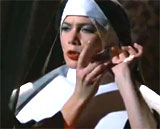 China Blue With the Reverend in a Nun's Outfit 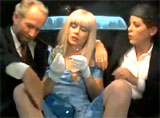 Botched Limousine Threesome 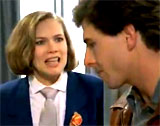 Grady Seeking Comfort From Joanna at Her Apartment - Causing Her Discomfort 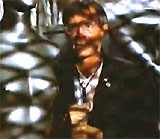 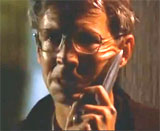 The Reverend Stalking Joanna at Her Workplace with His Giant Dildo 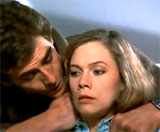 Grady Attempting to Coax Joanna Out of Her Shell Twisting Ending 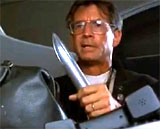 Threatening Joanna With His Dildo 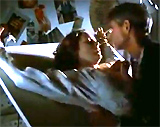 Joanna Tied Down on the Drafting Table in Her Apartment  A Reversal: China Blue Approaching the Reverend from Behind to Kill Him  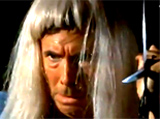 The Stabbed Reverend, Dressed in China Blue's Outfit, Attacking Grady With a Pair of Scissors 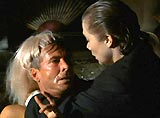 The Death of the Reverend ("Goodbye, China Blue")   Grady's Concluding Confession to Therapy Group |
|||||||||||||||||||||||||||
|
Crossfire (1947)
RKO's and Edward Dmytryk's noirish message drama (filmed mostly at night with low-key lighting), a taut, intelligent and exciting melodrama and murder mystery. The blunt, honest and engrossing box-office hit was based on Richard Brooks' 1945 novel "The Brick Foxhole," although in the book, the victim was homosexual, not Jewish. It was a rare Hollywood social issue film - a landmark film and one of the first to indict anti-Semitism, prejudice and bigotry, along with this year's Best Picture-winning Gentleman's Agreement (1947). Other than Double Indemnity (1944), the picture was the only 1940s-era film noir to be nominated for a Best Picture Oscar, and notable as the first B-picture to receive a Best Picture nomination. It also influenced another thriller about bigotry, Bad Day At Black Rock (1955). The engaging film opened in dark shadows in an apartment as two men beat to death another individual - they threw him into a lamp and he hit the floor - and then they fled. The catalyst of the film was this murderous incident (told in various flashbacks) that occurred one drunken evening. A small group of demobilized, recently-discharged soldiers were partying in a Washington DC hotel nightclub with Miss Lewis (Marlo Dwyer) and her Jewish boyfriend, war hero civilian Joseph "Sammy" Samuels (Sam Levene). Samuels had also been honorably discharged after an injury suffered in WWII. The soldiers involved in the later incident were:
After some of them went to the man's apartment, there appeared to have been an argument - and later, Miss Lewis found Sammy's beaten corpse. Subsequently, an investigation into the mysterious murder was conducted by
Finlay delved into the case and intensely questioned laconic military cop Sgt. Peter Keeley (Robert Mitchum), Mitchell's NCO, who firmly believed in Mitch's innocence. (At the same time, he had arranged to have Mitchell's wife Mary (Jacqueline White) fly to Washington for a long-overdue reunion.) The evidence seemed to be pointing, however, towards the emotionally-disturbed Mitch, since his wallet was found at the murder scene. He was suffering from post-war depression and drunkenness. Although he could not provide a convincing alibi - Keeley firmly believed in Mitch's innocence, and helped him to hide out in an all-night movie theatre until the facts were straightened out. There was a lengthy sub-plot about Mitch's disappearance and two non-credible witnesses to his whereabouts - working girl bar "hostess" Ginny Tremaine (Gloria Grahame) and her weird, tortured, bitter and spurned lover-husband (Paul Kelly) at her apartment - he had been dishonorably discharged. Ginny had given Mitch her apartment key so he could sleep off his stupor. One of the leading suspects, "Monty" Montgomery, admitted that the soldiers had been drinking at Samuels' apartment, but departed before the murder ("Mitch" claimed that he left first, but then was planning on returning, but then decided not to). The night's comings and goings were relayed by the suspects, in flashback, to the authorities. In an abrupt move to throw off the police and silence one of the potential and nervous witnesses against him, "Monty" beat and hanged Bowers with a necktie, leaving him presumed dead (and made to look like suicide). It was soon revealed, under interrogation, that the bigoted and unhinged "Monty," who openly despised Jews, had the proper motive to murder the Jewish boyfriend with his bare hands - but his hate crime needed to be proven. After piecing together the puzzling events, Finlay spoke about the deadly fact of hate and prejudice:
He planned on setting a trap for the violent, crazed and unstable "Monty," who was suspected of murdering Floyd Bowers. He called upon help from Monty's friend Leroy, who was also the object of Monty's bullying and hate for being a hick from the South. Many times, Monty had made fun of Leroy's accent, called him "dumb," laughed at him for being from Tennessee, and had bullied him as a "silly hillbilly." Finlay summarized to Leroy:
Finlay also spoke about Irish Catholic immigrants who had come to the US (due to the potato crop failure 100 years earlier). They faced lots of hatred, intolerance, and violence ("Fear and hatred of all Irish Catholics had developed and spread like a terrible disease"). They were accused of being many things: "a dirty Irish Mick, a priest lover, a spy from Rome, a foreigner trying to rob men of jobs." He told about how his Irish-Catholic grandfather Thomas Finlay was killed in 1848 because of intolerance. Hate had developed into a deadly act of violence, not always starting out as intentional ("They didn't start out to kill, they just started out hating. The way Monty started out"). He summarized:
Leroy was coached by Finlay to tell "Monty" that Bowers was alive and wanted to meet with him at a specific address (deliberately written incorrectly on a piece of paper by Finlay, for the house next-door). To Keeley, Finlay surmised that there was no obvious motive - because none of the suspects knew Samuels well enough. The motive had to have been in-grown prejudice:
When "Monty" arrived at the right address for best buddy Floyd, the scene of Floyd's murder, he revealed his obvious guilt. "Monty" fled from police onto the street and was shot dead by Finlay from a second story window, as the film concluded. Finlay concluded: "He was dead for a long time. He just didn't know it." |
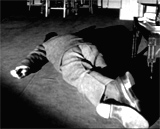 Murder of Samuels 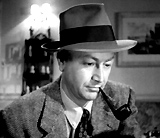 Det. Finlay (Robert Young) 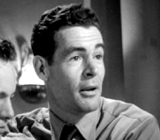 Sgt. "Monty" Montgomery (Robert Ryan) 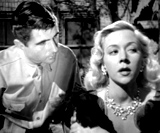 "Mitch" With Ginny Tremaine (Gloria Grahame) 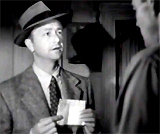 The Incriminating Note  Finlay Shooting "Monty" as He Fled Into Street |
|||||||||||||||||||||||||||
|
The Crying Game (1992, UK)
Writer/director Neil Jordan's taut political thriller film had the tagline:
Another was: "Desire is a Danger Zone." It has become legendary and famous for its shocking twist, exemplied in one of its ads: "The movie everyone is talking about... But no one is giving away its secrets." Guilt-ridden, reformed Irish Republican Army (IRA) volunteer terrorist Fergus (Stephen Rea) (with the adopted name of "Jimmy") journeyed to London to befriend the lover of deceased British hostage/soldier Jody (Forest Whitaker) who had been accidentally killed after being taken prisoner. Jody, who was trying to escape from captivity, was hit and run over by a convoy of British army soldiers in Northern Ireland. Fergus had been a message to deliver to Jody's lover Dil (Best Supporting Actor!-nominated Jaye Davidson). Fergus was pleasantly shocked that the dead man's lover turned out to be a beautiful cabaret-nightclub lip-synch singer/hairdresser named Dil. Dil was known as the 'wee black chick' that Jody loved. After kissing each other and making out, Dil performed oral sex on Fergus. Fergus then asked about Jody's possible reaction, but Dil avoided the question:
After going out to a bar to dance, and returning to Dil's place, they kissed some more, and prepared to have intercourse. Dil changed into a robe in the bathroom, and then returned to the bedroom, where Fergus asked: "Would he have minded?" When Dil responded, "No," the red kimono robe was dropped to the floor for a superbly unexpected moment of revelation. Dil turned out to be both a provocative and exotic female, when her true identity as a transvestite male (rather than as a female) was revealed in the film's major surprise. There was a sexually-disorienting view of Dil's penis -- his true gender and maleness was shown in this surprising full-frontal unveiling. It occurred with a slow camera pan down Dil's nude body to his genitals. But then, Dil realized that Fergus hadn't known: "You did know, didn't you? Oh, my God."
Fergus reacted with repulsion: "Jesus, I feel sick," struck Dil, and fled to the bathroom to vomit in the sink. Dil begged: "Don't go, Jimmy. I'm sorry, I thought you knew. What were you doing at the bar if you didn't know?" Then, he realized that Fergus had drawn blood:
|
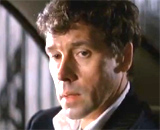 Fergus/"Jimmy" (Stephen Rea) 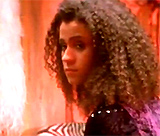 Dil (Jaye Davidson) 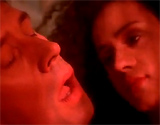 Oral Sex Performed by Dil on Fergus  Romantic Attraction   See Sex in Films For Reveal |
|||||||||||||||||||||||||||

|
Cube (1997, Can.)
Screenwriter/director Vincenzo Natali's debut feature film was this low-budget, psychological sci-fi horror-thriller. Two of its taglines were:
The sleeper film opened inside an immense, b/w cube-shaped room, with vault-like doors situated in the center of its six square surfaces. Each door led to another similar interlocking cubed room, although in different colors (blue, red, amber, green, etc.). Some of the maze-connected rooms were booby-trapped and triggered with motion-detectors, heat and sound sensors, and many destructive devices:
Each of the cube-shaped rooms was one of many rooms in a Rubik's Cube of sorts, that functioned like "a giant combination lock" moving through a cycle over a period of days. After the prologue, the six characters or "inmates" in the cubes [each clad in prison-style uniforms, and each with names of various prisons] were introduced. They were mysteriously placed there and did not know each other, although each had a purpose or "gift" in solving their predicament and attempting to escape from the labyrinthine trap (in order of deaths). The dwindling group of survivors were seeking a "bridge" or exit room that only appeared momentarily - the only means of escape to the outer shell:
By film's end, safe, untrapped rooms on the cube's outer edge where escape was possible were ultimately discovered to be marked with prime power numbers. |
 Alderson  "Wren"  Dr. Helen Holloway  Joan Leaven  David Worth  Quentin  The Only Survivor: Kazan |
|||||||||||||||||||||||||||
|
The Curious Case of Benjamin Button (2008)
Director David Fincher's romantic fantasy was based upon F. Scott Fitzgerald's 1922 short story (adapted for the screen by Eric Roth, with some modifications). Its basic plot was about the title character, Benjamin Button (portrayed by Brad Pitt), who was born old and grew younger as he aged in reverse (both physically and mentally). Its unusual premise was reflected in the film's many taglines:
The film opened with a significant prologue. It began with the story about a blind clockmaker named Mr. Gateau (meaning cake) who, after he lost his son in the Great War (in 1918), created a train station clock that went backward in time. It was a symbolic gesture - an attempt to turn back time. The clockmaker explained, apologetically:
The main plot-line was told as a flashback. A dying woman in her 80s, Daisy (Cate Blanchett) engaged in a deathbed conversation with her 40-ish daughter Caroline (Julia Ormond). As her mother was weakening and dying, the daughter read outloud the diary of Daisy's love of her life - Benjamin Button, born in 1918, the same year that the clockmaker's son died and his backwards-clock began functioning. The diary was dated: "April 4th, 1985 - New Orleans." It began:
Until the end of the film, although fairly obvious to viewers, Caroline was revealed to be Daisy's daughter by Benjamin, born out of wedlock (at the birth of the healthy baby girl, and recorded in Benjamin's diary):
Daisy had remarried and the daughter, Caroline, had grown up thinking that her stepfather Robert was her birth father. She was visibly upset by the revelation. As a pre-teen at age 12, Caroline (Joeanna Sayler) was introduced by 60-ish Daisy (who had been remarried to husband Robert) to twenty-ish Benjamin ("You knew him when you were just a baby") but not told that he was her biological father. At film's end, it was noted that in the year 2002, a new digital clock in the train station replaced the older one. And Benjamin died the next year in 2003. Daisy held Benjamin (as an infant) in her arms as he passed away. Daisy uttered her own last words: "Good night, Benjamin" - with a symbolic hummingbird at her window. As she died, Hurricane Katrina struck the hospital and flooded the city of New Orleans, including a warehouse where a reverse-running clock built for the train station (at the time of Benjamin's birth) had been stored and was still functioning. Benjamin's voice-over concluded the film, commenting on the diversity of human life:
|
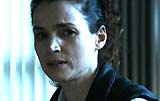 Caroline (Julia Ormond) 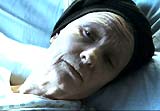 Dying Mother Daisy (Cate Blanchett) 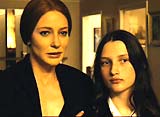 Caroline (Joeanna Sayler as Teen) Was Daisy's Daughter By Benjamin  2002: The New Train Station Clock 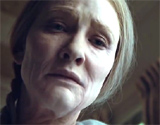 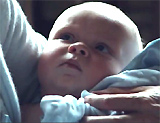 Benjamin as an Infant, About to Die in Mother Daisy's Arms  Hurricane Katrina Flooding the Warehouse Storing the Old Clock |
|||||||||||||||||||||||||||
|
Cutter's Way (1981)
Czech-born director Ivan Passer's R-rated neo-noir crime thriller was a precursor to the Coen Brothers' The Big Lebowski (1998). It was first released with its original book title "Cutter and Bone" by Newton Thornburg, and was a flop before being re-released with the new title. Its major flop was due to early negative reviews and a poorly marketed and botched publicity campaign. After some delayed positive reviews and showings at film festivals, the film was re-released theatrically with a new title later in the same year, and it became a minor hit. The gloomy, cynical and downbeat film provided dramatic commentary - profound discontent and disillusionment - about the state of America following the prolonged Vietnam War and the political scandals surrounding Watergate in the 1970s. These attitudes were personified in the characters of two misdirected friends: an ex-radical and current beach-bum "golden boy" without much of a will to do anything, and a disillusioned, traumatized, damaged and physically-disabled veteran who remained indignantly bitter and aggressive toward everything - mostly due to his military experience and the US' pro-war policies. The film's score by Jack Nitzsche provided the haunting, discordant sounds of a glass harmonica and zither. The film's MacGuffin - the whodunit murder mystery - wasn't as crucial as the character interactions between the three leads. The title character's direct, intense and hardcore approach to life was evidenced by the tagline:
Another tagline stated: "Alex Cutter had a fantasy...one his friends could not escape." And a third gave away some of the plot: "Bone saw the killer. Cutter knew the motive." Embittered, self-righteous, drunken, one-eyed, one-armed, one-legged, limping, crazed Vietnam vet Alexander "Alex" Cutter (John Heard), was living in the Santa Barbara area in the 1970s. Cutter found some refuge with his friendship to his frequent housemate - someone with a completely different nature:
In the introductory scene in a room at the El Encanto Hotel, Bone was touching up his chin-mustache with a woman's electric shaver following hiring out his gigolo services to a blonde (Nina Van Pallandt) for a one-night stand. She believed that her husband was a reluctant boat customer ("I don't think I can convince my husband") for his business. Due to her unsatisfactory experience, she suggested he buy some vitamin E for himself, rather than his claim that he needed cash to buy medicine for a sick friend. Cutter was in a troublesome marriage (doomed by alcohol) to cynical, sad, and desperate Maureen "Mo" Cutter (Lisa Eichhorn), who was involved in a love triangle with Bone. After his gigolo duties were over, on a rainy night, Bone (in his broken down car stalled in an alleyway) witnessed a car pull up behind him next to a dumpster. He was unaware that the body of a young girl (with her stilettoed shoes extending out) had been deposited in the garbage. Bone abandoned his car, walked by the dumpster, and met up with a close friend Alex in a bar at about 1:30 am. The next day when questioned about the slaying and wishing to clear himself, he reported that all he had seen was a dark silhouetted figure, and a face with sunglasses. The victim was a 17 year-old sex-crimes victim named Vickie, the sister of Valerie Duran (Ann Dusenberry). According to the autopsy report, Vickie had a crushed trachea, fractured skull, and semen in her throat and on her face. During the town's Fiesta celebration parade with Alex, Bone happened to point out an individual riding on horseback in a parade that he said resembled the killer: ("That's him...That looks like the guy I saw at the trash can...This guy right here!") - the man was identified as the Presidente of the parade, an important figure in town:
Cutter became obsessed with tracking down the killer with Valerie, believing that Cord represented all that was wrong with America in the post-Watergate, post-Vietnam era: ("He's responsible!... For everything! Him and all the mother-f--kers in the world just like him. They're all the same...You know why they're all the same, Rich? Because it's never their ass that's on the line, never. It's always somebody else's. Always yours, mine, ours. So leave off the morality, okay? And don't write me off as a money-grubbing bastard altogether"). Valerie and Cutter concocted an entrapment and blackmail scheme that would extort a large sum of money from Cord and get him to confess, and then they could report him to police - if their wild conspiracy theory proved correct. "Mo" told her disgruntled husband and Valerie that their plan to blackmail/extort Cord regarding the girl's murder was itself a dumb crime:
After Cord learned of the plotting against him, Cutter expressed his belief to Bone that the guilty, "smart and powerful" Cord had taken revenge and was responsible for the house-burning death of his own wife "Mo" ("I know he did, so do you"). In the stunning concluding scene at a garden party in Cord's mansion, after Cutter and Bone entered the heavily-guarded residential mansion on foot, interloper Bone was recognized by Mrs. Cord (Patricia Donahue) in the foyer and reported to a security bodyguard; as Bone attempted to locate Cord, he came upon Cutter in one of the outdoor tents feeding himself - he suggested: "Let's go find the murdering bastard!"; when Bone asked for Cutter's gun, he was told it wasn't loaded (a lie); the two continued to search for Cord in the mansion to confront him. Bone was apprehended and roughed up by a group of guards, although Cutter was able to escape and awkwardly ran through the outdoor crowd toward Cord's horse stables; Bone was brought to speak with Cord in his study; the influential businessman showed an eerie calm about being harrassed; he regarded veteran Cutter's war experience as the reason for his extremely paranoid "fantasy" beliefs:
In the meantime, Cutter stole a white stallion from Cord's stables, evaded two bodyguards, rode away heroically (and tragically, almost quixotically on a "white horse"), and galloped into the party-goers in the crowded mansion grounds; he cried out: "CORD!" before lethally crashing through Cord's study window; Bone repeatedly cried out to his bloodied friend on the floor as he died: "Alex. It was him. It was him. (Alex's body went limp) Alex?"
Bone turned from his dead friend to look accusingly at Cord as he stated: "It was you"; Cord scoffingly answered and admitted to the fact that he was the female's killer: "What if it was?" The passing of Cutter inspired the usually-uncommitted and reluctant Bone to take up his buddy's fight; as Cord non-chalantly put on his sunglasses, Bone aimed the weapon still in Cutter's dead, limp and lifeless hand at Cord, and then they pulled the trigger together; the gun blast abruptly ended the film ambiguously as it cut to black
|
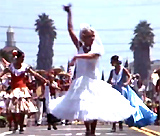  The Blonde in a Fiesta Parade  Bone (Jeff Bridges) Witnessing Body Dumping  The Dumped Female Corpse  Traumatized, Resentful Vet Alexander "Alex" Cutter (John Heard) in a Bar Getting Drunk  The Victim's Sister Valerie Duran (Ann Dusenberry)  J.J. Cord (Stephen Elliott) In Parade - Identified  Cutter's Dissatisfied, Long-Suffering Alcoholic Wife Maureen ("Mo") (Lisa Eichhorn)  Cutter's Theft of a White Stallion From Cord's Stables Cutter's Final Horse Ride  Cutter's Heroic Ride to the Death in a Doomed Effort to Kill J. J. Cord  Cutter Lethally Crashing Through Cord's Study Window  Bone's Killing of Cord with the Gun in Cutter's Hand |
|||||||||||||||||||||||||||

|
Cypher (2002) (aka Brainstorm)
The overwhelming and perplexing plot of director Vincenzo Natali's futuristic, science-fiction spy thriller (direct-to-video) was only comprehensible when it was explained in a few sentences at its conclusion. Its taglines were quite general and not very intriguing, although they made sense after viewing:
The stylized film's themes were brainwashing, the manipulation of identity, paranoia, and corporate espionage, conducted between two rival and faceless computer conglomerates: Digicorp Technologies and Sunways Systems. There was something to be learned from the multiple meanings of the title word cipher --
The corporate spy assuming a different name was a non-entity geek/pawn named Morgan Sullivan (Jeremy Northam), to "spy on other corporations, inform us of their business plans, research programs, and counter-intelligence operations." He took the name Jack Thursby, living a suburban life in San Jose, when he was hired at Digicorp to infiltrate Sunways. He was instructed by Digicorp's Head of Security, Ed Finster (Nigel Bennett) to attend various business conventions and presentations of Sunways, and secretly record them with a pen - in order to transmit information back to Digicorp. He was also told to create his own personality: "He's whoever you want him to be." Then, about halfway through the film, he switched sides and Thursby was recruited to work as a counter-intelligence double-agent for Sunways. He was briefed by its Head of Security Frank Callaway (Timothy Webber). Sunways' goal was to have Thursby feed Digicorp false and corrupted data to sabotage their operations. He wasn't aware that both companies were ruthless corporations that planned to eliminate him after he had completed his espionage operation. In both cases as a double-agent, he had a newly-acquired taste for scotch on the rocks, golf, and smoking cigarettes, and he fantasized about sailing in the South Pacific islands. As Thursby, he met a mysterious, cool and aloof femme fatale Asian woman - a guardian angel of sorts named Rita Foster (Lucy Liu) during his cross-country travel experiences (which included painful, recurring brain flashes, headaches and neck aches). When he became increasingly confused about his own identity, she told him that he was being conditioned and brainwashed by Digicorp, by his drinking of mineral water at their conventions. She warned that he could be eliminated. She offered pills to help him get rid of his nightmares, and then a syringe injection (of a green liquid) to 'undrug him' - to "block out the Digicorp narcotic" and keep him from being brainwashed and programmed with a new identity.
Later, Callaway told Thursby when he was hired at Sunways that Rita was working for an unseen, enigmatic boss - a deep-cover mole in cyberspace working for Sunways named Sebastian Rooks ("a freelance operative who we hired to find out how Digicorp was getting their agents past our neurograph"). Rooks was considered "very dangerous and very ruthless," but Rita promised he would protect Thursby. In the derivative film's conclusion, it appeared that double-agent Morgan Sullivan was in the reprogramming grip of three different entities, serving all of them as a data courier. Rita helped Sullivan escape from Sunways' underground metal vault (their secured data warehouse) in Wichita, Kansas after he had penetrated the vault's secure network and stolen a blue computer disc containing a vital downloaded data file. She then delivered him to meet Sebastian Rooks in a downtown penthouse suite. But feeling "used" and lied to from the very start, Sullivan shot Rita in the shoulder and threatened to destroy the disk. Then, in an adjoining room, he noticed three objects he loved (whiskey, golf clubs, and cigarettes) and a picture of himself and Rita - his own lover. It suddenly dawned on him -- He was Sebastian Rooks. The wounded Rita then explained everything:
But she didn't know what was on the blue computer disc. They were interrupted by assault teams from both companies seeking Sebastian. To fly away in an escape helicopter that Sebastian had designed, Rita prompted Sullivan to remember his past self as Sebastian to pilot it. At first, both heads of security from Digicorp and Sunways believed it was Sullivan ("Just Morgan Sullivan, our pawn"), but then were astonished to recognize Sullivan as Sebastian ("Jesus, he's Rooks!"). He successfully prevented the two of them from being captured by exploding the skyscraper's roof. The final scene was on Rooks' sailing boat in the South Pacific, where Sebastian and Rita looked at the contents of the blue Sunways disc. The file displayed Rita's picture - she had been marked for death by Callaway at Sunways with the words:
As Sebastian tossed the disc (the only one of its kind, "the file in the vault was erased and this is the only copy") into the ocean to save his lover, he noted:
|
 Morgan Sullivan/Jack Thursby  With Rita Foster (Lucy Liu)  VR Helmets  Sunways' Complex and Vault 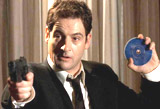 The Stolen Blue Computer Disk From Sunways  A Picture of Sullivan With Rita - He Was Sebastian Rooks! 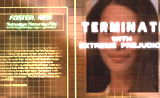 The Contents of the Disk - Terminate Rita  Rooks Sailing Away With Lover Rita After Saving Her |
|||||||||||||||||||||||||||





 They
All Did It, According to Undercover FBI Agent Mr. Green
They
All Did It, According to Undercover FBI Agent Mr. Green