|

|
|
|||||||||||||||||||||||
|
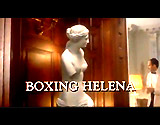
Boxing Helena (1993)
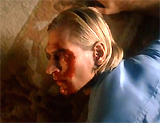
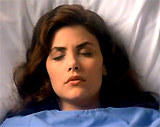
Director Jennifer Chambers Lynch's (David Lynch's daughter) directorial debut film was an erotic and disturbing psychosexual work of incestuous obsession, using the armless Venus de Milo statue as a major symbol and metaphor. Its main character was obsessive brilliant surgeon Dr. Nick Cavanaugh (Julian Sands) in Atlanta. In a flashback, he was shown to have a promiscuous and uncaring blonde-haired mother named Marion (Meg Register) who simultaneously teased, ignored and tormented him as a young boy. As a result of his unhealthy attachment to her, he developed problems with premature ejaculation as an adult. At the death of his mother, he inherited her home and moved into it, where he lived with pretty hospital colleague Anne Garret (Betsy Clark). However, he was still entranced by vivacious, unattainable, bitchy and libertine neighbor Helena (Sherilyn Fenn). In the past, Cavanaugh had experienced a brief one-night affair with her and they broke up, but he maintained lustful desires for her. He even peered into her window from a tree during a sensual evening tryst she was having with her sleazy macho boyfriend Ray O'Malley (Bill Paxton). To attract Helena's attention and impress her, he invited her to his newly-acquired palatial house for a fancy party, during which she sensuously showered herself in slow-motion in his outdoor fountain while stripped down to her black lingerie - and then left the party early with his friend Russell (Bryan Smith). However, she left her purse in his house, called and requested that Nick bring it to her at the airport the next morning before she departed for Mexico. When he arrived late, she noticed her address book was missing from her purse, and demanded to be taken to his place to retrieve it, before returning back to the airport. At his home, she point-blank told him: "You don't get it, do you? What is it gonna take, Nick, for you to realize I don't want anything to do with you. Wasn't last night enough?" When he revealed her address book on a silver platter, she was exasperated: "I'm leaving." Out on the street, as she turned to speak to Nick, she was the victim of a terrible hit-run vehicular accident. The screen turned black. And then Nick was reported absent from his hospital job for two weeks since his party (Anne had moved out), and he had cut off all contact with the outside world (he disconnected his telephone). He was hiding Helena in his house - he had performed surgery on Helena's crushed legs (off-screen) and made her a 'Venus de Milo' amputee (metaphorically and physically). He had removed her damaged legs. When chief surgeon Dr. Alan Harrison (Kurtwood Smith) visited the home, he discovered the victim-amputee in one of the bedrooms, and was shocked: "Why isn't she in the hospital?" Nick explained how he had whisked the horribly injured Helena into his own home to perform emergency surgery, and he promised to care for her 24/7 since he loved her, now that he was resigning from his job (and Dr. Harrison would be his replacement). Nick had imprisoned Helena and was keeping her as his possession in his home. He did everything he could to cover up his atrocious entrapment and attend to his imprisoned possession. She was in shock and kept repeating reassurances to herself: "It's a dream, everything's okay." Although still captive and dependent, much of the time, she criticized Nick for his poor love-making techniques and performance. And then he also removed her arms. She would continue to scorn and emasculate him with denouncements of his manhood, although eventually taught him (with limbs in a dream sequence) how a woman should be loved:
However, it was finally revealed that the entire sequence of the imprisonment of his captive - a dismembered quadruple amputee female companion - was a dream that was imagined when Nick was sleeping at the hospital following Helena's accident.
Just before the dream ended, Ray attempted to rescue Helena when he came upon them kissing in Nick's house. He was shocked by her amputations: "Helena? What happened? What the hell happened to her? You! You did this! You made her a freak!" Ray beat Nick up and bloodied him, although Helena yelled that Ray should stop and leave:
After Ray departed, she yelled at Nick: "Nick, I need you. I love you. WAKE UP, please wake up" - as he was about to be struck by his overturning, life-sized Venus de Milo statue.
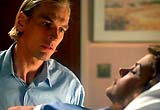
Suddenly, a curtain was pulled open in the hospital's waiting room by Nick's colleague Dr. Alan Harrison: "Back with us, Nick?" Nick awoke and asked about Helena, and learned she was recovering in Room 308 from six hours of surgery. He entered her hospital room, sat by her bed, and kissed her right hand.
In flashback, the accident was replayed (seen from Helena's POV), and Nick was shown rushing Helena to the hospital in an ambulance with a medical emergency response team, and waiting for her recovery. He also experienced many of the same flashbacked memories or dream-images from earlier - a peeping-tom view of Helen, the coffin burial of his father, his seductive mother, and views of Helen as his captive.
As the Venus de Milo statue explosively burst, Nick awoke again (!) from sleep in his own bed next to Anne, and rushed over to the Venus de Milo statue, as he heard his own echoing voice-over:
|
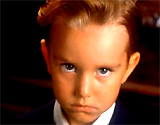 Nick (as young boy) (Matt Berry)  Haunted by His Mother Marion Cavanaugh (Meg Register) 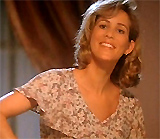 Nick's Live-In Girlfriend Anne Garret (Betsy Clark) 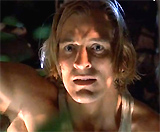 "Peeping Tom" Nick Cavanaugh (Julian Sands) 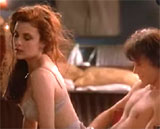 Watching Helena's (Sherilyn Fenn) Lovemaking with Ray O'Malley (Bill Paxton) 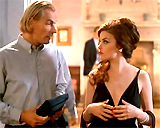 Nick with Helena at His Party 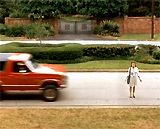 The Hit and Run Accident the Next Day 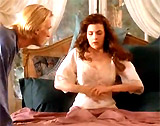 Helena Surgically Without Legs  Helena As an 4-Limb Amputee 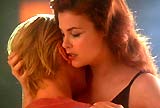 A Lesson in How a Woman Should Be Loved 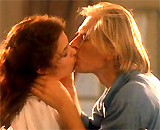 Nick and Helena Kissing 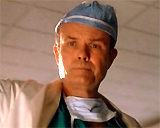 Curtain Pulled Back in Hospital: "Back with us, Nick?" 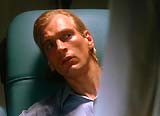 Nick Awakening in Hospital's Waiting Room |
|||||||||||||||||||||
|
A Boy and His Dog (1975)
In this vulgar black comedy set in a post-apocalyptic, nuclear wasteland of post WWIV 2024 (near Phoenix Arizona), people must live underground in an agrarian place and community called Topeka. A ruthless, dictatorial and impersonal Committee below ground was forced to search for semen from suitable studs to restock the depleted gene pool and impregnate dozens of virgins. Above ground, horny and lustful scavenging loner Vic (Don Johnson) used his wise-cracking telepathic dog partner-companion Blood (voice of Tim McIntire) to find solo females for him to rape. When Vic was seduced by beautiful new lover Quilla June Holmes (Susanne Benton), she tried to lure him underground, so that he could be used for breeding purposes - and then be killed. However, Quilla June turned against the Committee and told Vic about her love for him. Blood was both injured and starving - "He needs food and he needs medicine, We gotta get it fast, because we can't make it without him" said Vic, and he was faced with a difficult choice above ground between his starving dog Blood and Quilla June. In the final scene after a fade to black, (and after killing Quilla June offscreen), Vic then cooked and fed her to his starving dog, to revive him. He rationalized the killing: "She said she loved me. Oh, hell, it wasn't my fault she picked me to get all wet-brained over." The dark comedy's final controversial pun/one-liner was 'spoken' by Blood, as they walked off into the sunrise - chuckling to themselves:
|
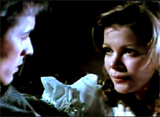 Vic (Don Johnson) With Quilla (Susanne Benton) 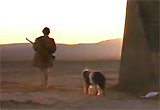 Walking Off With Dog Blood Into the Sunrise |
|||||||||||||||||||||

|
The Boy in the Striped Pajamas (2008)
Co-writer/director Mark Herman's intense childhood historical war drama told, through the eyes of a young boy, the development of a forbidden relationship during the Holocaust in WWII-era Germany:
Without any other playmates, Bruno disobediently ventured over to the death camp, believing it was a farmhouse with farm workers tending a garden - surrounded by barbed wire. Although he was forbidden to venture afar and play in the garden next to the camp, he struck up a friendship with one of the young prisoners, believing that Shmuel was wearing striped pajamas (and not an inmate uniform). Both boys were unaware of their true circumstances. The two boys met regularly with the electrified barbed wire fence in between them. Ultimately Shmuel divulged why the fence was there to keep his from escaping: "I'm a Jew." Bruno began to sneak food to Shmuel, and played board games with him. When Shmuel's father disappeared after participating in a march, Bruno decided to help Shmuel find his father. Bruno put on a prisoner's striped outfit and a cap to cover his unshaven head, and dug with a shovel under the barbed wire fence to join his friend Shmuel. While Ralf and his wife Elsa went on a search for the missing Bruno, the two boys and other inmates were led to a changing room, and ordered to strip off their clothes for a "shower." In reality, they were about to be herded into a gas chamber. The two boys held hands as the lights went out. Nearby, Ralf realized that his boy was being gassed to death, and frantically went running to search for him. Agonized, he cried out his son's name "Bruno!" (the film's last line of dialogue), as Elsa fell to her knees and wailed at the fence after discovering Bruno's discarded clothes.
The final shot was a reverse tracking-shot view of the closed door of the gas chamber, backing up with views on either side of the uniforms removed by the prisoners. |
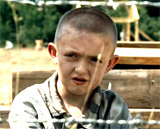 Shmuel (Jack Scanlon) 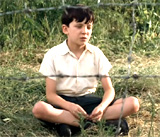 Bruno (Asa Butterfield) 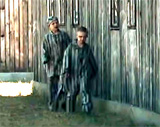 The Two Boys Inside the Camp 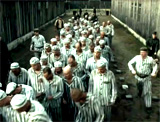
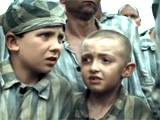 Led to the Gas Chamber With Other Inmates |
|||||||||||||||||||||

|
Terry Gilliam's satirical science-fiction drama was part of a three-film trilogy:
It told about an austere, dystopian futuristic society, in which one typical drone worker was harried by inefficiency, malfunctioning machines, corruption, automation, and bureaucratic mistakes:
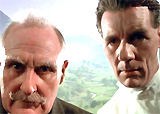
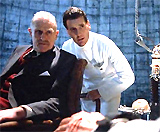
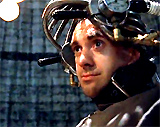
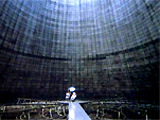
He often dreamed of a life in which he could leave the reality of his totalitarian-authoritarian society and fly away (as a winged superhero) with dream girl Jill Layton (Kim Greist) (in real-life, a truck driver), after rescuing her from a giant, Samurai warrior. He was targeted after attempting to manipulate and falsify her records so that she wouldn't be arrested as a suspected underground accomplice of a terrorist. In the disturbing and shocking ending, the troublesome Sam was blamed for a string of terrorist bombings and charged with treason. He was strapped into a torturer's chair in the middle of a circular platform that was situated under a vast, dark dome. A white-coated technician wearing a pock-marked, smiling baby mask approached to administer torture. Sam recognized him as his friend Jack Lint (Michael Palin). Suddenly, Sam was triumphantly rescued by a band of commandos led by terrorist Archibald "Harry" Tuttle (Robert DeNiro), a renegade (free lance) air-conditioning engineer, and Sam appeared to be reunited with his dream girl Jill in a happy ending, as they drove away from the city. However, his ideal perfect world was revealed to be a self-deluding illusion or fantasy. The green vista of a pastoral backdrop where he had escaped was covered over, and he was back in the domed torture chamber. The two torture agents, Lint and Deputy Minister of Information Mr. Helpmann (Peter Vaughan), commiserated about Sam's death, as the spritely tune Brazil played:
The final view of Sam was as he was humming "Brazil" to himself - insanely lost in his inner world. |
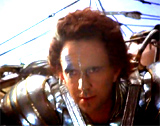 Sam Lowry (Jonathan Pryce) as Winged Super Hero  Dream Girl Jill Layton (Kim Greist) 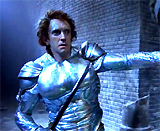 Sam Battling Giant Samurai Warrior 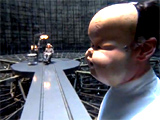 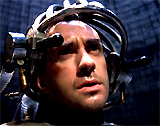 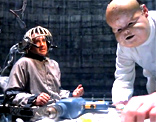 Torture-Dome 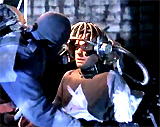 Dream-Rescue by Tuttle (Robert De Niro)  Dream of Escaping with Jill |
|||||||||||||||||||||

|
Brick (2005)
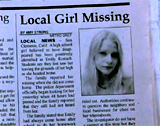
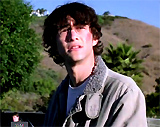
Writer/director Rian Johnson's modern-day film noir or neo-noir (with hard-boiled 40s lingo), his directorial debut film, was set in a Southern California (San Clemente) high school. It involved a menacing high school drug-crime ring, and the film's title 'Brick' was a reference to a compressed block of heroin. The film opened with brooding, jilted lonely teenager Brendan Frye (Joseph Gordon-Levitt) finding the body of his ex-girlfriend Emily Kostach (Emilie de Ravin) near a concrete sewer tunnel entrance beneath a freeway. He hid Emily's body, and avoided contacting authorities when he decided to investigate the murder himself, with assistance and help from his nerdy schoolfriend the Brain (Matt O'Leary).
The film then flashbacked to two days earlier to provide backstory. Just before Emily's murder, Brendan was given instructions in his locker to go to a pay phone, where he received a phone call from Emily. She was very scared and in trouble, and needed help. She gave him some key words that made no sense at first, among them: "poor frisco," "pin," "brick," and "tug" before abruptly hanging up when a Black Mustang car zoomed by and a cigarette butt - with a blue arrow design - was discarded. Brendan learned from his friend Brain that Emily had begun hanging out with a different crowd - and that she had become a drug-user and involved in some way with a drug-dealer nicknamed "The Pin." Her use of the term "brick" clearly referred to ten bricks of powdery heroin (and there was one missing brick that had been stolen). There were many suspects in this twisting tale of drug dealing and violence, including:
Brendan discovered Emily's red-paper invitation to a party, attended the event, and spoke to Laura where he learned from her that one of Emily's new acquaintances was drug-head Dode, who often met with Emily behind the local cafe Coffee and Pie, Oh My. Emily had been instructed by Dode to meet him, through a symbol drawn on a piece of paper, at the sewer tunnel entrance. This was the point in the film when the flashback ENDED. Brendan began to investigate the crime by infiltrating into the drug gang. After physical altercations with Tug, Brendan demanded to meet Tug's drug-dealing boss known as the Pin. He was driven to the Pin's address, where Brendan offered his services to Pin's drug operation to provide information about the competition. The Pin replied: "I'll have my boys check your tale, and seeing how it stretches we'll either rub or hire you." After the meeting, Brendan spoke to the conniving Laura, who informed him that the 'addicted' Emily had allegedly stolen a "brick" of heroin after being rejected by Pin's operation. The next day, Brendan learned that he had been hired by Pin. Brendan was threatened by Dode who claimed that he saw Brendan suspiciously hide Emily's body, and would use the information against him. Brendan was able to side with Tug (against Pin, who suspected that Tug was going to betray him); in Pin's house, Brendan was informed by Tug that Pin had recently bought 10 bricks of heroin. Eight of them had been sold. The 9th one disappeared (but was returned after it had been contaminated with laundry soap and killed Frisco), and the 10th brick was in Pin's basement. Dode accused Brendan of killing Emily, who was pregnant with Dode's baby when she died. Dode believed (mistakenly) that a jealous Brendan had killed his own pregnant ex:
During a tense confrontation at the sewer tunnel between Tug, the Pin, Dode and Brendan, Brendan was accused of Emily's murder by Dode, but Brendan denied the false allegation. Dode hinted to everyone that someone close to Emily had killed her - and her pregnancy was the motive - he pinned the murder on Brendan:
Instead of Tug attacking Brendan, he went beserk, assaulted Dode, and shot and killed him at point-blank range. [It was Tug's belief, although untrue, that Emily was pregnant with his own child. He had also been romantically involved with Emily.] Shortly later at Tug's house, Tug confessed to Brendan that he had killed Emily. Laura arrived to comfort the grieving Brendan, and they had sex. Brendan became suspicious of Laura, since she smoked the cigarette brand that matched the discarded butt earlier in the film, just before Emily's disappearance. A drug-war of sorts erupted between Tug and Pin at The Pin's house. Later, Laura described the "slaughterhouse" during a "party" at The Pin's house that she had orchestrated and set up. Six were found dead, including the Pin, Tug, and Emily, eliminating all the major players and revealing Tug as Emily's killer (Emily's body was in Tug's car trunk):
Then Brendan disclosed that he knew about Laura's double-dealing when he told her: "It's not finished."
Then, Brendan told Laura that he had tipped off the Assistant Vice Principal Gary Trueman (Richard Roundtree) about her drug involvement with The Pin. A cut-away showed Laura's locker being searched by the authorities, proving that she had in fact stolen the last brick. To retaliate and spite Brendan, the vindictive and mean-spirited Laura then told Brendan that Emily was three months pregnant, already showing, and didn't love the father (and was seeking an abortion), implying that Brendan was the father: "Do you know whose kid that makes it?" The film's last line was: "All right, you don't have to tell me" - the Brain's assertion to Brendan that he didn't want to know the 'dirty word' that Laura had just whispered in Brendan's ear ["Mother----"]. |
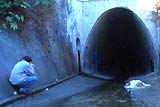 Discovery of Emily's Body at Tunnel Entrance by Brendan Frye 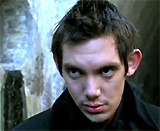 The Pin (Lukas Haas) - Drug Dealer  Tug (Noah Fleiss) - The Pin's Enforcer  Emily's Boyfriend Dode (Noah Seagan) 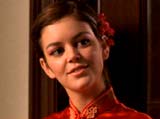 Laura Dannon (Nora Zehetner) 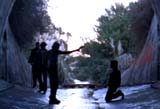 At the Tunner-Sewer, Tug's Murder of Dode 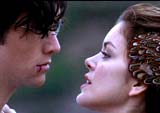 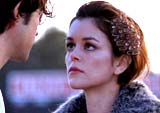 Brendan with Conniving Laura  Laura's Locker With Brick of Heroin |
|||||||||||||||||||||
|
The Broken (2008, UK)
Writer/director Sean Ellis' metaphysical (or existential) horror-thriller has been compared to Invasion of the Body Snatchers (1956), The Man Who Haunted Himself (1970, UK), and Mirrors (2008). It hinted that the heroine was replaced with apparently fearful alternate reality versions of herself (i.e., physical identify theft). The tagline appropriately stated:
The film was accused of having an overly-protracted and lengthy story until the final 10-15 minutes. Recurring symbols included mirrors (and mirror images of originals) and a mystery doppelganger woman. It opened with the Edgar Allan Poe quote, that gave away much of the plot:
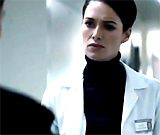
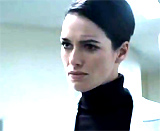
It opened in London at the work place of successful 28 year-old radiologist Gina McVey (Lena Headey). She had just examined X-rays of a subject whose heart was located on the right side of her body – a mirror image of sorts, not unique but rare ("One in a thousand"). She had planned a surprise celebration for her father, retiring US Embassy ambassador John McVey (Richard Jenkins), and guests included:
During a toast, a large mirror in the dining room inexplicably shattered ("seven years bad luck?"). The next day at work, a colleague mentioned to Gina that he had already seen her leaving work (an unidentified woman with stilettos), and out on the street while in a phone booth, Gina saw herself driving by in a red Jeep Cherokee vehicle resembling her own vehicle. She followed the female into the Pembridge House apartment building's underground garage. In her flat in the hallway, she saw a picture of the look-alike woman with her father. [Early Spoiler: She was in her own apartment.] Afterwards, as she fled in a disturbed state, she crashed head-on into a cab (seen multiple times in slo-motion), and afterwards in a hospital, she experienced substantial memory loss about the crash ("psychological scars"). When asked about the crash by counselor Dr. Robert Zachman (Ulrich Thomsen), she stated that she could only remember "fragments." After moving in with her boyfriend rather than returning home (a very BIG clue), she realized that Stephan was acting strangely:
She saw that there was a strange dripping leak from the ceiling of his bathroom. She was also frequently experiencing nightmarish, quick-flash montages of the distorted and horrific fragments of her memories. One occurred while she stood in front of a mirror - her reflected mirror image raised her hand to strike her, out of her view. The counselor suggested she was suffering from a rare disorder called Capgras Syndrome ("in which a person holds a belief that an acquaintance...has been replaced by an identical-looking imposter"). In most cases, he explained, the syndrome was directly caused by a "brain lesion." It was hinted - as a red herring - that both Stefan and John had been taken over by look-alikes. And then, during a bloody Psycho-like murder scene (occurring after the sound of a mirror breaking), Dan's girlfriend Kate was murdered while showering by her own doppelganger, who thrust her entire fist into her mouth to gag her to death. It was presumed that the broken mirror during the opening scene's party had unleashed duplicate clones who inhabited the bodies of some of the McVey family members and friends. Gina found the dead original of her boyfriend Stefan in the attic of his apartment. (Dan found mirror fragments on his floor, and stood face-to-face with a cloned Kate.) Gina began to fear that her own doppelganger was after her - and then the predictable plot twist was revealed when she retraced her steps back at her Pembridge House apartment. There, she found evidence of a struggle: broken fragments of mirrors. She relived the confrontation with her doppelganger (a scene that was not initially shown, and that withheld crucial information). She saw the suffocated and battered corpse of the original Gina lying on the bathroom floor. The surviving Gina was the 'mirror double' who had killed the real Gina when they first met in her own apartment, only to lose her memories after the traumatic car accident. An explanatory montage reconstructed and reviewed what had happened to her - signifying that her shattered memory was now restored. Then, at work in the lab room, she viewed her own X-ray - confirming with a technician that there was another case of "dextrocardia with situs inversus." Without any reaction, she took the X-ray and deposited it in the hallway's trashcan.
There, she stood across from her brother Dan, who fled in fear down the hospital hallway when he realized she was a cloned alien with a smirking, bloodshot stare. The last scene was of Gina in harsh sunlight driving with an emotionless blank look. |
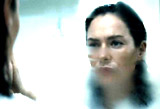  Gina McVey (Lena Headey)  Gina Seeing Herself Drive By 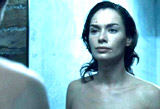  Gina's Scary Reflected Mirror Image  Stefan (Melvil Poupaud)  Murder of Dan's Girlfriend Kate (Michelle Duncan) in Shower 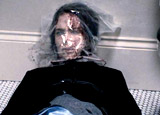 The Suffocated Corpse of the Original Gina 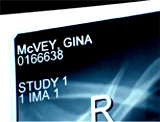 Gina's Own X-Ray With the Rare Condition |
|||||||||||||||||||||
|
The Brown Bunny (2003)
This independent arthouse film about a cross-country road trip from narcissistic and vain producer/director/actor/writer Vincent Gallo was critically derided and scorned when originally shown at the Cannes Film Festival. It told about the journey of motorcyclist racer Bud Clay (Vincent Gallo) - a tortured, empty-hearted loner, who often idealized and thought about his former girlfriend Daisy Lemon (Chloe Sevigny, Gallo's real-life ex-girlfriend). In the film's most notorious, explicit and controversial scene of unsimulated fellatio at the finale, Bud and Daisy were in a starkly-white hotel room - both lonely and needy individuals who were attempting to connect and speak to each other. After kissing and fondling of her naked breasts, as he stood before her at the side of the bed, he undid his belt buckle, released his pant's fly, and she took his male member into her mouth to begin the infamous 'blow-job' scene - as he held himself. As she pleasured him in her mouth, they still engaged in a conversation about their love for each other. When he was finished and satisfied, he stuffed himself back into his underwear and zipped up his fly. He laid on the bed, in a blurry shot and told her: "Thank you so much." Then, they talked about the last encounter of their tragic relationship, when Bud reacted jealously to Daisy's past indiscretion at a party, where she had smoked dope in the bathroom and acted provocatively with some other guys. She apologized ("I never meant to hurt you, Bud"). He moaned about her drug-addicted habit, especially when she was pregnant. She admitted that she was assaulted and raped by the guys after she passed out from getting high (which Bud witnessed passively through the partially-open door of the bedroom). Bud confessed that he didn't help her, but walked away.
The film's plot twist was revealed when their discussion came to a close. When he returned to the scene of the rape, an ambulance had already arrived at the scene, and he sadly kissed her corpse on a stretcher. The film's ending gave greater meaning to everything that came before, including the sex scene. It was revealed that Daisy had in fact died as a result of the incident (choking to death on her own vomit) - "I was dead" - and was later taken away in the ambulance. It was revealed that the scene in the hotel room was only a fantasy masturbatory sequence that Bud experienced as he thought about Daisy, his lost love and the only woman he ever loved. The controversy-provoking film ended with a shocking, melodramatic plot twist to explain Bud's complex personality and downer mood throughout the film. Bud's intense guilt about abandoning her and his continuing crisis of masculine insecurity were informed by the appearance of the deceased Daisy (in his mind only!) - as Bud had been masturbating alone to his memory of her. The film ended with him curled up in a fetal position on the hotel bed. |
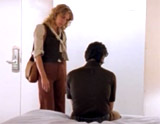 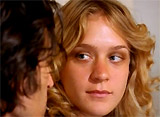 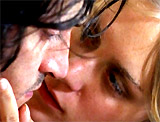 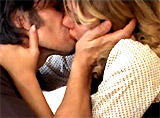 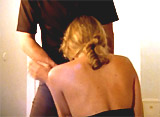 Fantasy Sex with Daisy 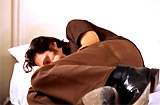 Bud Alone and Curled Up in Fetal Position on Hotel Bed |
|||||||||||||||||||||
|
Burn After Reading (2008)
The Coen Brothers' dark comedic spy-thriller (with the tagline: "Intelligence is Relative") followed the tangled, inexplicable repercussions of the loss of a CIA analyst job by a Balkan expert named Osbourne Cox (John Malkovich). He was reportedly fired for a "drinking problem," after which he decided to write his memoirs. His cuckolding, cool bitch, pediatrician-wife Katie Cox (Tilda Swinton) determined the time was right to divorce him. At the same time, Katie was having an affair with a jogging buff and a sex-addicted philanderer, Treasury agent Harry Pfarrer (George Clooney). She was expecting him to leave his wife Sandy (Elizabeth Marvel), a children's book author. With her lawyer's advice, Katie copied all of her husband Osbourne's financial records from his computer onto a CD and began to empty his accounts. When the lawyer's secretary accidentally left the disk on the floor of the locker room at a health club called Hardbodies, two idiotic employees cooked up a preposterous scheme to make some quick money:
They decided that they could blackmail Osbourne and receive $50,000 extortion money for the return of the disk, so that Linda could pay for four elective cosmetic surgeries (to improve her dating life) not covered by her club's HMO. In the end, betrayal, greed, and violent murders were the results of their misguided scheme. Harry was being followed throughout the entire film by a lawyer's agent hired by his wife Sandy - she was secretly planning to divorce Harry and was also having an affair. While searching through Cox's house, Chad was shot in the forehead by a startled Harry who found him in a closet - his unidentified body was dumped in the Chesapeake Bay (and later fished out and burned by the CIA). The only trustworthy individual in the entire film, Hardbodies' manager and ex-Greek Orthodox priest Ted Treffon (Richard Jenkins), Linda's boss, agreed to help her find missing employee Chad.
In the epilogue set in a CIA office, two confused bureaucrats, CIA Superior (J.K. Simmons) and CIA Officer Palmer (David Rasche), both baffled by the contorted backstabbings (called a "clusterf--k"), attempted to "make sense" of the loose ends. They made some hasty decisions:
Then, the exasperated CIA Superior intoned:
|
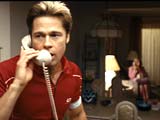 Chad Feldheimer (Brad Pitt) 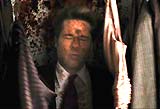 Chad Shot in Forehead by Startled Harry (George Clooney) - in Cox's Closet  Harry with Linda (Frances McDormand)    Cox Confronting Ted Inside His House With a Gun, And Assaulting Him Outdoors 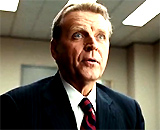 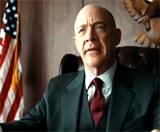 Two Baffled CIA Bureaucrats |
|||||||||||||||||||||
|
The Butterfly Effect (2004)
The science-fiction psychological thriller was the debut film of writers/directors Eric Bress and J. Mackye Gruber. It used Chaos Theory as the premise of its ludicrous plot (similar to a negative reversal of It's A Wonderful Life (1946)), stated in the film's opening:
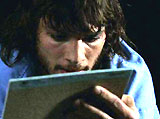
It began with a short scene in which a desperate man broke into an office and feverishly scrawled a note on a pad of paper:
The film's tagline reinforced his plan to go back in time and make things right, with unpredictable consequences:
The film then flashbacked to 13 years earlier, where young 7 year old Evan Treborn (Logan Lerman) [his name was a play on the theme: "Event Reborn"] was feared to be disturbed, due to a family history of mental illness and insanity beginning with his grandfather. His institutionalized father Jason (Callum Keith Rennie) became violent during Evan's first visit (Evan was nearly strangled to death) and a subduing blow to his head by guards killed him. Living in upstate New York, Evan's single parent mother Andrea (Melora Walters) was concerned that 13 year-old Evan (John Patrick Amedori) was following the same pattern, after drawing a violent and bloody picture at school (a foreshadowing of future events), and found carrying a butcher knife. But Evan had no recollection of drawing the photo. He was encouraged to write down his thoughts in journal/composition books - and he often revisited her journal entries to learn more about his childhood. As the film progressed to six years later, there were three scenarios that would be repeated, with varying details:
All three incidents involved Evan (Ashton Kutcher as adult) with his three 7 year-old and 13 year-old childhood friends:
In periods of stress (occurring during all of these scenarios and at other times), Evan would blackout, experience nosebleeds, but then found himself unable to fully recall what happened. It wasn't until seven years later in 2002, when Evan was a 20 year-old state college student, during a date with a coed in his room, that he realized that he could travel back to the past just by re-reading his journals. The page would vibrate and flutter and the physical world would shake, as he passed out, and then was transported back to the time of a traumatic blackout from his childhood. [Evan's time-travel episodes were the reason for his childhood blackouts - the blackouts occurred when the adult-Evan was occupying his younger consciousness.] As he read more and more of his journal entries, he realized that he had the ability to fine-tune, change or 're-do' various details of each dream, by inhabiting his younger self. When Evan visited a psychic palm-reader with his mother, he was prophetically told and warned: "You have no lifeline. You don't belong here....He has no soul. You were never meant to be." And his goth, overweight roommate Thumper (Ethan Suplee) wisely advised Evan:
The remainder of the film demonstrated the repercussions of his intrusive changes that often brought unexpected side-effects or results. Evan became a number of different alternate individuals with varying futures, for example:
Evan was eventually diagnosed as diseased with irreparable brain damage, and the creation of "alternate universes with colleges and prisons and paraplegics." In Kayleigh's (Amy Smart) case, as a struggling and bitter waitress at the local Hilltop Cafe after being abused by her father, she ended up suicidally dead, but in other scenarios with Evan:
Tommy (William Lee Scott), was an auto-body worker, but other scenarios also occurred:
In several instances, there were unforseen consequences, such as when Evan's mother became a terminal lung cancer patient due to chain-smoking after Evan blew off his arms, and Lenny was institutionalized after murdering Tommy (he angrily told Evan: "You should be where I am"). Evan decided to end the vicious cycle of going back in time and failing to fix the past, or causing more serious problems --
Theatrical Version: Evan went back to the first time he met Kayleigh as a child at a birthday party, deliberately offended her with a threat, and thereby ensured she would happily grow up with her mother, and not know him when she passed him on a Manhattan street eight years later. |
 Evan (Ashton Kutcher) Scrawling Note on Pad of Paper 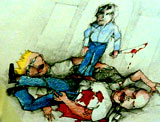 13 Year-Old Evan's Violent Drawing 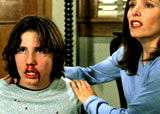 Waking Up From Time Travel - with Nosebleeds and No Recollection 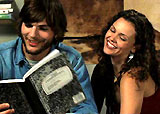 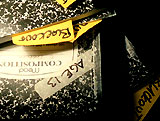 Time Travel Notebooks 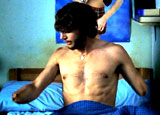 Evan - A Dynamite Victim With Two Stumped Arms  As Fetus, Evan Prevented His Own Birth 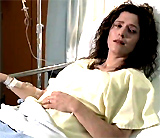 Miscarriage of Evan as Third Child Ending Montage Images:  Young Kayleigh and Tommy Living With Mother  Evan's Mother Remarried, Breaking the Cursed Cycle - With A Fourth Child, A Girl, Was Born to Evan's Mother 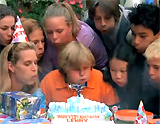 Lenny's 13th Birthday Party - Now Very Popular 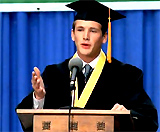 Tommy Delivering HS Graduation Speech to Class of 2000  Kayleigh's Happy Marriage |
|||||||||||||||||||||





 Helena's
Surgical Dismemberment Was Only Nick's Obsessive Dream; Another Alternative
- Almost the Entire Film was a Dream
Helena's
Surgical Dismemberment Was Only Nick's Obsessive Dream; Another Alternative
- Almost the Entire Film was a Dream