|
Film Spoilers and Surprise Endings O |

|
|
|||||||||||||||||

|
Obsession (1976)
This convoluted and suspenseful Brian De Palma film (with a haunting Bernard Herrmann score) reworked Hitchcock's Vertigo (1958), and some of Roeg's Don't Look Now (1973) as well as the scissors-stabbing scene in Hitchcock's Dial M for Murder (1954). New Orleans real estate developer Michael "Court" Courtland (Cliff Robertson) in 1959 was happily married to beautiful 28 year-old wife Elizabeth (Genevieve Bujold). They had a nine year-old daughter named Amy (Wanda Blackman). Suddenly, on the night of their 10th wedding anniversary reception and the occasion of a huge real-estate development deal, both were kidnapped at gunpoint. A note for a $500,000 cash ransom demanded the next day was left in Amy's bedroom:
The money was to be brought in a briefcase, and tossed onto the old Bermuda Wharf during the Cotton Blossom River Paddle-wheel Boat Tour at 11 o'clock. Courtland had to use funds he was planning to invest in the development of a Pontchartrain Park project with family friend and business partner "Uncle Bob" Robert LaSalle (John Lithgow), effectively withdrawing himself from involvement in the project. A rescue attempt was proposed by New Orleans Police Inspector August Brie (Stanley Reyes), including substitution of paper for the real cash ransom, and the placement of a small radio transmitter in the locked briefcase so it could be traced. The plan was botched as the kidnappers learned about the ploy, told the abductees ("This is what your old man thinks you're worth, nothing!") and fled. The resultant car chase ended on a bridge, when the kidnappers' getaway car collided with a fuel tanker and burst into flames - presumably killing both Elizabeth and Amy. However, their bodies were not located in the currents of the Mississippi River. Michael grieved and was severely guilt-ridden by their loss, and built a huge memorial to their honor in Pontchartrain Memorial Park. Fifteen years later in 1975, on a business trip to Florence, Italy, Michael saw a woman - a doppelganger (Genevieve Bujold again) who strikingly resembled his former wife, in the same church where he had met Elizabeth years earlier. He followed her around the streets of Florence before introducing himself. In their first conversation, the young, French-accented but Italian restoration artist and historian Sandra Portinari greeted him with "Buon Giorno" - and then switched to speaking English, telling him: "I speak English. You are American?" He was entranced by her, asked her out, and soon fell in love. He asked her to return back to New Orleans with him, and made plans to marry her in a church wedding on May 2nd, 1975. During the weeks before the wedding, she learned of the 1959 kidnapping and death of Michael's wife and child. Michael was vainly dissuaded from impulsively and hastily marrying Sandra by psychiatrist Dr. Ellman (Stocker Fontelieu) who had been summoned by LaSalle to his office - Michael was advised:
In a rippling dream sequence, Michael envisioned them being married in a private ceremony in his home (instead of in a large cathedral ceremony), and that night he told her: "I've waited so long" in his bedroom as he hugged and kissed her - she told him:
In the long (and slightly preposterous and contrived) conclusion, when he awoke the next morning, he found that Sandra had been kidnapped with an identical-looking ransom note (it was a newspaper facsimile of the first ransom note, torn by Sandra from Michael's scrapbook of memories of his dead wife, that she had found in his locked master bedroom in an earlier scene). During this second ordeal, Michael raced to the home of LaSalle and desperately begged for him to accompany him to the bank to acquire $500,000 to pay the ransom with real cash this time, even promising to sign over his half of land ownings to LaSalle ("I'll give you anything for a short while"). As Michael signed papers with LaSalle, his briefcase (filled with cash) was switched behind his back. He took the same Paddle-boat Tour and went through the same routine to give the kidnappers the briefcase. There were a number of surprises that followed:
|
 Elizabeth (Genevieve Bujold) and Michael Courtland (Cliff Robertson) 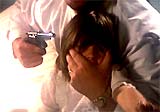 The Kidnapping 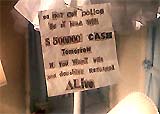 Note For Cash Ransom 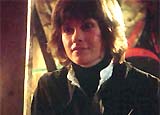 Sandra Portinari in Italy - Elizabeth's Doppelganger 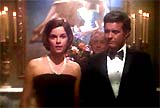 Sandra with Michael  Opening the Briefcase - Again with Worthless Deposit Slips: The Double-Cross 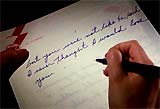  On a Plane Back to Italy - Sandra's Letter to Her "Father"  Michael Stabbing Swindler LaSalle to Death  Airport Rendezvous |
|||||||||||||||

|
An Occurence at Owl Creek Bridge (1962) (aka La Rivière du Hibou) (short)
This classic 28 minute film which won the Academy Award for Best Short Subject was based on Ambrose Bierce's 1886 short story first published in 1891. It aired on American television in late February 1964 as the last episode of Rod Serling's original anthology series The Twilight Zone. In the story, innocent Civil War Confederate soldier Peyton Farquahr (Roger Jacquet) escaped his hanging when the rope broke and he floated downriver. He was able to flee through a forest toward his beloved wife (Anne Cornaly) and child at his home. When he stretched out his arms to her for an embrace, he suddenly screamed and arched backwards. He never actually escaped death -- the entire film was a fantasy he experienced in the few seconds of life he had during his execution just before his neck was broken in the noose. Rod Serling ended the segment with the voice-over narration:
|
 The Botched Hanging  Escape and Flight  Dream of Embracing Wife 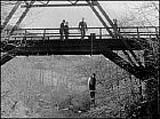
The Reality |
|||||||||||||||

|
Ocean's Eleven (1960)
Legendary director Lewis Milestone's caper-heist film was the first movie featuring the so-called 'Rat Pack'. [Note: the Rat Pack nickname was a misnomer. It was earlier used to identify a group surrounding Humphrey Bogart, and later referred to a group that called themselves "The Summit" or "The Clan."] A group of World War II 82nd Airborne paratroopers/veterans assembled together, known as Ocean's Eleven. They met in Beverly Hills at the home of racketeer Spyros Acebos (Akim Tamiroff). The group of war buddies was recruited by Danny Ocean for a major heist or big score:
Also appearing in the film, making up the remainder of the "Ocean's Eleven" group were:
The simultaneous heist of five Las Vegas casinos (the Sahara, the Riviera, the Desert Inn, the Sands and the Flamingo) occurred at midnight on New Year's Eve, by 'Ocean's Eleven'. By orchestrating a power outage (an explosion at the electrical transmission tower), the group (with an elaborate rewiring plan to inhibit back-up power) was able to unlock the cashier cages and vault doors and rob the casinos. After the successful heist, prominent underworld figure Duke Santos (Cesar Romero), suspicious of Danny and his friends, met with the managers of the five casinos and negotiated to return the money for thirty percent of the total. He also threatened to turn in Danny and Sam unless they give him half of the money. In the tale's twist ending, the money originally stashed in garbage bags - was hidden in the coffin of Tony, one of the group members, who had suffered a surprise heart attack after the job was completed. Then, during the service in the mortuary for Tony, attended by the entire group sitting in one row, it was learned that the money was accidentally being incinerated when his body was cremated in its coffin. An usher explained the rumbling sound that was heard - the deceased was in the adjoining crematory. Tony's widowed, estranged wife Grace (Jean Willes) had decided at the last minute, through the advice of the undertaker Mr. Cohen (Charles Meredith), to have the service in Vegas rather than San Francisco where she lived, to save money. She had already received $10,000 of the money, set aside for her. The last sequence, just before the credits rolled, showed the group of eleven stunned, bewildered and silent robbers walking down Las Vegas Blvd. in front of the Sands Hotel, to the tune of Sammy Davis Jr. singing: "Eee-O-11." |
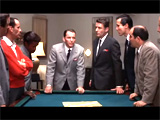 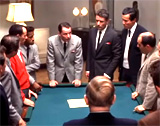 The Plan: Robbery of Five Casinos Simultaneously on New Year's Eve  The Neon Lights of the Five Casinos Before the Power Outage 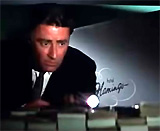 The Vault of Cash at the Flamingo - Robbed by Jimmy (Peter Lawford) 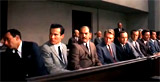 The Funeral Service 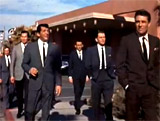 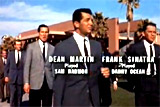 The Ocean's Eleven Group Leaving the Mortuary - Empty-Handed |
|||||||||||||||
|
Oldboy (2003, S. Korea)
This compelling, mysterious, and visceral (double) revenge thriller from Korean director Park Chan-wook was adapted from the Japanese manga written by Tsuchiya Garon.
The tagline incorporated a brief description of the plot:
Its potently sinister tale of revenge, hypnotism, and incest was told mostly in flashback -- a recently-released prisoner, a womanizing businessman named Dae-su Oh (Choi Min-sik), had been inexplicably kidnapped from a phone booth (on his daughter's birthday, July 5th!). He was kept in a dingy, shabby windowless cell in a strange, hotel-like room for 15 years, without knowing the charges. During his imprisonment, he learned over television that he was framed for the murder of his wife, and his young three year-old daughter was sent to a foster parents home in Sweden. He also suffered hallucinations of ants crawling on him and emerging through his skin. After being inexplicably freed by his villainous, sadistic and insane captor/tormentor Woo-jin Lee (Yu Ji-tae), he had only five days (until July 5th, again) to find answers: to seek surrealistic vengeance and discover the enigmatic reasons for what had occurred, while engaged in a cat-and-mouse game with Woo-jin. After his release, Dae-su stumbled into a restaurant where he became acquainted with Mi-do (Kang Hye-jeong), a helpful and young female sushi chef. After consuming a wriggling, live octopus (eaten headfirst!) and receiving an enigmatic phone call from Woo-jin, Dae-su fainted, and Mi-do took pity on him and took him in. She assisted him in following clues in order to unravel the mystery. A major revelation was that persecuting millionaire villain Woo-jin's diabolical vengeful plan against Dae-su was in retaliation for an incident years earlier when they were classmates at Evergreen school. Dae-su had been blamed by Woo-jin for spreading a rumor ("Your tongue got my sister pregnant") regarding an incestuous pregnancy (between young Woo-Jin and his own slutty sister Lee Soo-ah (Yoon Jin-seo) who were having sexual relations). When rumors spread the news of the incest, Woo-jin's humiliated sister allegedly committed suicide. Eventually, grown-up Mi-do became Dae-su's lover. She signaled to him that she was ready to have sex, by singing a song mentioned in Dae-su's journal: "The Face I Want to See." Falling in love and having sex with her was the villain's diabolical vengeful plan. Woo-Jin had raised Mi-do in secret, and had both Mi-do and Dae-su hypnotized to fall in love when she grew older - a punishment suited to fit the crime.
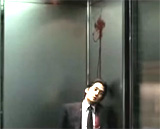
When Dae-su realized in horror that he had taken the virginity of his own long-lost daughter, he wished to atone and appease Woo-jin, to prevent any further rumors or talk, and to avoid having him reveal the truth to Mi-do. Dae-su cut off his own tongue with a rusty pair of scissors (the same tongue that spread a false rumor years earlier). Dae-su learned by the film's end the reason for his imprisonment - the film's major plot twist, in a startling flashback scene set in an elevator. Woo-jin experienced a guilt-ridden memory revealing that he had murdered his own sister (by letting go of her over the side of Habchun Dam) - she had not committed suicide. As the guilty memory came over him, he shot himself in the side of the head inside an elevator as the door opened, leaving a bloodstain on the wall.
In a major concluding hypnosis scene, Dae-su tried to brainwash himself with a female hypnotist to erase his unbearable memories that his lover was his daughter; she put him in a spell - she asked him to return mentally to Lee Woo-Jin’s apartment and to split up into two different people when he heard the sound of a bell she was holding; two different Oh Dae-Sus were viewed: (1) the one who had no memory, and (2) the monster who held the secret and died pacing:
The film ended ambiguously in an unidentified place, in the snowy mountains, with Dae-su embracing his daughter Mi-do, who told him: "I love you... Dae-su" - but did he remember the truth about their true identities? |
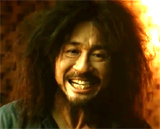 Dae-su Imprisoned for 15 Years 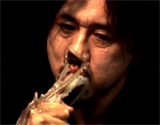 Live Octopus Eaten Headfirst  Rumors of Sex Between Young Woo-Jin and His Own Sister Lee Soo-ah, Spread by Dae-su   Prison Manager Mr. Park's Tooth Extractions 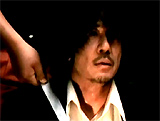 Dae-su   Mi-do 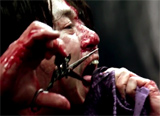 Dae-su's Self-Inflicted Mutilation - Cutting Out His Own Tongue  The Hypnotist to Erase Dae-su's Memory:  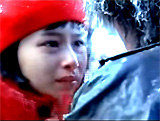  Enigmatic Ending: Did it Work? |
|||||||||||||||

|
On Her Majesty's Secret Service (1969, UK)
In the shocking and tearjerking ending of this sixth film in the James Bond series, the British Secret Service 007 agent (George Lazenby) was speaking to his newly-wed wife Contessa Teresa Di Vicenzo or Tracy Bond (Diana Rigg). They discussed raising a family (Tracy: "three girls, three boys") only moments after their Portugal wedding, as they drove away to their honeymoon in his flower-adorned Aston Martin DBS car. He assured her:
When Bond parked the car on the side of the mountain road to remove some of the flowers to give her as a gift, she mentioned that the best wedding present she had already received was "a future." He kissed her with a flower between her lips - their last kiss. Suddenly without warning, MP-40 submachine gun fire from a passing silver Mercedes 600 sedan strafed their car, and then drove away after the drive-by. SPECTRE villain Ernst Stavro Blofeld (Telly Savalas) (with a neck brace) was driving the vehicle in the attempt on Bond's life -- his henchwoman Irma Bunt (Ilse Steppat) had fired the shots from the back seat of the sedan. Bond ducked and avoided being hit. He shouted twice: "It's Blofeld" as he jumped into his car. He then realized that Tracy had been hit in the forehead by a bullet through the windshield and instantly killed. He cradled her in his arms, and at first denied her death to a police officer on a motorcycle:
Bond's mournful words were underscored by Louis Armstrong's beautiful and ironic rendition of "We Have All the Time in the World." [NOTE: This was the only film in which Bond married one of his Bond girls.] |
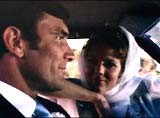 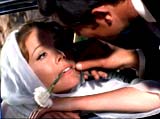 Their Last Kiss 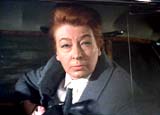 Assassin Irma Bunt 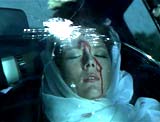 Death of Tracy 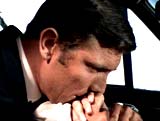 Bond's Grief |
|||||||||||||||
|
Open Your Eyes/Abre los Ojos (1997, Sp./It./Fr.)
This confusing, baffling and somewhat captivating film was a remake of Hitchcock's Vertigo (1958). The film was remade in Hollywood as Vanilla Sky (2001) with Tom Cruise and Penelope Cruz (again). The virtual reality plot/theme has since been used innumerable times by other films such as eXistenZ (1999) and The Thirteenth Floor (1999), as well as the "It's All A Dream" plotline. 25 year-old handsome, and attractive playboy César (Eduardo Noriega) related his story, in flashback. (Important: Throughout the entire film, all of Cesar's recollections of his world and life were very suspect.) To begin, on the occasion of his 25th birthday, he had met and flirted with beautiful brunette Sofia Cueto (Penelope Cruz), the girlfriend of his good friend Pelayo (Fele Martínez). During the party at his place, his jealous, obsessive, abandoned black-haired lover Nuria (Najwa Nimri) gate-crashed and had come to his bedroom - hinting that she felt jilted because she hadn't been invited to his party, and that she knew of his flirtations with the brunette. She forced kisses on him, causing him to leave and attend to his guests. Cesar's sexual flirtation with Sofia was obviously unethical - his friend Pelayo would soon accuse him of stealing her away. He flirted with Sofia that evening and they shared portrait sketches of each other. He told her: "That smile's going to kill me." At this time, he reluctantly chose not to sleep with her, out of respect for Pelayo (Sofia: "It would be wrong if we did anything tonight...Pelayo. Remember? Your best friend"). The next morning, Nuria picked Cesar up in her red sports-car. While driving, she downed a napkin full of pills, then said "happiness" was being with him, although he admitted his thoughts were elsewhere and he didn't want to have a heavy conversation with her. She said she felt used by him only for sex, and that he didn't really know her. Nuria asked him: "Tell me something. Do you believe in God?" Then, Nuria deliberately smashed her car into a guard rail, sending them down an embankment into a cement wall. She killed herself and injured him as her passenger - with a fractured skull. After the accident, with severe facial disfiguration, Cesar had a prosthetic mask. He became suicidal and was suffering from mental trauma and delusions, and was looking for a way to resolve his life predicament. Obviously, he wanted to reunite with Sofia, but not in the condition he was in.
With the words "Open your eyes," (similar to the film's opening dream sequence when an alarm clock kept repeating "Open your eyes" to him), he was seen lying on the street, holding his prosthetic face mask in his hand, and revealing his severe facial disfigurement. A female was whispering and prodding him to wake up. He jerked backwards when he first saw her face - it was his obsessive ex-lover Nuria - but then she immediately 'changed into' Sofia. She said: "Forgive me" - and then touched his scarred face, kissed him, and said: "I love you." They went walking into a park, hand-in-hand. He said he felt like he was experiencing 'deja-vu' ("I've been here before"). She thought it might be explained as a "lapse in the brain." Cesar was accused of murder and placed in a cell for the criminally insane awaiting trial. He was planning a defense of "temporary derangement." Cesar was speaking to his psychiatrist Antonio (Chete Lara) in a psychiatric penitentiary in Madrid, about his recurring dreams. The confusing part of the film was that much of the second half of the film was a virtual reality dream (spliced into his real memories) of what César imagined he had experienced after the night of his birthday party. He began to have unsettling disjunctions, dreamy wish fulfillments (mostly to get together with Sofia, or to have a new face), and bewildering reality flips.
It was explained that there was a "splice of 150 years" inserted between Cesar's "real life" and "virtual life." The splice was something that he shouldn't have noticed because he was "dead and frozen," but apparently Cesar did. In fact, he was told: "From when you woke up, nothing was real. We wiped what really happened from your memory...You never saw Sofia again. And the doctors were never able to rebuild your face." The nature of all of Cesar's reality and his memories was also questioned when he was helped at a bar by a reappearing Frenchman advertising on TV, Serge Duvernois (Gérard Barray). He assured Cesar that he wasn't "mad," and advised him that he was simply "dreaming":
Duvernois explained to Cesar that what he was 'dreaming' was entirely under his own control - even the existence of the people around them at the bar depended upon him. He could create his reality: "Look at those people. They seem to be talking about their own business, completely unaware of you. And yet, they could be there because you wanted it. What's more, you could have them at your complete service or have them destroy you." When Cesar wished that they would be quiet - they suddenly turned stationary and still. He was indeed living in a dream. Through hypnosis with his psychiatrist, Cesar remembered that around the time of his disfigurement, he was pressured to sign papers ("You won't regret it. Sign") for a contract with an American cryogenics company called Life Extension (or L.E.). The company was thought at first to be the name of the Madrid office's secretary 'Eli'. He had contracted for L.E. to freeze his body (after he committed suicide in despair over the accident), and provide him with other after-life services. The cryonization company was paid to give him "immortality" after death ("You pay to live eternally") - in other words, a rebirth. He would be given a future fantasy virtual paradisical life of "artificial perceptions" (in Clause 14) or virtual reality dreams - based upon his past experiences. At the end of the film, Cesar was permitted to visit the high-rise offices of the L.E. company with his psychiatrist. In one of his dreams, he realized: "I've been here before." He was told by an L.E. salesman:
He learned, however, that his dreaming subconscious could play "dirty tricks" on him because the process wasn't completely foolproof and perfect. There were technological glitches in L.E.'s cryonics VR system. Cesar realized:
Abruptly, Cesar decided: "I want to wake up!...This is a nightmare!" - he wished to 'kill' his virtual life that he had contracted for. He believed that the nightmarish visions he was experiencing were solely created by L.E. On the high-rise rooftop of the L.E. company, the TV pitchman Serge Duvernois, now revealed as a representative of L.E. or Life Extension, told the psychiatrist that reality was only a state of mind:
Cesar was told that he had signed the papers with L.E. to put him into a dream of how he wanted life to be - but because of his traumatic recollections, he was living a "nightmare" life:
Cesar believed that he had finally overcome his fears and could live a better life ("You just have to ask") in the future year of 2145, about 150 years into the future (150 years could also be a few hours, a day, a week - an indeterminate amount of time). Duvernois asked Cesar: "Do you have any wish before you die?" Cesar closed his eyes, and conjured up his long-dead lover Sofia, breathtakingly beautiful in an almost transparent white dress, and restored his own face to normal. Wordlessly, he embraced her. He also imagined his long-dead best friend Pelayo looking on. He wanted to see them one last time before 'killing' his life. He resolved to "open his eyes" to non-cryogenic healed life in the future - he elected to wake up and be resurrected, now that plastic surgery had advanced and might help him. Duvernois warned that all he was experiencing on the rooftop were images in his own head:
Cesar gave Sofia a farewell kiss, and then jumped - hopefully to trigger his rebirth. An instant before he hit the ground, the film cut to black, and a strange woman's voice (a nurse?) soothed him: "Tranquilo. Tranquilo. Abre los ojos..." ("Relax. Relax. Open your eyes..."). Questions inevitably arose:
|
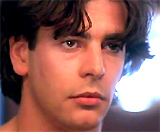 Cesar (Eduardo Noriega) 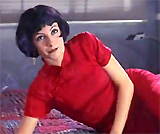 Jilted Nuria (Najwa Nimri)  Flirting with Sofia Cueto (Penelope Cruz) 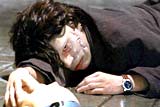 Facially-Disfigured Cesar 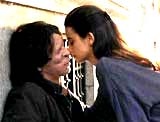 Cesar With Sofia 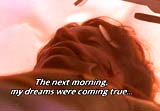 Frozen Cyrogenically - Everything Was Only a Dream  Cesar Making Love With Sofia 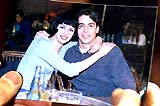 Cesar's Black-Haired Lover Nuria (Najwa Nimri) - or was it Sofia?  Sofia/Nuria Smothered  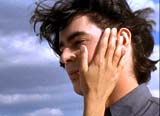 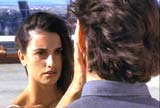 His Final Meeting With Sofia on a Rooftop 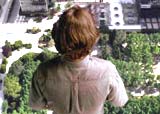  Suicidally Jumping From Roof to End His Nightmarish Life and Trigger Rebirth |
|||||||||||||||
|
Original Sin (2001)
Assumed identities and duplicitous scams were two of the themes of writer/director Michael Cristofer's poorly-reviewed erotic crime drama. The sluggishly-directed film was based on the novel "Waltz Into Darkness" by Cornell Woolrich, which had previously been adapted for the screen by director Francois Truffaut as La Sirene du Mississippi (1969, Fr.) (aka Mississippi Mermaid). Convoluted plot twists in the flashbacked melodramatic story were mostly predictable. Its tagline was:
Antonio Banderas and Angelina Jolie were hyped as the two lovers in an arranged marriage, with steamy, overheated sex scenes, some of which were edited to avoid an NC-17 rating. [The explicit unrated version was about 6 minutes longer than the theatrical version.] The trashy thriller with inane dialogue (similar to soft-core Red Shoe Diaries episodes) opened with a full-lipped unidentified female talking through her prison cell bars. She was about to be executed (by garrotting), and was narrating (in voice-over and flashback) her tale, the film's story, to a priest (Mario Ivan Martinez):
Julia Russell (Angelina Jolie) had arrived in late 19th century Cuba - as a mail-order mystery bride from Wilmington, Delaware commissioned to wed Don Luis Antonio Vargas (Antonio Banderas), who had advertised himself in a Baltimore newspaper as a clerk in a coffee export house, although he was the wealthy owner of a coffee-export business. He had expected a homely woman from her photographs, but she was an exquisitely beautiful and seductive female. She explained that she didn’t want him to be interested in her just because she had "a pretty face," so she had sent a picture of a plain-looking relative. They both shared similar devious motivations - the film's major clue was stated by Julia: "We are both not to be trusted." They were married almost immediately, but did not consummate their love until a few days later ("And there, in his arms, she became someone else. Someone more like herself"). There were various glistening sexual couplings at different angles, photographed from above. She then began to exhibit unusual behaviors: a secretive backstage theater meeting with an actor (a Mephisto devil figure) (Luis reacted: "You'll be the death of me"), strange dreams, and horizontal scars on her back. She refused to open her trunk from America, and was suspected of breaking the neck of her caged bird. Luis gave Julia access to his personal and business accounts, and compelled her to finally write to her sister Emily (Cordelia Richards), to tell her that she was okay. At the same time, Luis met private investigator Detective Walter Downs (Thomas Jane), hired by Emily in Delaware to find her sister Julia. Shortly later, Emily also traveled to Cuba where she claimed to Luis that the recent letter sent by Julia was "not sent by Julia" but from an imposter - "This letter was not written by my sister...That is not Julia's handwriting." Luis knew his wife was a fake, had withdrawn almost all of his money and then fled. He was comforted by his wise black servant-lady, Sara (Joan Pringle): "You've been married to a dream. A dream that stole your soul!" Although devastated, he told Sara: "I want her back." The love-struck, gullible Luis visited a brothel and began drinking for relief, as Julia's voice-over continued:
Luis sought the assistance of PI Walter Downs to track down Julia (a clever con-artist), and although she hadn't committed a crime (by emptying his accounts), he stated his aim: "I want to kill her." The two set out to look for Julia in Havana. It appeared from Walter's brief investigation that Julia was a murderous impostor, that Luis' real intended mail-order wife had been killed by her on the boat to Havana, Cuba, that she had then assumed the woman's identity and possessions, and that she might be working with an accomplice.
Unexpected plot twists and revelations came, as the distrustful femme fatale continued to dupe both men - with more betrayals, counter-cons, and staged deaths:
To earn more money, Julia taught Luis how to cheat at cards. At a gambling table, she helped Luis win by viewing the other players' cards and signaling what they were, although they were found out and Luis was beaten up. Luis sold out his business, and Julia had acquired the rest of Luis' money.
The film concluded with Julia about to be executed at daybreak. But she had escaped her cell by wearing the priest's garment. In the last very unlikely scene, she had perfected her petty card shark schemes and was now at a gambling table in Morocco with Luis. He told the other players:
|
  In a Cell: The Story Told in Flashback 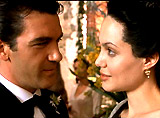   Julia (Angelina Jolie) with Luis (Antonio Banderas)  Walter Downs (Thomas Jane) 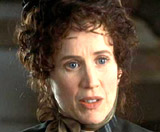 Emily (Cordelia Richards) 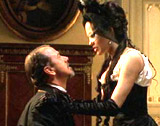 Bonny Castle (Angelina Jolie) with Colonel Edwin Worth (Gregory Itzin) 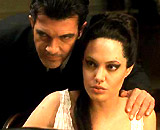 Luis Confronting Julia/Bonnie 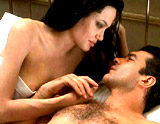  Reaffirming Her Vows as Luis' Wife 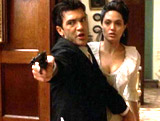 Luis Shooting Walter  Julia/Bonny with Accomplice Walter/Billy 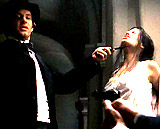 The Death of Walter/Billy 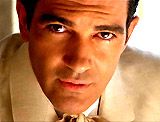 
|
|||||||||||||||
|
Orphan (2009)
Director Jaume Collet-Serra's trashy, formulaic and sleazy psychological horror-thriller was about the terrorizing aftermath of the adoption of a mysterious 9 year-old Russian orphan girl named Esther (11 year-old Isabelle Fuhrman) by a family. The film's trailer exclaimed:
The film's plot resembled:
The adoptive couple in Hamden, Connecticut - neurotic, recovering alcoholic Kate (Vera Farmiga) and clueless, wealthy architect husband John Coleman (Peter Sarsgaard), had just experienced a tragic loss - the still-born birth of a daughter named Jessica.
The John and Kate Coleman family, with a troubled marriage, consisted of:
Suspicions arose about a mature, well-mannered, artistically-inclined, educated, freckled, and Russian-accented Esther. The Colemans adopted her from St. Mariana Home for Girls. Her parents had allegedly died in a house fire (ruled a case of arson), and she barely survived herself. However, she was suspiciously not what she appeared to be:
The disturbed and manipulative girl exhibited anti-social psychosis, and borderline personality disorders. She had repeatedly injured or killed former foster family members and other children - her goal was to separate the spouses so she could isolate and seduce the adoptive fathers. She was having that effect on John (orchestrating ways to sleep in John's bed, telling him he was the perfect daddy, etc.). She kept photographs of former daddys that she had seduced. It was later revealed she had painted pictures (seen in black-light) of her fantasized love-making. It was revealed by Estonia's Saarne Institute (a mental hospital!) that Esther was an escaped patient from a year earlier. She had been incarcerated after killing at least seven people, and was really a psychotic, demonic, and malevolent 33-year old woman named Leena Klammer with a rare hormone disorder, hypopituitarism (or proportional dwarfism). Her neck and wrists were covered, because when she was in the asylum, her violent struggles to release her straitjacket left deep scars. To hide her age and appear Lolita-esque, she wore makeup, false teeth, and old-fashioned dresses, with body wrappings (to hide her figure) and ribbons (to cover her scars). In the protracted and violent 20-minute conclusion during a snowy night, Leena repeatedly stabbed John to death, and then stalked Max. She also shot Kate in the left arm, and then further followed Max into the attached greenhouse with the gun. Kate rescued Max from Leena's deadly pursuit by falling onto her through the greenhouse roof, although they soon ended up fighting each other atop the nearby frozen pond-lake. Max used the gun to shoot a hole in the ice, causing both of them to fall through as they struggled. Kate climbed out of the ice-hole, refused to listen to Leena's little-girl begging to save her (Esther: "Please, don't let me die, Mommy." Kate: "I'm not your f--king Mommy!"), and kicked Leena in the face. Her neck snapped, and she fell back underwater and drowned. |
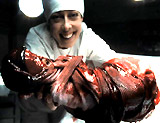 Nightmare: The Bloody Miscarriage 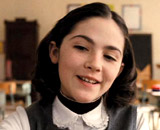  The Colemans with 9 Year-Old Esther (Isabelle Fuhrman) 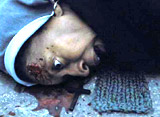 Murder of Sister Abigail 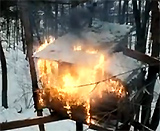 Treehouse Fire Injuring Danny 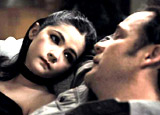 Seducing John 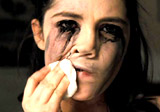 The Disguise - Removing Her Makeup  Fantasized Love-Making 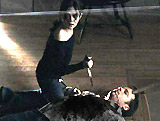 Stabbing John to Death 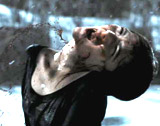 Death of Esther |
|||||||||||||||

|
The Orphanage (2007, Mex./Sp.) (aka El Orfanato)
This chilling gothic thriller, by first-time director Juan Antonio Bayona, centered around an abandoned Spanish seaside orphanage that had been restored and set up as an institution for "special children." Red-headed wife Laura (Belen Rueda) had been raised at the institution as a child in the mid-1970s when it was called The Good Shepherd, before it was abandoned. Now 30 years later, she had persuaded her husband Carlos Sanchez (Fernando Cayo) to reopen the orphanage and use the facility's space to help disabled children. They moved in with their child:
Simon began to exhibit strange behavior. He had an active imagination, and would often communicate and play hide-and-seek with six imaginary "invisible friends" (or 'ghosts') in the haunted building. One of his imaginary "ghost" friends was named Tomas. In the game, they would hide a person's "treasure," and search for it by following clues, in order to be granted a wish. Shortly after the arrival of a strange older woman named Benigna Escobedo (Montserrat Carulla) - claiming to be a social worker - Simon learned that he had been lied to by his parents regarding his adoption. Feeling unloved, he prophetically told his mother something he claimed was told to him by Tomas. He knew that he was adopted and that he was going to soon die:
At the start of a children's welcoming party at the orphanage (during which some of the children wore masks), Simon was stubbornly disobedient, refusing to come down to participate, and Laura slapped him for his misbehavior. Later when Laura looked for him, she was confronted by a sack-masked boy in the hallway. It was presumed that the boy was Tomas (his name was sewn on his shirt). He pushed her backwards into the bathroom and locked her there when she tried to remove his mask. [Note: She didn't know it at the time, but the sack-faced boy was Simon, not Tomas!] Afterwards, Simon disappeared and Laura searched frantically for him (she looked for him in a closeted door under the stairs - inadvertently rearranging some yellow steel construction posts that fell). She hysterically imagined seeing him in an ocean cave, trapped by the rising tide, but he couldn't be found. That night, Laura heard unexplainable banging noises in the orphanage. During a subsequent investigation into Simon's mysterious disappearance, police psychologist Pilar (Mabel Rivera) conjectured that Benigna might have kidnapped Simon. Subsequently, Laura sought many ways to try and discover Simon's whereabouts. Six months after he went missing, Laura unsuccessfully sought support from a bereavement group, and was then dismayed when she saw elderly Benigna struck and killed by a speeding ambulance, while she was pushing a baby carriage with a mask-headed doll in it. It was revealed through Benigna's Super 8 films and photographs that Benigna had worked at the orphanage when Laura was there as a orphaned child. She had a son who was born deformed named Tomas, who was hidden away and masked ("No one knew about him"). Tomas disappeared while playing one day -- the same thing that happened to Simon. Shortly after Laura's adoption, Tomas was found dead on the beach after some of the other orphans had played a trick on him. They had taken off his sack mask in the cave - where he hid out "but he never emerged. He drowned" in the high tide. Nine months after Simon's disappearance, Laura sought out psychic medium Aurora (Geraldine Chaplin) for clues to Simon's whereabouts and evidence of anything else in the orphanage. While in a trance, she heard five, very sick children crying from the past, and when she opened a door, exclaimed: "What have they done to you?" - and then learned that the orphans had been poisoned. During a scavenger treasure hunt as Laura followed the clues, she was led to discover sacks of human ashes and partial skeletal remains in the orphanage's coal shed.
Not wanting to stay at the orphanage any longer, Laura's husband Carlos packed up and left. For the next two days, a crazed Laura, wearing an orphanage uniform, converted the orphanage to its former state, and then took sedatives to approach even closer to death - to help her find her son. She summoned the 'ghost' children (symbolized by dolls) to the dinner table by ringing a bell, and then by playing a hide-and-seek game ("One, Two, Three, Knock on The Wall") from her childhood with the apparitions that appeared. Eventually, the ghosts led her to discover Simon in the secret cellar/basement room accessible through a closet door under the stairs. She imagined that she found him alive and carried him in his arms (as the camera circled them), but he was really dead on the floor after being trapped there many months earlier (she screamed in horror: "Nooooo!"). Laura now realized that the sack-headed 'ghost' boy in the hallway during the party was her own son Simon, who had put a sack-bag on his head after she punished his misbehavior, and then hid in the secret room. When she tried to find him, she accidentally blocked the passageway to the room within the closet, and he perished there. In the end, Laura took an overdose of pills to be close to her dead son ("I want Simon back"), who came to life in her arms, as did all the other deceased children ("It's Laura"). When her husband Carlos returned, he walked up to the gravestone marker of his wife and son and the other children, to lay roses there. The film ended with Carlos finding Laura's medallion on a bedroom floor in the orphanage - he looked up and smiled as doors opened in front of him. |
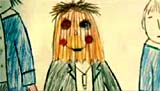 Simon's Drawing of Imaginary Playmate Tomas Wearing a Sack Mask 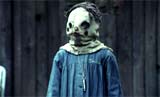 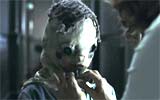 Sack-Faced Boy - Not Tomas - But Laura's Son Simon! 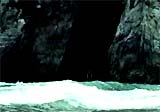 Ocean Cave Where Benigna's Son Tomas Was Drowned 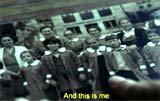 "And this is me." 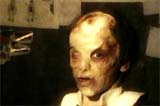 Deformed Tomas 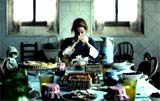 Laura's Search for Simon  Discovery of the Closet Under Stairs   "This is a fantasy, my darling."  Laura's Fantasy After Overdose Death  Carlos Smiling |
|||||||||||||||
|
The Others (2001)
This spooky, atmospheric and dramatic supernatural horror tale, by director Alejandro Amenábar, was set at the end of WWII. It was similar in plot to Henry James' 1898 Gothic ghost story The Turn of the Screw, and also similar in its plot twist to The Sixth Sense (1999). Its most used tagline was:
Another tagline gave away the plot twist: "Sometimes the world of the living gets mixed up with the world of the dead." It told about a family in the mid-1940s who moved into a spooky gothic English mansion, and began to suspect it was haunted by ghosts - and it was! The family included:
Grace was awaiting the return of her husband Charles (Christopher Eccleston) from the war in France, a year and a half earlier. She began to suspect that their rambling, gothic house in Jersey (in the UK) was haunted when they heard odd sounds and thought there were intruders. The arrival of three new servants, after the previous ones vanished into thin air a week earlier (without collecting their wages) added to the mystery:
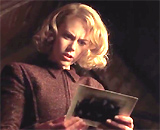
She stressed to the new hires that the curtains had to remain closed (to protect her "photosensitive" children from reacting by breaking out in sores, suffocating, and dying!), and she was concerned about doors: "No door must be opened without the previous one being closed first." She also stated: "Silence is something that we prize very highly in this house. So we have no telephone, radio or anything that makes a racket. We don't have electricity either." Another strange comment made was that the servants said that they used to work there, a few years earlier. The two young children discovered that the graves outside were of the three servants that were now newly employed (who arrived without a want ad, since Grace's letter to be mailed to the newspaper was still in the mailbox). The eerieness was intensified when their death (or mourning) portrait daguerreotype dated 1891 was discovered by Grace. During a scary moment, Grace confronted a decrepit old woman with a veil over her head, who had the voice of a little girl:
Grace attacked the figure and attempted to strangle it, while screaming out: "You're not my daughter" - although the figure when unveiled was her daughter. The film's title was part of the double plot twist - "The Others" - referred to the Marlish family (the parents, a boy named Victor, and an older woman) who had moved into the mansion. They were considered "intruders" by Grace.
|
 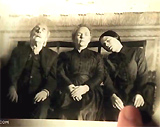 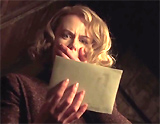 An 1891 Daguerreotype of The Three "Ghostly" Servants 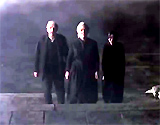 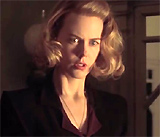 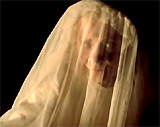 Old Woman With Veil: "I Am Your Daughter" 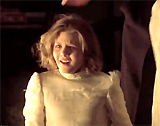 Unveiled 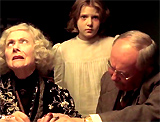 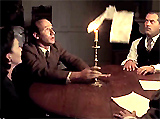 The Marlish Family Seance - They Were "The Others" |
|||||||||||||||





 Michael's
Second Wife Sandra Was Actually His Own Daughter; He Was Double-Double
Crossed by Business Partner "Uncle Bob" LaSalle
Michael's
Second Wife Sandra Was Actually His Own Daughter; He Was Double-Double
Crossed by Business Partner "Uncle Bob" LaSalle