|

|
|
||||||
|
The Bird with the Crystal Plumage (1970, It.) (aka L'Uccello Dalle Piume di Cristallo)
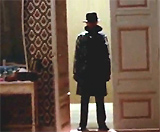
This Dario Argento murder mystery (his directorial debut) with many red herrings and a twist ending revealed that the opening scene (with POV shots from the victim's perspective) was misleading and open to misinterpretation. An American writer in Rome named Sam Dalmas (Tony Musante), living with his model girlfriend Giulia (Suzy Kendall), witnessed what he thought was a murder attempt on a female by a sinister individual in a dark raincoat and black leather gloves. As Sam watched, he was powerless when trapped between a double set of glass doors adjacent to the scene of the crime - an art gallery. The suspected assailant fled, leaving the woman clutching her bloody flesh wounds, and reaching out to him. It appeared like an attempted murder by an unidentified assailant of Monica Ranieri (Eva Renzi), the beautiful wife of art gallery owner Alberto Ranieri (Umberto Raho). Sam became obsessed with helping to investigate the ongoing crime. He visited an art gallery shop - where one of the murdered victims had worked just before she was killed. The same day as her murder, she had sold a "strange...macabre" painting of a stark snowy landscape with a dark-clothed assailant murdering a young girl. [Note: Later, it was shown that the painting had been purchased by the killer, and was hanging in the murderer's home.] Another female victim (Rosita Torosh), the 4th, was assaulted with a knife by the black-clothed killer in her own bed. Her thin negligee was slit open, her panties were ripped off, and then she was stabbed to death.
And then, both Sam and Giulia began to receive threatening phone calls, and both came under physical attack. During a struggle between Monica and Alberto, with a knife between them, the authorities heard her screams near Rome's zoo (where a rare bird with crystal plumage was caged), and entered their locked 6th floor apartment. When efforts were made to restrain Alberto, he was knocked backward from the balcony, and after dangling there for a minute, fell to his death six stories down onto the sidewalk below. As he lay dying, he confessed to the murders to turn suspicion away from his wife ("It's true, I am the murderer, I killed all of them. Please take care of my wife. She tried to stop me. I love her"). It was revealed that Alberto knew of his wife's murderous tendencies, and tried to cover up for her, and even appeared as the murderer himself. In the shocking and suspenseful twist ending in the film's final minutes, Sam found his friend Garullo (Gildo Di Marco) stabbed to death in the back, while his girlfriend Giulia in the same room was gagged and bound (with her arms behind her back). And then the assailant stepped from the shadows. It was Monica who revealed herself as the deranged, cackling serial killer with black gloves and a trenchcoat. Sam realized that he had misinterpreted the earlier attempt on Monica's life in the art gallery:
He pursued Monica back into the art gallery. There, as he was pinned to the floor by a large and heavy sculpture that she had released onto him, the knife-wielding Monica threatened to kill him. She teased him with her weapon ("Now, you're going to die!"). She was prevented from stabbing Sam as she raised her blade, and he was rescued from certain death by the authorities. As it was explained by a well-known psychiatrist, Professor Rinaldi (Giovanni Di Benedetto), Monica was now "hopelessly insane" and "unbalanced" and had been taken to a psychiatric hospital. What was her motivation for the murders? Already possessing "paranoid tendencies," Monica had been brutally attacked (sexually?) ten years earlier and had "suffered severe trauma." Her severe "mental disturbance" remained dormant for ten years, and she lived a normal life, until the day she came across the snowy landscape painting which depicted the horrible scene in which she had been the protagonist. Her latent violence then came to life:
Monica had become insanely jealous of pretty women - and then went on her murder spree, aided and abetted by her equally-psychotic husband. Sam and Giulia returned on a jet to the US, recalling how they were promised that Italy was "a peaceful country - nothing ever happens there." |
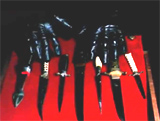 The Black-Gloved Killer's Collection of Knives 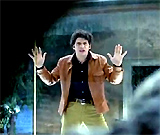 Sam Witnessing an Attack 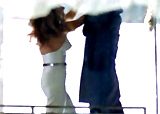 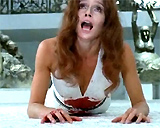 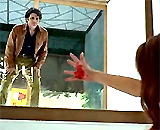 The Opening Assault in the Art Gallery 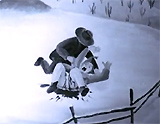 A Key Clue: The Painting 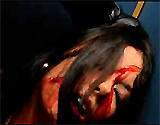 5th Victim Tina (Karen Valenti) With a Straight-Edged Razor 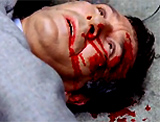 Death of Alberto and His Confession: "I am the Murderer"  Giulia (Suzy Kendall) Bound and Gagged  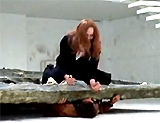 The Killer Monica Revealing Herself and Teasingly Threatening Sam Under a Heavy Sculpture |
||||
|
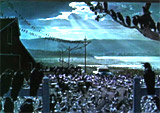
In Hitchcock's unsettling film about unexplained attacks by birds on the inhabitants of a California coastal town, dawn had arrived and Mitch (Rod Taylor) went outside his house where he found thousands of birds gathered and seated - surrounding, watching and tyrannically claiming the house. After everyone was able to get to the car, the beleaguered survivors drove away from the house toward an uncertain future, surrounded on the left by the barn, in the foreground by threatening birds amassing for their next attack, and on the right by a tree. The triumphant, menacing birds appeared to chatter and applaud their conquest; the unsettling, apocalyptic ending - an open-ended one of continuing terror - was not accompanied by a customary "THE END" title. |
|
||||

|
Bitter Moon (1992, Fr./UK/US)
This ultra-kinky, voyeuristic drama/thriller from Roman Polanski, rated R for its "depiction of a perverse sexual relationship," was set on a Mediterranean ocean liner on the Black Sea bound for Istanbul (and ultimately India). It told about the sado-masochistic, increasingly-torturous and passionate affair between:
On the cruise, Mimi and Oscar became acquainted with a British couple:
As the film progressed, mostly through flashbacks and narration to expose the complete extent of the twisted, corrupt and degraded relationship between Oscar and Mimi, Oscar conversed with Nigel and made him his "listener" - telling him the contents of his third great novel. It was revealed that Mimi had found revenge against the embittered, self-loathing, paralyzed and dependent Oscar (after a Parisian amour fou affair that had disintegrated into kinky sex, torture, heartlessness, infidelity and abuse). During a period of two years after Mimi had been abandoned on a plane to Martinique, Oscar resorted to partying and had drunkenly stepped in front of a vehicle (expecting to go on an orgy with two party girls) and fractured his femur. Mimi suddenly reappeared in his hospital room and vengefully paralyzed Oscar from the waist down by dumping him from his bed - causing him to become a permanent paraplegic, so that she could become his devotedly permanent caretaker/nurse. Turning the tables on him, she began to humiliate, torture and dominate him - keeping him mostly in solitary, and using dirty needles for his medication. Later, she presented Oscar with a birthday present of a gun, singing Happy Birthday to him with one candle. [The gun would later figure in the tragic conclusion.] He thoroughly despised himself: "I hate myself worse than you could ever hate me," but she cruelly countered: "No one could hate you more than I do." Although they were married, she proved her hatred by flirting with both Nigel and Fiona during a drunken New Years dance party on the ship. Previously-repressed Fiona ("I'm feeling dangerous tonight") and exhibitionist Mimi performed a sexy dance and passionate lesbian kiss in front of a crowd - and a crestfallen Nigel. That night, Nigel found the two ladies in a naked embrace in Mimi's cabin, where Oscar had voyeuristically observed them: "Two nymphs sleeping off their amatory exertions. You really missed something, Nigel. Fiona was a revelation. All fire. I doubt if you've ever really made the most of her." In the surprise ending, the distressed Oscar shot Mimi in the back as she slept next to Fiona, and then suicidally blew off the back of his own head by placing the gun in his mouth, after remarking to Mimi: "We were just too greedy, baby. That was all." The film ended with stretchers carrying their two bodies off the ship, as Fiona and Nigel sobbed during an embrace on the ship's deck, under a clouded moon. |
 Mimi (Emmanuelle Seigner) 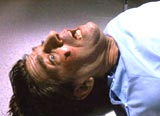 Mimi's Vengeful Paralysis of Oscar (Peter Coyote) 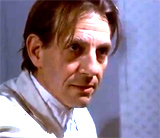 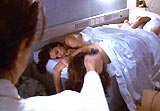 The Murder of Mimi  Fiona Cringing After Mimi's Killing   Oscar's Double-Murder  Fiona With Nigel on Ship-Deck |
||||

|
Black Christmas (1974) (aka Silent Night, Evil Night)
This Canadian, low-budget exploitative cult horror/slasher film from director Bob Clark had the tagline:
It was remade as the flawed Black Christmas (2006) (aka Black X-Mas) with Andrea Martin in the role of Mrs. MacHenry! It told about four residents of Pi Kappa Sig sorority house in Bedford during the Christmas break:
They began to receive strange, threatening, creepy and sometimes obscene phone calls around Christmas time, calling them "Pigs" and warning: "Let me lick your pretty pink c--t." These calls were followed by slayings - presumably from a Killer hiding out in the attic ("It's me, Billy"). There was also a missing person report in the neighborhood - a 13 year-old girl named Janice Quaife, who had suddenly disappeared while on her way home from school (and her body was soon found in the park). There were a number of murders in the sorority house in rapid succession:
Many years before the film When a Stranger Calls (1979), this film offered the premise that the caller was inside the house ("The caller is in the house. The calls are coming from the house. Jess, Jess - GET OUT! And don't go up there!"). The final girl Jess was confronted and pursued by the Killer (and by Peter) through the house and into the basement - where she bludgeoned her boyfriend Peter with a fireplace poker, suspecting that he was the murderer (the film's 'red herring'). With Jess sedated for a number of hours (and unable to be questioned), the police had to wait for the forensic lab group to further search the house's attic and cellar in about an hour ("Don't touch anything until the state lab guys get here"), but the bodies that had been discovered would be taken to the morgue for autopsies and identification by the coroner. It was presumed that Peter was the killer. Jess was left alone, sleeping in her sorority house room, with only one guard outside the house. The film's final twist was that the killer was still in the attic (where the bodies of Clare and Mrs. Mac were still undiscovered) - the camera panned over to the attic's ladder and trap door, where the killer was heard whispering: "Agnes, its me, Billy!" As the camera slowly panned away from the outside of the house, the phone in the house began to continuously ring during the final credits - a signal that another murder was about to take place! |
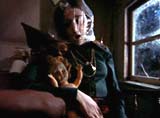 Clare's (Lynne Griffin) Suffocation Death in Attic  Death of House Mother 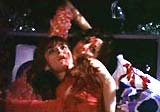 Stabbing Death of Barb 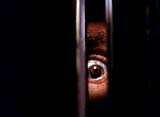 The Spying Eye of Jess' Boyfriend Peter (Keir Dullea): "Agnes, its me, Billy! Don't tell what we did!" 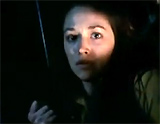 Jess (Olivia Hussey) Terrorized in Basement by Peter 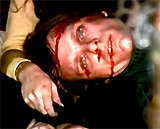 Peter Bludgeoned to Death by Jess 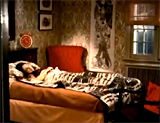 Jess Sedated in Her Bedroom 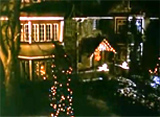 The Last Image: Outside of House |
||||

|
Black Swan (2010)
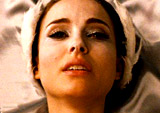
In Darren Aronofsky's great psychological thriller, Natalie Portman won the Best Actress Oscar for her portrayal of damaged, fragile, severely repressed and sadomasochistic ballerina dancer Nina Sayers. Nina was competing for the role of the Swan Queen in an upcoming NYC Lincoln Center performance of Tchaikovsky's Swan Lake. The former prima ballerina and director's lover, Beth Macintyre (Winona Ryder), was forced out and to be replaced with someone younger, after auditions. The troubled but flawless Nina had secured the role of the virginal and pure White Swan (Odette), but was uncertain that she could also adequately perform as the seductive, visceral and dark Black Swan (Odile). Slowly, she underwent a mental breakdown as she began hallucinating, suffering at the hands of her smothering, infantilizing, overbearing and resentful stage mother Erica (Barbara Hershey), an ex-ballerina herself who resented giving up her career for her daughter. They lived together in a claustrophobic apartment they shared on the Upper West Side. She found a free-spirited, sexually-confident rival in tattooed, sexy SF dancer Lily (Mila Kunis), her understudy. There were many signs that the unhinged and agonized dancer didn't know the difference between reality and her imagined world:
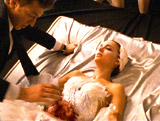
In her climactic delusional performance as the Black Swan (which she morphed into), she took masochistic self-destruction to the limit, stabbing herself in the abdomen with a mirror shard (although she imagined herself murdering Lily in a blood-soaked gory scene in her dressing room), and dying in the swan song finale as the White Swan - falling backwards onto a mattress at the rear of the stage. She admitted that she had ultimately found freedom when other cast members and Thomas surrounded her and congratulated her ("My little princess. I always knew you had it in you") - although they noticed the growing blood stain on her white costume. She had attained or fulfilled her tormenting goal of bloodying her innocence, of being perfect, as she affirmed in the film's final line:
The audience chanted her name as the bright lights of the stage obliterated her view - she appeared to die. |
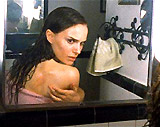  Nina Sayers (Natalie Portman) 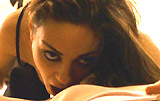 Bi-Sexual Love Scene With Lily (Mila Kunis) 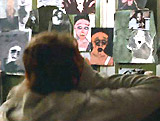 Munch-like Paintings 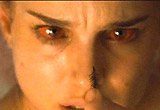 Craziness and Mental Breakdown 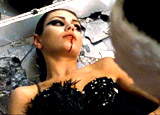 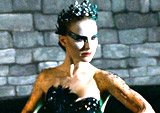 Black Swan |
||||
|
This classic science-fiction thriller by director Ridley Scott was set in Los Angeles in the year 2019. Its noted 1992 Director's Cut re-release strongly implied that replicant-hunting "bladerunner" cop Rick Deckard (Harrison Ford) was also a replicant (artificial or cloned human), with implanted memories of his own, demonstrated by the celebrated "unicorn reverie" daydream. At the film's conclusion, fellow cop Gaff (Edward James Olmos) apparently knew of the implanted memories and pre-programmed short lifespan of replicants when he left a silver, tin-foil origami of a unicorn outside Deckard's apartment. It was one of Gaff's sculptured, calling-card creations. Its unique shiny, silvery color was different from all the other origami creations. He had spared replicant Rachael's (Sean Young) life when he had the chance to kill her. The sinister Gaff had seemingly acquired empathy and let Rachael live - after all, she only had a short time to live anyway with her reduced lifespan. He had often reminded Deckard that he must kill Rachael. Gaff's words about her short time to live were recalled to Deckard (as he held up the origami creation):
Deckard joined love interest Rachael in the elevator as they left to escape the law into an uninhabited wilderness. In a tacked-on ending found in the 1982 theatrical version, Deckard and Rachael left the city and were driving in a police spinner through an uninhabited wilderness, although they appeared to be soaring through clear blue skies. A final voice-over narration explained that Rachael was a special replicant without a pre-set or fixed termination date:
|
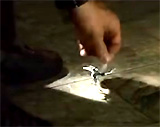 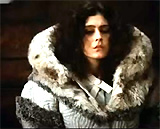 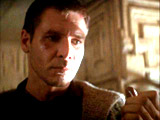 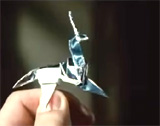 Deckard and The Tin-Foil Origami Unicorn Found Outside Deckard's Apartment as He Fled with Rachael |
||||

|
The Blair Witch Project (1999)
This coarsely-made, low-budget fake documentary and mystery horror film was about an urban legend (the Blair Witch). It told about three young documentary filmmakers in October of 1994 who disappeared in the woods near Burkittsville, Maryland:
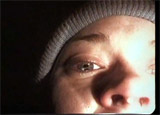
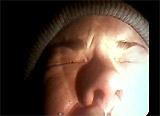
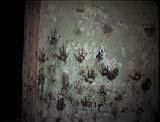
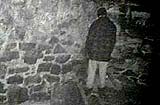
A year later, their videotaped "found footage" was discovered in the woods, and compiled into the movie. Heather delivered a close-up, desperate, teary-eyed, video-taped confessional goodbye to her family and friends (fellow students Mike and Josh) in the dark Maryland backwoods, with snot dripping from her nostrils. Her face was lit by her flashlight shining from the side. She was now feeling totally vulnerable and in danger. The closing scene involved a chase in the darkened woods by Heather and Michael for their missing friend Josh. They had found bits of his teeth and hair in fragments of Josh's blood-soaked shirt outside their tent. In the final scene, they entered the seemingly-abandoned Parr house, past kiddie-handprints on the wall (the Blair Witch myth told about children killed many years earlier), and then split up. It appeared that someone was screaming from the cellar. Mike got there first. When Heather (amidst screams and jerky hand-held camera shots) also approached, she saw Mike, in a final ambiguous shot, standing motionless and facing a wall in a corner of the basement. Was he drugged, semi-conscious, or propped up dead, in order to distract the next victim? The film's final POV shot was accompanied by the sounds of "thwack", "thump", and "crash" as Heather's camcorder hit the ground (after she was attacked and killed?). The camera was broken, but was still running -- before the end credits appeared. |
|
||||

|
Blink (1994)
Director Michael Apted's formulaic, neo-noirish crime-mystery stalker thriller was similar to Wait Until Dark (1967) and the subsequent The Eye (2008). Its tagline was: "In the blink of an eye, things are not what they seem." The main protagonist was an attractive female who was afflicted with blindness:
Her sight was damaged 20 years earlier when as an 8 year-old child (Heather Schwartz), her crazed mother (Marilyn Dodds Frank) smashed her head into a mirror, calling her a "little whore" because she was putting on make-up. A key component of the film was that her sight was slowly being restored after a corneal transplant operation. But she still experienced problems with her sight from an exasperating phenomenon known as "perceptual delay." Sometimes, she didn't "remember" what she had seen until later:
She became involved as a 'witness' to a murder six weeks after her operation. At 3:48 am, she heard noises upstairs from her victimized apartment neighbor Valerie Wheaton (Joy Gregory). After the commotion, she saw a shadowy figure descending the stairs. It was learned two days afterwards that Valerie had been strangled, then raped and had her wrists slashed (postmortem) to drain her blood, and was left in her bathtub with a Russian cross necklace. There was a second similar murder of Nina Getz with the same circumstances. Emma reported the incident to smart-mouthed, skeptical and cocky Chicago Detective John Hallstrom (Aidan Quinn), who was assigned to investigate. Sarcastically, she told him that she "saw" a mysterious and shadowy man descending the stairs. She sensed his strong soapy and sweaty smell and remembered his voice, when he had whispered to her:
It would be the next morning until what she saw, the killer's face, was registered - but with other odd flashbacks, it was unclear what her blurred visions or sightings actually were. During the case, Hallstrom's dirty-minded buddies at the police station kept teasing him about his romantic interest in his pretty witness, as he pieced together clues with her, and eventually became her lover in the predictable romantic sub-plot. While the killer appeared to stalk the semi-defenseless but feisty Emma - the case's dubious but "key" witness, Hallstrom was temporarily sidetracked by more victims. A third victim was Margaret Tattersall (Lucy Childs), discovered in Milwaukee, and a fourth in Indiana. Meanwhile, the killer targeted Emma, drawing two eyes on her closet's mirror in her apartment, and then pursued her on an El train (although it turned out to be one of the detectives). Red herrings were proposed to throw the viewer off. When Emma realized the killer's hands were washed with surgical soap to get rid of the blood, it was hinted that Emma's eye doctor, Dr. Pierce (Peter Friedman), a spurned paramour, was the killer. The film concluded with an out-of-left-field premise -- that one of the victims of the insane serial killer, neighbor Valerie, was murdered erroneously, due to a mistake on Emma's hospital admissions file, read by the killer - who was an employee at the Illinois Masonic Medical Center where Emma had her operation. Emma's apartment address was misinterpreted as being on the 3rd floor (# 3B) rather than the second floor (# 2B):
The killer's victims, all except Valerie, were people who had received donated organs from deceased donor Leslie Davison - a girl the killer had been obsessed with. Leslie had been a nurse at the hospital where the killer also worked. Her four donations for the four victims were:
The wrists of all the victims were slashed post-mortem, to drain the body of blood so that the organs of the donors (in each of the cases) would be useless: "Blood loss speeds the decay of the organs. The result is, they can't be passed on again." To add complexity, according to Dr. Pierce, the 'mother' of Leslie Davison was threatening to sue, objecting to having her daughter's organs harvested. Accompanied by Officer Crowe (Matt Roth), Emma was driven to speak to 'Mrs. Davison' to convince her that the transplant was a life-changing event - unknowingly arriving at the address of the killer (who had impersonated the Davison's lawyer on the phone to Dr. Pierce). When Emma knocked on the door, no one answered. As she ran across the street to a garage where the squad car was parked, she looked in the driver's seat, where she saw someone else - Neal Booker (Paul Dillon), a quiet and unassuming orderly at the hospital. Crowe's throat had been slit as he sat in his patrol car. Emma was assaulted by the delusional murderer in the garage across the street from his home, and stood face-to-face with him. At first, he thought she was Leslie: "Your eyes are different, Leslie...They're not the right color...I've been looking for you. In all of them, I saw them carrying pieces of you away." He urged her to put on a Russian cross necklace he dangled before her. And then when she broke away, he realized: "You're not Leslie, you're one of them. You killed her to give you life. Like that fat sow who had her heart, her little beating heart and all that..." She fired Crowe's weapon at him. He threatened: "I'm closer than you think. I could be right beside you, and you wouldn't even know. I'm coming." Although Detective Hallstrom arrived with sirens blaring, he and other officers went to search in the house across the street. As the killer came closer and terrorized Emma with: "I'm taking back the eyes you stole" - her vision cleared and she shot him point-blank. Afterwards, outside the police department office, she was happily reunited with Detective Hallstrom, who offered to take her to breakfast. |
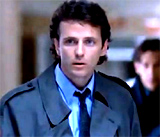 Chicago Detective John Hallstrom (Aidan Quinn) 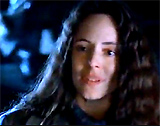 Emma Brody (Madeleine Stowe) 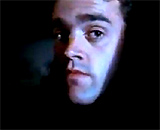 The Killer in the Driver's Seat of Cop Car 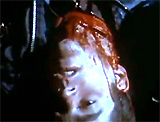 Officer Crowe With Slashed Throat 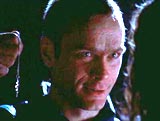 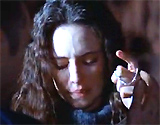 The Necklace 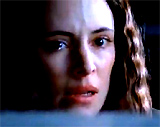 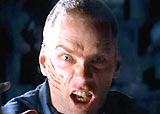 Neal Booker Threatening: "I'm taking back the eyes you stole" 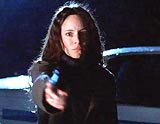 Emma Shooting Booker Point-Blank 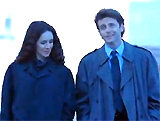 Reunited With Det. Hallstrom |
||||





 The
Killer Was Monica, Who In The Opening Scene Was Attempting to Kill
Her Husband Alberto
The
Killer Was Monica, Who In The Opening Scene Was Attempting to Kill
Her Husband Alberto