|

|
|
|||||||||||||||||||||||
|
Blown Away (1993)
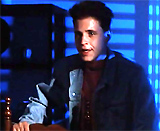
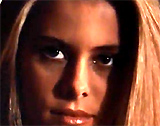
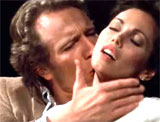
This erotic thriller and dramatic action-romance was advertised with the tagline: "She'll charm you. Seduce you. She might even kill you." The femme fatale was blonde, wild-living, pill-popping rich 17 year-old teenager Megan Bower (Nicole Eggert), who eventually romanced two brothers with long-standing sibling rivalry - and deadly consequences:
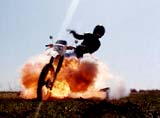
In the film's opening scene a year earlier, Megan's mother had been mysteriously 'blown away' by a ticking car bomb planted under her gas tank that exploded and sent her car into a gas station causing another explosive fireball. A year later, the conniving sexpot was plotting, during a torrid affair with Rich, to have him help her further her own ends - to kill her tyrannical, overprotective father Cy (Jean Le Clerc) and acquire the family's inheritance. Megan's father died when an explosive time bomb secretly planted in his motorbike's gas tank exploded near a cliffside and resulted in a fall to his death. Afterwards, she told Rich:
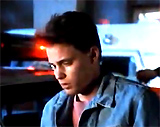
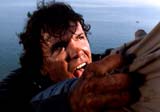
Rich was skeptical and wondered whether he should turn her in to the authorities: "Sooner or later, they're gonna figure out that it wasn't an electrical problem." He was placed in jail, where Megan visited him and assured him of her love: "I want to feel you inside of me right now." She suggested that he become a fugitive and she would join him later with the money. She then provided bail money for him, gave him the keys to her pink Targa Porsche sports car (with Colorado plates: GOTCHA), and told him to meet her at her house where she had made "all the arrangements." Although he was wary of her and looked for another car bomb, he didn't find any, until his car spun out and he spotted the detonator with only 4 seconds to spare - enough to save his life. It was then revealed that Wes was in cahoots with Megan and was also sleeping with her, sarcastically calling her "a lying, murdering bitch" - he had helped her in the double cross to kill his brother with the car bomb ("I can't believe we got away with it"). As Wes and Megan made love, the camera panned to the right to disclose that Rich had silently entered the bedroom and was watching them from the side, commenting: "Wes and his amazing penis."
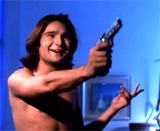
When Wes stood up and went to pull the trigger on his brother Rich (telling him: "You will never know how much I hate you"), he was shot in the back by Megan and killed. Megan rationalized to Rich that it was all Wes' fault: "Rich, he was gonna kill you. Rich, he's the one that beat me. He killed Darla...All this was his idea. He was making me do it. Do you still love me?...Come on, Rich, we can still do this. I mean, we could have everything." But Rich knew better about her true nature: "It was all you." When Megan admitted: "I really did love you," she began shooting at Rich with a gun in each hand. A number of state police (tipped off by Rich after the failed attempt on his life) entered her bedroom, blasted her with a shotgun and other weapons, and propelled her out of the second-story window to her death on the pavement below. As the film concluded, Rich handed back a concealed wire to the chief of police ("Here's your f--kin' wire"). Outside next to a police car, Rich thought about Megan and grieved over the loss of life.
|
  Death of Megan's Father 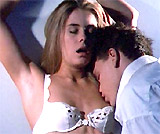 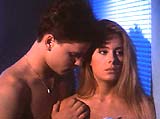 Megan's Torrid Affair With Rich (Corey Haim) 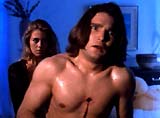 Wes Shot in the Back by Megan 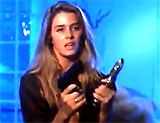 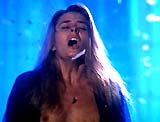 Megan Killed by Shotgun and Other Blasts  Megan's Body on Pavement  Rich Returning His Concealed Wire |
|||||||||||||||||||||
|
Blow Out (1981)
This dark and twisty Brian De Palma (writer and director) political thriller was a Hitchcockian-type film that paid homage to both Blow-Up (1966) and Coppola's The Conversation (1974). Its riveting themes were audio voyeurism, political dirty tricks, and corruption (with illusions to Watergate, the JFK Zapruder film, and the Chappaquiddick scandal). The Reagan-esque era film opened with a 'film within a film' - the shooting of Co-ed Frenzy - a cheap, low-budget exploitation film (set in a sorority house filled with scantily-clad females) where a killer (from his POV as in Halloween (1978)) stalked and slashed a nude female (Missy Cleveland, April 1979 Playboy Playmate) in a shower. [Note: It was a scene reminiscent of the early 1980s film Friday the 13th (1980) when other imitation slasher films were being spawned.] Jack Terri (John Travolta), a sound F/X recorder-technician working on the low-budget exploitation film in the "Personal Effects" department, laughed and rated the undubbed death scream: "That scream is terrible." His director-producer Sam (Peter Boyden) asked: "What cat did you strangle to get that??" Jack replied: "That's her voice"; Jack was informed: "Look Jack, I didn't hire that girl for her scream. I hired that girl for her tits"; Jack considered the picture their "finest film" together, but was asked to replace the weak cry from the naked coed's lips, and also to find new wind sound effects. In fact, Jack took his sound-effects job seriously at Independence Pictures Inc. in Philadelphia where he had worked for two years - and was interested in capturing truth and reality in his recordings (weather effects, footsteps, heartbeats, clocks, glass breaks, gunshots, a body fall, etc.). While Jack was recording outdoor sound-effects later that night with a directional baton-like microphone (and a portable reel-to-reel device), he witnessed a fatal car crash when a car's tire popped and screeched, and the vehicle plunged off a deserted Philadelphia road into a river. Jack dived in, swam down and rescued the driver's companion, later identified as a ditzy yet good-hearted blonde named Sally Bedina (Nancy Allen, director DePalma's real-life wife), but it was fatal for the driver who had drowned. At the hospital, Jack reported to disbelieving Detective Mackey (John Aquino) that he had first heard a "bang" before the tire blow out ("the bang was before the blow out"). Then, he learned that the deceased was notable Governor George McRyan (John Hoffmeister), a hopeful presidential candidate who, the evening of his death, had announced his entrance into the primary election. Officials wanted to entirely hush the embarrassing fact that the Governor was with a female "playmate" companion, although Jack stressed that what he saw was "the truth" and he didn't want to lie about it. But Jack went along with the deception and cover-up proposed by the governor's assistant Lawrence Henry (John McMartin) -- until he had second thoughts after listening to his recorded sounds tape, in a participatory scene. He realized that he had inadvertently recorded evidence of an assassination ("I think your tire was shot out"). Jack believed that the governor's left car tire was shot before the tire blew, causing the accident (he hypothesized there was a gunman in the bushes, where a puff of smoke was seen). He became more suspicious when a photographer named Manny Karp (Dennis Franz) sold his "exclusive" series of still pictures (taken from his motion picture camera film) of the McRyan's accident to the press - appearing in a News Today article entitled "McRyan's Tragic Blow Out." His faith in the authenticity of his film craft was reawakened. In his past (seen through flashback), the principled Jack had helped crack down on police corruption until one of his concealed wires short-circuited and caused undercover cop/detective Freddie Corso (Luddy Tramontana) to be found out and murdered during a botched sting. The tools of his F/X trade had failed him, leading to his choice to avoid the truth and make cheap exploitation films with phony sound effects. But now that he found himself caught up in some kind of political corruption, he convinced the rescued blonde Sally to join him to investigate the suspicious incident. Jack synchronized Karp's series of photographs with his own audio tape to create a film of the incident. He decisively pinpointed the moment of the gunshot - seen as a flash in the bushes. He hid the incriminating film in a ceiling panel in his office, believing it was evidence of a major political conspiracy. He then reported his findings to Detective Mackey, who was mostly uninterested, reflecting the times' political apathy: "Nobody wants to know. Nobody cares." Meanwhile, there were other interesting revelations:
The film's climactic, violent pursuit scene occurred during a surreal Liberty Day Jubilee 1981 centennial celebration in Philadelphia with red-white-blue-fireworks and a parade down Market Street; to cover all the bases, Jack had 'wired' Sally and vowed to her: "Nobody's gonna f--k me this time." She would be recorded as she met with Donahue to give him the tape and film. However, as Jack listened, he realized that Sally was speaking to Burke, who had intercepted her and was impersonating Donahue. After a car pursuit and frantic chase after Burke, across Philadelphia in his Jeep during the crowded festivities, Jack crashed and was injured. He didn't reach Sally in time before she was killed by strangulation, on the top of the Port of History building. Jack killed Burke by stabbing him with his ice-pick weapon, and was stunned to realize that Sally's lifeless body meant that she was truly dead.
Ironically, Sally's recorded scream - haunting and sad - and intensely realistic, was used for the re-edited soundtrack of the shower scene in the cheap, exploitational slasher film seen in the film's opening (Producer Sam: "Now that's a scream!"). Jack muttered to himself: "It's a good scream," but he held his ears to drown out the sound. |
 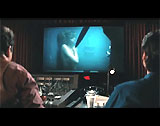 Cheap, Low-Budget "Film-Within-A-Film": Co-ed Frenzy 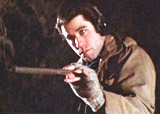 Sound Effects Technician Jack Terri (John Travolta) 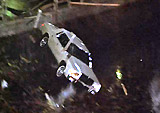 Governor's Fatal Car Crash  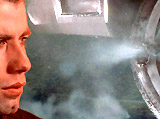 Jack Listening to Tire Shooting and Blow-Out 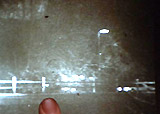 Gunman in Bushes 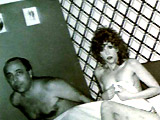 One of Pimp/Photographer Karp's Incriminating Photos by of Sally (Nancy Allen) To Incriminate Cheating Husbands 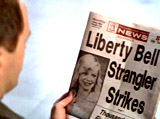 Burke: The Liberty Bell Strangler 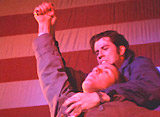  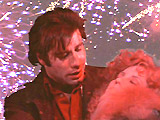 Murder of Sally by "Strangler" |
|||||||||||||||||||||
|
Italian director Michelangelo Antonioni's first English-language film, set in mod 60s London, was a thought-provoking, art-house masterpiece. Most of all, it was an engaging, provocative murder mystery that examined the existential nature of reality through photography. It quickly became one of the most important films of its decade.
A desensitized-to-life, nihilistic, high-fashion London free-lance photographer Thomas (David Hemmings), who lived a mid-60s life of excess (riches, fame, and women), became bored with his lucrative career of glamour photography. So he resorted to photographing, in documentary style, the seamy and sordid side of life in London, in flophouses and slums. Innocently and voyeuristically, he took candid photos in a deserted park of what he thought was a lover's tryst-rendezvous between a black kerchief-wearing, enigmatic woman (Vanessa Redgrave) and a middle-aged, gray-haired man in a light-gray suit. She pursued him to ask for the illicit photos (she claimed he had invaded her privacy). She persistently begged for the undeveloped roll of film, first in the park. He became both intrigued and suspicious by her demands ("What's the rush?"), and when she stated: "We haven't met. You've never seen me." She ran off - and it appeared that the man she was with had disappeared. He took more photos of her standing next to a bush far in the distance [on close inspection, a body was lying there, although most viewers wouldn't notice it on first viewing]. Later at his studio after following him, she went topless and offered sexual favors. To get her to leave, he gave her a different roll of undeveloped film from his park visit. He enlarged ('blows-up') some of the pictures to poster size, and pinned the magnified photos around his studio's living room. A few of the pictures were enlarged even more - and he imagined in a suspenseful scene that he saw a man and a gun in the shadows of some bushes behind a fence. The photographs were in sequence - giving them life and activity as if they were individual frames in a motion picture. His picture-taking had possibly foiled a potential murder attempt, as the pictures were now revealing more than he originally saw in the park as just a scene of sexual intrigue:
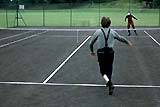
As tension heightened, he then imagined a more riveting possibility - that he may have accidentally recorded and obtained visual, criminal evidence of a murder. He used a magnifying glass to look at more photo detail, revealing what could be a dead body lying prone on the ground in the far distance next to some bushes. He enlarged the photo and studied the grainy blow-up. That night, he returned to the park (he passed by a white neon sign (FOA), a symbolic foreshadowing, in the shape of a gun), to find the gray-haired man's prone corpse next to some bushes at the far end of the park. This was real proof of a murder that he had accidentally recorded as a witness. However, when he returned to his studio, he discovered that all the blown-up pictures and negatives were stolen - except for the extreme blow-up of the body on the ground. But it was too fuzzy to serve as proof of anything. By the next morning, the corpse had disappeared. The evidence was at once more difficult to ignore and more impossible to define. Without photographic evidence produced by his camera-tool - his sole means of communicating with the world, Thomas was left with nothing. As he wandered through the park, he came upon a group of wandering mimes in white-face, playing an invisible game of tennis (without balls or rackets). His attention was directed toward the lengthy charade, and he also suspended his belief in concrete reality to join in. He became directly involved when he tossed an invisible tennis ball back to the two players when it was imagined that the ball was hit out of the court. On the soundtrack, one could now hear the illusion in Thomas' mind - the sound of an actual tennis game. It was another indelible image emphasizing the slim line between objective reality and illusion.
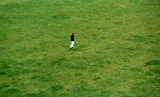
The film ended with an aerial view of Thomas standing at a distance in the middle of a grassy field in the park near the tennis court, with his camera in his hand. He faded from view just before the words THE END zoomed forward. |
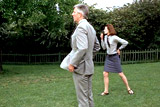 Witnessing and Photographing The Park Rendezvous Tryst 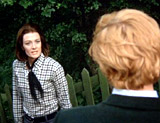 The Woman (Vanessa Redgrave) Demanding the Roll of Film 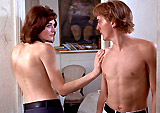 The Woman Desperate to Get the Film From Thomas (David Hemmings) 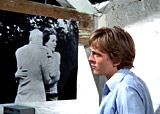 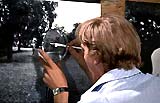 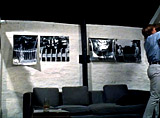 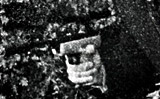 Photos Blown-Up and Possibly Revealing a Murder 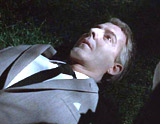 The Body in the Park Found During a Return Nighttime Visit to the Park 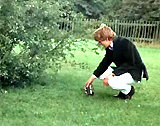 However, the Body Was Missing the Next Day |
|||||||||||||||||||||
|
The Blue Dahlia (1946)
The who-dun-it from a Raymond Chandler screenplay had a different conclusion than the one offered in this hard-boiled Alan Ladd/Veronica Lake noirish crime film regarding the identity of the murderer - the murderer was changed by demands from the military - from a soldier returning from service who was suffering from blackouts, to a less politically-sensitive killer. It was the third of four screen pairings between Alan Ladd and Veronica Lake. Director George Marshall combined various elements to produce a well-made noir, about a hard-nosed GI soldier returning from service who became entangled with a mysterious blonde when they were both faced with unraveling a murder. Its tagline was: "Tamed by a brunette - framed by a blonde - blamed by the cops!" Returning 28 year-old WWII veteran and naval flier Lt. Cmdr. Johnny Morrison (Alan Ladd) was one of three soldiers discharged from service and in Southern California. His buddies included Buzz Wanchek (William Bendix) (with a serious mental health disability) and George Copeland (Hugh Beaumont). Johnny soon discovered that his boozing, unfaithful estranged wife Helen (Doris Dowling) had been promiscuous with LA's The Blue Dahlia nightclub owner Eddie Harwood (Howard Da Silva) during his absence. Trampish Helen was surprised by Johnny's unannounced return to her Wilshire Boulevard Cavendish Court Hotel and Bungalow (# 93), in the midst of a wild house party. When he confronted the couple kissing as Eddie was leaving by the front door, he quipped to Harwood before punching him in the chin:
Clad in a slinky trouser suit and drunk, she seemed unapologetic to Johnny, mentioning to the other guests as she dismissed them: "He probably wants to beat me up." Helen asserted her promiscuous independence from him: ("Don't start preaching. I take all the drinks I like, any time, any place. I go where I want to with anybody I want. I just happen to be that kind of a girl"), and then hinted that Johnny might now be violent after serving in the military when he tried to get her to stop drinking:
She then laughingly admitted to him that their young son Dickie had been killed in a DUI car-crash accident while she was driving - drunk. He had earlier been led to believe that Dickie had died of diptheria: ("I was drunk. I was in a car smash. Dickey was killed. I wrote you he died of diphtheria because I was afraid to tell you the truth"). The news caused him to angrily pull out his gun on her (he hinted: "That's what I oughta do, but you're not worth it"), but then he walked out on her while throwing his gun into an armchair before leaving the bungalow. In the Blue Dahlia club, Harwood was informed that his wife had just separated from him for a few days, presumably because of his on-going affair with Helen (Harwood: "If you think my wife left me because of another woman, it was something else entirely"), and also because of his criminal ties and past. [Note: Much later, Harwood was revealed to be using a fake name. His real name was Bauer - and he was a wanted fugitive-murderer in Passaic, New Jersey fifteen years earlier for killing a bank messenger.] Feeling miffed and rejected, Helen called Harwood and used pressure and blackmail to prevent him from ending their affair: "Supposing I don't want to call it a day? Two walkouts in one evening would be just a little too much for me, Eddie. Ever think of that? And if I don't want to call it a day, I'm quite sure you won't for a very good reason." Meanwhile, Johnny was hitchhiking with his suitcase and picked up in the rain by Harwood's wife, long blonde-haired wife Joyce (Veronica Lake). He hesitated at first but was convinced by her good humor: "Well, you could get wetter if you lay down in the gutter." Remaining anonymous to each other but realizing they were both running away from something, the two strangers shared a drive up the coast to Malibu and beyond, and after parting were not aware until the next morning that they both spent the night at the same beachfront motel, the Royal Beach Inn (in separate rooms). The next morning, a maid found Helen murdered on the sofa in her bungalow, with Johnny's gun on the floor. There came news on the radio in the motel lobby that Helen had been murdered (it wasn't ruled a suicide after autopsy tests), and that Johnny was a prime suspect. He returned by bus back to Los Angeles, took an assumed name (Jimmy Moore) and rented a cheap hotel, while trying to clear his name (with some assistance from Joyce). Meddlesome bungalow motel house detective "Dad" Newell (Will Wright) was questioned by police and testified that he had heard Johnny fighting with Helen, and that he had witnessed Harwood enter her bungalow. Johnny was accused of the crime of Helen's murder, along with other suspects:
In the conclusion, most of the suspects were assembled in the Blue Dahlia nightclub as the police authorities pressured Buzz to confess. But as it turned out, all of the suspects were eliminated one-by-one. The surprise killer was revealed to be disgruntled house detective 'Dad' Newell. He had attempted to blackmail Helen about her affair with Eddie, but when she refused to comply, he killed her. Captain Hendrickson (Tom Powers) questioned him to the breaking point:
When Newell pulled out a gun after incriminating himself, he was startled when a door opened behind him, and he was shot by Hendrickson. The film concluded as Johnny suggested continuing his relationship with Joyce, even though he neglected to tell her that her husband was dead or critically wounded:
|
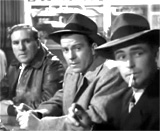 Returning Veterans (l to r): Buzz, George, Johnny 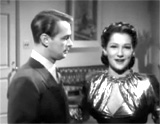 Johnny's Arrival in His Home to Greet His Wife Helen (Doris Dowling) 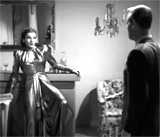 Johnny Threatening Helen with a Gun ("You're not worth it!") 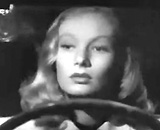 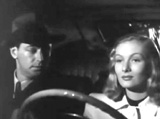 Joyce Harwood (Veronica Lake) - Picking up Hitchhiker Johnny in Rain  Helen - Found Murdered in Bungalow, with Johnny's Gun on Floor 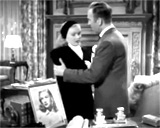 Joyce With Estranged Husband Eddie Harwood 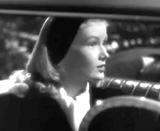 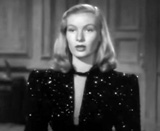 Joyce - She Aided Johnny and Believed He Was Innocent - Before Revealing She Was Eddie's Wife 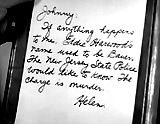 Incriminating Clue About Harwood's Criminal Past, Written by Helen  Buzz Wanchek (William Bendix) - Remembering the Night With Helen When He Ran Off   The Killer: House Detective 'Dad' Newell (Will Wright) - Confessing His Guilt  Johnny and Joyce Finding Each Other |
|||||||||||||||||||||
|
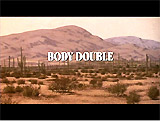
Body Double (1984)
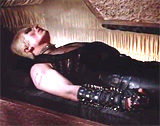
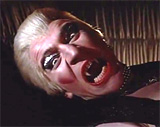
Brian De Palma's sensationalist erotic thriller with a triple-flip ending - paid homage to Alfred Hitchcock's films: Rear Window (1954) (with a voyeuristic theme), Dial M for Murder (1954) (about a husband's plot to murder his wife), and Vertigo (1958) (with scenes of stalking) - it was criticized for being misogynistic and violent; clues were provided in the film's title and in the film's taglines - "You can't believe everything you see," and "A Seduction, A Mystery, A Murder." In the opening title credits sequence - a schlocky, B-movie horror-tinged segment with wolves howling and red blood dripping off names of cast members - the camera panned down into a graveyard's open coffin - during the film's first "film within a film"; struggling, B-movie working LA actor Jake Scully (Craig Wasson) was entombed and reclined inside the open box as an undead vampire; he froze with claustrophobia when he turned toward the camera with a frightful look; the director Rubin (Dennis Franz) became worried: "Action, Jake. Jake! Action. Cut. Look, Jake, what's your problem, huh?...Something's the matter with him. That's all right, Jake, just relax"; he was experiencing trouble in acting roles in vampire films due to his claustrophobia.
The set-up: the hard luck and out-of-work LA actor Jake was fired due to his frequent problems with claustrophobia; he was also emasculated after catching his live-in girlfriend Carol (Barbara Crampton) having sex with another man. But then fortuitously, Jake was 'hired' to house-sit in a Hollywood Hills mansion, arranged by fellow thespian actor 'Sam Bouchard' (Gregg Henry) who claimed he was Seattle-bound. As the current house-sitter, 'Sam' had been looking after the place of his friend Alan (who spent a lot of time in Europe), but needed Jake to take the job for 5 weeks while he was performing in a gig out-of-town; 'Sam' showed off "one very special feature" of the house-sitting job - the auto-erotic, exhibitionist, brunette dancer-neighbor who night-after-night stripped within easy view, and performed a self-pleasuring dance night-after-night. Jake became an obsessed 'peeping tom' as he voyeuristically ogled the beautiful, rich Gloria Revelle (Deborah Shelton), an auto-erotic exhibitionist, in the apartment across the way through a high-powered telescope.
During a lengthy sequence, the infatuated Jake followed after the mysterious Gloria during a cat-and-mouse stalking through an upscale Rodeo Drive (Beverly Hills) mall - while she was also being tailed by a black-hatted, sun-glasses-wearing, menacing creepy Indian who snatched her purse. It appeared to be a simple theft case (the purse-snatching Indian had taken her card key). Jake watched voyeuristically as Gloria tried on a pair of panties in an open-curtained dressing room within a store; the sequence ended with Jake and Gloria kissing on the beach (with obvious back-projection) - using a stunning, Vertigo-like 360 degree revolving camera, until she declared: "I can't do this" - and ran off. Then one night as he was leering into Gloria's apartment, in the film's most infamous, grisly and tense sequence, he witnessed the sexy neighbor murdered by a pony-tailed, disfigured-faced 'Indian' with an erect power drill. [Note: later it was revealed that she was a rich tormented wife who had separated from her abusive husband Alexander Revelle (disguised as the creepy Indian character - and spoiler: later revealed to be 'Sam Bouchard')]; the murder weapons were a phone cord (for strangulation) and a phallic-shaped, erect power drill; during the extended killing, Jake attempted to reach her and save and rescue her, although thwarted by her dog, and he was powerless to stop the killing. Jake began an investigation of his own, and happened to be resting on his revolving bed, drinking Jack Daniels straight from the bottle; he watched late-night adult cable TV, listening to an interview with a porn star named Linda Shaw (Herself) of Linda Shaw Enterprises (known for such X-rated flicks as "The Mating Game," "One Night at a Time" and "Bold Obsession"). He also watched a short promotional clip of bleached-blonde adult film porn queen Holly Body (Melanie Griffith in a breakthrough role) in an X-rated porn shoot titled Holly Does Hollywood ("The Gone With the Wind of Adult Films" according to Eros Magazine; Erotic X Film Guide called it "A Hedonist's Heaven"). Her familiar-looking, self-pleasuring provocative dance in the porno film, in the same manner that Gloria danced, caused Jake to wonder whether Holly might provide a link to Gloria's murder. He immediately rented the video from the "Adult Section" of a local 24 hour video rental store, and watched Holly's full-length performance - confirming that she was the film's suspected "body double." Shortly thereafter, Jake went into undercover mode and entered the business of hardcore X-rated films as a nerdy newcomer, in order to meet Holly. He participated as a nerdy-looking supporting actor in a short music-video scene with her. It was an X-rated 'film within a film' - shot to the tune of "Relax" by British pop band Frankie Goes to Hollywood. During the filming of the actual X-rated raw sex scene music video with her, after Jake had spotted her in a room labeled "Sluts," he spoke his short amount of dialogue to her in his opening ironic line: "I like to watch" - followed by Holly's seduction: ("Makes you hot, doesn't it?...Makes me hot too. Why don't you come over her, and I'll show you how hot"); he became so involved in the scene (he also fantasy-imagined being in the arms of Gloria for a moment, as the camera spun around 360 degrees) when making love to her that the 'money shot' was not visible to the startled cameraman who asked: "Where's the cum shot?..The cum shot. I thought we were doing 'Body Talk' here, not 'Last Tango.'"
Jake expressed a desire to hire Holly to be in his own porn film: ("I want you in my picture"), she asserted upfront, to prevent misunderstandings later on: "I do not do animal acts. I do not do S & M or any variations of that particular bent. No water sports either. I will not shave my pussy, no fist f--king, and absolutely no coming in my face. I get $2,000 a day and I do not work without a contract"; when he asked about a routine of "a woman alone, getting herself off, it's got to be really hot," she claimed that self-pleasuring was her speciality: "I have a routine that is a sure-ten on the peter meter." He was tipped off that the "show" ("masturbation routine") she was referring to was the same 'show' that Gloria had put on in the house nearby; both were performed by Holly: ("That was you in the Revelle house!"); she revealed that she had been paid by Alexander Revelle, Gloria's rich, disgruntled husband, to wear a dark-haired wig and dance in his house, to perform for two nights only, and impersonate his wife Gloria; her revelation would ultimately help him to unravel the conspiracy behind Gloria's murder. Jake was able to have Gloria confirm that "Sam's" voice during a phone conversation was the same as the man who had hired her to perform for two nights. She helped Jake to unravel the conspiracy underlying the murder - learning that it was more than "a little practical joke" but a case of murder instead. Jake's fellow actor 'Sam Bouchard' (alias name for Alexander Revelle) knew that Jake would be watching the sexy neighbor - and ultimately witness Gloria's murder. Jake realized that he had been set-up by 'Sam' to be a convenient witness/alibi to her murder: "He was throwing out a net. He was sizing me up for a part that he was casting...And I fit the bill perfectly: lovesick sucker out on his ass...The part of the witness...Alexander Revelle set me up in this house to witness the murder. And he hired a porno actress to be the bait." In the conclusion set at a nearby reservoir site, the killer-Indian ("Sam") had kidnapped Holly in a Ford Bronco, and was planning on burying her in a large earthen pit. When Jake interrupted and confronted him, they fought inside the burial hole. And as they struggled, the latex face makeup came off, unmasking and revealing the rubber-faced killer-Indian to be a disguised "Sam." Jake became paralyzed with claustrophobic fear after falling into a deep earthen burial pit. As "Sam" threw dirt onto him, he admitted angrily to Jake: "Look what you did. You ruined my surprise ending. I gave you your part: the witness. You were perfect. You played it to a T. But that was it. End of part. Wrap Jake Scully. Oh no, you had to play the hero. Improvise all this crap about finding a body double and unmasking the Indian. But you didn't think it through, did you, Jake? Sometimes heroes come to tragic ends. What's the matter, Jake? A little short of breath? What a terrible way to die. Especially when you're so claustrophobic. Wait a minute, wait a minute. I'll give you another take, Jake. The only problem is, you've got to act. Come on, Jake. Action." To save himself, Jake visualized himself being directed in a vampire horror film role, and fearfully frozen inside a coffin (the same sequence from the film's opening). However, this time he didn't want assistance ("I can help myself"). He begged for an immediate second take ("Let's do it") and overcame his phobia when the director warned him: "You'd better get it right this time." Returning to his predicament at the reservoir, Jake screamed, fought off "Sam" who ended up getting pushed backward (by his charging, snarling dog) to his death into the churning reservoir water below. During the epilogue and end credits, Jake was recast as a full-time actor performing again in a cheap vampire horror film. In the filming of a Psycho-like scene, with Holly watching from the side, Jake was in the shower with the lead movie actress (Denise Loveday) when a 'body double' (for the nudity) named Mindy was substituted for the lead actress. With a heavy accent and while chewing gum, Mindy asked Jake to be careful because her breasts were very tender ("I've got my period"). After fondling her, Jake bit into her neck, causing a cascade of blood down her naked chest. Off-screen, Holly advised the robed lead actress watching the nude double - "You know what? You're gonna get a lot of dates when this comes out." [Note: This was De Palma's answer to his critics for using a 'body double' for Angie Dickinson in the opening of Dressed to Kill (1980).] |
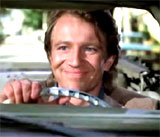 LA actor Jake Scully (Craig Wasson) 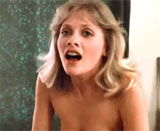 Jake's Cheating Girlfriend Carol (Barbara Crampton) 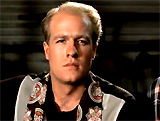 'Sam Bouchard' (Gregg Henry) 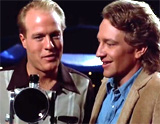 Jack's Invitation by 'Sam' To Voyeuristically Peep 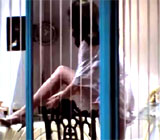 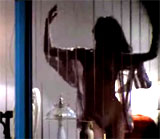 Exhibitionist Neighbor Gloria Revelle (Deborah Shelton) ? 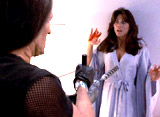  The Phallic-Drill Murder of Gloria by Disguised Killer Indian    Promotional clip of Porn Queen Holly Body in X-rated Holly Does Hollywood  Unmasking a "Disguised" Alexander Revelle (alias 'Sam Bouchard')  'Sam' Speaking to Jake Paralyzed in Deep Earthen Burial Pit 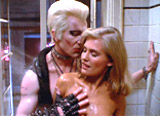 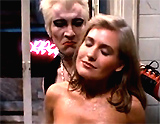 Jake in Shower Scene with Film Actress (Denise Loveday)  Jake in Shower Scene with "Body Double" Mindy  Holly to Actress: "You're gonna get a lot of dates..." |
|||||||||||||||||||||

|
The tagline of this Double Indemnity-like (and Out of the Past (1947)) , neo-noir thriller by director Lawrence Kasdan (his directorial debut film) described the basic setup:
A more detailed tagline outlined the plot:
Seedy, dense-minded, small-town, Miranda Beach, Florida lawyer Ned Racine (William Hurt) was enticed to began a passionate affair, during a sweltering summer, with a married woman. Her name was "Matty Walker" (Kathleen Turner in her film debut) - the unhappy wife of wealthy businessman Edmund Walker (Richard Crenna), who lived in the exclusive Pinehaven area, and was engaged with shady dealings (real estate investments, venture capital). With a pre-nuptial agreement, she was discouraged from seeking a divorce. Edmund's will left everything to his young niece, Heather Kraft (Carola McGuinness), and indirectly to Heather's mother Roz (Lanna Saunders) - Edmund's sister. Although they attempted to keep their affair private, Ned made two crucial mistakes:
"Matty" proposed to Ned that her husband be eliminated, and that Edmund's will could be rewritten ("Every little change would mean a lot for us, Ned. And you're a lawyer. You know how to write it. It wouldn't seem so odd"), but he was reluctant and worried ("We'll get burned"). The night of the planned murder of Edmund, Ned drove to the Walker estate, engaged in a struggle with him, and beat him to death over the head with a wooden plank. He placed the corpse (wrapped in plastic) in his car's trunk, drove to the abandoned Breakers hotel near the beach (one of Edmund's properties), stashed the body there, and detonated a timer-explosive (pre-set by Ned's client Teddy Lewis (Mickey Rourke)) to make it look like a botched arson job that would provide Edmund with insurance money. After the murder, Ned received a call from Edmund's concerned Miami lawyer Miles Hardin (Michael Ryan), explaining that there were problems with Edmund's revised will, submitted (to his surprise) by Ned!:
The revised will equally divided the estate's proceeds between Heather and Mrs. Walker. The document was witnessed by Mary Ann Simpson, the life-long friend of Matty's living in Europe who was visiting when she signed the document, and was now unavailable. The lawyer explained that the poorly-prepared will was written wrongly, violated the rule against perpetuities ("it forbids an inheritance to be passed down indefinitely for generations"), and was therefore invalid. He concluded: "Edmund Walker died intestate, as though there were no will at all." Racine then explained the consequences - that Matty would inherit the entire estate:
Afterwards, "Matty" admitted to Ned that she had stolen some of Ned's stationary, and forged Edmund's revised will - without Ned's knowledge. She told Ned about her past legal experience while working in a lawyer's office in Illinois when she was at a low point in her life: "I learned a lot there. That's where I picked up the business about making a will invalid." "Matty" also claimed she rewrote the will to help both of them, although she had used him: "I'm greedy, like you said. I wanted us to have it all." Ned was forced to falsely admit that he had been involved in rewriting the will with Edmund and Matty, and that Mary Ann had signed it as a witness. During the investigation into Edmund's death by Ned's friends: prosecutor Peter Lowenstein (Ted Danson) and police detective Oscar Grace (J. A. Preston), they were suspicious about a number of things, including:
And then "Matty" called Ned to tell him that Edmund's glasses were in the boathouse on the Walker estate. Her crafty deviousness and evil were revealed when Ned entered the boathouse - he realized she had booby-trapped it (with help from Lewis) to kill him. As she left him to enter the boathouse to look for Edmund's glasses (that she knew were not there!), she vowed her loyalty: "Ned, no matter what you think, I do love you." At the last second, Ned began running toward the boathouse - "No, Matty!" But then an explosive blast detonated. It killed "Matty" Walker (her body was identified by dental records). The duped lover Ned was charged with the murder of "Matty" and imprisoned in a Florida state penitentiary. One night, he awoke with a start, believing that "Matty" was somehow still alive: "She's alive!" Ned suspected that "Matty" had eliminated Mary Ann Simpson, but he had no proof. Ned speculated that there had been a concerted effort to hide "Matty's" identity. And he suspected that she had planted Mary Ann's body in the boathouse before the explosion, and escaped with her own life:
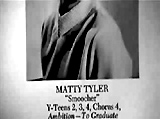
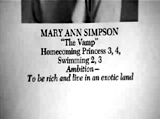
He summarized "Matty's" determined nature: "That was her special gift. She was relentless. Matty was the kind of person who could do what was necessary. Whatever was necessary." Ned sent for "Matty's" Wheaton High School 1968 yearbook in Illinois. In the climactic plot twist, he found conclusive evidence inside that 'Matty' Tyler had swapped identities with Mary Ann Simpson.
Under Mary Ann Simpson's yearbook picture (with 'Matty's' picture), her ambition was described as: "To be rich and live in an exotic land" - a wish that was fulfilled in the last image of "Matty" lying on a beach somewhere in an exotic land. |
  The Torrid Affair Between Ned and "Matty" 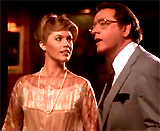 "Matty" With Husband Edmund (Richard Crenna) 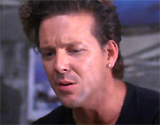 Bomb-Maker Teddy Lewis (Mickey Rourke)  Edmund's Body in Plastic Bag 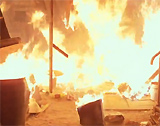 The Breakers' Explosion With Edmund's Body Inside 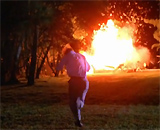 The Boathouse Explosion, Killing "Matty"   Ned in Jail: "She's Alive!" - Explaining the Deception  "Matty" On an Exotic Beach |
|||||||||||||||||||||
|
In the Depression-era Midwest, a small-town girl and a petty bank robber met:
The tagline described their escapades as infamous criminals:
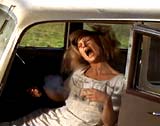
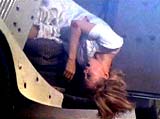
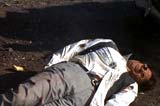
The two became lovers (although Clyde had homosexual tendencies and insecurities), and went on a cross-country spree of violent, small-time stickups and murders. After many crimes and exploits throughout the Southwest, they were chased from state to state by law enforcement officers, and earned the status of romanticized, celebrity folk heroes. They were determinedly followed and stalked by mustachioed Texas Ranger Capt. Frank Hamer (Denver Pyle) - their major nemesis for much of the film. The pair joined up with a dim-witted, back-country, grinning attendant/mechanic named C. W. Moss (Michael J. Pollard), and then were aided by Clyde's older, All-American, hearty, loud-mouthed, ex-con brother Buck (Gene Hackman) and his reluctant, but excitable, hysteria-prone, and flighty wife Blanche (Estelle Parsons). Although their doomed fates were inevitable, it was still a climactic shock when they were both gunned down. They were betrayed by C. W.'s father Ivan (or Malcolm) Moss (Dub Taylor), who alerted police to their whereabouts in order to plan an ambush. Knowing that the couple would be driving by, Moss' father flagged down their car for help while faking a flat tire on his truck by the side of the road. He spoke the last lines of the film: "I've got a flat tire, and I ain't got no spare." The finale was a brutal and tense "ballet of blood" showcasing the ultra-violent deaths of the doomed lovers during a country backroads assault by police. In their final freeze-frame of life, with a silent glance at each other, Bonnie and Clyde revealed both panic and love in their faces. Their frenzied corpses writhed in slow-motion as they were gunned down and riddled with bullets; they were re-animated by gunfire - into involuntary dances of death. They died cinematically-beautiful, abstracted deaths to accentuate the romance of the myths and the larger-than-life legends that surrounded them. Their corpses twitched to life and were re-animated by gunfire - involuntary dances of death. Their last moment of 'life' occurred when Clyde rolled over gently in slow-motion and Bonnie's arm dangled unnaturally and then stopped moving. Bonnie's flowing blonde hair, streaked in sunlight and gently blowing in the breeze, cascaded down in many arcs as she hung out of the car. |
|
|||||||||||||||||||||
|
Boogie Nights (1997)
Writer-director Paul Thomas Anderson's fact-based period film, with the recreated look of the LA adult film-porn industry in the San Fernando Valley in the late 70s and early 80s - it was about the empty search for fame, wealth, and hard-core sex; this was an acclaimed film with three Oscar nominations (Best Supporting Actor and Actress, and Best Original Screenplay); the ensemble film told about the lives of a number of misfits - mostly damaged and lost individuals, including a well-endowed superstud. The main star was a high-school drop-out, a bus-boy/dishwasher, who was transformed into a popular porn star:
After meeting adult film director Jack Horner (Burt Reynolds), the well-endowed Eddie was renamed "Dirk Diggler." There were other subplots about a wide range of characters including:
In the unexpected, surprise conclusion, Dirk (who had resorted to gay hustling and dangerous drug-dealing) was again reconciled with Jack Horner, and returning to work for him after splitting from him following a violent argument over a competitive successor named Johnny Doe (Jonathan Quint). Sitting in front of a mirror, Dirk repeated lines of dialogue to himself (a scene playing homage to Scorsese's Raging Bull (1980)):
Then he stood up and unzipped his pants. He revealed - in an impressive full-frontal screen view - his main (and pathetic) claim to fame: his 13" penis (a prosthetic), as he boasted:
|
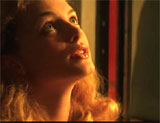 Porn Starlet Rollergirl (Heather Graham) 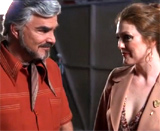 Porn Director Jack Horner (Burt Reynolds) with Star Amber Waves (Julianne Moore) 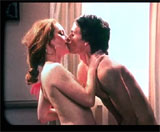 Amber Waves Performing with Dirk Diggler (Mark Wahlberg) in His First Porn Film 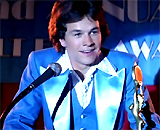 Dirk Accepting Adult Film Award 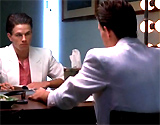  Dirk Diggler's Revelation and Claim to Fame - See Full Reveal in Sex in Films |
|||||||||||||||||||||





 Double-Crossing
Murderess Megan Was Shot to Death
Double-Crossing
Murderess Megan Was Shot to Death