|

|
|
||||||||||||||
|
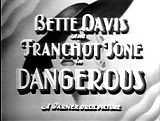
Dangerous (1935)
This soapish melodrama from director Alfred E. Green was notable because Bette Davis won her first Best Actress Academy Award for her role - as a consolation because she wasn't nominated for Of Human Bondage (1934) a year earlier.
The protagonist of the film was alcoholic former Broadway stage actress Joyce Heath who was first seen drinking straight gin in New York's Jerry's Joint. She had vanished from public view and was notorious for her quick downfall and 'jinxed' superstition following after her:
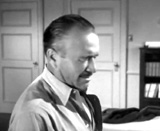
She was found in a drunken stupor by idealistic, aspiring, handsome, aristocratic architect Don Bellows (Franchot Tone), who took her to his Connecticut country house to have her sober up. The next morning, Joyce demanded: "Get me a drink!" She said she'd rather be drunk than sober. When she hinted that he might be proud of his sexual conquest over her, he said the only emotion that she aroused in him was pity. Prideful, she struck back:
He explained the real reason he brought her to his home for a few days - in "gratitude" for her past performances (he claimed he was inspired to leave Wall Street and become an architect). He was resolved to rehabilitate her ("You could go on. Talent like yours doesn't die. You were a star once. You can be again"), although she was doubtful: "You'd better run for your life...Two men who loved me are dead, some financially ruined. Shows have folded." She prophetically claimed she would be a jinx: "Helping Joyce Heath is like shaking hands with the devil. The worst luck in the world." Even his housekeeper Mrs. Williams (Alison Skipworth) warned him of Joyce's curse:
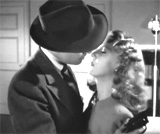
Later that evening, he kissed the fascinatingly-seductive Joyce during a long nighttime cloudburst as lightning struck (the screen faded to black after their clinch). But then the next morning over breakfast, Don admitted that he was engaged to wealthy fiancee Gail Armitage (Margaret Lindsay), and claimed he had impulsively lost his senses with her. He asked for her forgiveness, then wondered if he had hurt her. Humorously shocked, she laughed at him and cruelly insulted him:
When they talked again, she apologized for her spiteful remarks, but still warned him that she was dangerous: "I'm the kind of a woman who destroys, not builds." He concurred with her admission of destructiveness, although was hugging her at the same time:
Joyce admitted her love for him and urged him to leave before it was too late and their love overpowered them:
Soon after, he hinted at his romantic indiscretions to his fiancee Gail Armitage:
Gail responded that his unspoken love for someone else would be "unendurable." His honest confession effectively broke off their engagement when she gave back her ring (but she privately hoped that he would soon come back to her). Don then decided to invest in Joyce's comeback performance in But To Die with $80,000 of his own funding given to producer George Sheffield (Pierre Watkin), because she was regarded as 'the jinx woman of the theatre.' Expecting it to be a great success and a career boost for her, he forced Joyce to promise to marry him. She agreed ("When the lights go out and that curtain goes up, oh, Don, it's being alive. I love you, I love you for bringing me back to life"), but was deceptively hiding the fact that she was married. She was hesitant about the subject of getting married and attempted to steer the conversation elsewhere, when he insisted they marry after opening night: "Monday night or never!" Joyce rushed off to beg for a divorce from her weakling, clinging estranged husband Gordon Heath (John Eldredge). She implored him to agree to a divorce, but he still loved her, even though he had given up everything for her. Their marriage had ruined him (he was a lowly bookkeeper in the company he once owned). He steadfastly refused to set her free to be happy ("You'll be my wife until the day I die"). She viciously berated him:
To kill either one or both of them, the scheming Joyce deliberately crashed her speeding convertible into a tree, slightly hurting herself (with a mild concussion) and seriously injuring Gordon:
Subsequently, the show was prevented from opening. Because of the scandal tabloid headlines read: "TRIANGLE INVOLVING ACTRESS AND SOCIALITE REVEALED BY ACCIDENT! Joyce Heath and Don Bellows Estranged by Rendezvous with Husband." Don's 10-year architectural project also failed and he was ruined when the doomed show closed after providing $80,000 of his own funds. In her hospital room where Joyce was recuperating, Don blamed her for lying to him about getting married, and broke off any involvement with her. He accused her of being a rotten, selfish, and deceptive jinx:
Afterwards, Joyce briefly contemplated suicide by stabbing herself. However, she decided to beg producer George Sheffield to resume the show - she vowed to pay off Don's debt, and to support her injured-for-life husband. She claimed she had found a way to break her jinx. She was ready to start rehearsing again - on the next Monday. Joyce spoke one more time to Don and was "frank and honest" -- she coldly admitted that he was no longer important to her. Don's accusation was true - that he had been "just a means to an end" to her. She added: "I'm rather expensive. Remember what it cost you." Eleven weeks later, the show had been revitalized, Don married Gail, and Joyce took flowers to her husband in Mercy Hospital to try and rebuild her marriage. |
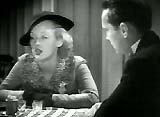 Drunken Joyce Heath (Bette Davis) 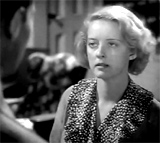 "Get me a drink!" 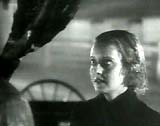 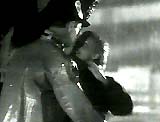 Clinch in the Rain Between Joyce and Don Bellows 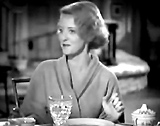 Insults: "Hurt me? You delight me!" 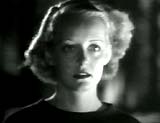 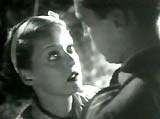 "Oh, I'm bad for people." 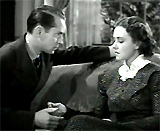 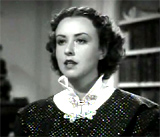 Gail Returning Her Engagement Ring But Hoping for Reconciliation 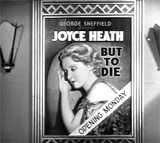 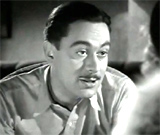 Joyce's Estranged Husband Gordon Heath (John Eldredge) 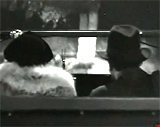 Deliberately Crashing Into Tree, Injuring Husband 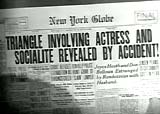 Love Triangle Revealed 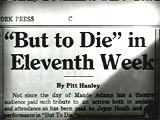 Show Revitalized 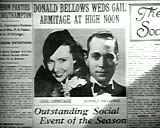 Headlines: Donald Bellows Weds Gail Armitage 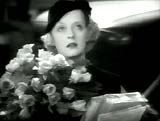 Joyce Delivering Flowers to Hospitalized and Crippled Husband Gordon Heath |
||||||||||||
|
Dark City (1998)
Alex Proyas' visually-stunning, labyrinthine and visionary sci-fi noir effectively twisted unreal reality. It should be noted that the opening of the theatrical version contained a voice-over narration (a major spoiler!) that was removed in the Director's Cut version:
It was the tale of John Murdoch (Rufus Sewell) - a man with memory problems. He awoke in a bathtub in a strange hotel. Notified by phone just after midnight, Dr. Daniel Schreber (Kiefer Sutherland) frantically told him about his dilemma ("You have lost your memory. There was an experiment. Something went wrong. Your memory was erased. Do you understand me?") - and he urged him to flee immediately into the dark city. Murdoch had frequent flashes of childhood memories that he was from a coastal town named Shell Beach. Murdoch discovered that he had been a guest at the hotel for three weeks, and was now being pursued as a wanted man - on the run for killing a ritualistically-murdered, half-naked call-girl (the sixth hooker victim!), and sought by police inspector Frank Bumstead (William Hurt). Schreber, claiming to be Murdoch's doctor, summoned nightclub singer Emma Murdoch (Jennifer Connelly), John's wife, to his office. It was claimed that three weeks earlier, John had separated from her after suffering delusions, complete memory loss, and a psychotic break. He was potentially violent and "searching for himself." Murdoch was pursued and tracked in a nightmarish, retro 40s-style futuristic world by the police and a group of individuals known as Strangers. As described in the prologue, they were actually malevolent alien beings living underground who wore black coats and fedoras. The Strangers were revealed to be a dying race of fiendish alien parasites who had abandoned their own world to seek a cure for their own mortality. Their telekinetic "tuning" powers could stop time (after midnight) - they could put people to sleep, alter reality (the city) and re-program the memories of its inhabitants by their will alone. The 'dark city' was revealed to be an experiment set up by the endangered aliens to determine the nature of the human soul by manipulating and transplanting people's memories each night. They were attempting to discover insights that would help their race survive. It was explained by Dr. Schreber, their human helper, that everyone's past history was non-existent:
Murdoch's quest for the mythic Shell Beach ended with a fake beach painted on a brick wall at the edge of the city - Dr. Schreber warned:
A break through the wall showed that the 'dark city' existed as a contained environment in the vast void of starry outer space. By film's end, Murdoch defeated the Strangers' leader Mr. Book (Ian Richardson) after a psychokinetic battle of massive proportions. He then began using his 'tuning' powers to start "making a few little changes" in the world - he 'recreated' Shell Beach by flooding the area within the force field with water and forming mountains and beaches. Murdoch was interrupted for one final conversation with the dying Mr. Hand (Richard O'Brien), the last remaining Stranger, to tell him that the aliens had been looking in the wrong place for the secret of humanity:
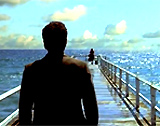
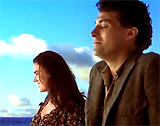
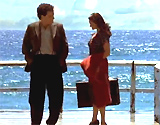
He then continued by tilting the city to bring sunlight to it - thus vanquishing the remaining Strangers. He was reunited with Emma Murdoch (now known as Anna) at the end of a pier in the bright sunlight. However, with new memories and identity, she had no recollections of his old identity. They strolled together down the pier in search of Shell Beach.
|
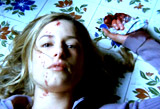
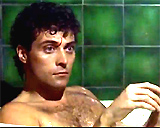 John Murdoch (Rufus Sewell) in Hotel Bathtub 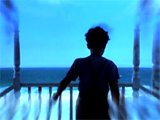 Childhood Memories of Shell Beach 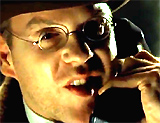 A Warning Phone Call to John From Dr. Schreber (Kiefer Sutherland) 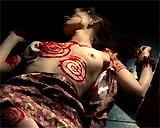 Murdered Call Girl 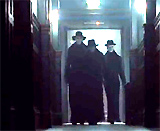 The Strangers 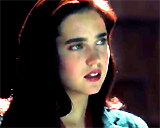 Emma Murdoch (Jennifer Connelly) 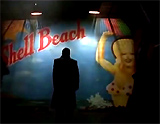 Fake Shell Beach Painting on Brick Wall 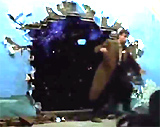 Breaking Through The Wall 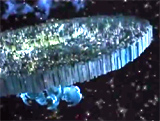 Beyond Dark City - The Void of Space 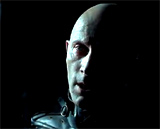 Encounter With Last Remaining Stranger, Mr. Hand (Richard O'Brien)  Tilting the City Toward Sunlight |
||||||||||||
|
The Dark Hours (2005, Can.)
Although one of the lowest grossing films of all-time (at only $423) due to distribution and marketing challenges (it played for only one week at an indie-friendly theatre in NYC), director Paul Fox's psychological thriller was nonetheless an effective film. Without well-known cast members and shot on a low-budget, it contained one of the more obvious plot twist devices - much of the action on screen was composed of the crazed delusions of the protagonist. Under the credits, psychiatrist Samantha Goodman (Kate Greenhouse), a counselor for the criminally disturbed and insane in a prison in Canada, examined cat-scans of her own inoperable brain tumor. Although stable for two years, the tumor was now growing, according to her self-diagnosis. She was medicating herself with shots (in a rashy spot on her upper thigh) of an unapproved drug, and seemed to be having blackouts and other mental hallucinations. During the film's first scene, she conducted a review with an angry and delusional patient, and was attacked across the table. Losing her grip on reality, she took the weekend off (for a break) and drove to a rural cabin in the snow to spend a surprise weekend with her writer-husband David (Gordon Currie) who was finishing a novel, assisted in editing by Samantha's pretty younger sister Melody (Iris Graham). Along the way, her brief stop at a roadside diner confirmed her compromised view of the external world (i.e., she lost her hearing in the middle of a conversation with the waitress about the veal cutlet coming from headless calves). In the early scenes at the cabin, she discovered a suspect bottle of champagne in the refrigerator, and she also appeared to lock herself in the bathroom for a half hour, after sharing morbid news with David and Melody about her worsening condition. [This was the point at which everything became imagined.] Two new characters were unexpectedly introduced:
The threesome of hostages were forced to play sinister mind games at gunpoint (or when threatened with an axe), including Strip-Phoner and Truth or Dare, that led to revealing confessions:
And then the action was replayed: Harlan and Adrian were only ghosts ("We all carry our ghosts with us") acting as her guilt-ridden subconscious voice, and leading her to jealously suspect her husband's affair. She found Dan and Melody having sex on the couch in front of a fire upon arrival. In a moment of crazed insanity, she axed Dan in the back and then viciously swung multiple times at Melody, killing her too. She then shot the dog (off-screen). Her mind games were presumably all in her head, voiced by the two menacing visitors whom she used as a projected scapegoat for her murderous acts. Samantha also convinced herself to cut off her little finger (the film was rated R for this scene of self-mutilation) with a pair of pliers, a squirm-inducing scene, to prove to herself that she wasn't crazy or in a dream and could still feel pain! As the film ended, she gave herself another injected dose of medication. In her compromised brain, the hypodermic syringe was seen as lipstick and the drug vial was seen as a perfume bottle. In reality, it was the suicidal overdose that she had given herself earlier in the bathroom. As she died on the bathroom floor, her addled brain hallucinated everything that followed (the assault of the two intruders, the axe murders, etc.).
The film concluded with the camera tracking in toward her lifeless eye, and the soundtrack recorded frantic doorknob sounds/scurrying mice in the attic. |
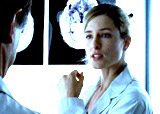 Psychiatrist Samantha Goodman (Kate Greenhouse)  Self-Medication for Brain Tumor 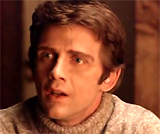 Husband David (Gordon Currie) 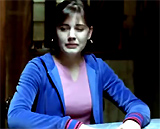 Sister Melody (Iris Graham) 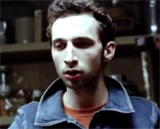 Adrian (Dov Teifenbach) - Gun-Wielding Hitchhiker 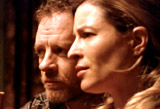 Harlan Pyne (Aidan Devine) With Samantha 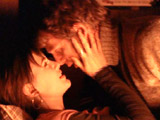 Imagined Adulterous Affair Between David and Melody 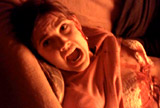 Axing Melody to Death 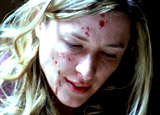 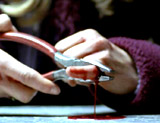 Cutting Off Her Little Finger |
||||||||||||
|
Director Christopher Nolan brought his 'Batman trilogy' to a close with this highly-anticipated Batman film in the series: The Dark Knight Rises (2012) followed after his own Batman Begins (2005) and The Dark Knight (2008). An evil masked, revolutionary terrorist-mercenary named Bane (Tom Hardy) threatened to 'liberate' and destroy Gotham City, forcing a reclusive Bruce Wayne/Batman (Christian Bale) to come out of hiding. Wayne was on the verge of bankruptcy, after he closed down his fusion reactor project when he learned that the core could be weaponized. Wayne's clean energy project, in which he had invested a large amount of money, included a nuclear fusion reactor. The potential danger was that the core of the reactor could be modified to make a nuclear weapon. Wayne appointed his Wayne Enterprises board member Miranda Tate (Marion Cotillard) and love interest to take over his company. She was entrusted with control of Wayne Enterprises and the reactor. He stipulated that nothing would be done with the reactor "until we can guarantee its safety." If it couldn't be kept safe, he proposed to destroy it: "Decommission it. Flood it." At Wayne Enterprises' next board meeting, Miranda was officially appointed as the new CEO and Chair of the Board of Directors of Wayne Enterprises, now that Bruce was ousted, in order to stave off a take-over attempt. Bane's intention was to fulfill Ra's al Ghul's mission to destroy Gotham with remnants of the League of Shadows. Bane bragged to Wayne: "I am here to fulfill Ra's Al Ghul's destiny." Bane wounded and captured Wayne/Batman, and interred him in a round, deep cylindrical Pit prison, where Bane had been formerly imprisoned (this was where Bane had "learned the truth about despair").
Bane convinced Miranda, one of his hostages, to unlock and activate the nuclear reactor, so that it could be converted into a 4 megaton nuclear bomb, to destroy Gotham by isolating and separating it. The villain was on the verge of isolating Gotham City and threatening to detonate the nuclear reactor as a bomb within a few hours. Bane admitted that he had never escaped the Pit as the child of Ra's Al Ghul, as Wayne had assumed. Hostage Miranda came up behind Batman and stabbed him in the back, as a major reveal was divulged by her - she, not Bane, was Ra's al Ghul's child:
She identified herself as Talia, the daughter of Ra's Al Ghul, who had climbed out of the pit. She was named by her mother before she was killed. Fellow prisoner Bane was her "protector" who saved her from also being killed, and freed her to escape. Her father returned to exact vengeance, rescued Bane from the Pit, and took him into the League of Shadows to be trained. But Ra's Al Ghul could not accept Bane: "He saw only a monster," and Bane was excommunicated. She admitted her love for Bane:
She had planned the Gotham operation with Bane, in honor of her father, to seek vengeance against Batman who had killed her father. She planned to complete her father's work by detonating the bomb and destroying Gotham. Batman fired upon the bomb truck, with Miranda in the driver's compartment - and she was fatally wounded when it crashed. Talia/Miranda was able to detonate the bomb before dying, and believed that her plan to destroy the city that killed her father would come true. She caused Batman to sacrifice himself by flying the dangerous bomb away from the city to explode harmlessly. Although Batman presumably died in the explosion, vignettes at film's end proved otherwise. Batman had used the autopilot mechanism (patched and fixed) on the Bat as he flew the bomb over the Bay - to escape the explosion. In a Florentine cafe-restaurant in Italy, faithful butler Alfred Pennyworth (Michael Caine) spotted Bruce having a meal in Italy with Selina Kyle/Catwoman (Anne Hathaway), and John Blake (Joseph Gordon-Levitt) revealed that his real first name was Robin - identifying him as Batman's sidekick. |
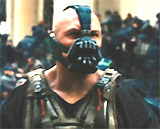 Bane (Tom Hardy) 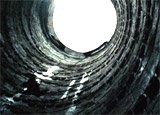 The Deep Pit Prison 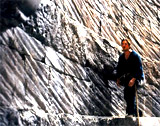 Bruce Wayne Interred in Deep Pit by Bane 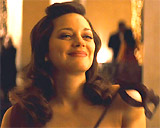 New CEO Miranda Tate (Marion Cotillard)  Talia (The Daughter of Ra's Al Ghul) 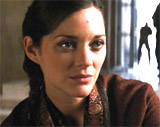 The Main Reveal - Miranda Was Ra's al Ghul's Child 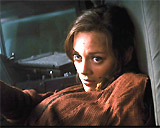 Miranda's Death in Bomb Truck |
||||||||||||

|
The DaVinci Code (2006)
Director Ron Howard's much-anticipated, big-screen religious conspiracy thriller opened with the brutal murder of the Louvre Museum's elderly curator Jacques Sauniere (Jean-Pierre Marielle) in the Parisian museum. The curator was shot in the abdomen and bled to death - his naked body was found in a revealing pose on the floor (resembling DaVinci's famous Vitruvian Man sketch), with a pentacle symbol (the symbol for the female goddess Venus) that he had etched into his own bloody chest, and an enigmatic encrypted code written in blood (including a numerical sequence) on the floor. He was killed by a self-flagellating albino Opus Dei hooded monk named Silas (Paul Bettany), an "angel" of death who was later learned to be in the employ of both devious high-ranking Council of Shadows Bishop Manuel Aringarosa (Alfred Molina) and a mysterious individual known only as "The Teacher." Religious symbologist and Harvard professor Robert Langdon (Tom Hanks), lecturing in town, was called to the crime scene, and unbeknownst to him, was considered the prime suspect by police Captain Bezu Fache (Jean Reno) (an Opus Dei member) and Lieut. Collet (Etienne Chicot). The last line in the mysterious code message on the floor (P.S. Find Robert Langdon) was wrongly thought to identify him as the killer. Further, Fache had been notified by the Bishop that Langdon admitted to committing the crime during a confessional. French police cryptologist Sophie Neveu (Audrey Tautou), who arrived at the museum, tipped Langdon off that he was "in grave danger," and the two fled. The following items were revealed as they investigated the case ("a treasure hunt") to find Sauniere's killer - they solved a byzantine trail of clues left by Sauniere to keep one step ahead of the authorities:
To summarize, there were two opposing groups:
"The Teacher" was revealed to be double-crossing Teabing himself - the film's ominous 'bad guy' - when he poisoned his own compatriot butler Remy Jean (Jean-Yves Berteloot), and sent French police chasing after Silas and the Bishop to betray them. Teabing admitted he had persuaded the Council of Shadows to be allied with him so he could crush them. Although held at gunpoint by Teabing, Langdon tricked him by solving the cryptex with the code word: A-P-P-L-E. He had then secretly removed the parchment inside. The clue was based upon Sir Isaac Newton's inspiration about gravity when an apple (an orb - and fruit with a rosy red flesh and seeds inside) fell on his head from a tree, resulting in wrathful repercussions by the church at the time against his scientific theory. Teabing was arrested by the French police and whisked away. The parchment held further clues that led Sophie and Langdon to Rosslyn Chapel (Scotland): "The Holy Grail 'neath ancient Roslin waits, The blade and chalice guarding o'er her gates, Adorned in masters' loving art, she lies, She rests at last beneath the starry skies." In the basement was a trap door stairway, leading to the location where Mary Magdalene's remains (in a sarcophagus) had been kept at one time. Sophie was not really Sauniere's granddaughter, but he had led her to believe that she was part of a family that was killed in an automobile accident when she was four years old. Newspapers proved that the entire family perished. Her real name was Sophie Saint-Clair, one of the oldest families in France from a line of Merovingian kings (she possessed sang real or "royal blood"). Sauniere had been training her in puzzles and secrets to prepare for a future day - but NOT to guard the secret of the Holy Grail. Langdon realized: "Sophie, you are the secret. You survived the accident. If it even was an accident." The Priory had concealed the fact that she was alive and hid her with "the Grand Master himself." Langdon proclaimed:
At Rosslyn, members of the Priory of Scion, guardians or keepers (and friends of Sauniere), recognized Sophie as the heir. She was introduced to her grandmother. She learned that when Sauniere died, he took the location of Mary's sarcophagus with him to his death. There was no empirical proof that she was the heir. Langdon emphasized to her: "the only thing that matters is what you believe." In the final scene, Langdon was inspired by a blood-line pattern in his sink, after cutting himself shaving in his hotel room. He followed the Rose Line (prime meridian line) back to the Louvre's striking outdoor pyramidal structure itself. The camera spiraled downward to the sarcophagus of Mary Magdalene which appeared to be located in a chamber underneath where the two triangular pyramids (the Blade-male-upright pyramid, and the Chalice-female-inverted pyramid) geometrically-echoed each other. |
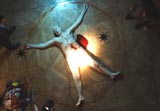 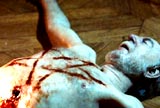 The Murder of The Louvre's Curator 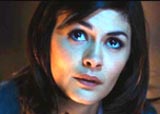 French Cryptologist Sophie Neveu (Audrey Tautou) 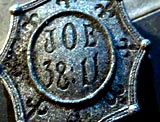 Church Stone: Job 38:11  Numerical Sequence on Floor 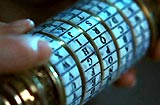 The Cylindrical Cryptex 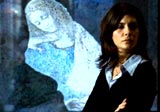 DaVinci's Last Supper Painting 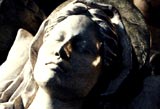 Sarcophagus 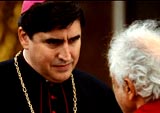 Bishop Manuel Aringarosa (Alfred Molina) 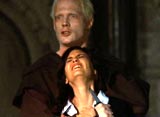 The Albino Killer Silas Holding Sophie 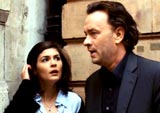 Sophie With Langdon 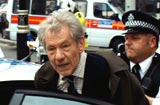 Arrest of Sir Leigh Teabing (Ian McKellen) - The Teacher 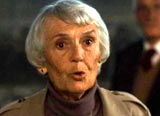 Sophie's Grandmother 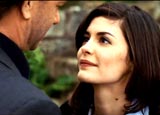 "You are the Heir" 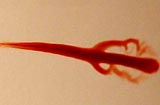 Blood Line Pattern in Sink 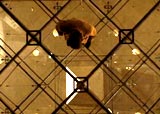 The Louvre's Pyramidal Sructure 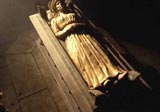 The Discovery of the Hidden Sarcophagus Under the Louvre |
||||||||||||
|
Dead Again (1991, UK/US)
This puzzling and twisting tale was director/star Kenneth Branagh's first American film. It was composed of two parallel plots in different time periods (and its story about past-life regression), was presented by color for the present-day scenes, and black and white for the past. 1990s LA police detective Mike Church (Kenneth Branagh), who usually investigated cases of missing persons, took the case of a amnesia-suffering mute client nicknamed 'Grace'/aka Amanda Sharp (Emma Thompson). She was having nightmares about the murder of a pianist named Margaret Strauss (also Emma Thompson) by her world-famous composer/conductor husband Roman Strauss (also Kenneth Branagh) in the late 1940s. She had been stabbed in the throat with a pair of barber's scissors. Before Margaret's death, she had become suspicious that Roman's housekeeper-maid Inga (Hanna Schygulla) and her disturbed, stammering son Frankie (Gregor Hesse) were stealing from her husband. Roman was falsely put to death by the electric chair for the murder of his wife Margaret, who was actually stabbed and murdered with a pair of scissors by Frankie. The motive for the murder? - Frankie blamed the unhappiness of his mother Inga on Margaret, because Inga was in love with Roman, but rebuffed. In the present day story, Mike came into contact with hypnotist and antiques dealer Franklyn Madson (Derek Jacobi) who believed that 'Grace' suffered severe trauma in her past life. [Note: Franklyn (or Frankie!) Madson was the reincarnation of Frankie, the stammering maid's son who murdered Margaret.] Under regressive hypnosis, it was revealed that there were remarkable similarities and parallels between the stories of Roman and Margaret in the past, and Mike and 'Grace' in the present. There were two major discoveries:
The love and death of Roman and Margaret Strauss in the past began to be re-enacted once again in the present. In the dramatic, over-the-top conclusion (with fast cuts between the past and the present), Madson/Frankie received his comeuppance - he died when impaled on a giant-sized scissor sculpture made by 'Grace.' In the final frames, which changed from black and white to color, the doomed 1940s lovers, Margaret and Roman, dissolved into their counterparts Mike and Grace. Mike held his partner 'Grace' and exhaustedly said at film's end:
|
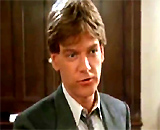 Mike Church (Kenneth Branagh) 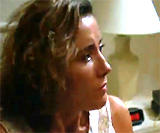 'Grace' (Emma Thompson) In the 1940s: 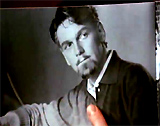 Photograph of Roman Strauss (Kenneth Branagh) 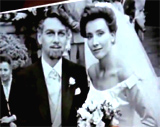 Photo of Roman Strauss and Wife Margaret (Emma Thompson) 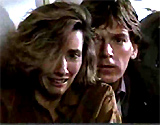 The Dramatic Conclusion: Mike and Grace |
||||||||||||
|
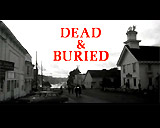
Dead & Buried (1981)
Director Gary Sherman's classic and gory early 1980s horror film featured the tagline:
The favorite cult film had an intelligent script written by the creators of Alien (1979), Dan O'Bannon and Ronald Shusett. It had similar elements to Invasion of the Body Snatchers (1956) and Night of the Living Dead (1968). The setting was Potters Bluff, a coastal New England town. It opened with "Freddie" (later identified as George LeMoyne) (Christopher Allport), a vacationing photographer from St. Louis who was snapping shots at the seashore's foggy beach. He was propositioned by pretty blonde 'Lisa' (Lisa Blount), an aspiring model who asked him to take her picture. After a few pics, she opened up her red blouse to show off her breasts, asking: "How's this, Freddie?...Do I look good to you, Freddie?...Do you want me, Freddie?" He was taken aback: "Right here?" As he approached, she grabbed his camera, and other locals popped up behind her. "Freddie" suffered a violent and sadistic beating - he was struck with a crowbar, wooden bat and shovel, and then staked and wrapped against a wooden post within a fishing net. While pictures were taken of him, he was set on fire with gasoline. The town's beachside sign read: Welcome to POTTERS BLUFF, A NEW WAY OF LIFE. The immolation was made to look like a fiery traffic accident in the photographer's upside-down VW van. The town's naive Sheriff Dan Gillis (James Farentino) investigated the case, along with the eccentric, witty and morbid coroner-mortician from the local mortuary - elderly big band-loving William G. Dobbs (Jack Albertson). In one memorable early scene, the obsessed and eccentric Dobbs described his "black magic" artistic profession to the Sheriff:
Later, the near-dead but recuperating burn victim, almost completely bandaged, was killed in a local hospital with a long syringe stabbed into his left eyeball by the same blonde, Nurse 'Lisa'. Curiously, the local who lit the match to start the deadly fire was waitress Midge (Linda Shusett/Turley) in the local cafe. What was additionally strange was that the newly-deceased victims, such as 'Freddie,' were often recycled and still alive (but with new personalities or occupations) after being horribly murdered. The Sheriff continued to investigate the mysterious rash of frequent murders (often with their deaths photographed by the participating onlookers). There were some memorable gruesome killings - all of strangers passing through town:
Gillis suspected that his schoolteacher wife Janet (Melody Anderson) was involved somehow - she seemed to be hiding an affair with the photographer before he died (and 'reanimated'), and she had taken a newfound interest in reading a book on the black arts of witchcraft and voodooism, which she was teaching to her pupils. A passage was marked: "Ancient folklore has they can only be made from persons dying a violent death." She had also hidden a decorative dagger in her drawer (she described it as being used to cut out a person's heart). Gillis began to suspect Dobbs after digging up "Freddie's" (George LeMoyne's) coffin and finding only his wrapped-up heart inside. After a background check, it was determined that Dobbs was formerly a Providence, Rhode Island pathologist who had been dismissed about 10 years earlier for "unauthorized use of dead bodies" (autopsies) in the county morgue. He was censured by the medical association and left town. Dobbs had been experimenting on 'reanimating' the dead, and had performed the technique on Potters Bluff townsfolk - they were the 'undead' zombies who were responsible for the murders. The Sheriff watched B/W film footage of a past murder - during sex, Janet stabbed an unidentified male lover in the back with a dagger, and then other townsfolk aided her. In the morgue, the Sheriff confronted Dobbs with his suspected monstrous crimes against his wife. Dobbs shockingly admitted that Janet had been his first and favorite creation: "Janet, my crown jewel. My very first." Dobbs played multiple reels of film of all of the murders that had occurred in town.
He told how he had found Janet drowned in her car in Harris Creek and made her beautiful again as an 'undead' zombie: "Yes, she was, she is like all the others." He then told the distressed Sheriff about his 'black magic' art and his gift of Janet to Daniel:
He claimed to the Sheriff that the victims were better off after their deaths and reanimations:
The Sheriff threatened to shoot Dobbs, who insanely encouraged him: "Help me to become one of my own children." He first shot his 'undead' wife Janet, who pleaded: "Dan, I'm dead, please bury me," then turned and shot Dobbs in the stomach. The Sheriff followed Janet to the cemetery where he covered her body with dirt in a grave, and then fled from a threatening group of 'undead' townsfolk surrounding him. When he raced back to the morgue, he saw that Dobbs had reanimated himself.
There, the Sheriff watched more of the film footage, and the film's final plot twist was revealed - the Sheriff was the one in bed making love to Janet when she stabbed him in the back - he was also one of the 'living dead.' Dobbs had ordered his murder, performed by Janet. In the conclusion, the Sheriff noticed his hands decomposing, and Dobbs offered:
|
 Model 'Lisa' (Lisa Blount) 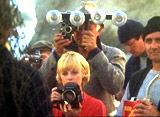 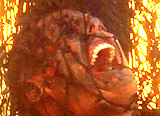 Lisa Leading the Violent Beating and Immolation of Photographer "Freddie" 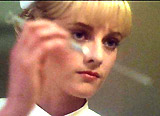 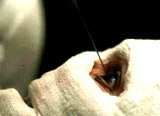 Nurse 'Lisa' Murdering Burn Patient "Freddie" 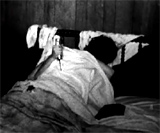 Film of Murder of Victim During Sex 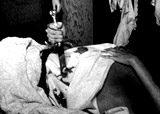 Lover Stabbed  Killer was Sheriff Gillis' Wife Janet (Melody Anderson)  Mortician Dobbs (Jack Albertson)  Sheriff Dan Gillis (James Farentino)  Gillis Shooting "Undead" Wife Janet  Sheriff Gillis Confronting Dobbs  After Being Shot Dead, Dobbs Reanimated Himself |
||||||||||||

|
Dead Calm (1989, Australia)
This taut Australian erotic thriller from director Phillip Noyce told about a vacationing couple on their yacht the Saracen. The couple, with their dog Ben, were sailing in the calm Pacific waters off the coast of Australia. They were recovering from an auto accident that claimed the life of their toddler son:
They rescued a man drifting in the middle of the ocean, Hughie Warriner (Billy Zane). The frantic Hughie claimed that he had survived a sinking black schooner named Orpheus after everyone died from salmonella poisoning. John left the castaway with his wife, while he took a dinghy to the Orpheus to investigate the claims - finding himself on a sinking craft and in danger of drowning himself. Meanwhile, the unstable and domineering Hughie kidnapped Rae and began sailing off. Hughie was a terrorizing, psycho-homicidal drifter and mass murderer who had actually slaughtered the crew on his vessel. After a long series of struggles, it was thought that John and the resourceful Rae had finally conquered Hughie by wounding him with a harpoon, knocking him unconscious, tossing him onto a rescue raft, and setting him adrift. But then, after they noticed his free-floating raft in the open sea, Rae sank it with two flare-gun shots, although a panning shot to the other side of the boat where a rope dangled into the water hinted that Hughie was possibly alive and had climbed on board. The next morning, Rae returned to the deck after a swim, where her husband helped to rinse her hair of the salt water, and shampoo her hair. He left the deck for awhile, as she put her head back and closed her eyes. When a pair of dirty hands resumed the shampooing some time later, she fantasized what she would like:
Suddenly, she realized that the hands belonged to the vengeful Hughie, who had reappeared in the startling shock 'return-from-the-dead' twist ending. He attempted to cover her mouth to stifle her screams, and to strangle her. As John reappeared with a beautifully-prepared breakfast tray, he saw the 'silhouetted' struggle occurring behind the sail. He dropped the tray, grabbed a flare gun, and aimed it at Hughie. The fiery flare tore through the sail, struck Hughie in the mouth, exploded, and forcefully propelled him backwards off the deck into the ocean. Presumably, he was now dead, floating away face-down, as the relieved couple hugged each other. |
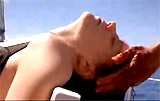 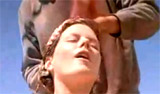 Suspenseful Shampoo Scene 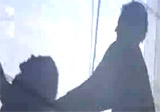 Hughie Attacking Rae 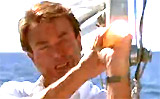 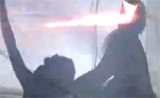 John Defending Rae With a Flare Gun 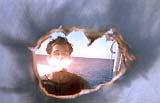 Hughie's Death |
||||||||||||
|
Dead End (2003, Fr.)
This was a low-budget, predictable Twilight-Zone like horror-twister (and similar to Carnival of Souls (1962)) with elements of dark humor from writers/directors Jean-Baptiste Andrea and Fabrice Canepa, although effective nonetheless. Its tagline was:
Every clock or watch had stopped at the hour of 7:30, hinting that life also stopped. On Christmas Eve, the Harrington family of four (parents with two teen kids, and one friend) was enroute in their Jeep SUV to the in-laws for the holiday - an annual trek taken for over 20 years within California. The occupants were:
Traveling in their car at night and taking a "back-way" short-cut instead of the interstate (on an unmarked, dark, narrow, and mysterious road), Frank dozed off and then was startled back to consciousness with a near-miss accident. Laura was exasperated with Frank: "Are you crazy? You almost killed us." The travelers continued on the never-ending road, seemingly unhurt, but they were hopelessly lost. Frank admitted: "Everything's so f--ked up on this goddamn road." As it turned out, their car had crashed into an oncoming vehicle driven by a Lady in White (Amber Smith). Encounters along their road trip, during their "f--kin' nightmare" (Frank's words), included:
Dirty secrets or intentions were revealed about each family member during the trip:
The sole-surviving daughter Marion awoke in St. Luke Hospital after the deadly accident when she was thrown from the car and had suffered a short-term coma. She had broken ribs and a concussion. Everything that occurred after the fatal accident was in the daughter's mind. Marcott, their destination seen repeatedly on a road sign, was the name of the emergency room doctor, Dr. Marcott (Karen S. Gregan), who was treating Marion at the hospital. The name was interwoven into her recollections. Also interwoven into her confused thoughts was a man dressed in black at the hospital, who had reported the accident, and had given Dr. Marcott a lift in his vehicle (a black hearse) after her shift. In the midst of the credits, two road-sweeping workmen were cleaning up the crash site on Christmas Day. They found Frank's handwritten note - his Christmas wishes - with charred edges - that he had composed earlier and discussed with Marion:
The note was tossed onto the ground and swept up. The tacked-on, almost unnecessary coda put into question the whole idea that everything was an imagined dream. |
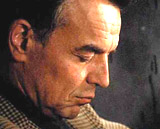 Frank Harrington (Ray Wise) 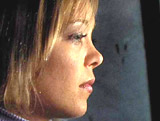 Marion (Alexandra Holden) 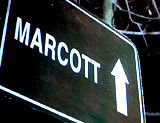 Destination: Marcott  Lady in White (Amber Smith)  Wife Laura (Lin Shaye)   Sole Surviving Daughter Marion 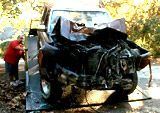 Cleaning Up Crash Site 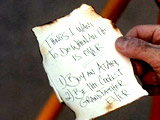 Discovery of Frank's Handwritten Note |
||||||||||||
|
Dead Ringer (1964)
Paul Henreid's dramatic and suspenseful thriller about identity theft was considered a classic of 'Grand-Dame Guignol'. During the opening funeral scene at LA's Rosedale Cemetery, the death of wealthy 'Frank' DeLorca (from an alleged heart attack) brought together estranged identical twin sisters after 18 years - throughout the early part of the film, the two were seen in the frame together in a few amazing split-screen trick scenes:
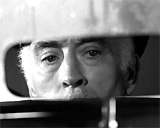
Edith visited the DeLorca mansion after the funeral - providing a major contrast in their lifestyles - Maggie's life of shopping, luxury, maids & servants, and Edith's working-class life running a seedy bar in downtown Los Angeles (at Figueroa and Temple), living in a one-room decrepit apartment above the cocktail lounge, and three months behind in rent and facing eviction. The backstory causing conflict between the two sisters was that both females loved DeLorca, but Maggie had tricked him into marriage by claiming she was pregnant. The secret fact was revealed by the family chauffeur George (George Chandler) (seen in the rear-view mirror) to a shocked and then vengeful Edith during her drive away from the mansion, that there was no child. Maggie was lured to visit Edith's apartment, and Edith questioned Maggie as she looked around: "A dump?" - followed by her cross examination of Maggie about the faked pregnancy, and Maggie's subsequent confession: "There never was a baby. That's what you want to hear, isn't it?..."; Edith was still angry: "You never loved him. You never made him happy. You ruined both our lives" - and was plotting to steal back the life that had been taken from her. Maggie was shot to death in Edith's apartment - an off-screen death made to look like Edith's suicide. Edith pulled the trigger on a gun next to Maggie's right temple (with a brief cutaway to a musician loudly playing drums in the bar), then left a suicide note, modified her hair style to bangs, changed clothes with her sister, and returned to the mansion to impersonate her sister. Throughout the remainder of the film, "Maggie" was confronted by the many complexities and complications of assuming another person's identity and 'playing' the role of "Maggie": she didn't know the combination to the wall safe containing valuables and jewelry, she confused her maid Janet (Monika Henreid), Edith was a chain-smoker (but Maggie had given up smoking many years earlier), there was a changed relationship with Maggie's now-friendly Great Dane named Duke, and more. To avoid having to sign Maggie's papers for the family lawyer Paul Harrison (George MacReady), Edith/"Maggie" resorted to burning her hand with a hot fireplace poker. In a few instances, "Maggie" realized that her former life as Edith was possibly happier and more worry-free: (1) her off-handed discovery that in Mr. DeLorca's will, he had left her $50,000 - enough to have covered her debts, and (2) her close relationship with cop/friend Sgt. Jim Hobbson (Karl Malden). In a confrontative sequence, Maggie's secret lover, playboyish, gold-digging golf pro Tony Collins (Peter Lawford) easily saw through her charade - that "Maggie" wasn't Maggie - the despicable Tony tricked her by claiming they had vacationed together in places they had never been: ("You don't want me to make love to you? I don't understand. After all the fun we had, Honolulu, Nassau, Miami. It was fun, wasn't it?"); when she answered: "Well, of course," he knew she was lying: "You're not Margaret, you're Edith! Maggie and I never went to any of those places! Never! You killed her. The smoking, the dog"; he slapped her but was restrained by Sgt. Hobbson. Collins blackmailed "Maggie" for her jewelry to buy himself a Maserati ("I'm gonna take you for everything you got"). Soon after, a search of his high-rise apartment after he failed to pawn off some of the jewels led to the discovery of a sackful of arsenic powder: ("Arsenic poisoning is often mistaken for a heart attack"), and he was suspiciously linked with Maggie and the death of her husband. Tony was mauled to death by the attacking Great Dane, when "Maggie" was quarreling with Tony and ordered him out - and the dog thought that he was going to hurt her. Now a suspect in the murder of her husband, "Maggie" appealed to suspicious Sgt. Hobbson by claiming to be Edith (and that she didn't commit the crimes that Maggie had):
But he asserted that he didn't believe her:
"Maggie" walked back her attempt for sympathy: "Forget it, Sergeant. It was just a, a lousy joke. Edie and I used to try and fool people all the time when we were kids." A rapid montage of "Maggie's" trial consisted of the super-imposition of her face onto the proceedings with quotes from witnesses and lawyers from both sides of the case:
In the final scene, "Maggie" was found guilty of first-degree murder and sentenced to the gas chamber at San Quentin State Penitentiary. She seemed resigned to her fate (she had committed murder, but not of Mr. DeLorca). As she was led to a police car from the courthouse, she had one final discussion with a very troubled Sgt. Hobbson, who was still wondering about her identity:
He solemnly watched as she was driven away. |
 Chauffeur's Revelation of Faked Pregnancy 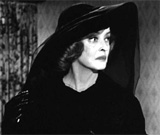 Maggie 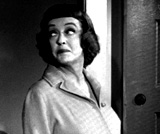 Edith 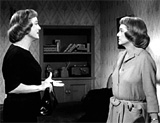 Split-Screen 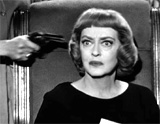 The Murder of Maggie 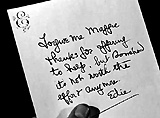 The Fake Suicide Note 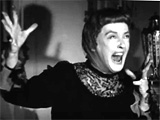 The Hot Poker 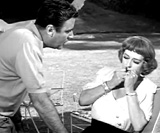 "Maggie" Confronted by Playboy-Golddigger Tony (Peter Lawford) 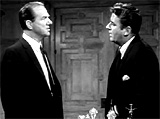 Sgt. Hobbson Accusing Tony of the Arsenic Poisoning of Mr. DeLorca 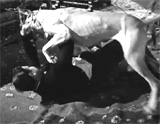 Tony Mauled to Death by Duke, a Great Dane 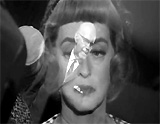 "Maggie's" Trial 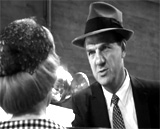 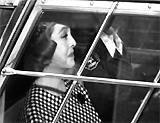 The Ending |
||||||||||||
|
Dead Silence (2007)
Director James Wan's supernatural mystery-horror film was advertised as a film with a great pedigree: "From the writers and director and producers of 'Saw'." Its tagline provided an important plot element:
The film opened with a title card:
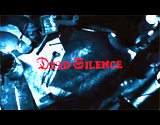
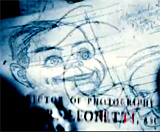
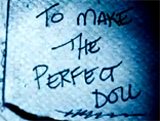
Under the opening credits with blood-red lettering, filmed as a grainy and jerky blue-tinted silent film, a craftsperson designed and manufactured ventriloquist dummies - "to make the perfect doll." The main protagonist was:
In another town a far distance from his hometown of Raven's Fair, Jamie found his wife Lisa's (Laura Regan) body in bed (with her tongue excised from her wide-open mouth), where she was posed as a mannequin. He had gone out for a few minutes to get take-out food. He thought he heard Lisa speaking to him just before he found her corpse - but without a tongue and already dead, that was highly unlikely. A ventriloquist doll named "Billy" that they had just received in an unmarked package was lying on the floor. When questioned by police Detective Jim Lipton (Donnie Wahlberg), Jamie explained:
Although released, Jamie (now a widower) was considered the main suspect and continually dogged by authorities. He returned to his hometown for the funeral, where he visited with:
In town, Jamie was warned by senile and crazed Marion (Joan Heney) and her husband, town mortician Henry Walker (Michael Fairman), that the town's legendary Mary Shaw (from a scary poem) was dangerous (and that Mary Shaw had killed Jamie's wife). Then, Henry described to Jamie the local Raven's Fair legend about a ventriloquist named "Mary Shaw" (Judith Roberts) from the 1940s. During a performance on the Guignol Theater stage with her "Billy" dummy, she was accused of being a fraud by a boy named Michael in her audience ("Your lips are moving"). A few weeks later, the disbelieving little boy vanished - presumably kidnapped (and murdered!), and Shaw was considered the only suspect. Not long after, she was murdered. According to her will's specific wishes, the mortician (the current mortician's father) buried Mary Shaw with her so-called "children" (101 handmade vaudeville dolls) in the local cemetery, after also making her into a puppet/dummy ("she asked to become a doll herself"). After Shaw's death, there were a series of strange murders in the town -- most people thought Mary Shaw's puppets were seeking revenge. Jamie's wife Lisa had now become the most recent victim. Henry also added that only those who screamed would be punished by Shaw:
Jamie wanted to unravel the mystery, although Henry warned: "If you go looking for answers, you just might find them." At the old dilapidated and run-down Guignol Theater, Jamie found a crucial clue -- Michael's last name was also Ashen. While Jamie was gone, Henry was killed by 'Mary Shaw' - with his tongue cut out. When Jamie returned home to find more answers from his father, he learned additional crucial facts. Jamie was revealed to be the great nephew of his kidnapped and murdered great-Uncle Michael Ashen (Steven Taylor). The Ashen family from generations earlier had led the attacks on Mary Shaw, although others were also involved. Vengeful townsfolk led by Michael's family hunted her down ("there was only ever one suspect, Mary Shaw. So they dealt their own justice"). They forced her to scream so that they could chop her tongue out. Then they killed her:
It appeared that the entire Ashen bloodline was now being targeted by Mary and her puppets ("Spirits have long memories"). Edward had sent his son Jamie to live in another town to escape the curse. Then, Detective Lipton arrived to tell Jamie his recent discovery - that all of the 100 dolls had been dug up from their graves and removed from their coffins, and Lipton suspected that Jamie had been "stealing evidence." Both Jamie and Detective Lipton found themselves at the Guignol Theater after Jamie received a phone call from "Henry" to go there. All 100 of the exhumed dolls and Michael Ashen's string-attached marionette body were lined up on the stage. Jamie realized: "I think we just solved the 70 year old missing persons case" -- (It looked like Shaw had attempted - but failed - to make a "perfect doll" out of Michael's body, Jamie's "long-lost relative"). Then Shaw - speaking as a ventriloquist through one of the dolls, divulged the reason for Lisa's death - it was to prevent another Ashen child from being born, since Lisa was pregnant:
Mary Shaw then extended her sticky elongated tongue and licked Jamie's cheek. Lipton and Jamie realized that they must not scream. Jamie had the sudden realization that they must destroy the dolls to end the curse: "She's living in the dolls! Destroy the dolls!" To defeat Shaw's evil ghost once and for all, Jamie and Detective Lipton burned the 100 puppets - but Lipton lost his life when he fell off a catwalk, screamed!, and had his tongue ripped out. In the shocking, twist ending, Jamie made one final visit to his father's mansion to destroy the one last remaining "Billy" dummy located there. He learned that his father had suffered a stroke and actually died. "Edward Ashen" was only a life-sized doll (a lifeless corpse), propped up and made into a "human dummy." He was controlled by Ella through a gaping hole and control stick in his back - she was harboring or possessed by the evil and vengeful spirit of ventriloquist Mary Shaw.
The "perfect doll" that Mary Shaw had created was Ella, who frighteningly turned into Shaw, and asked: "Now, who's the dummy?" Jamie screamed an open-mouthed "NO!" - and he became the final victim. A composite photo in Mary Shaw's sketch book album (from the film's opening) was of the six humans whom she had made into dummies or puppets:
In this final scene, Jamie (in voice-over) was heard reciting the entire verse from the scary poem partially heard in the opening scene by his wife Lisa that offered advice ("That old ghost story about the woman who had all those dolls" that Jamie's mother used to tell him):
|
  Opening Credits 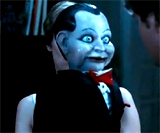 "Billy" Dummy, Sent to Jamie (and Lisa) Ashen 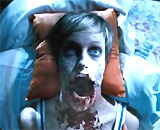 Lisa's Murder  Detective Jim Lipton (Donnie Wahlberg) 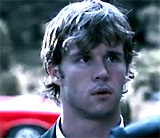 Jamie Ashen (Ryan Kwanten) 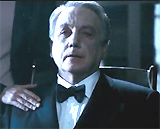 Edward Ashen (Bob Gunton) 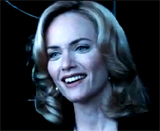 Ella (Amber Valletta) 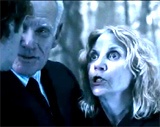 Mortician Henry Walker and Crazed Wife Marion 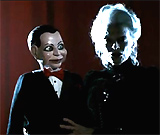 1940s: Mary Shaw and Dummy Billy 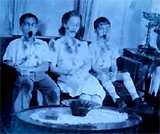 Dead Townsfolk, Posed in Family Portraits 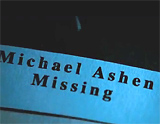 Major Clue! 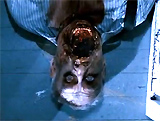 Henry Killed by Mary Shaw 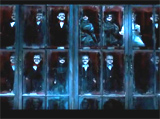 The 100 Dolls Lined Up in the Guignol Theater 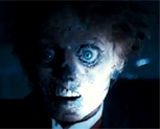 Michael Ashen "Dummy" 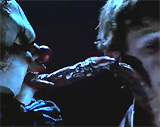 Mary Shaw Speaking Through Doll: "The last Ashen was inside her!" 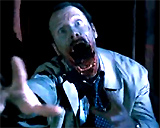 Detective Lipton's Death 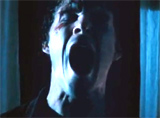 Jamie's Scream 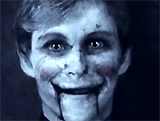 Jamie as Newest Dummy 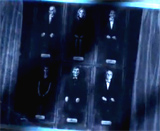 The Dummy Photo |
||||||||||||
|
Deathtrap (1982)
The many plot twists and triple-cross in this Sidney Lumet film (set in one location) were witty and complex -- and it paid homage to Les Diaboliques (1955, Fr.). Its tagline was:
English professor and fading playwright Sidney Bruhl (Michael Caine), with writer's block, suffered another failure - a flop on Broadway. Fortuituously, he came into contact with one of his young ex-students, a gay fledgling author named Clifford Anderson (Christopher Reeve) who had supposedly written a brilliant murder mystery thriller-play titled Deathtrap. Sidney plotted with his dubious, ailing, naive wife Myra Bruhl (Dyan Cannon) to invite Clifford to their Long Island home and murder him - in order to steal his play and make it his own .Anderson was strangled with a chain and buried. However, it was revealed that Clifford's death had been faked. Later that night, he suddenly appeared -- scaring Myra into having a cardiac arrest. In the twist reveal, it was shown that Bruhl and Anderson were really gay lovers (who performed one scandalous homosexual kiss on-screen) and the two had plotted this elaborate scheme to kill Myra. Afterwards, Anderson moved in to be Bruhl's new 'secretary,' and now began writing a play called Deathtrap with a plot that resembled the murder of Myra. Eventually, the two distrusted and murdered each other (in a scene that included lots of murder weapons: a gun, an axe, handcuffs, and a crossbow). Surviving neighboring Dutch psychic Helga Ten Dorp (Irene Worth) ("In this room, there's pain") was able to incorporate the murderous events into her own play - which went on to become a huge Broadway smash-success after its opening night. |
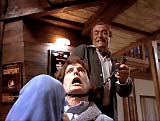 Sidney (Michael Caine) Strangling Clifford (Christopher Reeve) - A Faked Death 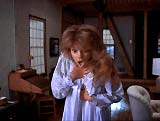 Myra's Cardiac Arrest 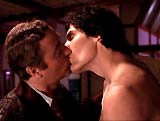 Gay Lovers - Kiss 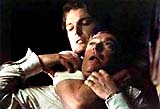 Murdering Each Other 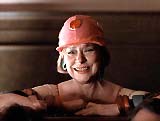 Surviving Playwright Neighbor Helga |
||||||||||||
|
Decoy (1946)
Director Jack Bernhard's little-known cult B-film noir from Monogram featured one of the most ruthless, greedy, mean and hard-hearted, deceitful and manipulative femmes fatales in noir history. Social-climbing seductress Margot Shelby (British actress Jean Gillie) was capable of using whatever means necessary to reach her selfish and devious ends. It trumpeted sensational taglines:
This little-known, low-budget, cult B-film noir opened with betrayed and seriously-wounded Dr. Lloyd Craig (Herbert Rudley) in a disheveled suit washing his soiled and bloody hands and face in a grimy washroom sink (with broken mirror) at a gas station. After hitchhiking to San Francisco 75 miles away, he proceeded, zombie- or Frankenstein-like, to the 6th floor posh suite apartment of the glamorous Margot Shelby (who was preparing to flee town). There, he vengefully shot her and then dropped dead.
Hard-nosed, tough-guy, and snappily-dressed detective Sgt. Joseph "Jo Jo" Portugal (Sheldon Leonard) had been following a related robbery-case, but arrived too late at Margot's apartment, just as Dr. Craig collapsed in front of him. He found Margot seriously wounded and dying, and carried her over to the sofa. She frantically begged for a money chest dropped on the floor to be brought to her: ("Give it to me. I want it...It's mine. It's all mine now"). She explained that the money chest held the $400,000 proceeds from her boyfriend Frankie Olins' bank robbery. She described what had happened in a lengthy flashback, beginning with:
At the Watchaprague State Prison, ex-gun moll Margot visited convicted robber Frankie Olins (Robert Armstrong). He told her why he had stolen the money - it was for his own possessive reasons related to her alone: ("You're the only thing I care about. That's all that money means to me, you! Clothes for you, pretty things for you. That's why I did it, that's why I took the chance, even on a murder rap, because I want you to be beautiful for me. For me. Not for anybody else, just me").But he also asserted that he wouldn't reveal the location of the $400,000 until someone broke him out of jail ("The secret of where that money is doesn't walk out of here unless I walk out with it"). Margot systematically schemed, seduced and cooperated with two individuals (both of whom were romantically interested in her) to somehow get their hands on the cash - she called it a "long-shot" plan:
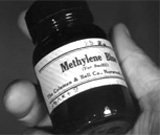
Her scheme was to have the prison doctor inject Frankie's fresh corpse (after he had expired in the prison's gas chamber from hydrocyanic gas) with Methylene Blue as an antidote within one hour and revive him, in order to learn the treasure's whereabouts.
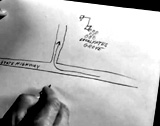
To carry out the plan, Dr. Craig declined a customary autopsy at the prison and injected Frankie's fresh corpse with Methylene Blue before it was loaded into a coffin bound for the morgue (and cremation). The morgue truck was hijacked, and one of Vincent's nasty gunmen Tommy (Philip Van Zandt) killed the paid-off morgue driver Pete (Kenneth Patterson) with a stiletto. The body was delivered to Dr. Craig's office where Olins was miraculously resurrected (Lazarus-like). After he was convinced that his rescuers needed the dough for expenses and for Olins' necessary cosmetic surgery (to create a new face), Frankie agreed to a deal, just in case he didn't pull through. He drew a map of the dough's location - he kept one-half of the crude map, and gave the other half to Margot ("I'll give Margot a map showing the place where I hid the dough"). When Olins tried to give Margot a "little welcome back kiss," revealing that he was still enamoured by her ("My little Margot, who doesn't have to worry anymore about what's going to happen to her after I die"), Vincent shot him dead from behind - and then kissed Margot. Their kiss was witnessed by Dr. Craig, who realized that he had been swindled, was implicated in the crime, and was professionally ruined. Margot reminded him of his complicity:
Back at her apartment, Margot was confronted by suspicious detective Sgt. Portugal who was following clues in the case of the hijacked morgue truck (and Frankie's lack of an autopsy report) - he told her, in a classic line: "People who use pretty faces like you use yours don't live very long, anyway," to which she replied: "How do you think I should use my face...?" It was evident that Margot would soon be double-crossing her remaining male compatriots. In the middle of the night, Margot ("I've got money singing in my brain") and Vincent (now with the two parts of the map) took Dr. Craig as their hostage. He was forced to drive his car to the treasure's location (a quarter of a mile off the State Highway, and ten feet from a eucalyptus tree). After they changed drivers, the unrepentant Margot deliberately ran over Vincent fixing their flat tire (the duplicitous female had deliberately let the air out). She then stole his gun and his half of the map. Sadistically, she then backed up and ran him over twice more to make sure he was dead. [Note: this sequence was often excised in various prints.] She also calmly handed her pistol over to Dr. Craig who had told her about his desire to kill her, but he didn't have the nerve to shoot her. She then had Dr. Craig do the dirty work by digging up the treasure box in a eucalyptus grove (he again had the opportunity to strike her with a shovel, but lacked courage). After telling Dr Craig: "All our hopes, all our plans...," she exorted him with sexually-laced language: "Quickly, Lloyd, quickly! Dig for it! Deeper! Faster!", and explained how guilty they all were:
Then, she gleefully shot him twice, laughing hysterically and maniacally as he lay on the ground. She ran off with the strong box in her arms, cackling: "It's mine. It's all mine now!" The film ended with a return to the present where Dr. Craig had followed Margo to her apartment - and lethally shot her. She was still speaking the words: "Mine. It's all mine now." Margot asked Sgt. Portugal to lower himself down to her (for a kiss?): "Jo Jo, please, just this once, come down to my level," but as he bent down, she laughed in his face. Before she died, her last words were: "Simple arithmetic. That's all it was." The treasure box was opened by Sgt. Portugal above her body after she expired on her apartment's couch - where it was revealed as a decoy - with only $1 and a note from Frankie. The $1 bill floated down onto her corpse:
|
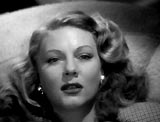 Margot Shelby (Jean Gillie) Dying on Sofa - Start of Flashback 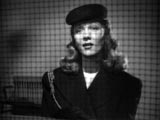 Margot Visiting Frankie in Prison Before His Execution 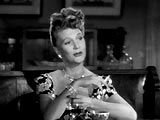 Margot Scheming with Jim Vincent 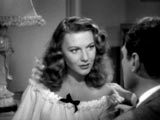 Margot Scheming with Dr. Craig 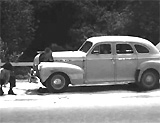 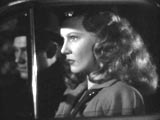 Margot Deliberately Running Over Vincent with the Vehicle 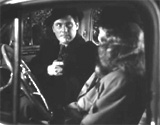 Dr. Craig with the Gun - But Unable to Shoot Margot 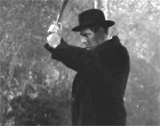 Dr. Craig Unable to Bash Margot with Shovel 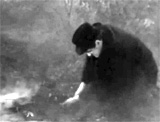 Dr. Craig Feverishly Digging for Treasure Box (Margot: "Quickly, Lloyd, quickly! Dig for it! Deeper! Faster!")  Margot Seriously Wounding Dr. Craig With Two Shots After He Dug Up the Strongbox  End of Flashback: Dying Margot on Sofa  Margot Laughing in Sgt. Portugal's Face  Detective Portugal Opening the Strongbox Above Margot's Body  Margot's Death - with Only $1 and a Note |
||||||||||||

|
Deep Blue Sea (1999)
The surprise in this science-fiction horror film was that much of its cast was killed off - only partway into the film. The tagline referred to monstrous Mako sharks, the CGI stars of the film:
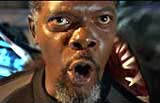
A group of scientists was working on a super-intelligent shark program in a top-secret, deep-sea location known as Aquatica. The laboratory facility was a former submarine refueling station. Their work involved extracting brain tissue from three giant Mako sharks (secretly genetically-engineered), to use in a study of Alzheimer's disease. Almost immediately, there were disasters - escaped sharks, and deadly attacks on humans. Called to the site, Chimera Pharmaceuticals' corporate financier Russell Franklin (Samuel L. Jackson), with a goatee and glasses, delivered a stirring "let's pull together" motivational speech to the group. He spoke about a previous brush with death that he had experienced during a mountaineering and avalanche disaster (where there were seven survivors and only five made it out alive, due to inhumane cannibalism). In the middle of his exhortations -
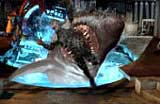
He was abruptly grabbed by one of the enormous predatory Mako sharks that erupted out of the water behind him, chewed him and then tore his body in half. The sharks (smarter than normal due to increased brain sizes) planned to flood the facility so that they could escape into open waters and breed. Eventually as Aquatica was sinking, the three Mako sharks (two "small" Gen I Mako's and a massive Gen II Mako, about 25 feet long) were killed - similar to the plots in the three Jaws films. There were only two survivors (although both were injured), after blonde medical biologist Dr. Susan McAlester (Saffron Burrows), the one responsible for genetically-engineering the sharks, sacrificed herself:
Seated on floating debris and wreckage from the explosion, the two discussed what had happened, as the new workers' boat arrived and rescued them:
|
  The Devouring of Russell Franklin (Samuel L. Jackson)  Survivor Dudley (LL Cool J)  Survivor Blake (Thomas Jane) 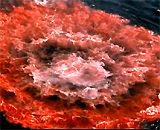 The Exploding Underwater Lab 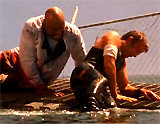 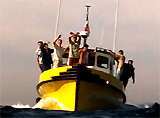 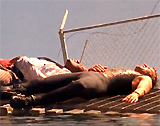 The Two Rescued |
||||||||||||
 
|
Deep Red (1975, It.) (aka Profondo Rosso, or The Hatchet Murders)
Dario Argento's gripping murder mystery had a scary tagline:
During the opening titles, there was a flashback to a bloody stabbing murder with a knife dropped on the floor and shown from the perspective of a child (shot at floor level), while an eerie child's nursery rhyme lullaby was playing. The killer's calling card was the doggerel tune.
Before the plot twist at the end, there were a number of murders (shot in the giallo-style by the "Italian Hitchcock") by a black raincoated figure wearing black leather gloves.
Marcus Daly began an investigation into Helga's death. A clue was revealed in a wall painting (hidden behind plaster) of what appeared to be a child stabbing an adult (the opening murder). This led to his discovery of a secret room in an abandoned haunted house (written about by author Righetti) holding the skeleton remains of a corpse. A friend of Daly's - troubled, depressed, alcoholic artist Carlo (Gabriele Lavia), had drawn a bloody-murder painting, but further clues revealed that he was not the murderer of Helga. As Carlo fled from police, he died a grisly death (the film's fifth murder) by being dragged from a garbage truck and then having his head run over by another car. A flashback revealed the killer of all the crimes - a hatchet murderer:
During the holidays when music was playing, she had stabbed and killed her husband (Aldo Bonamano) in the back with a carving knife in front of a young Carlo (Jacopo Mariani). The boy picked up the knife and then had repeatedly drawn the disturbing image and covered up for his mother's crime. (The skeleton in the wall was the body of Marta's husband.) The mother's deadly motive was to prevent being committed to a psychiatric hospital by her husband.
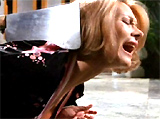
The film ended with Marta attacking Marcus with a meat cleaver, but her necklace became caught in the bars of a descending elevator shaft - both strangling and decapitating her (shown in close-up in all its gory red detail). |
 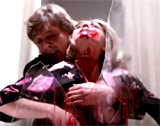 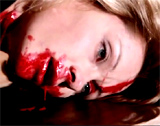 The Meat Cleaver Murder of Parapsychologist Helga Ulmann  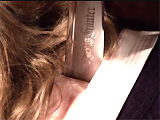 The Death of Professor Giordani - Knifed in Neck 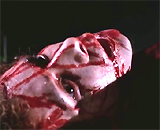  Artist Carlo's Head Dragged and Squashed 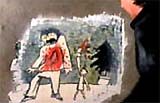 Clue: The Wall Painting (Child Stabbing Adult) 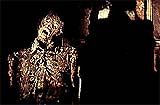 Skeletal Remains 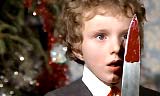 Young Carlo - Covering Up for His Mother's Crime |
||||||||||||





 Don
Bellows Returned to His Fiancee Gail Armitage and Married Her, and
Joyce Heath Cared for Hospitalized Estranged Husband Gordon After
Deliberately Crippling Him in a Car Crash
Don
Bellows Returned to His Fiancee Gail Armitage and Married Her, and
Joyce Heath Cared for Hospitalized Estranged Husband Gordon After
Deliberately Crippling Him in a Car Crash